The rare albino gnome is not easy to capture on film (or digital), but these gnomes are on a quest to capture the pooka that turned them albino. They said the pooka did it on a dare from a puck. They did not think it was a hockey puck, but they weren’t 100 percent sure. After all, they have been on this quest for several centuries now, with little success in finding the pooka. And only the pooka that made them albino can turn them back. Because they have had no luck in finding the pooka, they are turning to you for help. Should you come across the pooka that turned these gnomes albino, please contact them. Leave a message under a rock by a stream running backwards under the light of a new moon on a Thursday. It is important you use this exact gnomeclature when contacting them. Otherwise, the message will be lost. Thank you for your help.
Photo finish Friday: “Nobody gnomes the trouble I’ve seen”
Filed under Photo by author, Photo Finish Friday
Haiku to you Thursday: “Susurrate”
Brown leaves susurrate /
beneath the rake’s battered tines /
budding blossoms bared.
Filed under Haiku to You Thursday, poetry by author
Writing tip Wednesday: “To Indie or not to Indie publish”
Most Amazon bestselling authors aren’t making minimum wage
By Charlie Jane Anders
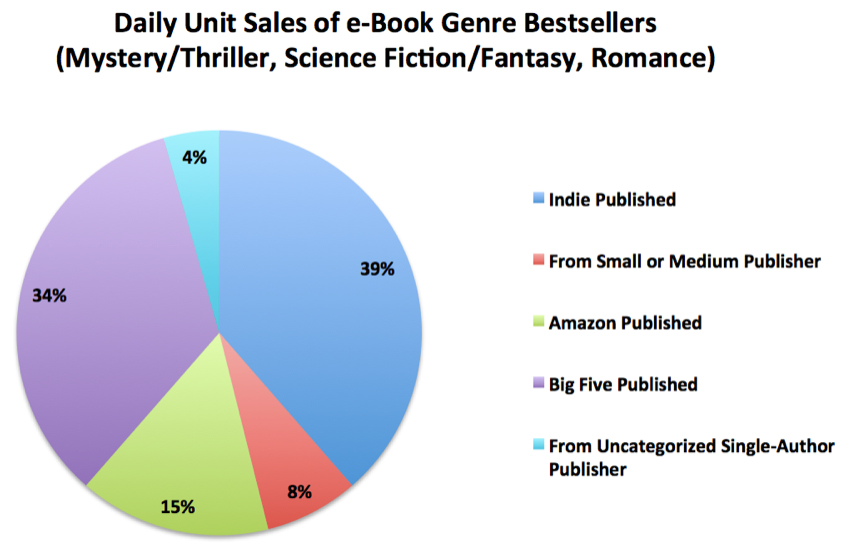
Yesterday we posted a chart from Hugh Howey’s new report on author earnings, showing indie and self-published authors pulling ahead of people published by the “big five” in terms of total unit sales. Now here’s another chart from an e-book publishing expert who’s calling some of Howey’s conclusions into question.
Chart:
Writing in Digital Book World, Dana Beth Weinberg points out that there are a number of questions about Howey’s data, even beyond the potential flaws that you’d already noticed. For one thing, Howey isn’t representing all self-published and indie authors — just the top 1.5 percent, or the cream of the crop. There are also some questionable assumptions in Howey’s methodology, writes Weinberg, and some statistical problems.
But leaving that stuff aside, even if you accept Howey’s data and his conclusions, it’s not clear that most of his indie/self-published authors are doing better than people published by the big mainstream publishers, argues Weinberg. What is clear, though, is that the people who are doing best, on Amazon e-book sales, are those published by Amazon’s own publishing imprints.
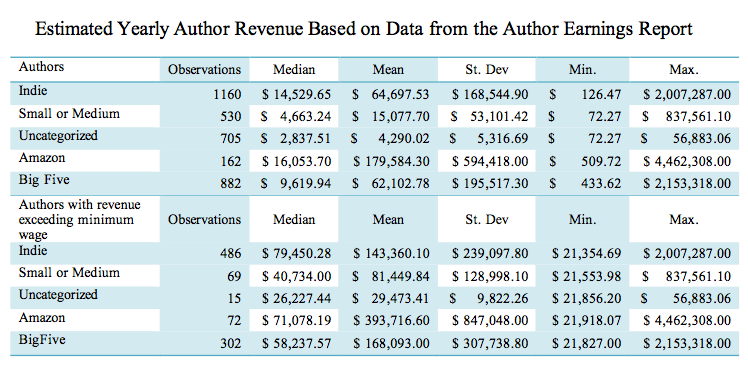
The really depressing thing? Weinberg estimates that most of the authors in the survey, whether self-published or published by a New York publishing house, are not making minimum wage:
Sales figures:
Full article at: http://io9.com/most-amazon-bestselling-authors-arent-making-minimum-w-1522482723
Source material at:
The Report, by Hugh Howey, Feb. 12, 2014
Full article at: http://authorearnings.com/the-report/
The Principal of Digital Abundance — thoughts on author earnings, by Damien G. Walter, Feb. 12, 2014
Full article at: http://damiengwalter.com/2014/02/12/the-principle-of-digital-abundance-thoughts-on-author-earnings/
Note: This post suggested by Research Assistant Ashlie
Filed under writing tip, Writing Tip Wednesday
Monday morning writing joke: “blood money”
Q.: What did one English vampire writer say to another English vampire writer?
A.: “All this bloody writing is sucking the life out of me.”
Filed under Monday morning writing joke
The blathering idiot and the sign
There had been complaints about how some of the blathering idiot’s co-workers had been mistreating the restroom facilities, so management had devised a new sign to help everyone understand. It was all in pictures in the hopes that there would be no confusion. Still, the blathering idiot had a few questions.
He understood that an “X” through the drawing meant do something or that is was wrong to do something. And from the new chart, he saw that it was okay to sit on the commode. Though all it looked the man was doing was sitting there and resting. His pants did not look pulled down and he was sitting too erect to be doing anything. A man needed to lean forward a little more when he pooped. And good luck if he tried to pee while sitting that way.
The second drawing puzzled the blathering idiot. Why would a man pour marbles into a commode?
Then there was the third drawing. Was that man praying?
As for the fourth drawing, he wondered why any man would try to ride a commode like a jockey. Had somebody at work really done that?
And then there was fishing in the commode. He had never thought of that. But certainly what was in there was not usually worth fishing for to begin with. Even he knew that. Unless, maybe, you accidentally dropped something in before doing anything else. What do yo do then? Call your supervisor?
As for the last drawing, it was the oddest of them all. It looked like a man squatting back from the commode and taking aim with an object or some sort, maybe even a child’s toy like a missile or torpedo, and trying to aim it at the commode. Did he mean to blow up the commode? Was he trying to throw into the commode something that he hadn’t been able to get to come out until he gave up sitting on the commode the way the man in the first drawing was? He did look a little like he was squatting, after all.
The blathering idiot pondered this poster until he couldn’t come up with any answers that made sense. He went to his supervisor for guidance, but all his boss would say is that it was being used in the Olympics and that if it was clear enough for them, it should be clear enough for everybody working for him.
The blathering idiot felt it was going to be a long shift.
Filed under blathering idiot
Experience Just How Big the Universe is, in One Mind-Blowing Interactive – PolicyMic
Experience Just How Big the Universe is, in One Mind-Blowing Interactive – PolicyMic.
Recently, NASA scientists combined data from the Spitzer and Hubble Space Telescopes to discover the most distant galaxy known to date. The galaxy, named Abell2744 Y1, was formed around 13.2 billion years ago when the universe was extremely young. As the universe is expanding, Abell2744 Y1 is currently closer to 40 billion light years away from us, an astounding distance.
Filed under size
Photo finish Friday: “Fix me!”
Forlorn and sitting on the couch
a friend in need about the house.
A note, a fix, a hope today
that the friend can still play.
Attempts are made but none work.
Attempts are made but dog inert.
Forlorn and sitting on the couch
a friend in need about the house.
A note, a fix, a hope today
that the friend can still play.
Filed under Photo by author, Photo Finish Friday, poetry by author
Haiku to you Thursday: “Oak leaves”
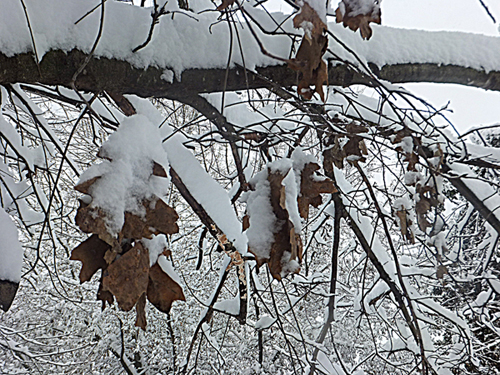
Autumn bats hanging down /
painted white with falling snow /
clutching hope for spring.
Filed under Haiku to You Thursday, Photo by author, poetry by author
Writing tip Wednesday: “The End”
Dos and Don’ts for the Last 10,000 Words of Your Story
By James V. Smith Jr.
DON’T INTRODUCE ANY NEW CHARACTERS OR SUBPLOTS.
Don’t introduce anything new. Any appearances within the last fifty pages should have been foreshadowed earlier, even if mysteriously. What this means: If you bring in a new character this late, your audience will feel cheated, as if you’ve been holding back important information for a cheap surprise. They want clues throughout the novel so that way, even if they couldn’t solve it early, they can look back and say “Oh yeah, now that makes sense.”
DON’T DESCRIBE, MUSE, EXPLAIN, OR PHILOSOPHIZE.
In other words, keep the author out of the story, and don’t let it drag. By this point in the story, setup is done, complication is wrapping up, and resolution should be entirely uncluttered so you and the reader can make an unimpeded dash to the finish line. Keep description to a minimum, action and conflict to the max.
What this means: No long details about the setting or sudden dishing about backstory. This is what your story is all about. Your protagonist has sacrificed and made wrong turns to get to this moment. Make these pages as face-paced as possible.
DO CREATE THAT SENSE OF OH, WOW!
Once or twice on every page, if possible, more frequently.
What this means: Stories that play out “Then this happened. Then this happened. Then this happened.” in the final moments aren’t memorable. It’s better to put in an “But unexpectedly …” as the final chapters close up your story, especially if it ties up moments you’ve foreshadowed earlier in your novel.
DO ENMESH YOUR READER DEEPLY IN THE OUTCOME OF YOUR STORY.
Make her unable to put down your novel to go to bed, to work, or even to the bathroom until she sees how it turns out.
What this means: Like in sports, the most captivating part is the final minutes or innings of a close game. You can’t take your eyes off of it because you not only want to know the outcome, you feel like you need to know the outcome—and you need to know it immediately. Think of your ending in those terms.
To learn more, go to: http://www.writersdigest.com/how-to-improve-your-writing-skills-the-last-10000-words?et_mid=656501&rid=239626420
Filed under writing tip, Writing Tip Wednesday