
First writer, pointing to his t-shirt: “See what it says?”
Second writer nods.
First writer: “It says, ‘will writer for food.'”
Second writer: “So whom are you going to write first?”
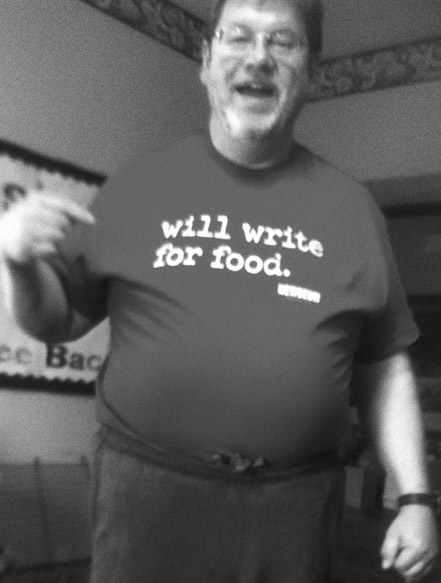
Whom will he try to write for food first? Will it work?
First writer, pointing to his t-shirt: “See what it says?”
Second writer nods.
First writer: “It says, ‘will writer for food.'”
Second writer: “So whom are you going to write first?”
Whom will he try to write for food first? Will it work?
Filed under Monday morning writing joke
The American Scholar: Ten Best Sentences – Our Editors.
Its vanished trees, the trees that had made way for Gatsby’s house, had once pandered in whispers to the last and greatest of all human dreams; for a transitory enchanted moment man must have held his breath in the presence of this continent, compelled into an aesthetic contemplation he neither understood nor desired, face to face for the last time in history with something commensurate to his capacity for wonder.
—F. Scott Fitzgerald, The Great Gatsby
I go to encounter for the millionth time the reality of experience and to forge in the smithy of my soul the uncreated conscience of my race.
—James Joyce, A Portrait of the Artist as a Young Man
This private estate was far enough away from the explosion so that its bamboos, pines, laurel, and maples were still alive, and the green place invited refugees—partly because they believed that if the Americans came back, they would bomb only buildings; partly because the foliage seemed a center of coolness and life, and the estate’s exquisitely precise rock gardens, with their quiet pools and arching bridges, were very Japanese, normal, secure; and also partly (according to some who were there) because of an irresistible, atavistic urge to hide under leaves.
—John Hersey, Hiroshima
Find the rest at: http://theamericanscholar.org/ten-best-sentences/#.U4K1USiootV
Filed under Uncategorized

Sometimes love is literally on the rocks. Or, at least spelled out on them.
With something like this you could “fall in love.”
Or, love is just a stone’s throw away.
Filed under Photo by author, Photo Finish Friday
The heavens are home /
to night’s turns of phrase and stars: /
love, mass, and light squared.
Filed under Haiku to You Thursday, poetry by author
Cop to poet: “Did you meet her?”
Poet to cop: “I had no rhyme or reason to do so.”
Filed under Monday morning writing joke

“Times are bad. Children no longer obey their parents and everyone is writing a book.”
— Cicero, 43 BCE
Since I am working on a book or two, I guess I am adding to the bad times. And you?
Filed under Writers on writing

Would you buy a yard (of anything) from this “man”?
Does this mean that all the best buys have already been “picked clean”?
Filed under Photo by author, Photo Finish Friday
Open tapestry /
spinning forward the empty wheel /
time fulfilling yarn.
Filed under Haiku to You Thursday, poetry by author
Source: http://www.writersdigest.com/online-editor/the-7-tools-of-dialogue?et_mid=673791&rid=239626420
The 7 Tools of Dialogue
by James Scott Bell
My neighbor John loves to work on his hot rod. He’s an automotive whiz and tells me he can hear when something is not quite right with the engine. He doesn’t hesitate to pop the hood, grab his bag of tools and start to tinker. He’ll keep at it until the engine sounds just the way he wants it to.
That’s not a bad way to think about dialogue. We can usually sense when it needs work. What fiction writers often lack, however, is a defined set of tools they can put to use on problem areas.
So here’s a set—my seven favorite dialogue tools. Stick them in your writer’s toolbox for those times you need to pop the hood and tinker with your characters’ words.
#1 LET IT FLOW.
When you write the first draft of a scene, let the dialogue flow. Pour it out like cheap champagne. You’ll make it sparkle later, but first you must get it down on paper. This technique will allow you to come up with lines you never would have thought of if you tried to get it right the first time.
In fact, you can often come up with a dynamic scene by writing the dialogue first. Record what your characters are arguing about, stewing over, revealing. Write it all as fast as you can. As you do, pay no attention to attributions (who said what). Just write the lines.
Once you get these on the page, you will have a good idea of what the scene is all about. And it may be something different than you anticipated, which is good. Now you can go back and write the narrative that goes with the scene, and the normal speaker attributions and tags.
I have found this technique to be a wonderful cure for writer’s fatigue. I do my best writing in the morning, but if I haven’t done my quota by the evening (when I’m usually tired), I’ll just write some dialogue. Fast and furious. It flows and gets me into a scene.
With the juices pumping, I find I’ll often write more than my quota. And even if I don’t use all the dialogue I write, at least I got in some practice.
#2 ACT IT OUT.
Before going into writing, I spent some time in New York, pounding the pavement as an actor. While there, I took an acting class that included improvisation. Another member of the class was a Pulitzer Prize–winning playwright. When I asked him what he was doing there, he said improvisational work was a tremendous exercise for learning to write dialogue.
I found this to be true. But you don’t have to join a class. You can improvise just as easily by doing a Woody Allen.
Remember the courtroom scene in Allen’s movie Bananas? Allen is representing himself at the trial. He takes the witness stand and begins to cross-examine by asking a question, running into the witness box to answer, then jumping out again to ask another question.
I am suggesting you do the same thing (in the privacy of your own home, of course). Make up a scene between two characters in conflict. Then start an argument. Go back and forth, changing your actual physical location. Allow a slight pause as you switch, giving yourself time to come up with a response in each character’s voice.
Another twist on this technique: Do a scene between two well-known actors. Use the entire history of movies and television. Pit Lucille Ball against Bela Lugosi, or have Oprah Winfrey argue with Bette Davis. Only you play all the parts. Let yourself go.
And if your local community college offers an improvisation course, give it a try. You might just meet a Pulitzer Prize winner.
#3 SIDESTEP THE OBVIOUS.
One of the most common mistakes aspiring writers make with dialogue is creating a simple back-and-forth exchange. Each line responds directly to the previous line, often repeating a word or phrase (an “echo”). It looks something like this:
“Hello, Mary.”
“Hi, Sylvia.”
“My, that’s a wonderful outfit you’re wearing.”
“Outfit? You mean this old thing?”
“Old thing! It looks practically new.”
“It’s not new, but thank you for saying so.”
This sort of dialogue is “on the nose.” There are no surprises, and the reader drifts along with little interest. While some direct response is fine, your dialogue will be stronger if you sidestep the obvious:
“Hello, Mary.”
“Sylvia. I didn’t see you.”
“My, that’s a wonderful outfit you’re wearing.”
“I need a drink.”
I don’t really know what is going on in this scene (incidentally, I’ve written only these four lines of dialogue). But I think you’ll agree this exchange is immediately more interesting and suggestive of currents beneath the surface than the first example. I might even find the seeds of an entire story here.
You can also sidestep with a question:
“Hello, Mary.”
“Sylvia. I didn’t see you.”
“My, that’s a wonderful outfit you’re wearing.”
“Where is he, Sylvia?”
Hmm. Who is “he”? And why should Sylvia know? The point is there are innumerable directions in which the sidestep technique can go. Experiment to find a path that works best for you. Look at a section of your dialogue and change some direct responses into off-center retorts. Like the old magic trick ads used to say, “You’ll be pleased and amazed.”
Other tools include Cultivate Silence, Polish a Gem, Employ Confrontation, and Drop Words. For Details on these tools, go to http://www.writersdigest.com/online-editor/the-7-tools-of-dialogue?et_mid=673791&rid=239626420
Filed under writing tip, Writing Tip Wednesday, writing tips
Lear-ing
There once was a man named Lear /
who wrote in verse to make it clear /
that no matter what you say /
if you say it the right way /
even the sincere can come out with a leer.
[Editor’s note: This limerick is in honor of National Limerick Day, which was actually May 12th and Edward Lear, the 19th century English poet, author, illustrator known for popularizing the limerick form of poetry.]

Edward Lear, 1812 – 1888
Filed under poetry by author


 Booker's Blog