
Failure stares at me /
feral animal, dark smile /
face fractured with fear.
Failure stares at me /
feral animal, dark smile /
face fractured with fear.
Filed under Haiku to You Thursday, poetry by author
by Marie Lamba (marielamba.com) author of the YA novels What I Meant…, Over My Head and Drawn. She’s also associate literary agent at The Jennifer De Chiara Literary Agency (jdlit.com)
OK, class. What sets a middle-grade novel apart from a young adult novel? If you said MG is for readers ages 8–12, and YA is for readers ages 13–18, then give yourself a check plus. But if you’re writing for the juvenile market and that’s all you know about these two categories, then I’m afraid you still need to stick around for the rest of this class. A book that doesn’t fit within the parameters of either age category is a book you won’t be able to sell.
In my work with The Jennifer De Chiara Literary Agency, I see my inbox flooded every day with queries for manuscripts that suffer from an MG/YA identity crisis. Like when a query says, “I’ve written a 100,000-word MG novel about a seventh-grader who falls in love and has sex for the first time.” Or when one states, “In my 20,000-word YA novel, a 14-year-old holds her first sleepover and learns the meaning of true friendship.” Both queries would earn a swift rejection, based on both inappropriate manuscript lengths and on content that’s either too mature or too young for the audience they’re targeting. Sadly, by not understanding what makes a book a true MG or a solid YA, these writers have hamstrung their chances for success, regardless of how well written their stories may be. It’s like they showed up to a final exam without ever cracking a book.

One difference between middle grade and young adult is the age of your protagonist. But it is not the only one.
Mg At A Glance
Age of readers: 8–12.
Length: Generally 30,000–50,000 words (although fantasy can run longer to allow for more complex world-building).
Content restrictions: No profanity, graphic violence or sexuality (romance, if any, is limited to a crush or a first kiss).
Age of protagonist: Typically age 10 for a younger MG novel, and up to age 13 for older, more complex books.
Mind-set: Focus on friends, family and the character’s immediate world and relationship to it; characters react to what happens to them, with minimal self-reflection.
Voice: Often third person.
Ya At A Glance
Age of readers: 13–18.
Length: Generally 50,000–75,000 words (although there’s also a length allowance for fantasy).
Content restrictions: Profanity, graphic violence, romance and sexuality (except for eroticism) are all allowable (though not required).
Age of protagonist: Ages 14–15 for a younger YA with cleaner content aimed at the middle-school crowd; for older and more edgy YA, characters can be up to 18 (but not in college).
Mind-set: YA heroes discover how they fit in the world beyond their friends and family; they spend more time reflecting on what happens and analyzing the meaning of things.
Voice: Often first person.
MG vs. YA Characters
When picking your hero’s age, remember that kids “read up,” which means they want to read about characters who are older than they are. So an 8-year-old protagonist won’t fly for the MG category, though it’d be OK for a younger chapter book or easy reader. For the widest audience, you’ll generally want your protagonist to be on the oldest side of your readership that your plot will allow. That means a 12- or even 13-year-old hero for MG, and a 17- or 18-year-old for YA (just remember your hero can’t be in college yet—that would push it into the “new adult” category).
MG vs. YA Readers
Middle-grade is not synonymous with middle school. Books for the middle-school audience tend to be divided between the MG and YA shelves. So which shelf do those readers go to? While there is no such thing as a ’tween category in bookstores, there are degrees of maturity in both MG and YA novels that’ll appeal to the younger and older sides of the middle-school crowd. A longer, more complex MG novel with characters who are 13 could take place in middle school and be considered an “upper-MG novel.” But the material can’t be too mature. It’s still an MG novel, after all, and most readers will be younger. Writing a sweeter, more innocent YA? Then it’s pretty likely that your readers will be ’tweens, that your characters should be around 15 years old, and that your book will be marketed as a “young YA.”
While it’s useful for you to understand these nuances as you craft your story and relate to your true audience, when it comes time to submit, don’t go so far as to define your novel as upper MG or younger YA in your query. That’s already pointing to a more limited readership. Instead, just stick to calling it either MG or YA when you submit, and let an interested agent draw conclusions about nuances from there.
MG vs. YA Content and Voice
What’s cool to a fourth-grader differs from what a 10th-grader will idolize. Same goes for the way they speak and the way they view the world. Which is why if romance appears in an MG novel, it’s limited to a crush and maybe an innocent kiss, as it is in Shugby Jenny Han. A YA could involve deep, true love as well as sexuality, as in The Fault in Our Stars by John Green. Another key difference? Overall, MG novels end on a hopeful note, while YA novels could have less optimistic endings, as in Green’s tearful story. You could say that that’s youth vs. experience coming into play.
The rest of the article at: http://www.writersdigest.com/online-editor/the-key-differences-between-middle-grade-vs-young-adult?et_mid=685611&rid=239626420

Willard wondered if there was a Sag Wagon for the sagging middle of novels?
Filed under cartoon by author, CarToonsday
Q.: What do you call the principal at a zombie school?
A.: The headmaster.
///
Q.: What is a zombie’s worst nightmare?
A.: The Headless horseman.
///
Q.: What is a zombie’s favorite spread on bread?
A.: Head cheese.
Filed under Monday morning writing joke

Can't get into highbrow novels? Ditch them, says Nick Hornby – Telegraph.
When struggling through a classic novel, many have found honour in persevering to the end.
But it appears it might be better just to give up quickly.
Nick Hornby, the bestselling novelist, has argued readers should put down difficult books immediately if they are not enjoying them.
Battling through them, he said, would only condition people to believe reading is a chore, leaving a “sense of duty” about something you “should do”.
Instead, Hornby argued, reading should be seen more like television or the cinema, and only undertaken as something people “want to do”.
Speaking at the Cheltenham Literary Festival, about his new novel Funny Girl, Hornby argued even children should not be compelled to read books they do not want to, saying setting targets of books they “should” read is counterproductive.
Hornby, the author of Fever Pitch, High Fidelity and About A Boy, said: “I’m passionate about reading and what reading can do for you, but I don’t want anyone to tell you what you should read.
Read the rest of the article at: http://www.telegraph.co.uk/culture/books/booknews/11141627/Cant-get-into-highbrow-novels-Ditch-them-says-Nick-Hornby.html
[Editor’s note: Thank you to Ashlie for the link to the article.]
Filed under reading
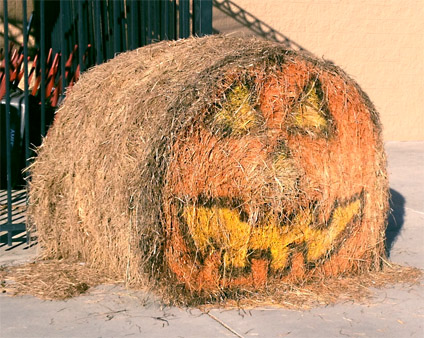
Happy Bale-o-ween or is that Straw-o-latern?
Filed under Photo by author, Photo Finish Friday
Wind slaps the darkness /
folding into noisy flaps /
pieces of the night.
Filed under Haiku to You Thursday, poetry by author
Readers can’t resist turning pages when characters are facing tough choices. Use these 5 keys to weave moral dilemmas into your stories—and watch your fiction climb to new heights.
By Steven James
Key #1: Give Your Character Dueling Desires
Before our characters can face difficult moral decisions, we need to give them beliefs that matter: The assassin has his own moral code not to harm women or children, the missionary would rather die than renounce his faith, the father would sacrifice everything to pay the ransom to save his daughter.
A character without an attitude, without a spine, without convictions, is one who will be hard for readers to cheer for and easy for them to forget.
So, to create an intriguing character facing meaningful and difficult choices, give her two equally strong convictions that can be placed in opposition to each other.
For example: A woman wants (1) peace in her home and (2) openness between her and her husband. So, when she begins to suspect that he’s cheating on her, she’ll struggle with trying to decide whether or not to confront him about it. If she only wanted peace she could ignore the problem; if she only wanted openness she would bring it up regardless of the results. But her dueling desires won’t allow her such a simple solution.
That creates tension.
And tension drives a story forward.
So, find two things that your character is dedicated to and then make him choose between them. Look for ways to use his two desires to force him into doing something he doesn’t want to do.
Key #2: Put Your Character’s Convictions to the Test
We don’t usually think of it this way, but in a very real sense, to bribe someone is to pay him to go against his beliefs; to extort someone is to threaten him unless he goes against them.
For example:
Look for ways to bribe and extort your characters. Don’t be easy on them. As writers we sometimes care about our characters so much that we don’t want them to suffer. As a result we might shy away from putting them into difficult situations.
Guess what?

Spin your protagonist’s moral compass around and make him doubt his belief that pigs can’t fly.
That’s the exact opposite of what needs to happen in order for our fiction to be compelling.
What’s the worst thing you can think of happening to your character, contextually, within this story? Now, challenge yourself—try to think of something else just as bad, and force your character to decide between the two.
Plumb the depths of your character’s convictions by asking, “How far will s/he go to … ?” and “What would it take for … ?”
Key #3: Force Your Character Into a Corner
Don’t give him an easy out. Don’t give him any wiggle room. Force him to make a choice, to act. He cannot abstain. Take him through the process of dilemma, choice, action and consequence:
If there’s an easy solution there’s no true moral dilemma. Don’t make one of the choices “the lesser of two evils”; after all, if one is lesser, it makes the decision easier.
For example, say you’ve taken the suggestion in the first key above and forced your character to choose between honoring equal obligations. He could be caught between loyalty to two parties, or perhaps be torn between his family obligations and his job responsibilities. Now, raise the stakes—his marriage is at risk and so is his job, but he can’t save them both. What does he do?
The more imminent you make the choice and the higher the stakes that decision carries, the sharper the dramatic tension and the greater your readers’ emotional engagement. To achieve this, ask “What if?” and the questions that naturally follow:
Again, make your character reevaluate his beliefs, question his assumptions and justify his choices. Ask yourself: How is he going to get out of this? What will he have to give up (something precious) or take upon himself (something painful) in the process?
Explore those slippery slopes. Delve into those gray areas. Avoid questions that elicit a yes or no answer, such as: “Is killing the innocent ever justified?” Instead, frame the question in a way that forces you to take things deeper: “When is killing the innocent justified?” Rather than, “Does the end justify the means?” ask, “When does the end justify the means?”
The other two items are:
For information on these steps and the a little more about the other three, go to http://www.writersdigest.com/online-editor/5-moral-dilemmas-that-make-characters-stories-better?et_mid=694352&rid=239626420
Filed under writing tip, Writing Tip Wednesday, writing tips

At least Willard has reached some point in his writing.
Filed under cartoon by author, CarToonsday
Q: Where do zombie kids begin their education.
A.: In Head Start.
///
Q.: What’s a zombie’s goal in education?
A.: To get to the head of the class.
Filed under Monday morning writing joke


 Booker's Blog