
Night stops at the edge. /
Clouds crawl from the horizon. /
Stars gather the sunrise.
Night stops at the edge. /
Clouds crawl from the horizon. /
Stars gather the sunrise.
Filed under Haiku to You Thursday, poetry by author
New Millennium Writings contest

Details at: http://newmillenniumwritings.com/awards.php
To apply online, follow these guidelines:
$4,000 offered in Literary Grants and Awards, Plus Publication
$1,000 for best Poem
$1,000 for best Fiction
$1,000 for best Nonfiction †
$1,000 for best Short-short Fiction
† Nonfiction includes humor, memoir, creative nonfiction, travel, opinion, essay, interview, features, investigative reporting, etc.
Details at: http://newmillenniumwritings.com/awards.php
Filed under writing tip, Writing Tip Wednesday, writing tips

It was almost enough to drive a man to drink.
Filed under cartoon by author, CarToonsday
Two writers were sitting at a bar, as writers are sometimes known to do.
A woman at a table near the bar was doing her best to get the attention of one of the writers. The other writer noticed this and asked the first writer what was going on.
First writer: “She sent me a text message.”
Second writer: “A fan of yours?”
First message: “I hope not. Her message said: ‘Y-o-u-r cute.’ I sent her back a message that said: ‘No. Y-O-U-R-‘-E cute.’ I was only correcting her misspelling.”
Second writer: “And?”
First writer: “And now she thinks I like her. I can’t get her to leave me alone.”
Second writer: “Here, let me see you phone.”
First writer hands the second writer his phone. Second writer types a message and sends it. The woman looks at it, shows it to her friend, puts a sour look on her face, and then gets up and leaves.
First writer: “What did you write?”
Second writer shows him. The message read: “You’re not my typo.”
Filed under Monday morning writing joke
It is the first weekend of the month and time again for a new word to live by. This is a word or phrase not currently in use in the U.S. English lexicon, but might need to be considered. Other words, such as obsurd, crumpify, subsus, flib, congressed, and others, can be found by clicking on the tags below. Today’s New Word is a compounding of three words: Auto, Body, and Experience. Without further chattering, Auto Body Experience is the new word / phrase for this month:
Auto, n. an object, such as a car or truck that propels itself by way of an engine.
Body, n. the physical structure of a plant, animal, or human, dead or alive.
Experience, n. a specific instance of personally undergoing, encountering, or observing something.
Auto Body Experience, n. The total of what happens when you experience a wreck while you are in your own car. It similar to but not the same as an out-of-body experience. With an Auto Body Experience, there is often a jolt of unreality, particularly if you get hit from behind and are at first confused as to what is happening.
Whether you see it coming or not, whether it involves other cars, or only your car, you, and a stationary object — such as a guard rail after you and your car have started spinning on a thin sheet of ice — there is nothing quite like an Auto Body Experience.
And then there is all the paperwork.
Filed under new word, New words to live by

Santa and a “demented” little Red Riding Hood.
As a side note, a fellow in an adjoining historic neighborhood complained that as the weather turned colder and rain and wind picked up, he had parents come to collect for their kids who stayed in the cars. I saw one or two examples of that, but mostly I saw kids and adults with umbrellas making the best of it.
Regardless, as you can see, that is quite a few tricksters who came to Old North Knoxville. I dressed as Santa Claus and handed out candy, while my wife and daughter went trick-or-treating with some friends. I surprised a few young tricksters when I would open the sidelight window next to our front door and stick my head out. Some were rendered speechless. A few asked if I was real, to which I replied, “I’m as real as you.” Two or three wanted to touch my white-gloved hand or my beard. A few older, more “seasoned” kids started into their Christmas wish list, including one young lady who wanted both an iPad and an iPhone among the items on her list. I just don’t know if she has been good enough to receive both or even one. She looked a little naughty to me. Then, again, I guess Halloween was the night for a little naughtiness.
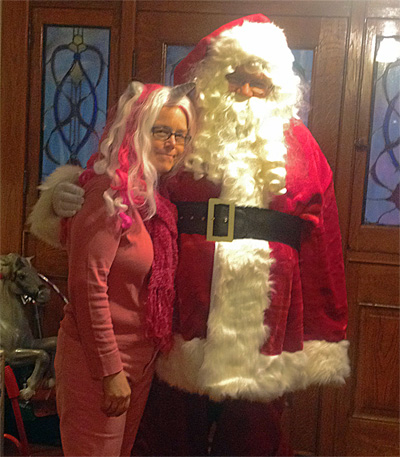
Santa Claus and the Pink Unicorn Lady. Nothing says Halloween quite like a woman in pink with a horn on her head.
Filed under holiday
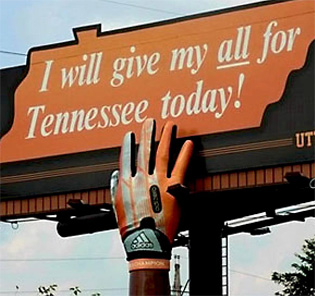
And then a hand reached up and took it ALL.
Happy Halloween!
Filed under Photo Finish Friday
Goblins gather near /
storm the porch as conjurers /
plundering delights.
Filed under Haiku to You Thursday, poetry by author
First the article about tracking down the reviewer:
When a bad review of her first novel appeared online, Kathleen Hale was warned not to respond. But she soon found herself wading in
by Kathleen Hale

Kathleen Hale
“No,” she said firmly, taking the pen away. “Kathleen, you understand we can’t make any more changes, right?”
“I was just kidding,” I lied. Eventually she had to physically prise the book from my hands.
A lot of authors call this “the post-partum stage”, as if the book is a baby they struggle to feel happy about. But for me, it felt more like one of my body parts was about to be showcased.
“Are you excited about your novel?” my mom asked, repeatedly, often in singsong.
“I’m scared,” I said. Anxious and inexperienced, I began checking goodreads.com, a social reviewing site owned by Amazon. My publisher HarperTeen had sent advance copies of my book to bloggers and I wanted to see what they thought. Other authors warned me not to do this, but I didn’t listen. Soon, my daily visits tallied somewhere between “slightly-more-than-is-attractive-to-admit-here” and “infinity”.
For the most part, I found Goodreaders were awarding my novel one star or five stars, with nothing in between. “Well, it’s a weird book,” I reminded myself. “It’s about a girl with PTSD teaming up with a veteran to fight crime.” Mostly I was relieved they weren’t all one-star reviews.
One day, while deleting and rewriting the same tweet over and over (my editors had urged me to build a “web presence”), a tiny avatar popped up on my screen. She was young, tanned and attractive, with dark hair and a bright smile. Her Twitter profile said she was a book blogger who tweeted nonstop between 6pm and midnight, usually about the TV show Gossip Girl. According to her blogger profile, she was a 10th-grade teacher, wife and mother of two. Her name was Blythe Harris. She had tweeted me saying she had some ideas for my next book.
“Cool, Blythe, thanks!” I replied. In an attempt to connect with readers, I’d been asking Twitter for ideas – “The weirdest thing you can think of!” – promising to try to incorporate them in the sequel.
Curious to see if Blythe had read my book, I clicked from her Twitter through her blog and her Goodreads page. She had given it one star. “Meh,” I thought. I scrolled down her review.
“Fuck this,” it said. “I think this book is awfully written and offensive; its execution in regards to all aspects is horrible and honestly, nonexistent.”
Blythe went on to warn other readers that my characters were rape apologists and slut-shamers. She accused my book of mocking everything from domestic abuse to PTSD. “I can say with utmost certainty that this is one of the worst books I’ve read this year,” she said, “maybe my life.”
Other commenters joined in to say they’d been thinking of reading my book, but now wouldn’t. Or they’d liked it, but could see where Blythe was coming from, and would reduce their ratings.
“Rape is brushed off as if it is nothing,” Blythe explained to one commenter. “PTSD is referred to insensitively; domestic abuse is the punch line of a joke, as is mental illness.”
“But there isn’t rape in my book,” I thought. I racked my brain, trying to see where I had gone wrong. I wished I could magically transform all the copies being printed with a quick swish of my little red pen. (“Not to make fun of PTSD, or anything,” I might add to one character’s comment. “Because that would be wrong.”)
Rest of the article at: http://www.theguardian.com/books/2014/oct/18/am-i-being-catfished-an-author-confronts-her-number-one-online-critic
****
Reaction to the article:
Kathleen Hale faced backlash on social media after admitting to tracking down a book blogger at her home address.
by Jenna Guillaume
On Saturday (October 18, 2014), YA author Kathleen Hale published an essay on The Guardian about confronting “her number one online critic,” and a social media storm of epic proportions erupted.
In the article, called “Am I Being Catfished?”, Hale describes how she obsessed over a book blogger named Blythe Harris who had given her book, No One Else Can Have You, a one-star review.
After Hale’s essay was published, the book-blogging community rushed to defend Harris, arguing she had done nothing wrong but that Hale had actually stalked her.
To see the array of reactions, some by well-known authors such as Neil Gaiman, go to:
http://www.buzzfeed.com/jennaguillaume/this-is-what-happens-when-an-author-tracks-down-a-critic-irl#2kyqd1o
***
Best thing to do: don’t follow this example. There will always be somebody who makes his or her “mark” by trying to leave a mark on you through your work. The best revenge is to ignore and write more and work to improve. After all, nobody’s perfect, not even critics.
Or in the words of author Robert A. Heinlein: “Critics can’t create, therefore, they feel justified in critiquing those who do. There is some logic in this: they hate all creative people equally.”
Filed under writing tip, Writing Tip Wednesday, writing tips

Some nights were longer than others.
Filed under cartoon by author, CarToonsday


 Booker's Blog