Writing tip Wednesday: “Guidance from an author”

Neil Gaiman

http://www.neilgaiman.com/

  1. Write.
  2. Put one word after another. Find the right word, put it down.
  3. Finish what you’re writing. Whatever you have to do to finish it, finish it.
  4. Put it aside. Read it pretending you’ve never read it before. Show it to friends whose opinion you respect and who like the kind of thing that this is.
  5. Remember: when people tell you something’s wrong or doesn’t work for them, they are almost always right. When they tell you exactly what they think is wrong and how to fix it, they are almost always wrong.
  6. Fix it. Remember that, sooner or later, before it ever reaches perfection, you will have to let it go and move on and start to write the next thing. Perfection is like chasing the horizon. Keep moving.
  7. Laugh at your own jokes.
  8. The main rule of writing is that if you do it with enough assurance and confidence, you’re allowed to do whatever you like. (That may be a rule for life as well as for writing. But it’s definitely true for writing.) So write your story as it needs to be written. Write it ­honestly, and tell it as best you can. I’m not sure that there are any other rules. Not ones that matter.

Leave a comment

Filed under 2016, writing tip, Writing Tip Wednesday

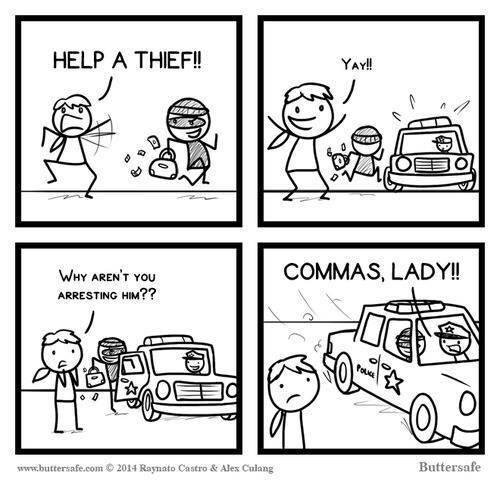
cARtOONSdAY: “cOMMA, pOLICE”

Commas lady_96dpi_5x5

Leave a comment

June 21, 2016 · 10:29 pm

Monday morning writing joke: “Give and take”

A cactus and a vampire walk into a bar. The bartender can’t decide who’s the bigger prick.

***

Q.: What do you call a zombie with rod and reel?

A.: Hooked.

Leave a comment

Filed under 2016, Monday morning writing joke

The end of the end (stop)?

Period. Full Stop. Point. Whatever It’s Called, It’s Going Out of Style

http://www.nytimes.com/2016/06/10/world/europe/period-full-stop-point-whatever-its-called-millennials-arent-using-it.html

By DAN BILEFSKY

LONDON — One of the oldest forms of punctuation may be dying

The period — the full-stop signal we all learn as children, whose use stretches back at least to the Middle Ages — is gradually being felled in the barrage of instant messaging that has become synonymous with the digital age

David Crystal

David Crystal

So says David Crystal, who has written more than 100 books on language and is a former master of original pronunciation at Shakespeare’s Globe theater in London — a man who understands the power of tradition in language

The conspicuous omission of the period in text messages and in instant messaging on social media, he says, is a product of the punctuation-free staccato sentences favored by millennials — and increasingly their elders — a trend fueled by the freewheeling style of Facebook, WhatsApp and Twitter

“We are at a momentous moment in the history of the full stop,” Professor Crystal, an honorary professor of linguistics at the University of Wales, Bangor, said in an interview after he expounded on his view recently at the Hay Festival in Wales

“In an instant message, it is pretty obvious a sentence has come to an end, and none will have a full stop,” he added “So why use it?”

In fact, the understated period — the punctuation equivalent of stagehands who dress in black to be less conspicuous — may have suddenly taken on meanings all its own

Increasingly, says Professor Crystal, whose books include “Making a Point: The Persnickety Story of English Punctuation,” the period is being deployed as a weapon to show irony, syntactic snark, insincerity, even aggression

If the love of your life just canceled the candlelit, six-course, home-cooked dinner you have prepared, you are best advised to include a period when you respond “Fine.” to show annoyance

“Fine” or “Fine!,” in contrast, could denote acquiescence or blithe acceptance

“The period now has an emotional charge and has become an emoticon of sorts,” Professor Crystal said “In the 1990s the internet created an ethos of linguistic free love where breaking the rules was encouraged and punctuation was one of the ways this could be done”

Social media sites have only intensified that sense of liberation

Professor Crystal’s observations on the fate of the period are driven in part by frequent visits to high schools across Britain, where he analyzes students’ text messages

Researchers at Binghamton University in New York and Rutgers University in New Jersey have also recently noted the period’s new semantic force

They asked 126 undergraduate students to review 16 exchanges, some in text messages, some in handwritten notes, that had one-word affirmative responses (Okay, Sure, Yeah, Yup) Some had periods, while others did not

Those text message with periods were rated as less sincere, the study found, whereas it made no difference in the notes penned by hand

Geoffrey Nunberg, a linguist who teaches at the University of California, Berkeley, noted that the 140-character limit imposed by Twitter and the reading of messages on a cellphone or hand-held device has repurposed the punctuation mark

“It is not necessary to use a period in a text message, so to make something explicit that is already implicit makes a point of it,” he said “It’s like when you say, ‘I am not going – period’ It’s a mark It can be aggressive It can be emphatic It can mean, ‘I have no more to say’

Can ardent fans of punctuation take heart in any part of the period’s decline? Perhaps.

The shunning of the period, Professor Crystal said, has paradoxically been accompanied by spasms of overpunctuation

“If someone texts, ‘Are you coming to the party?’ the response,” he noted, was increasingly, “Yes, fantastic!!!!!!!!!!!”

But, of course, that exuberance would never be tolerated in a classroom

At the same time, he said he found that British teenagers were increasingly eschewing emoticons and abbreviations such as “LOL” (laughing out loud) or “ROTF” (rolling on the floor) in text messages because they had been adopted by their parents and were therefore considered “uncool”

Now all we need to know is, what’s next to go? The question mark

Leave a comment

Filed under 2016, syntax

Photo finish Friday: “Replacement parts”

Parts is parts and even your innards are made of plastic. You have to ask yourself: "How recyclable am I these days?"

Parts is parts and even your innards are made of plastic. You have to ask yourself: “How recyclable am I these days?”

Leave a comment

Filed under 2016, photo by David E. Booker, Photo Finish Friday

Haiku to you Thursday: “A thousand eyes”

A thousand eyes long /

this river of ice and time /

we adventure in love.

Leave a comment

Filed under 2016, haiku, Haiku to You Thursday

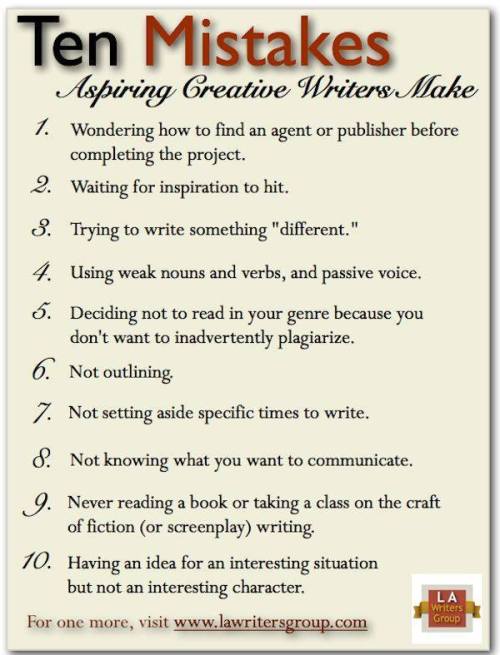
Writing tip Wednesday: “Ten to avoid”

Some may be easier to avoid than others. For more tips, go to www.lawritersgroup.com.

Some may be easier to avoid than others. For more tips, go to www.lawritersgroup.com.

Leave a comment

Filed under 2016, writing tip, Writing Tip Wednesday

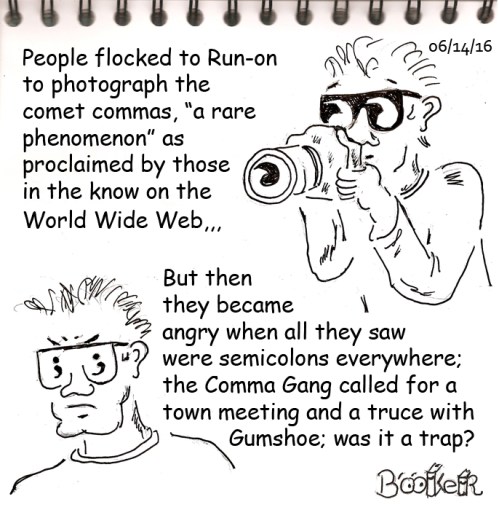
cARtOONSdAY: “cASE lOGIC 10: sEMI-pLISTIC”

P.I. Graham R. Gumshoe paused to consider his options; and punctuation;

P.I. Graham R. Gumshoe paused to consider his options; and punctuation;

Leave a comment

Filed under 2016, cartoon by author, CarToonsday

Monday morning writing joke: “Famous last words”

Last words of A. Nonymous

Here lies the brokenhearted.
After a love spat, he departed.
Shuffled off this mortal coil.
Now he lies beneath this soil.
A struggling writer he once was,
but you never heard of him because….

Leave a comment

Filed under 2016, Monday morning writing joke, poetry by author

New words to live by: “Hypocrassy”

It is time, once again, for New words to live by. This is a word or phrase not currently in use in the U.S. English lexicon, but might need to be considered. Other words, such as obsurd, crumpify, subsus, flib, congressed, and others, can be found by clicking on the tags below. Today’s New Word is a compounding of two nouns into a new word. Without further waiting, hypocrassy (hypocrisy + crass) is the new word for this month.

OLD WORDS
Hypocrisy, n. 1. A person pretending to have moral or religious beliefs, principles, or a virtuous nature that he or she does not possess. In other words, a pretense toward something virtuous. 2. An instance or act of hypocrisy.

Crass, n. 1. Devoid of delicacy, sensitivity, or refinement. Also known as gross, stupid, obtuse.

NEW WORD
Hypocrassy, n. 1. A person pretending to have moral or religious beliefs, principles, and is devoid of delicacy, sensitivity, or refinement. In other words, he or she will repeat a lie even when told it is a lie or knows it is a lie in an effort to make the lie the “known truth.” Also, a group of supposedly virtuous people all promoting the same lack of moral or religious judgment.

Example:
A certain U.S. presidential candidate who continues saying he’s going to build a wall along the Mexican border and is going to make the Mexicans pay for it, and that the wall will keep undocumented immigrants out of the United States. And because he is, a judge of Mexican decent can’t officiate at a trial that involves one of the candidate’s many failed enterprises.

Leave a comment

Filed under 2016, new word, New words to live by