
Q. Why are Saturday and Sunday the toughest days?
A. Because the others are weakdays.
Enjoy your weak. Yeah, I know, a week joke.
Q. Why are Saturday and Sunday the toughest days?
A. Because the others are weakdays.
Enjoy your weak. Yeah, I know, a week joke.
Filed under 2017, Monday morning writing joke
Time, once again, for New words to live by. This is a word or phrase not currently in use in the U.S. English lexicon, but might need to be considered. Other words, such as obsurd, crumpify, subsus, flib, congressed, and others, can be found by clicking on the tags below. Today’s New Word is created by taking an adjective and creating a noun form of the word. Without further waiting, scraggle.
OLD WORD
Scraggly, adj. 1. Irregular, uneven, jagged. 2. Unkempt, ragged.
NEW WORD
Scraggle, n. 1. Something or someone ragged or unkempt, often in a small patch. 2. Something or someone jagged, irregular, or uneven.
Somewhere between the stickers and thorns, vines and broken branches, scraggles of grass and clay soil in front of me was the voice.
Filed under 2017, new word, New words to live by
 About a quarter of American adults (26%) say they haven’t read a book in whole or in part in the past year. Who, exactly, are these non-book readers?
Source: Who doesn’t read books in America? | Pew Research Center
by Andrew Perrin
About a quarter of American adults (26%) say they haven’t read a book in whole or in part in the past year, whether in print, electronic or audio form. So who, exactly, are these non-book readers?
Several demographic traits correlate with non-book reading, Pew Research Center surveys have found. For instance, adults with a high school degree or less are about three times as likely as college graduates (40% vs. 13%) to report not reading books in any format in the past year. A 2015 Pew Research Center survey shows that these less-educated adults are also the least likely to own smartphones or tablets, two devices that have seen a substantial increase in usage for reading e-books since 2011. (College-educated adults are more likely to own these devices and use them to read e-books.)
Adults with an annual household income of less than $30,000 are about twice as likely as the most affluent adults to be non-book readers (33% vs. 17%). Hispanic adults are also about twice as likely as whites (40% vs. 23%) to report not having read a book in the past 12 months.
Older Americans are a bit more likely than their younger counterparts not to have read a book. Some 29% of adults ages 50 and older have not read a book in the past year, compared with 23% of adults under 50. In addition, men are less likely than women to have read a book, as are adults in rural areas compared with those in urban areas.
The share of Americans who report not reading any books in the past 12 months is largely unchanged since 2012, but is slightly higher than in 2011, when the Center first began conducting surveys of book-reading habits. That year, 19% of adults reported not reading any books.
Given the share that hasn’t read a book in the past year, it’s not surprising that 19% of U.S. adults also say they have not visited a library or a bookmobile in the past year. The same demographic traits that characterize non-book readers also often apply to those who have never been to a library. For example, men, Hispanics, older adults, those living in households earning less than $30,000 and those who have no more than a high school diploma or did not graduate from high school are the most likely to report they have never been to a public library.
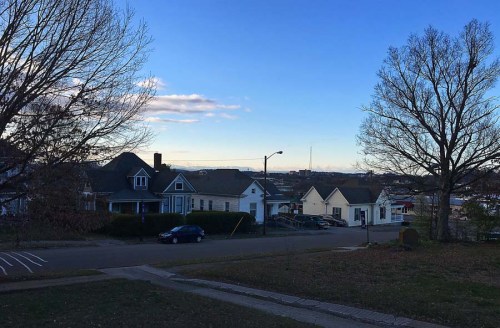
Spring morning after a day of rain.
Filed under 2017, photo by David E. Booker, Photo Finish Friday
use blinking blinkers /
you fool in front of me, or /
Spring will end too soon.
Filed under 2017, Haiku to You Thursday, poetry by author
Source: 10 Things I Learned About Writing and Publishing From Managing a Porn Store | LitReactor
By Christoph Paul
I used to manage a porn store in northeast D.C. I worked there for two years and it was the best writer job I ever had. There were whole blocks of time where I could read and write while I sat behind the counter. It was a blessing to get paid to practice my craft. All the hours added up and I became a better writer, but managing the porn store also taught me certain skills that I use on a daily basis in my writing and publishing career.
Covers and Titles
The first thing I learned was that we had to buy and sell lots of rentals on our new releases to stay afloat. If I picked a lot of bad movies for the new release wall that didn’t get bought or rented within the first month, my boss would be pissed. The customers also got pissed, and then I would have to deal with a lot of bullshit instead of focusing on writing or reading. The only real work I had besides putting movies back on their shelves was picking the weekly new releases. With the goal of having my boss stay off my back, I made sure to kill it each week with my new release section. I learned what sold and what type of titled stood out. I use that same skill when writing or publishing a new book. Whether it be porn or fiction, the cover and title has to show the readers and viewers that they will enjoy the product. The cover must at least peak curiosity and satisfy something a reader or porn watcher is wanting. Bad covers, whether on a porno or on a novel, are easy to spot and will always stay on the shelf.
Dialogue
My shift was eight hours a day, five days a week. Though I would have loved to spend every hour reading and writing, I had to interact with the customers. There were a lot of regulars who wanted to talk about politics, sports, their personal lives, their kinks, and their jobs. They would not hold back, and almost treated me like a priest. I heard some hardcore confessions. When I am figuring out how a certain character would sound, I have a ton of examples from the porn store. I can use their quirks and speech patterns to inject more realism and humor into my dialogue. Whether it be someone in the closet renting gay porn or a person explaining why they don’t want to have sex with their significant other anymore, I heard people speaking their truths. This gave me an ear for both inner and outer dialogue. There are things that a character reveals in more subtle and nuanced ways, through their rhythms, vocabulary, and even through the things they pointedly leave out.
Writing Through Chaos and Distractions
You can write anywhere. That is what I learned those years behind the porn store counter. I’d have homeless people come in, zoning law inspectors, gang bang recruiters (seriously), cops coming in to shoot the shit, the boss stopping by to complain, and customers looking for very specific fetishes. I learned to stop and deal with who or whatever I had to attend to, and then get back to writing. While there, I finished the second draft of a literary novel, some short stories, and read a ton. I learned there is no perfect place to read and write, and that even through the most awkward disruptions you can still find time to be creative.
Con Selling
If you can sell a $29.95 DVD with ‘anal’, ‘cuckold’, and/or ‘big cocks’ in the title, you can sell a book you have edited or written to a stranger. I picked up some practical sales skills at the porn store. My constant goal was to keep enough money coming in so my boss never suspected I was writing on the job. Though selling shitty porno movies and fake penis growth pills felt disenchanting at times, it taught me how to interact with strangers. When I started doing book festivals and conferences three years ago, they were a joy, because I actually believed in my books and understood how to communicate each book’s value. While penis enlargement pills are bullshit, I actually believe in what I sell. That combination of enthusiasm and sales skills has helped me finish in the black for almost every con/festival I have attended.
Character Studies
It wasn’t just dialogue I learned from the porn patrons. It was crafting real characters with real quirks and commonalities. Listening and talking to the porn store patrons was as good as reading any craft book on creating realized and memorable characters. After working the store for a year, I could usually tell a lot about a person within the first minute of talking to them. I noticed the physical: body language, the sound of their voice, build, did they look me in the eyes or not; sociological: how well read or educated they were, where they worked, what kind of money they made, religion, nationality; and emotional: were they stable, lonely and needing to connect, fake happy, assertive or aggressive, timid. All of these characteristics combined into making them who they were. I could use this skill to build real characters in my fiction. I could take physical, sociological, and emotional attributes and combine them into a unique human being. I would sometimes compare them to real individuals I met at the porn store to see if they felt ‘real.’
Genre Expectations and Surpassing Them
Different fetishes and types of porn are really just different genres. The videos that end up getting rented and bought the most not only meet ‘genre expectation,’’ they also add something special. While I don’t want to get super graphic here, it usually involves something memorable in the video—a scene, a style, and many times, a certain actress. I learned from the popular porno videos that when writing in a certain genre you have to make those genre fans happy, but also give them something unique. It can be your style of language, it can be taking a new approach on a familiar trope, and most importantly giving the reader an outstanding character. When you meet the expectations of genre and create something memorable in your story, your books will sell as good as porn.
Talking Books
On very slow days I would sit behind the register and read. A lot of customers didn’t want to interact and I would just look up, put in my bookmark, and get them their movie. This was pretty standard, but sometimes the porn patrons would be curious about what I was reading. Many of these guys were proud non-readers. I took this as a challenge to infuse the porn store with at least a little literary curiosity. To do this I had to tell them why the book was enjoyable and get them interested enough to want to hear more. I was very proud when I was able to get 4 men excited about the story of one of my favorite novels, Anna Karenina. Experiences like that have made it a lot easier for me to write the back copy of my own as well as other writers’ books.
Vibrator Editor
Until I got the hang of it, selling and recommending vibrators was a challenge. Though white male privilege exists, it doesn’t come in handy when talking to a woman about what vibrator she should buy. At first it was very awkward and I didn’t sell many vibrators, but I learned that I had to help the female customer feel comfortable. I also needed to be knowledgeable and a little humorous, as well as respectful. When I took this approach I easily sold vibrators and learned better communication skills. These skills help me so much when editing other people’s work. Communication and making artists feel comfortable is important. Sex toys, someone’s story, they both involve vulnerability, but if you communicate the right way, a writer will be able to access the right technique and tool for the job.
Storytelling
When it was cold, the porn sales always rose. Wintertime was the most popular time in the store. Not just for rentals and purchases, but for guys just wanting to hang out. The porn store would feel a lot like a barbershop. There were guys who proudly didn’t read and didn’t even like watching movies or TV. They only liked sports, but some of these guys would come up with the funniest stories I have ever heard. There were always men wanting to talk, but if you couldn’t tell a good story or keep people’s interest, they wouldn’t give you a chance to be heard. I saw that being a great storyteller had nothing to do with being a great writer. Storytelling was a separate skill, and there were some guys who might not have ever picked up a book but could tell a great story. I started listening to these guys and dissecting their stories. I realized they were using many of the techniques I read about in the craft books about great storytelling.
Snobbery
I started the porn store job a good 7 years ago. At the time, I was a big literary snob. I believed that only the serious literary novel is what people should read, and even though I was selling porno, I thought erotica and romance writers were total hacks. After two years of working there my mind really opened, and I saw that whether it be porn, erotica, or romance, they were art forms and audiences enjoyed the fantasy and desire that they provided. I lost my snobbery, seeing that any kind of storytelling takes skill. A few years later I would take what I learned at the porn store and write erotica under a pen name. The erotica I have created is still the most successful work I have published. If I hadn’t worked at the porn store, I would be just another bitter failed literary novelist complaining about Chuck Tingle.
Filed under 2017, Writing Tip Wednesday
I will be mixing some of the stories from the old Pulphouse days along with brand new fiction. I figured most of those older stories have long been forgotten and they need a new life. For each story we will push the author information and be clear to the reader if the story is new or if a reprint, where the story was originally published.The magazine will have an attitude, as did the first run. No genre limitations, but high quality writing and strangeness.Each issue will have some fan favorite authors from the old runs and brand new authors.SubmissionsI am not taking submissions. Period. So please don’t ask.
Source: Pulphouse Fiction Magazine Is Coming Back!
Click on the link above for the full article.
That’s right, after twenty years, Pulphouse returns.
Kris and I are bringing it back.
I figured I had better talk a little about it here since I am the editor and I bought some really stunning and wonderful Pulphouse stories for the magazine this last week. But just to be clear, Kris is with me on this. Pulphouse was always the two of us and even though WMG Publishing Inc. is now the company behind Pulphouse, the magazine is still our vision.
First Some History
Kris and I started Pulphouse Publishing in 1987 and dissolved the corporation in 1996. We started off with Pulphouse: The Hardback Magazine and expanded to numbers of imprints, including Axolotl Press, Author’s Choice Monthly Press, Short Story Paperbacks Press, and Writer’s Notebook Press, among others.
Along the way we ended the Hardback Magazine run that Kris had edited. She moved to editing F&SF and we started up Pulphouse: A Fiction Magazine that I edited. She remained as Pulphouse book editor.
We managed to get out nineteen issues and an Issue Zero before shutting down the business. But along the way the magazine was nominated three times for the Hugo Award among other awards.
The New Magazine Details
As you can see from the pictures, we are doing an Issue Zero again this time that will be limited and part of a Kickstarter later in the summer. First issue comes out in January 2018 and the magazine will be quarterly, with about 70,000 words of short fiction every issue. It will be the size and shape of Smith’s Monthly.
I will be mixing some of the stories from the old Pulphouse days along with brand new fiction. I figured most of those older stories have long been forgotten and they need a new life. For each story we will push the author information and be clear to the reader if the story is new or if a reprint, where the story was originally published.
The magazine will have an attitude, as did the first run. No genre limitations, but high quality writing and strangeness.
Each issue will have some fan favorite authors from the old runs and brand new authors.
Submissions
I am not taking submissions. Period. So please don’t ask.
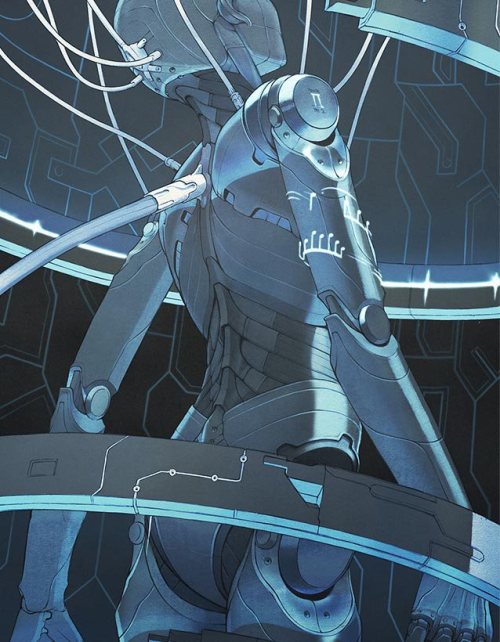 In a cyber-enhanced, futuristic Chicago, Sonata knows near-immortality is achievable through downloading her mind into a cyborg body after death. But this young artist wants to prove that living fo…
Source: The Three Lives of Sonata James | Tor.com
Click on the link to read the rest of the novella.
Filed under 2017, science fiction

by Ben Blatt
The first literary mystery to be solved by numbers was a 150-year-old whodunit finally put to rest in 1963. Two statistics professors learned of the long-running debate over a dozen contested essays from The Federalist Papers, and they saw that they might succeed where historians had failed. Both Alexander Hamilton and James Madison claimed to have written the same 12 essays, but who was right?
The answer lay in how each writer used hundreds of small words like but and what, which altogether formed a kind of literary fingerprint. The statisticians painstakingly cut up each essay and counted the words by hand—a process during which “a deep breath created a storm of confetti and a permanent enemy.” And by comparing hundreds of word frequencies, they came up with a clear answer after so many years of speculation: the contested essays were distinctly the work of James Madison.
Since 1963, similar methods have continued to yield major findings. Take, for instance, last year’s revelation that Shakespeare collaborated with Christopher Marlowe. And in the meantime, the technology involved has leapt from scissors and paper to computer and code, giving rise to a whole new field of study—the digital humanities.
In my new book, Nabokov’s Favorite Word is Mauve, I use simple data to whiz through hundreds of classics, bestsellers, and fan fiction novels to explore anew our favorite authors and how they write. I uncover everything from literary fingerprints and favorite words and tics, to the changing reading level of NYT bestsellers and how men and women write characters differently.
If you have a body of literature, stats can now serve as an x-ray. Here are a few fascinating examples from Nabokov’s Favorite Word is Mauve:
Writing Advice
There is a lot of writing advice out there. But it’s hard to test, and it’s often best to judge someone not by what they say but what they do. Novelists may tell their adoring fans to do one thing, but do they actually follow their own advice? With data, we can find out—looking at everything from the overuse of adverbs to Strunk and White’s advice against qualifiers like “very” or “pretty.”
One of my favorite examples comes from Elmore Leonard’s 10 Rules of Writing, where Leonard offers the following rule about exclamation points: “You are allowed no more than two or three per 100,000 words of prose.” A writing rule in the form of a ratio is a blessing for a statistician, so I ran with it. Does Leonard practice what he preaches?
From a strict numerical view, no. Leonard wrote over 40 novels which totaled 3.4 million words. If he were to follow his own advice he should have been allowed only 102 exclamation points his entire career. In practice, he used 1,651—which is 16 times as many as he recommends.
But looking deeper, we find that Leonard did follow the spirit of his own rule. Below are 50 novelists, representing a range of classic authors and bestselling authors. Elmore Leonard beats out everyone.

And the picture gets even more interesting when we look at how Leonard’s use changes over time. The chart below shows the number of exclamation points that Leonard used in each one of his novels from the start of the career. He loved the exclamation point as a novice, but he slowly weaned off of it over time.
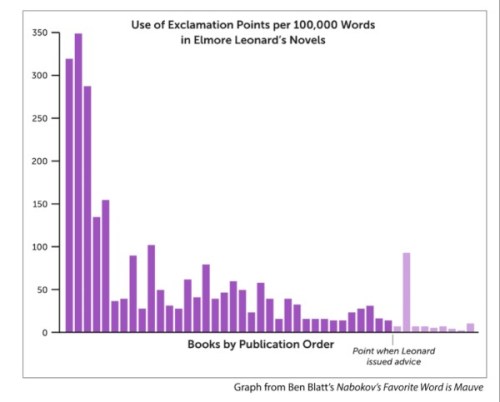
Interestingly, after he delivered his exclamation point rule in 10 Rules for Writing, his use decreased even further (the one exception was Leonard’s sole children’s novel). He may have been a zealot: no one I looked at uses exclamation points at a rate lower than two or three per 100,000. But Leonard practiced what he preached: he got closer to his magic ratio than any other writer, especially in his final stretch of novels.
He was also on to something. I parsed through thousands of amateur fan-fiction stories online and found they were not only enthusiastic about their story universes, but for exclamation points as well. The average published author relies on about 1/4th as many exclamation points as the average amateur writer.
How Cliché
The book world loves a good list: bestsellers, award winners, “best of the year” lists. But what other superlative lists are there to uncover out there in the literary world? In Nabokov’s Favorite Word is Mauve, I decided to ask: who uses the shortest sentences, the most adverbs, writes at the lowest grade level or relies on the most clichés?
I took all expressions mentioned in the 2013 book by Christine Ammer titled The Dictionary of Clichés. These are phrases like “fish out of water,” “dressed to kill,” and “not one’s cup of tea”—4,000 phrases in total. To my knowledge, Ammer’s book is the largest collection of English language clichés. I then scanned through the complete bibliographies of the same 50 authors mentioned above to see who used the most clichés.

The answer: James Patterson.
You’d expect some recency bias in the dictionary of clichés (Jane Austen’s characters, unfortunately, weren’t ever described as “dressed to kill”). So I also looked at every single book that ranked on Publishers Weekly’s bestselling books of the year since 2000. James Patterson can’t blame his time period alone. Even compared to his contemporaries in genre and time, Patterson comes in with five of the 10 most clichéd books. He’s clearly making it work, though. Of those PW lists, Patterson has 16 books, more titles than any other writer.

Start with a Bang
In response to a question on Twitter about her favorite first sentence in literature, novelist Margaret Atwood answered: Call me Ishmael. “Three words. Power-packed. Why Ishmael? It’s not his real name. Who’s he speaking to? Eh?”
Atwood emphasized the brevity of the Moby-Dick opener, and she is similarly concise in her own work. I compared the median length of her opening sentence to that of the 50 authors in the exclamation point chart above. Only one author, Toni Morrison, beats her out.

Opening sentences are far from an exact science, but keeping them short and powerful by rule of thumb is a smart place to start. Drawing from a range of sources, I assembled a list of the consensus top 20 opening sentences in literature. And of that list, 60% of the openers are short when compared to the book’s average sentence length.
But when you look a much wider sample of literature, most authors in practice opt for long openers. In 69% of all of the books I looked at, the opening sentence is longer than the average sentence throughout the rest of the book. It might be that authors like Toni Morrison and Margaret Atwood are on to something as they keep their openers “power-packed.”
Beach Weather

In one last example, let’s return to Elmore Leonard’s 10 Rules of Writing. His first rule (#1!) is “Never open a book with weather.” Apparently Leonard had strong feelings about this trope, but anyone who’s ever heard too many plays on the old saw, “it was a dark and stormy night,” will know where he’s coming from.
Leonard again lives up to his own advice. But there’s one author who completely flouts it, and it’s an example I love.
Danielle Steel, known for selling hundreds of millions of books, should also be known for talking about the weather. She started her first book off “It was a gloriously sunny day and the call from Carson Advertising came at nine-fifteen.” She’s never looked back.
Nearly half her of introductions involve weather—mostly benign, positive weather (“perfect deliciously warm Saturday afternoons,” “perfect balmy May evening”, “absolutely perfect June day,” or simply: “The weather was magnificent.”). But like Patterson she has made her rule-breaking choice work. It’s a distinctive style that’s all her own—and it’s a quirk that at least this reader would never have been able to pin down without having been able to run the numbers first.
Filed under 2017, tendencies
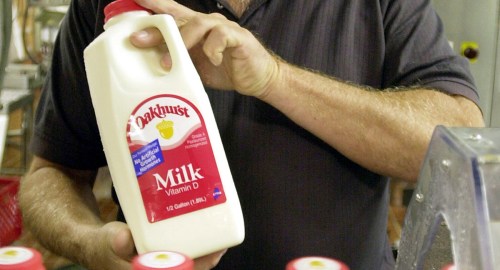
Source: Oxford Comma Decides Court Case in Maine Labor Dispute
Vampire Weekend and the AP Stylebook be damned! The Oxford comma—or rather, the lack of one—helped decide a Maine court case over overtime pay for dairy workers earlier this week.
Also known as the serial comma, the Oxford comma is used before a conjunction like “and” or “or” in a series of three or more items. (For example: “I’m going to buy some eggs, milk, and bread.”) Critics feel it’s clunky and superfluous, while diehard supporters believe it’s absolutely essential for clarity. (For what it’s worth, Boston magazine’s official style uses the Oxford comma.)
Delivery drivers for Oakhurst Dairy won their suit against the Portland milk and cream company, after a U.S. court of appeals found that the wording of Maine’s overtime rules were written ambiguously. Per state law, the following activities are not eligible for overtime pay:
The canning, processing, preserving,
freezing, drying, marketing, storing,
packing for shipment or distribution of:
(1) Agricultural produce;
(2) Meat and fish products; and
(3) Perishable foods.
Oakhurst argued that “distribution of” was separate from “packing for shipment,” which would allow the company to claim exemption from paying its delivery drivers over time. In trying to prove lawmakers’ intent, Oakhurst even pointed to Maine’s legislative style guide, which advises against using the Oxford comma.
“For want of a comma, we have this case,” U.S. appeals judge David J. Barron wrote.
The appeals court ruled in favor of the five delivery drivers Monday, citing the “remedial purpose” of the state’s overtime laws as reason to interpret them liberally. So rejoice, grammar nerds, and know that the law is on your side.


 Booker's Blog