

Save
Save
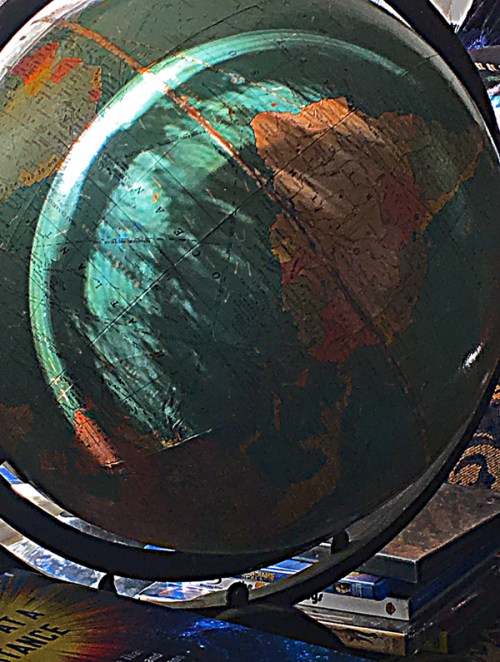
Some days your world is right side up. some days, upside down.
Filed under 2017, photo by David E. Booker, Photo Finish Friday
Strawberry moon ripens, /
descending the night sky /
into fields of dreams.
Filed under 2017, Haiku to You Thursday, poetry by author
Speaking at the Hay literary festival, the Irish novelist said modern writers should emulate Jane Austen and stop overdoing the backstory
Source: Bad memories: Colm Tóibín urges authors to lose the flashbacks | Books | The Guardian
By Mark Brown
Colm Tóibín has issued a rallying call against what he sees as the scourge of modern literature: flashbacks.
The Irish novelist said the narrative device was infuriating, with too many writers skipping back and forward in time to fill in all the gaps in a story.
“We are living in the most terrible age,” Tóibín told the Hay literary festival in Wales. “I know people are worried about Brexit and I know people worry about Donald Trump. But I worry about the flashback.
“You can’t read any book now – any book – without suddenly, on chapter 2, [the writer] taking you back to where everybody was 20 years ago. How their parents met, how their grandparents met.”
Tóibín was taking part in a panel discussion on Jane Austen, who, he said, wrote complex, layered characters without ever contemplating a flashback.
For example, he said, Mr Bennet in Pride and Prejudice is a number of different characters, with the reader feeling less on his side as the novel progresses. Fanny Price in Mansfield Park, meanwhile, is not very bright and then she is. “That lack of being obvious gives her a depth, especially her stubborn feelings.”
Tóibín urged writers to leave it to readers to figure out a person’s character. “I like the business of: we don’t know, it is left out, just imagine it yourself… you do it! I do not want to know how Mr Bennet met Mrs Bennet.” Having said that, how they met is a complete mystery, he said. “What happened that night?”
Tóibín said that although Mr and Mrs Bennet are not physically described in Pride and Prejudice’s first chapter, you know how to read both of them straight away from the things they say.
The panel was one of a number of Austen-themed events taking place in the run-up to the 200th anniversary of her death on 18 July. Tóibín was also launching his new book House of Names, a retelling of the classical Greek tales of the house of Atreus, including the stories of Agamemnon and his wife Clytemnestra, their son Orestes and daughters Iphigenia and Electra.
Filed under 2017, writing tip, Writing Tip Wednesday

It was clearly a case of misplace myopia.
Filed under 2017, cartoon by author, CarToonsday
First writer: “My editor told me my flashbacks were so weak they needed new batteries.”
Second writer: “What did you say?”
First writer: “I said, ‘You know, that reminds me of the first time you….’”
Filed under 2017, joke by author, Monday morning writing joke

The American Short Fiction Prize—a contest for stories between 2,000 and 6,500 words—is now open for submissions. This year we are honored to have Lauren Groff, author of Fates and Furies (Obama’s favorite book of 2015), as our guest judge. The first-place winner will receive a $1,000 prize and publication in our spring issue. One runner-up will receive $500 and all entries will be considered for publication. Submit your story through our online submission manager by June 15! More contest details after the jump.
Source: Deadline Extended: The American Short Fiction Prize –
– Submit your entry online between March 22, 2017 and June 1, 2017. The deadline has been extended to June 15, 2017!
– The first-place winner will receive a $1,000 prize and publication in our spring issue. One runner-up will receive $500 and all entries will be considered for publication.
– Please submit your $20 entry fee and your work through Submittable. We no longer accept submissions by post. International submissions in English are eligible. The entry fee covers one 6,500 word fiction submission.
– All entries must be single, self-contained works of fiction, between 2,000-6,500 words. Please DO NOT include any identifying information on the manuscript itself.
– You may submit multiple entries. We accept only previously unpublished work. We do allow simultaneous submissions, but we ask that you notify us promptly of publication elsewhere.
Conflicts of Interest
Staff and volunteers currently affiliated with American Short Fiction are ineligible for consideration or publication. Additionally, students, former students, and colleagues of the judge are not eligible to enter. We ask that previous winners wait three years after their winning entry is published before entering again.
Lauren Groff is the author of the novel The Monsters of Templeton, shortlisted for the Orange Prize for New Writers, Delicate Edible Birds, a collection of stories, and Arcadia, a New York Times Notable Book, winner of the Medici Book Club Prize, and finalist for the L.A. Times Book Award. Her third novel, Fates and Furies, was a finalist for the National Book Award in Fiction, the National Book Critics Circle Award, and the Kirkus Award. It won the 2015 American Booksellers’ Association Indies’ Choice Award for Fiction, was a New York Times Notable book and Bestseller, Amazon.com’s #1 book of 2015, and on over two dozen best-of 2015 lists. Her work has appeared in journals including the New Yorker, the Atlantic Monthly, Harper’s, Tin House, One Story, and Ploughshares, and in the anthologies 100 Years of the Best American Short Stories, The Pushcart Prize: Best of the Small Presses, PEN/O. Henry Prize Stories, and four editions of the Best American Short Stories. She lives in Gainesville, Florida with her husband and two sons.
Bananas or banannas? These are the top misspelled words in each state
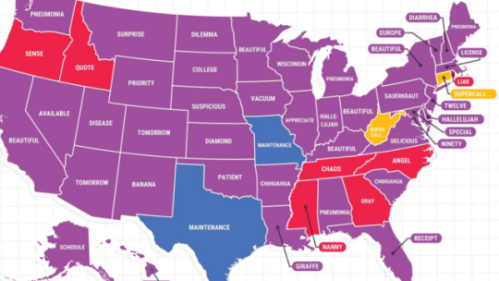
Where do you fit in?
Mary Bowerman , USA TODAY Network
EDITOR’S NOTE: A previous version of this story stated Wisconsin’s most misspelled word was “tomorrow” based on Google-provided data. A Google update with more current data found that the most misspelled word is actually Wisconsin.
Spelling champions from across the country are preparing to compete this week at the Scripps National Spelling Bee in Washington, D.C.
While we’ve all cringed after misspelling a word in a work email or a text, the National Spelling Bee competitors will be asked to spell words that make the word “chihuahua” look like a walk in the park.
In honor of those who aren’t as gifted as the National Spelling Bee champs, Google pulled the most misspelled words in each state so far this year.
Here’s a look at the most misspelled search words in each state:
Alabama: pneumonia
Alaska: schedule
Arizona: tomorrow
Arkansas: chihuahua
California: beautiful
Colorado: tomorrow
Connecticut: supercalifragilisticexpialidocious
Delaware: hallelujah
Washington, D.C. : ninety
Florida: receipt
Georgia: gray
Hawaii: people
Idaho: quote
Illinois: pneumonia
Indiana: hallelujah
Iowa: vacuum
Kansas: diamond
Kentucky: beautiful
Louisiana: giraffe
Maine: pneumonia
Maryland: special
Massachusetts: license
Michigan: pneumonia
Minnesota: beautiful
Mississippi: nanny
Missouri: maintenance
Montana: surprise
Nebraska: suspicious
Nevada: available
New Hampshire: difficult
New Jersey: twelve
New Mexico: bananas
New York: beautiful
North Carolina: angel
North Dakota: dilemma
Ohio: beautiful
Oklahoma: patient
Oregon: sense
Pennsylvania: sauerkraut
Rhode Island: liar
South Carolina: chihuahua
South Dakota: college
Tennessee: chaos
Texas: maintenance
Utah: disease
Vermont: Europe
Virginia: delicious
Washington: pneumonia
West Virginia: supercalifragilisticexpialidocious
Wisconsin: Wisconsin
Wyoming: priority
Filed under 2017

Reaching toward the future.
Reaching toward the future /
raindrops reflect the present /
while seeds crack the past.
Filed under 2017, photo by David E. Booker, Photo Finish Friday
Love is not defined /
except by the open heart /
and pain at parting.
Filed under 2017, Haiku to You Thursday, poetry by author


 Booker's Blog