

Monday haiku: “Soggy bottom”
Some days you get the /
dry sleeping bag; other days /
the bag gets soggy.

Filed under 2018, haiku, Photo by Lauren Booker, poetry by author
Monday morning writing joke: “Haulage of knowledge”
There once was a writer off for college /
All in the pursuit of higher knowledge. /
The four years they say /
Only got in the way /
And caused a great deal of haulage.
Filed under 2018, joke by author, Monday morning writing joke
Monday (morning) writing joke: “Assault with a deadly language”
There once was a author from Brisbane /
who thought a writer from Lisbon /
tortured language in a way /
that was “an assault and pepper spray” /
a syntax attack, if not misprision.
Filed under 2018, Monday morning writing joke, poetry by author
“Humans never learn”: the philosopher John Gray on New Atheism, the God Debate and why history repeats itself | The Sunday Times Magazine | The Sunday Times

Gray’s latest book, Seven Types of Atheism, targets the New Atheists
by Bryan Appleyard
Once upon a time an American writer called Sam Harris wrote a book called The End of Faith, about how silly it was to believe in God. The book sold many copies, so some other people — Richard Dawkins, Christopher Hitchens, Daniel Dennett, AC Grayling — wrote the same book. This made them all quite a bit richer and turned them into a movement called either Militant Atheism or the New Atheism. They were all fairly clever, but none of them was even half as clever as another philosopher called John Gray. (I would say he’s the greatest, but he’s a mate so you might think I’m biased.)
Gray became “bored and frustrated” with what came to be known as the God Debate, so he decided to put them in their place.
“They’ve not read very much of anything at all,” he explains, “and they don’t know anything very much.”
The New Atheists wanted to get rid of God because they thought he was the real problem. When communism collapsed in the late 1980s, people believed the West had won and soon everybody would be nice liberal democrats. It didn’t happen. Then along came 9/11, which was caused by God or, at least, bad religion. And it was this, the New Atheists concluded, that was stopping people becoming just like them.
So the New Atheists set up a new, godless religion of science. Science was the one human activity that shows constant progress, so letting science set the rules seemed the way to ensure constant progress in all things. This is, Gray believes, a fairy tale. In his view, there is no evidence whatsoever that human progress is inevitable and enduring. And there is plenty of evidence that it isn’t. The 20th century was a slaughterhouse from the trenches of the First World War to the Holocaust in the Second. The 21st is now heading that way with gas attacks on children in Syria, the genocide of the Rohingya in Burma and, most chilling of all, the recreation of the Cold War with the use of nuclear weapons now being discussed as an imminent reality. All civilisations, all human aspirations, eventually fail. The best we can do is sustain the good times. Humans can hope, but optimism — the belief in a fundamental change in our condition — is futile.
Gray’s new book, Seven Types of Atheism, is not just a demolition of the anti-God squad, it is also an assault on their strange religion. But who is John Gray?
Born in South Shields in 1948, Gray now lives in Bath with his Japanese wife, Mieko. They have been married for 30 years and have no children. They do, however, have a cat, Julian, a 21-year-old birman that is the hero of Gray’s next book, Feline Philosophy: Cats and the Meaning of Life. “Cats,” he says, “enjoy their lives without needing to turn them into stories.”
When he was growing up, cats “were a normal aspect of working-class life, everybody had cats”. He still has remnants of a Tyneside accent that becomes more pronounced when he tells funny stories, which he does a lot. From his upbringing and his parents — Nick, a joiner and, during the war, a docker, and Joan — he learnt most of the basics of his later thinking. He was born three years after the Second World War, in which our species decided to kill 85m of its members. There were too many such “hemoclysms” — bloodbaths — in the 20th century and I believe Gray is the only philosopher to have recognised their true import. “Secular meliorism — which is the religion of pretty much everybody who thinks they have no religion — says that what has been achieved in history in the way of improvements cannot be lost.” Gray, on the other hand, states that “they were repeatedly lost in the 20th century when whole peoples, whole forms of life were destroyed, so whatever improvements there were within them were gone. And that is normal.”
History, for Gray, is cyclical. There is no upward trend, we are stuck on the treadmill of our own inadequacies. The best that politicians can do is find “partial remedies to recurring human evils” and thereby sustain periods of improvement for a little longer. “I was a beneficiary of the Second World War. If it hadn’t happened, there would have been no welfare state and no opening up of opportunities and I probably wouldn’t have achieved anything. Of course, that improvement was itself a side effect of a catastrophic event … I do believe it was a just and necessary war, but with catastrophic suffering.”
Gray is hyperaware of fragility in all that we do, from the comical, small, daily failures to the life-changing disasters. His manner is, as a result, faintly nervous, but he survives all of this because of the stoicism he learnt from his parents. “I benefited from the inculcation of stoicism from my mother and the whole culture,” he says. “That’s disparaged now.” Stoics, however, can follow their best impulses and assert themselves against fate. Gray did this through books. He started going to the local library, and reading was a way out of Tyneside. Crucially, however, it was not a rejection of his terraced house community. “Doors were left open all the time. That I know because I lived that way. It’s not a romantic, nostalgic backward glance, it’s all true. But this is another lesson about how you can’t have the good without the bad. The downside was that those communities could be very repressive. If you were the son of a miner you were expected to go down the mines; if you were a woman, it was very patriarchal … So if you wanted to live in some other way, you had to leave.”
He went, via books and grammar school, to Oxford and a succession of academic posts in Britain and America. Latterly, he became professor of politics at Oxford and then professor of European thought at LSE. He retired in 2007.
Politically he had been on the left, then the right in the 1980s, then the left. In the 1980s and 1990s his books surveyed vast landscapes of political thought. His friend and Oxford mentor Isaiah Berlin’s analysis of the contradictions of liberalism was a vital inspiration. Gray’s book False Dawn: The Delusions of Global Capitalism, in 1998, was an assault on the right-wing ideology of neoliberalism and has achieved lasting authority because it foresaw the terms of the 2007 financial crash; this led to a new edition in 2009. His next book, Straw Dogs: Thoughts on Humans and Other Animals, however, began a new phase. “Straw Dogs marked a shift in subject matter, writing style and audience for my work. Rather than a treatise in academic political philosophy or a polemic like False Dawn, it was a text I hoped anyone interested in fundamental questions about what it means to be human could find stimulating. It was also a book I enjoyed writing.”
Straw Dogs trashed most modern pieties. For example: “As commonly practised, philosophy is the attempt to find good reasons for conventional beliefs.”
His books that followed — notably, The Immortalization Commission, The Silence of Animals and The Soul of the Marionette — seemed to dissolve all genres, even though they were trashed by many critics. They were philosophy, history, art and literature, economics and politics, all held together with funny stories. For instance, in Gray’s latest book we have the ludicrous atheist French philosopher Auguste Comte, who had clothes made with the buttons down the back so that you needed somebody else to help you dress — it was supposed to promote fraternal co-operation to compensate for the loss of God.
The main problem people seem to have with Gray’s late works is what they mistakenly see as their bleakness. They don’t know what to think or where to go when they put the books down, probably because they have lived their lives under the comfort blanket of the progressive, scientistic superstition. This is a misreading. It is true that, like Darwin, Gray sees humans as just one more species, a passing phenomenon — “The Earth will forget mankind. The play of life will go on.” It is also true that, as he keeps saying, he does not believe in anything. This led to the likes of Professor Terry Eagleton calling him a nihilist. Gray brushes this aside. “Nihilism in common parlance is anything that disrupts the pieties of the time. In 1890 if you said gay sex was OK you’d be a nihilist — ‘You mean buggery is OK! Only a moral nihilist, someone who believed there was no moral order in the cosmos, would say this!’ Well, the Greeks didn’t seem to mind.
“The local piety now is the belief in progress, the human spirit, uplift. In my view this is always dancing on the edge of depression. They need to stand up stiffly for fear of falling flat on their face.”
His latest, Seven Types of Atheism, is a provocation. Even the title itself is designed to rile the New Atheists as they seem to think theirs is the only type of atheism: a disbelief in God and a belief in science as the only road to salvation. This is a fairy tale that has so often had an unhappy ending — communism, Nazism — that it is hard to believe it is still being told. But it survives because of another incurable human attribute: forgetfulness. It is this that made the absurd “God Debate” possible. This debate, Gray says, is “ignorant and parochial and uninformed”. He’s tired of poking holes in Dawkins’s deficient learning and self-serving logic, but he still likes to stick the odd knife into Sam Harris, the American leader of the movement, accusing him of “a willed ignorance of the history of ideas”.
“The whole God Debate was a recycled and cheapened version of debates that went on in the 19th century, with not much that is genuinely new … There is nothing that wasn’t in Victorian atheism, which was often better expressed and certainly with more knowledge of Christianity and biblical texts.”
For Gray, to say you are an atheist is not to say that there is no God, but rather to say you don’t need a God. (In these terms, he is an atheist himself.) Historically, atheism has taken many forms — secular humanist, scientific, apocalyptic, God-hating and so on. The particular contemporary form, with its emphasis on a story of redemption through science, is, Gray claims, quite clearly religious — a version of the monotheistic belief in a linear history terminating with salvation. Also, the religion attacked by the New Atheists is only a small local sect.
“They talk as if all religion is a series of iterations of 20th-century American, Protestant, fundamentalist Christianity. Christianity is incomparably, almost inexhaustibly richer than that. They’re not really talking about religion or even atheism. They’re just prosecuting a local culture war. Why should anyone be interested in that?” Their parochialism, he says, makes them too hung up on belief, which they do not distinguish from faith. His wife, Mieko, for example, introduced him to Zen Buddhism, which requires no belief whatsoever and, like many other faiths, does not need a God. Now, for Gray, “the heart of religion is living in a particular way, it is a form of life”.
And as for science and technology — well, yes, they are the only human artefacts that do, in fact, progress. But that does not and cannot lead to ethical or political progress. Anaesthetic dentistry and, possibly, contraception are the only developments he acknowledges that did not come with a cost. And he goes back to South Shields when he talks about the well-meaning progressives who knocked down the terraced houses to build tower blocks. People were better housed, but communities were destroyed — “Everything comes with a shadow.”
Or, to put it another way, the best of us cohabits with the worst of us. “Human nature is shown by the high degree of constancy in human needs, desires, passions and reactions. It is why human history and events are so repetitive.”
If we weren’t mixed, fallen, incurable, we wouldn’t be human.
Seven Types of Atheism is published on Thursday (Allen Lane £18)
Filed under 2018, author profile
Ian McEwan ‘dubious’ about schools studying his books, after he helped son with essay and got a C+
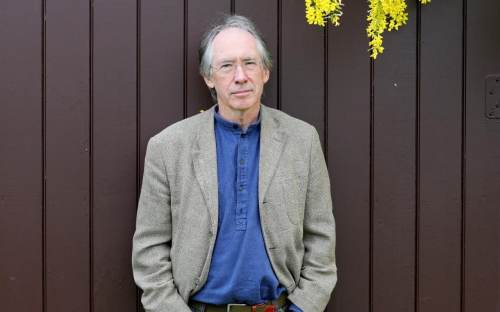
Ian McEwan, the award-winning author, has admitted feeling “a little dubious” about people being compelled to study his books, after helping his son with an essay about his own novel and receiving a C.
Source: Ian McEwan ‘dubious’ about schools studying his books, after he helped son with essay and got a C+
by Hannah Furness, Arts Correspondent, 8 May 2018
McEwan, author of works including Atonement, Amsterdam, and On Chesil Beach, said he remained unconvinced about the purpose of asking students to analyse his work.
“I always feel a little dubious about people being made to read my books,’ he told Event magazine, saying his son Greg was required to write an A-Level essay on Enduring Love several years ago.
“Compelled to read his dad’s book – imagine. Poor guy,” McEwan added.
“I confess I did give him a tutorial and told him what he should consider. I didn’t read his essay but it turned out his teacher disagreed fundamentally with what he said.
“I think he ended up with a C+.”
Asked for his thoughts on the literary landscape of 2018, McEwan suggested he was sceptical.
“Literary fiction is in a curious nosedive saleswise, down about 35 per cent over the past five years,” he said.
“Everyone’s got a theory: TV box sets, some sort of fatigue, who knows. Maybe it’s not just good enough.
“When people ask me who are the amazing writers under 30, I’m not in a position to judge. I start a lot of modern novels and don’t find myself compelled to continue.”
McEwan’s latest work has seen him adapt his novel, On Chesil Beach, for the screen after other books were turned into films by outside scriptwriters.
“I’ve learnt from experience that if you want to have influence, you have to get your hands dirty,” he said, admitting: “I tinker – I can’t stop.
“There’s one scene in the movie I know that if it had occurred to me when I was writing the novel, I’d have put it in.
“What’s also not in the book is the ending, because cinematically it’s irresistible.”
Filed under 2018, author interview
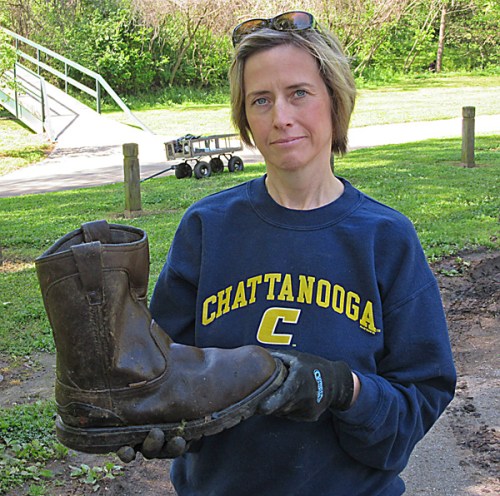
Haiku to you Thursday (and photo): “The boot”
Water resistant, /
creek find, Herman boot rescued. /
Spring planter reuse.
One space between each sentence, they said. Science just proved them wrong. – The Washington Post
 Obviously, there needs to be a standard. But do we really want to leave it to science?
Source: One space between each sentence, they said. Science just proved them wrong. – The Washington Post
In the beginning, the rules of the space bar were simple. Two spaces after each period. Every time. Easy.
That made sense in the age of the typewriter. Letters of uniform width looked cramped without extra space after the period. Typists learned not to do it.
But then, at the end of the 20th century, the typewriter gave way to the word processor, and the computer, and modern variable-width fonts. And the world divided.
Some insisted on keeping the two-space rule. They couldn’t get used to seeing just one space after a period. It simply looked wrong.
Some said this was blasphemy. The designers of modern fonts had built the perfect amount of spacing, they said. Anything more than a single space between sentences was too much.
And so the rules of typography fell into chaos. “Typing two spaces after a period is totally, completely, utterly, and inarguably wrong,” Farhad Manjoo wrote in Slate in 2011. “You can have my double space when you pry it from my cold, dead hands,” Megan McArdle wrote in the Atlantic the same year. (And yes, she double-spaced it.)
This schism has actually existed throughout most of typed history, the writer and type enthusiast James Felici once observed (in a single-spaced essay).
The rules of spacing have been wildly inconsistent going back to the invention of the printing press. The original printing of the U.S. Declaration of Independence used extra long spaces between sentences. John Baskerville’s 1763 Bible used a single space. WhoevenknowswhateffectPietroBembowasgoingforhere.Single spaces. Double spaces. Em spaces. Trends went back and forth between continents and eras for hundreds of years, Felici wrote.It’s not a good look.
And that’s just English. Somewrittenlanguageshavenospacesatall and o thers re quire a space be tween ev e ry syl la ble.
Ob viously, thereneed to be standards. Unless you’re doing avant – garde po e try, or something , you can’tjustspacew ords ho w e v e r y o u want. That would be insanity. Or at least,
obnoxious.
Enter three psychology researchers from Skidmore College, who decided it’s time for modern science to sort this out once and for all.
“Professionals and amateurs in a variety of fields have passionately argued for either one or two spaces following this punctuation mark,” they wrote in a paper published last week in the journal Attention, Perception, & Psychophysics.
They cite dozens of theories and previous research, arguing for one space or two. A 2005 study that found two spaces reduced lateral interference in the eye and helped reading. A 2015 study that found the opposite. A 1998 experiment that suggested it didn’t matter.
“However,” they wrote, “to date, there has been no direct empirical evidence in support of these claims, nor in favor of the one-space convention.”
So the researchers, Rebecca L. Johnson, Becky Bui and Lindsay L. Schmitt, rounded up 60 students and some eye tracking equipment, and set out to heal the divide.
First, they put the students in front of computers and dictated a short paragraph, to see how many spaces they naturally used. Turns out, 21 of the 60 were “two-spacers,” and the rest typed with close-spaced sentences that would have horrified the Founding Fathers.
The researchers then clamped each student’s head into place, and used an Eyelink 1000 to record where they looked as they silently read 20 paragraphs. The paragraphs were written in various styles: one-spaced, two-spaced, and strange combinations like two spaces after commas, but only one after periods. And vice versa, too.
And the verdict was: two spaces after the period is better. It makes reading slightly easier. Congratulations, Yale University professor Nicholas A. Christakis. Sorry, Lifehacker.
Actually, Lifehacker’s one-space purist Nick Douglas pointed out some important caveats to the study’s conclusion.
Most notably, the test subjects read paragraphs in Courier New, a fixed-width font similar to the old typewriters, and rarely used on modern computers.
Johnson, one of the authors, told Douglas that the fixed-width font was standard for eye-tracking tests, and the benefits of two-spacing should carry over to any modern font.
Douglas found more solace in the fact that the benefits of two-spacing, as described in the study, appear to be very minor.
Reading speed only improved marginally, the paper found, and only for the 21 “two-spacers,” who naturally typed with two spaces between sentences. The majority of one-spacers, on the other hand, read at pretty much the same speed either way. And reading comprehension was unaffected for everyone, regardless of how many spaces followed a period.
The major reason to use two spaces, the researchers wrote, was to make the reading process smoother, not faster. Everyone tended to spend fewer milliseconds staring at periods when a little extra blank space followed it.
(Putting two spaces after a comma, if you’re wondering, slowed down reading speed, so don’t do that.)
The study’s authors concluded that two-spacers in the digital age actually have science on their side, and more research should be done to “investigate why reading is facilitated when periods are followed by two spaces.”
But no sooner did the paper publish than the researchers discovered that science doesn’t necessarily govern matters of the space bar.
Johnson told Lifehacker that she and her co-authors submitted the paper with two spaces after each period — as was proper. And the journal deleted all the extra spaces anyway.
Note: An earlier version of this story published incorrectly because, seriously, putting two spaces in the headline broke the web code.
Filed under 2018, punctuation
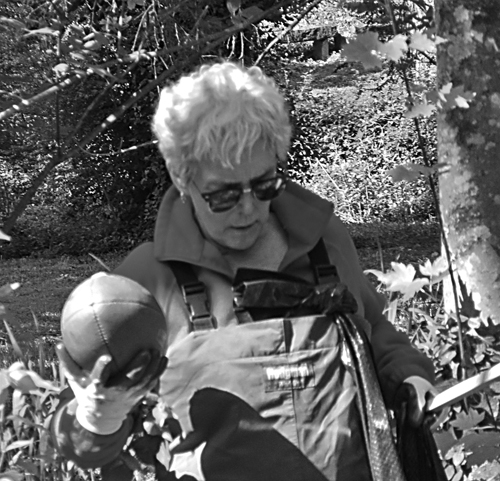
Photo finish Friday (and haiku): “Creek cleanup”
The Hail Mary here /
Is neither pass nor prayer /
but hope for the creek.
Filed under 2018, Photo by Lauren Booker, Photo Finish Friday, poetry by author
Haiku to you Thursday (and photo): “Irresistible”
It is not a nut. /
It is a legume, you say. /
I say, It’s a truck.

Filed under 2018, Haiku to You Thursday, Photo by Beth Booker, poetry by author


 Booker's Blog
