

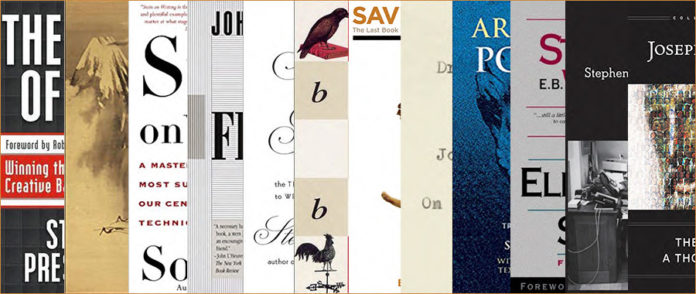
One of the best ways to improve your writing is to read about the craft.
Source: These 13 Books Will Make You a Better Writer in 2019 | Inc.com
- Ernest Hemingway on Writing, edited by Larry W. Phillips
Ernest Hemingway never codified his insights on writing into a book, but he did share his thinking on the topic in commissioned articles; letters to his agents, publishers, and friends; and through his novels. Ernest Hemingway on Writing is a collection of his insights on the craft of writing, and includes several practical and inspiring tips.
- Zen in the Art of Writing, by Ray Bradbury
The prolific science-fiction author Ray Bradbury collected the lessons he had learned about the craft during his long and successful career in Zen in the Art of Writing.
- Nobody Wants to Read Your Sh*t: Why That Is and What You Can Do About It, by Steven Pressfield
Steven Pressfield recently returned to writing about writing with a brand-new book, Nobody Wants to Read Your Sh*t. It’s a no-nonsense guide to writing stories that people will want to read. While the bulk of the book addresses how to write fiction, Pressfield shows how the same principles of writing good stories can apply to writing nonfiction.
- The Artist’s Way: A Spiritual Path to Higher Creativity, by Julia Cameron
The Artist’s Way: A Spiritual Path to Higher Creativity is the classic book by author and creativity coach Julia Cameron in which she introduces what she calls “morning pages.” Morning pages is a powerful stream of consciousness writing exercise that is not intended to yield publishable material, but which can help you get your pen moving and your thoughts flowing–even if you never intend to share them with the rest of the world.
- Turning Pro: Tap Your Inner Power and Create Your Life’s Work, by Steven Pressfield
Ever since reading his classic book, The War of Art, I’ve read every book about writing by Steven Pressfield (and I will continue to read every one he writes, including the one he’s publishing soon, which he’s generously serializing on his blog). In that book he gave a name to what every writer grapples with. He called it Resistance.
To fight the Resistance, writers (and other artists, for he was addressing artists broadly in that book) need to give up their amateur mindsets and habits and “turn pro.” In Turning Pro, his follow-up to The War of Art, Pressfield fleshes out what he means exactly when he tells writers to “turn pro.”
- On Writing Well: The Classic Guide to Writing Nonfiction, by William Zinsser
William Zinsser was a journalist, author, and writing instructor at Yale. His book On Writing Well is a classic among writers and has sold nearly 1.5 million copies in the 40 years since it was published. It’s one of the first books I recommend to anyone seeking to improve their writing.
- On Writing: A Memoir of the Craft, by Stephen King
Fifteen years ago, mega-best-selling author Stephen King wrote a book about the craft of writing that became an instant bestseller: On Writing: A Memoir of the Craft. After telling the story of how he became the writer he is today, King devotes the second half of the book to sharing his writing strategies, like his suggestion that you should write for your “Ideal Reader.”
- Process: The Writing Lives of Great Authors, by Sarah Stodola
This book looks at the techniques, inspirations, and daily routines of 18 iconic authors of the 20th century, including Franz Kafka, Ernest Hemingway, Virginia Woolf, David Foster Wallace, Toni Morrison, and Margaret Atwood.
After profiling so many successful authors, what did Stodola learn about their writing process? “Genius, I have concluded, is the presence of not one ability but several that work together in tandem. Genius is far more tedious, far less romantic, far more rote, far less effortless, than we imagine it.”
- The War of Art: Break Through the Blocks and Win Your Inner Creative Battles, by Steven Pressfield, edited by Shawn Coyne
All writers struggle with writer’s block in one form or another, but Steven Pressfield named the enemy and outlined a strategy for conquering it in The War of Art, the perennially best-selling guide for writers and other creative professionals. In the first part of the book he introduces what he calls Resistance – the force within us that conspires to prevent us from fulfilling our creative pursuits – and then spends the next two sections sharing his solutions for overcoming it.
- The Art of Nonfiction, by Ayn Rand
As the late novelist and philosopher Ayn Rand describes in The Art of Nonfiction, an edited collection of lectures she gave on the craft of writing, part of the reason why it took so long to finish her second novel is because she often suffered from severe bouts of writer’s block.
- Lifelong Writing Habit: The Secret to Writing Every Day, by Chris Fox.
In Lifelong Writing Habit: The Secret to Writing Every Day, Chris Fox describes the 12-step process he created that has allowed him to make the transition from part-time writer to full-time author of several best-selling thriller novels and nonfiction writing guides.
At the beginning of the book, Chris describes what a habit is, and explains how you can reprogram your brain just like a computer to install new habits. Habits live in a part of the brain called the basal ganglia, and they consist of three parts: The trigger, the routine, and the reward. The key to changing your habits is to identify which ones are good for you, which ones are bad, and then “flip” the bad ones to good ones.
- 8-Minute Writing Habit: Create a Consistent Writing Habit That Works With Your Busy Lifestyle, by Monica Leonelle
Monica Leonelle, a novelist and author of several books about writing, has written a book that speaks directly to those of us who struggle to get our writing done while balancing other commitments at work and home.
In the first part of The 8 Minute Writing Habit: Create a Consistent Writing Habit that Works With Your Busy Lifestyle, Leonelle describes several “blockers” that get in the way of our writing, thoughts like “writing might not pay off,” “I’m not good enough to be a writer,” and “I’m stuck in the planning/writing/editing phase.” For each blocker, she offers several practical tips for overcoming them. In the second part of the book, she shares nine strategies the pros use to write consistently.
- Several Short Sentences About Writing, by Verlyn Klinkenborg
Verlyn Klinkenborg is an author and creative writing instructor at Yale. In the preface to Several Short Sentences About Writing, he argues that “most of the received wisdom about how writing works is not only wrong but harmful,” and then devotes the rest of the book to smashing assumptions and correcting misconceptions about the craft.




The Lost Books of Jane Austen by Janine Barchas review – how Austen’s reputation has been warped | Books | The Guardian
A deliciously original study of the cheap editions of Pride and Prejudice and other novels – ignored by literary scholars – casts new light on Austen’s readership
Source: The Lost Books of Jane Austen by Janine Barchas review – how Austen’s reputation has been warped | Books | The Guardian
Jane Austen aficionados think that they know the story of their favourite author’s posthumous dis-appearance and then re-emergence. For half a century after she died in 1817, her books were little known or read. A few discriminating admirers such as George Henry Lewes and Lord Macaulay kept the flame of her reputation burning, but most novelists and novel readers were oblivious to her. Then, in 1869, her nephew James Edward Austen-Leigh published a memoir about her and the public got interested. Her novels started being republished and widely read. She has never looked back.
Janine Barchas’s The Lost Books of Jane Austen puts us right. Her book about books is a beautifully illustrated exploration, indeed compendium, of the popular editions of Austen’s novels that have appeared over the last two centuries. This includes those decades when Austen was supposedly lost from sight. The first chapter is a “vignette” on a copy of Sense and Sensibility, published in 1851 for George Routledge’s Railway Library (books suitable for reading on the train). It cost one shilling and was bought for the 13-year-old Gertrude Wallace, the youngest daughter of a Plymouth naval officer. It is the first of many examples of cheap and popular editions of Austen’s work that kept it alive for ordinary readers and that literary scholars have largely ignored.
After Austen’s death, the copyrights to her novels were bought by the publisher Richard Bentley, who issued them in his Standard Novels series in 1833, in single volumes at six shillings each – much cheaper than the triple decker editions selling for a guinea and a half, but still out of reach of all but the affluent. He cut his prices in the 1840s, but already there were alternatives. By the late 1840s, there were what we would call paperback editions of her novels cheaply available and aimed at train travellers. Pioneering publishers such as Simms & M’Intyre produced Austen novels for a shilling a shot, and then for sixpence each in their Books for the People series. (They paid no attention to the fact that Bentley officially still owned the copyright to some of these.)
“Cheap books make authors canonical,” proclaims Barchas’s first sentence. Thousands of mid-century readers consumed “yellowback” versions of Austen’s novels, so-called because of the yellow paper stuck to the back of them on which advertisements were printed. The sheer proliferation of cheaply produced editions of Austen’s fiction has been invisible because very few of these books have survived. Paradoxically, the expensive first editions of Austen’s novels are now easier to find than the mass-market editions of the Victorian age. Barchas has clearly relished her detective work (and apparently amassed quite a collection herself). She not only describes them, she shows us what they looked like.
Photographs are essential to this book. There in front of you is the 1851 Parlour Library reprint of Mansfield Park, with its red design and lettering on a startling acid green cover, in waxed paper boards. It retailed at WH Smith at British railway stations for two shillings. The willingness of publishers to spice up Austen’s novels is caught in the 1870 Chapman & Hall edition of Pride and Prejudice, whose cover depicts Lydia Bennet flirting with officers at their camp in Brighton, or the 1887 sixpenny Sense and Sensibility, featuring Colonel Brandon and Willoughby pointing their duelling pistols at each other (neither scene was actually included in either novel).
Tracking down these endlessly repackaged reprints, Barchas is in terra incognita. Scholarly bibliographers have minutely recorded the various respectable editions of Austen’s fiction, but most of these cheap popular products, never having made it on to the library shelf, remained unknown to bibliographers. These are volumes that scarcely feature in the catalogues of the great research libraries of Britain and North America. The existing record is, as Barchas characteristically says, “gobsmackingly incomplete”. Her style is sometimes informal, but her attention to print history is painstaking.
She explains the importance of stereotyping processes, whereby printers could mould and then cast in metal the expensively assembled type of a new edition. The resultant stereotyple plates could be used over and over again. Routledge would go on to use his same stereotype plates to produce seven more editions of Sense and Sensibility over the next three decades. (Barchas gives us a photograph of all of them in their very various liveries.) Austen stereotype plates would be sold on from one publisher to another, the resultant type becoming more and more faded as one printing succeeded another.
There clearly was a new enthusiasm for the novels after 1870. Barchas shows us the flurry of colourfully jacketed Austen volumes that began appearing, some evidently intended for the juvenile reader. In America, where publishers treated Austen’s texts with greater literary respect, the market for her work was much quieter in the mid-19th century, but appears to have taken off in the 1870s. Her novels became available for a dime or 15 cents each. In Britain, the sixpenny novel became standard. Soon Austen was being serialised.
In the 1890s, radical publishers produced a library of “famous books” for working-class readers at a penny per volume, which included Sense and Sensibility. At the same time Pride and Prejudice was being boiled down by two thirds for William Stead’s Penny Prose Classic series for young readers. In the 1890s the soap manufacturers Lever Brothers published their own editions of the two novels as prizes for teenage consumers who sent in the largest number of soap wrappers. Barchas dedicates a whole chapter to her researches into the Sunlight Library, calculating that the company gave away some 1.5m books over the course of seven years (though perhaps more by Sir Walter Scott than Jane Austen).
Another chapter chronicles the surprising religious and morally improving uses of her fiction. In the 1840s her novels were included in a multi-volume library of nonconformist tomes aimed at right-minded female readers. Often, they were given as prizes in Sunday schools (despite the creepy vicars she depicts). In the 1890s, editions of Austen were commissioned by a Christian temperance society for distribution to labourers in the West Midlands: Mansfield Park was presented as an alternative to another visit to the pub.
Barchas follows popular editions of Austen well into the 20th century, looking at how publishers began to take images from Hollywood films such as the 1940 MGM Pride and Prejudice to lend excitement to new editions.
A final chapter charts “The Turn to ‘Chick Lit’”, with Barchas arguing that it was only really in the 1960s that “gendered marketing strategies” created the false sense that Austen was a women’s novelist. Among the dizzying variety of 1960s paperback covers that she displays – from austerely antiquarian to lividly psychedelic – are examples of “pinked” editions, deploying the colour wherever possible as a “consumer signal to women”. Sales seem to have risen even further.
Barchas enjoys quoting such writers as Mark Twain and Henry James, as they huff and puff about Austen’s mere popularity. The lesson of this delicious book is that she was even more popular for even longer with an even greater variety of readers than we ever thought. When you look at all the uses to which she was put, you think of Frank Kermode’s definition of a literary classic as a work that “sub-sists in change, by being patient of interpretation”. Austen’s novels have long been very patient.
• John Mullan’s What Matters in Jane Austen? is published by Bloomsbury.
Share this:
Leave a comment
Filed under 2019, author commentary, books
Tagged as Jane Austen, Janine Barchas, reputation, Saturday, The Guardian