

My beauty is now /
In this moment, at this place. /
See me; see yourself.
.
.
#haiku #poem #poetry #see #beauty #me #yourself #lily #oldnorthknoxville #knoxville #tennessee #flower
My beauty is now /
In this moment, at this place. /
See me; see yourself.
.
.
#haiku #poem #poetry #see #beauty #me #yourself #lily #oldnorthknoxville #knoxville #tennessee #flower
You can have it all. /
Except not at the same time. /
The truth never ends.
Filed under 2020, Haiku to You Thursday, Poetry by David E. Booker
Eliminating distractions is as important as heightening your focus. And no, they’re not the same thing.

Here’s the Gist:
Having a hard time focusing lately? You’re not alone. Research shows interruptions occur about every twelve minutes in the workplace, and every three minutes in university settings. In an age of constant digital interruptions, it is no wonder you’re having trouble ignoring distractions.
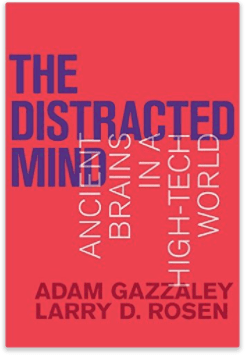
In their book, The Distracted Mind: Ancient Brains in a High-Tech World, Dr. Adam Gazzaley, a neuroscientist, and Dr. Larry Rosen, a psychologist, explain how our ability to pay attention works and what we can do to stay focused.
It turns out, attention isn’t as simple as it seems. In fact, paying attention involves two separate functions: “enhancement” (our ability to focus on things that matter) and “suppression” (our ability to ignore the things that don’t). Interestingly, enhancement and suppression are not opposites, they are distinct processes in the brain.
From The Distracted Mind: Ancient Brains in a High-Tech World:
“Although it may seem counterintuitive, we now appreciate that focusing and ignoring are not two sides of the same coin […] it is not necessarily true that when you focus more on something, you automatically ignore everything else better. We have shown in our lab that different [brain] networks are engaged when we focus compared to when we ignore the same thing.”
These processes are so separate, in fact, there are different networks of brain structures that carry out their respective functions, each of which is critical for attention.
If either of these brain processes is impaired, we lose focus. For example: we struggle with attention when we are tired, drunk, and, most notably, as we age.
Older adults are biologically more distractible than young adults. Personal anecdotes and scientific evidence demonstrate that our attentional capacity peaks near age twenty and diminishes over time. Gazzaley discovered that age-related declines are caused by a deficit in the suppression (ignoring) process.
From The Distracted Mind: Ancient Brains in a High-Tech World:
“Our main finding in this study was that, interestingly, older adults [focus on] relevant information as well as twenty-year-olds. Where older adults suffered a deficit was in suppressing the irrelevant information … We discovered that their main attentional issue was that they are more distractible than younger adults.”
The attentional decline we experience as we age has more to do with our inability to filter out distractions, not our lack of concentration. If you think it’s hard to pay attention now, just wait until you age a few more years.
To improve our ability to pay attention, we need to both remove distraction (especially as we age) as well as boost our capability to focus on one task at a time. Here’s how…
How to Eliminate Distraction
Have you ever noticed someone squinting their eyes in an attempt to recall something? Turns out closing your eyes to remember may actually work. Why this quirky technique is effective tells us something important about how the brain filters information. When your eyes are closed, your brain isn’t working as hard to filter out visual information. Instead of struggling to ignore everything in your field of view, your brain can devote more attention towards scanning your memory. Gazzaley conducted an experiment to see what type of visual information is the most distracting. He and his team asked volunteers to remember details while looking at one of three visual scenes: a plain grey screen, a busy picture, or with their eyes closed. From The Distracted Mind: Ancient Brains in a High-Tech World:
“The results of this experiment revealed that their ability to remember details [ …] was significantly diminished when their eyes were open and there was a picture in front of them, compared to either their eyes being shut, or their eyes being open while they faced a grey screen”
This experiment, along with others, provides evidence that cluttered and disorganized environments are more distracting than organized ones. Spaces filled with visual distractions force our brains to work harder to filter out superfluous information. When facing a pending deadline that you desperately need to focus on, clearing your desk and workspace to make it like the grey screen can increase your focus. Try clearing your virtual desktop of clutter as well. Limit yourself to one monitor, one browser tab or window and one computer program or app at a time. For more on “How to Clear Your Computer of Focus-Draining Distraction” click here. Removing distraction is important to maintain our focus as we age, but we also need to boost our capability to concentrate on one task at a time. Here’s how..
How to Boost Focus
Gazzaley and Rosen say some activities may boost cognition and attention by stimulating the brain’s ability to strengthen and reorganize existing neural connections, a process called neuroplasticity.
Activities that may boost cognition include physical exercise, meditation and spending time in nature. Recent research also finds that some cognitive exercises may also help. Although there are many brain training programs, some of which have over-promised and under-delivered, some scientists believe a new crop of clinically validated programs may soon come online.
From The Distracted Mind: Ancient Brains in a High-Tech World:
“Cognitive exercises are an attempt to improve brain function by harnessing our brain’s inherent plasticity, rather than by explicitly teaching a strategy or a skill. Most training programs attempt to accomplish this goal not just through repetitive task engagement, but also through adaptivity.”
For Gazzaley and Rosen, adaptivity is key. Just as athletes must adjust their exercise routines as they grow stronger; cognitive exercise programs must also adjust to how well, or how poorly, the participant is doing in the task. Personalized adjustments make the training more successful.
New research shows the of cognitive exercise programs in older adults and healthy populations. Gazzaley and Rosen caution that while the research is encouraging, more clinical trials are needed to prove medical benefits. However, many in the industry are hopeful doctors will one day prescribe game-like cognitive exercises as part of a healthy brain training regimen.
In the meantime, certain currently available video game titles may actually be good for brain health and improve cognition.
From The Distracted Mind: Ancient Brains in a High-Tech World:
“They are designed with a primary goal of engendering high levels of immersion, engagement, and enjoyment for the players, […] They do not tend to focus on one specific cognitive skill, as exercises usually do, but rather expose players to multiple demands that challenge a broad range of abilities. ”
A 2003 study of video-game play linked better cognition and higher scores on attention and memory tests in gamers vs non-gamers. But not all video games are created equal.
Non-gamers who played the first person shooter game, Medal of Honor, one hour per day for 10 days showed improvements in cognition, while the ones who played Tetris did not.
From The Distracted Mind: Ancient Brains in a High-Tech World:
“[The researchers’] conclusion was that the nature of action video game play was critical in ‘forcing players to simultaneously juggle a number of varied tasks (detect new enemies, track existing enemies and avoid getting hurt, among others)…”
Video games may give you a boost, but not every off-the-shelf game will do the trick. The difference between the games that work and the ones that don’t gives us information into how the brain changes in response to its environment.
Video games good for building focus create environments that are fast-paced, interactive, adaptive and have complex reward and gaming structures. Like a brain playground.
In 2013, Gazzaley verified that a custom-designed cognitive video game, NeuroRacer, improves cognition in older adults. Dr. Gazzaley’s research led to a proprietary technology platform to measure and improve certain executive functions.
In the future, cognitive video games will be like “Neuro Cross Fit Training” as Gazzaley calls it. They will combine elements of physical activity, meditation, and cognitive exercise, rolled into one game.
In the meantime, we can do our part to keep our attentional focus sharp by first reducing distractions to improve our suppression capabilities, and then beefing-up the brain’s enhancement functions through activities like exercise, meditation, outdoor time, and immersive video games. We can boost our ability to concentrate by doing just one thing well at a time.
Filed under 2020, writing tip, Writing Tip Wednesday
There once was a writer from Maine
Whom everybody thought was insane.
He wrote big books on evil
and owned pet boll weevil.
No one could cotton to him or complain.
New technology is helping archaeologists uncover details of the playwright’s home, workplaces and his final resting place.

William Shakespeare is widely regarded as one of the greatest authors of all time and one of the most important and influential people who has ever lived. His written works (plays, sonnets and poems) have been translated into more than 100 languages and these are performed around the world.
There is also an enduring desire to learn more about the man himself. Countless books and articles have been written about Shakespeare’s life. These have been based primarily on the scholarly analysis of his works and the official record associated with him and his family. Shakespeare’s popularity and legacy endures, despite uncertainties in his life story and debate surrounding his authorship and identity.
The life and times of William Shakespeare and his family have also recently been informed by cutting-edge archaeological methods and interdisciplinary technologies at both New Place (his long-since demolished family home) and his burial place at Holy Trinity Church, Stratford-upon-Avon. The evidence gathered from these investigations by the Centre of Archaeology at Staffordshire University provides new insights into his interests, attitudes and motivations – and those of his family – and shows how archaeology can provide further tangible evidence. These complement traditional Shakespearean research methods that have been limited to sparse documentary evidence and the study of his works.
Archaeology has the ability to provide a direct connection to an individual through the places and objects associated with them. Past excavations of the Shakespearean-era theatres in London have provided evidence of the places he worked and spent much of his time.
Attributing objects to Shakespeare is difficult, we have his written work of course, his portrait(s) and memorial bust – but all of his known possessions, like those mentioned in his will, no longer exist. A single gold signet ring, inscribed with the initials W S, is thought by some to be the most significant object owned and used by the poet, despite its questionable provenance.
Shakespeare’s greatest and most expensive possession was his house, New Place. Evidence, obtained through recent archaeological investigations of its foundations, give us quantifiable insights into Shakespeare’s thought processes, personal life and business success.
The building itself was lost in the 18th century, but the site and its remains were preserved beneath a garden. Erected in the centre of Stratford-upon-Avon more than a century prior to Shakespeare’s purchase in 1597, from its inception, it was architecturally striking. One of the largest domestic residences in Stratford, it was the only courtyard-style, open-hall house within the town.
This type of house typified the merchant and elite classes and in purchasing and renovating it to his own vision, Shakespeare inherited the traditions of his ancestors while embracing the latest fashions. The building materials used, its primary structure and later redevelopment can all be used as evidence of the deliberate and carefully considered choices made by him and his family.
Shakespeare focused on the outward appearance of the house, installing a long gallery and other fashionable architectural embellishments as was expected of a well-to-do, aspiring gentleman of the time. Many other medieval features were retained and the hall was likely retained as the showpiece of his home, a place to announce his prosperity, and his rise in status.
It provided a place for him and his immediate and extended family to live, work and entertain. But it was also a place which held local significance and symbolic associations. Intriguingly, its appearance also resembled the courtyard inn theatres of London and elsewhere with which Shakespeare was so familiar, presenting the opportunity to host private performances.
Extensive evidence of the personal possessions, diet and the leisure activities of Shakespeare, his family and the inhabitants of New Place were recovered during the archaeological investigations, revolutionising what we understand about his day-to-day life.
An online exhibition, due to be made available in early May 2020, presents 3D-scanned artefacts recovered at the site of New Place. These objects, some of which may have belonged to Shakespeare, have been chosen to characterise the chronological development and activities undertaken at the site.
Open access to these virtual objects will enable the dissemination of these important results and the potential for others to continue the research.
Archaeological evidence recovered from non-invasive investigations at Shakespeare’s burial place has also been used to provide further evidence of his personal and family belief. Multi-frequency Ground Penetrating Radar (GPR) was used to investigate the Shakespeare family graves below the chancel of Holy Trinity Church.
A number of legends surrounded Shakespeare’s burial place. Among these were doubts over the presence of a grave, its contents, tales of grave robbing and suggestions of a large family crypt. The work confirmed that individual shallow graves exist beneath the tombstones and that the various members of Shakespeare’s family were not buried in coffins, but in simple shrouds. Analysis concluded that Shakespeare’s grave had been disturbed in the past and that it was likely that his skull had been removed, confirming recorded stories.
These family graves occupy a significant (and expensive) location in Holy Trinity Church. Despite this, the simple nature of Shakespeare’s grave, with no elite trappings or finery and no large family crypt, coupled with his belief that he should not be disturbed, confirm a simple regional practice based on pious religious observance and an affinity with his hometown.
There is still so much we don’t know about Shakespeare’s life, so it’s a safe bet that researchers will continue to investigate what evidence there is. Archaeological techniques can provide quantifiable information that isn’t available through traditional Shakespearean research. But just like other disciplines, interpretation – based on the evidence – will be key to unlocking the mysteries surrounding the life (and death) of the English language’s greatest writer.
William Mitchell is a Lecturer in Archaeology at Staffordshire University.
Filed under 2020, author, author profile
Your book club probably already read Where the Crawdads Sing. How much did a long-ago murder in Africa influence Delia Owens’ first novel?

Where the Crawdads Singby Delia Owens is the sort of book that you’ve either never heard of or have already read for your book club. The bestselling hardcover title of 2019, Crawdads has sold more than 1 million copies—jaw-dropping for any first novel, much less one by an author who just turned 70, living on a remote homestead in northern Idaho. Publishers Weekly has called its success the “feel-good publishing story of the year.” (Spoilers for the novel follow throughout this piece.) If you’re one of the people who’ve read the book, you probably know a little of Owens’ romantic backstory, like the huge boost her debut got when Reese Witherspoon, the Oprah of our time, selected it for her book club. Or the fact that while Crawdads is Owens’ first novel, it’s not her first book. And then there’s the 22 years she spent in Africa with her husband, Mark, living close to the land and working in wildlife conservation. Delia and Mark wrote about those experiences in three memoirs. But what most of Crawdads’ fans don’t know is that Delia and Mark Owens have been advised never to return to one of the African nations where they once lived and worked, Zambia, because they are wanted for questioning in a murder that took place there decades ago. That murder, whose victim remains unidentified, was filmed and broadcast on national television in the U.S.
To be clear, Delia Owens herself is not suspected of involvement in the murder of a poacher filmed by an ABC camera crew in 1995, while the news program Turning Point was producing a segment on the Owenses’ conservation work in Zambia. But her stepson, Christopher, and her husband have been implicated by some witnesses. This murky incident from Delia’s past is hardly a secret. In fact, in 2010 it was the subject of “The Hunted,” an 18,000-word story written by Jeffrey Goldberg and published in the New Yorker. You can find a link to that story, along with a one-line reference to a “controversial killing of a poacher in Zambia,” in Owens’ Wikipedia entry. However, the Wikipedia entry for Owens comes as only the fourth result when you Google her name, and a lazy or unseasoned internet user might stop reading after browsing the official bios that outrank it. Apparently many such users are members of the press. In numerous interviews, Owens giggles about how her publishers “keep sending me champagne” or recounts how she was inspired by her observations of animals that “live in very strong female social groups.” (No such group appears in Where the Crawdads Sing.) But when it comes to the remarkable fact that, in the company of a charismatic but volcanic man, she apparently lived through a modern-day version of Heart of Darkness? Not a peep.
Goldberg—who spent months researching “The Hunted,” traveling to South Africa, Idaho, and Maine in addition to making three trips to the Luangwa area in Zambia, and interviewing over 100 sources—is bemused by how effectively Owens and her publisher have managed to overshadow perhaps the most fascinating, if troubling, episode in her life. “A number of people started emailing me about this book,” he told me in an email, “readers who made the connection between the Delia Owens of Crawdads and the Delia Owens of the New Yorker investigation. So I got a copy of Crawdads and I have to say I found it strange and uncomfortable to be reading the story of a Southern loner, a noble naturalist, who gets away with what is described as a righteously motivated murder in the remote wild.”
Several sources Goldberg spoke with, including the cameraman who filmed the shooting of the poacher, have stated that Christopher Owens—Mark Owens’ son and Delia Owens’ stepson—was the first member of a scouting party to shoot the man. (Two other scouts followed suit.) Others have claimed that Mark Owens covered up the killing by carrying the body, which was never recovered, up in his helicopter and dropping it in a lake. Whoever pulled the trigger that day, what seems indisputable from “The Hunted” is that, over the course of years, Mark Owens, in his zeal to save endangered elephants and other wildlife, became carried away by his own power, turning into a modern-day version of Joseph Conrad’s Mr. Kurtz—and that while Delia Owens objected, at times, to what was happening, she was either unable or unwilling to stop him or quit him. And despite being set in a different place and time, her bestselling novel contains striking echoes of those volatile years in the wilderness.
Mark and Delia Owens first arrived in Zambia in 1986 after getting kicked out of Botswana, where they had made themselves unwelcome by criticizing the government’s conservation policies. The young couple sought out a preserve in Zambia’s North Luangwa wilderness, an area whose indigenous inhabitants had been expelled by the nation’s former British rulers. They were drawn to the region’s isolation and then dismayed to discover that poachers were devastating the local elephant population. Some of the animals were killed by people who had lived in the surrounding area for generations and whose ancestors had long hunted its large mammals for meat, but the greatest threat came from poachers feeding a booming international ivory market.
These well-armed poachers overmatched the ragtag band of park service scouts charged with protecting the elephants. The Owenses raised money from European and American donors to better pay and equip the scouts; in exchange, they were named “honorary game rangers” by the Zambian government. According to many sources Goldberg spoke with in Zambia, Mark Owens became the de facto commander of the scouts, harrying poaching parties with firecrackers shot from a Cessna and later, from a helicopter, menacing them with a machine gun. Under his command, scouts raided villages and roughed up residents in search of suspects and poached loot. In one (highly contested) letter, Mark Owens informed a safari leader that his scouts had killed two poachers and “are just getting warmed up.” (Mark and Delia Owens deny most of these claims, alleging various conspiracies against them by those who resented their success and fame or who had a corrupt financial interest in the poaching trade.) “They thought they were kings,” the recipient of this letter said of the Owenses. “He made himself the law, and his law was that he could do anything he wanted.”
Delia Owens sometimes objected to the risks her husband took in combating the poachers, and in their co-authored 1992 memoir, The Eye of the Elephant, she describes at one point separating from him and building her own camp four miles away. Eventually, the couple reconciled. After the ABC story aired and Zambian authorities became alarmed at the idea of a foreign national overseeing a shoot-to-kill policy in one of their preserves, the Owenses traveled to the U.S. for a visit and never returned. According to Goldberg, “The American Embassy warned the Owenses not to enter Zambia until the controversy was resolved,” but as of 2010, the case was still open. “There’s no statute of limitations on murder,” an investigator told Goldberg. Mark Owens confirmed to me through his attorney that there have been no further developments in the case and noted that no charges were ever filed. His attorney also confirmed that the pair never returned to Zambia. I was unable to reach Christopher Owens.
The Owenses then moved to a remote area of land in Boundary County, Idaho. The couple “eventually divorced but remain friendly and live on the same acreage,” according to an edit to Delia Owens’ Wikipedia entry made on June 10 of this year. (In the acknowledgements at the end of Where the Crawdads Sing, Delia thanks Mark Owens for being one of the novel’s early readers.) A Wikipedia editor later deleted the passage, noting to the person who had altered Delia Owens’ entry and nothing else on the entire site, “Sorry if you have personal knowledge but articles must be based on verifiable sources.” In an interview with Amazon, Delia describes Mark as her “former husband,” and posts to her Instagram account suggest that she recently moved to North Carolina.
On first impression Where the Crawdads Sing, with its mid–20th-century Southern setting, suggests that Delia Owens has gotten over the traumas of her African years and the losses brought on by the exposure of her husband’s behavior in Zambia. Her novel is the story of a white girl who essentially raises herself in the swamps of North Carolina in the 1950s and early 1960s. Abandoned by her family and mocked by her classmates during the single day she agrees to attend public school, Kya Clark prefers to commune alone with nature, collecting specimens and producing exquisite drawings of the swamp’s flora and fauna. (Eventually, these are published in a series of successful books.) Kya’s story alternates with chapters set in 1969, in which Chase Andrews, a womanizing former quarterback, is found dead under an abandoned fire tower and police investigate the death as a possible murder.* Kya, stigmatized as “the Marsh Girl” by the townsfolk, is charged with the crime, and the last quarter of the novel depicts her trial.
“Almost every part of the book has some deeper meaning,” Owens said in her interview with Amazon. “There’s a lot of symbolism in this book.” To anyone who has read “The Hunted,” those lines are tantalizing, even if Owens doesn’t mean them to be. Having her heroine stand accused of murder echoes the Owens’ Zambian experience and the subsequent ordeal of becoming the subject of a 18,000-word exposé in a prominent magazine. Even more eyebrow-raising is the plot twist in the novel’s final pages: It turns out Kya did, after all, murder Chase.
Kya’s similarities to Delia Owens, who grew up in Georgia, are manifest. Both are lonely, yet prefer the company of animals to people; the Owenses’ memoirs recount one long search for life outside the human fold. “Here’s where civilization ends,” Mark once said admiringly of North Luangwa, Goldberg reports. Kya is depicted as a misunderstood victim, cast out of society by the small-minded prejudices of her neighbors. In his closing statements, her defense attorney exhorts the jury and the town itself to examine its conscience: “We labeled and rejected her because we thought she was different. But, ladies and gentlemen, did we exclude Miss Clark because she was different, or was she different because we excluded her?”
In every respect, Kya is wronged by those around her. Her father abuses the rest of the family, forcing her mother and siblings to leave. Her first love, a fellow marsh habitué who sweetly teaches her to read and write, does not return for her as promised once he leaves for college. White-gloved mothers pull their children away from her on the streets, calling her “dirty.” Chase seduces her with talk of marriage and children, but instead chooses a more socially acceptable bride. Later, he tries to rape her.
In the absence of any better models, Kya looks to the animals around her and reads scientific articles for insights into human behavior:
Some behaviors that seem harsh to us now ensured the survival of early man in whatever swamp he was in at the time. Without them, we wouldn’t be here. We still store those instincts in our genes, and they express themselves when certain circumstances prevail. Some parts of us will always be what we were, what we had to be to survive—way back yonder.
Apart from the novel’s final and highly implausible twist, Kya is depicted as a lovely, gentle, naϊve child of nature, devoid of any negative traits besides an unwillingness to give her first love, Tate, a second chance once he finally realizes that he can’t live without her. When Tate comes to visit Kya in her marsh cabin to plead his case, she appears as an angelic vision, “in a long, white skirt and pale blue sweater—the colors of wings.” Yet despite exhibiting no aggressive, atavistic impulses herself, Kya more than once contemplates the truth that “ancient genes for survival still persist in some undesirable forms among the twists and turns of man’s genetic code.” This idea—that, in extremis, a primitive drive for “survival” will trigger “harsh” and “undesirable” actions—resembles a moment in the ABC segment on the Owenses, in which Meredith Vieira (then a reporter for the program) describes the shooting of the poacher as the result of what “Mark Owens calls a ‘hardening of the human spirit,’ the ultimate price he has paid to work here.” Owens himself then remarks, “It’s a very dirty game. It’s a measure of the desperation of the situation, I think.”
Owens’ Kya is an impossible personality built on a moral conundrum: Her virtue arises from her purity—that is, her remove from the contaminating influences of “civilization,” with its false values, cruelty, and lies. Nature and animals, by contrast, are the locus of truth and spiritual sustenance. Nature also acknowledges Kya as its chosen daughter. When she is in custody during her trial, the jailhouse cat recognizes her quality and visits her cell at night. But “nature,” it seems, is also the excuse for Kya’s crime, which is a major one, a measure of the desperation of her situation, so to speak. And after all, isn’t Chase, like that nameless poacher, a bad man, who got his just deserts even if his killing technically violates the law of the land? Although Kya is in fact guilty, the book frames her trial as unfair, the targeting of a mistreated outsider by a community incapable of justice. And yet, she is acquitted, getting away with her crime.
Fiction writers often don’t realize how much of their own unconscious bubbles up in their work, but at times Owens seems to be deliberately calling back to her Zambian years. The jailhouse cat in Where the Crawdads Sing has the same name—Sunday Justice—as an African man who once worked for the Owenses as a cook. In The Eye of the Elephant, Delia describes Justice speaking with a childlike wonder about the Owenses’ airplane. “I myself always wanted to talk to someone who has flown up in the sky with a plane,” he said, according to Delia. “I myself always wanted to know, Madam, if you fly at night, do you go close to the stars?” When Goldberg tracked down Justice and asked him about this story, the man laughed. He had flown on planes many times as both an adult and a child before meeting Delia Owens. He later worked for the Zambian Air Force.
Thanks for signing up! You can manage your newsletter subscriptions at any time.
This example of what Goldberg tactfully calls the Owenses’ “archaic ideas about Africans” has its parallel in Where the Crawdads Sing, too. A black character, a kindly man called Jumpin’ who runs a gas station and general store for swamp boat operators, is among the very few people in the community to befriend Kya. She encounters Jumpin’ a few days after being sexually assaulted by Chase, her face still visibly bruised. “Was it Mr. Chase done this to ya?” he asks. “Ya know ya can tell me. In fact, we gwine stand right here tills ya tell me.” When Kya begs Jumpin’ not to report the assault to the sheriff, he protests that “sump’m gotta be done. He cain’t go an’ do a thing like that, and then just go on boatin’ ’round in that fancy boat a’ his.”
Even setting aside the Gone with the Wind–style dialect here (Owens is 70, after all), the scene betrays a profound racial and historical ignorance. The idea that any black man living in the rural South during the early ’60s would seriously considerreporting to local law enforcement the attempted rape of a white woman by the son of a prominent white family is ludicrous. He would have had ample knowledge of men like Chase getting away with even worse. One of the Owenses’ critics in Goldberg’s article touched on this obliviousness when he characterized the couple’s attitude toward Africa as “Nice continent. Pity about the Africans.”
Press coverage of Delia Owens since the runaway success of Where the Crawdads Sing has focused on her tomboy girlhood, her passion for helping African wildlife, and the pristine isolation of her Idaho home, portraying her as nearly as unspoiled as her heroine. But Owens’ past is far more dark and troubling than that—and also a much more interesting story than Crawdads’ tale of a persecuted, saintly misfit finding solace and transcendence in nature. Owens’ own story appears to be one of love and righteousness run amok, of the seductive properties of power and violence, of what it feels like to watch your husband become someone your neighbors have cause to fear. The Owenses have spent much of their lives trying to get as far away from humanity as they can, but theirs is an impossible quest: Like all of us, they bring humanity and its failings with them wherever they go.
Laura Miller is a books and culture columnist for Slate and the author of The Magician’s Book: A Skeptic’s Adventures in Narnia
Summer’s verdant leaves /
Whisper to the shaggy grass: /
Birds love us the best.
Filed under 2020, Haiku to You Thursday, Poetry by David E. Booker
There once was a writer named Stone
Who tried writing on his smart phone.
It started off fine
But then he got behind:
All the apps wouldn’t leave him alone.




 Booker's Blog