Category Archives: writing

Writing Tip: Drama is conflict

My writing is distinctly middle brow. Just ask anybody who has suffered through it. Still, I like to think that even in my middling way, I can offer some helpful advice when I stumble across it. Therefore, from time to time, I will post some writing advice, but not from me. The advice will come from established sources. I will endeavor not to make it overlong or overreaching, and sometimes it will simply be reminders of what we all probably already know, but it will be some tips I have picked up from reading, from attending writing conferences, or it may even come from you.

Writing with paperclips in ears and nose

Darma is conflict, sometimes even self-inflicted

The first bit of advice comes from a writing course the Knoxville Writers’ Guild sponsored way back in 1993. The teacher was Joseph Gunnels and the cost was $75. It was two-day event, May 15 and 16, and we spent part of a pleasant afternoon sitting on the grass outside the Candy Factory, on The 1982 World’s Fair site. I took over 30 pages of notes, but rather than bore you with details, here is the essence of what I took away from the seminar:

Drama is conflict;
Without conflict no action;
Without action no character;
Without character no story;
Without story, who cares?

In a future entry, I’ll give you a short, crisp definition for conflict that I learned at a more recent one-day writing seminar. It comes from a very highly regarded script doctor in Hollywood, but applies just as well to other forms of fiction writing. Stay turned.

Leave a comment

Filed under advice, building a better story, character, conflict, drama, story, tension, words, writing, writing conference, writing tip

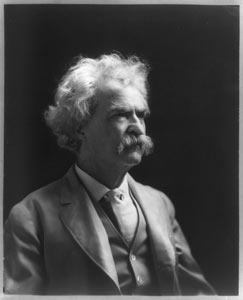
Mark Twain quote on writing

Mark Twain photo

photo of Mark Twain

“The time to begin writing an article is when you have finished it to your satisfaction. By that time you begin to clearly and logically perceive what it is you really want to say.” —Mark Twain

And somehow, if you don’t know who Mark Twain is, here’s where you can get a clue: Mark Twain.

Leave a comment

Filed under advice, humor, Mark Twain, quote, Quote of the day, words, writer, writing, writing tip

Sign of times: Quality Used Furniture

While the photo is not the clearest it could be, in its own way it may match the hand-painted sign that reads “Quality Used Furniture,” and underneath it are sections of firewood. Could the sign be referring to the birds that once nested in the tree’s branches? To the squirrels, rodents though they may be, that once frolicked about from sturdy limb to sturdy limb as they ventured forth from their squirrel nest? Or is this type of furniture what is meant by rustic or roughing it? Possibly this is a Platonic set of furniture. Furniture glimpsed obliquely and incompletely in its state of perfection.

What do you think it is? Make up your own caption and send it my way. I may list the most interesting ones.

Quality Used Furniture

The sign read: Quality Used Furniture

1 Comment

Filed under bird, Commentary, furniture, humor, nature, Plato, sign of the times, tree, Uncategorized, word play, words, writing

Writing quote for the day

There’s nothing to writing. All you do is sit down at a typewriter and open a vein. –Walter Wellesley “Red” Smith

Leave a comment

Filed under quote, words, writer, writing

The Blathering Idiot and Discovery

The blathering idiot went to work for an advanced scientific and technology firm. One day, when he passes the door of a leading scientist of the firm, he found a note tacked to the door.

Upon further examination, he saw it was not a note, but a memo, on official company letterhead, from the legal firm that this company used when discussing patent and invention issue.

In short, the memo said: All discoveries must be registered with this firm before they are discovered. All inventions must be registered with this firm before they are invented. No patents will be issued unless the proper form has been filled out in triplicate and registered with this firm. We must be notified at least six months in advance of any discoveries, inventions, ideas, or potentially patentable issues. Those who fail to follow this memo will be properly punished.

The Blathering Idiot and Discovery

After all, he needed the work.

The blathering idiot then had an idea. He wondered if his idea was a patentable issue he had to register with the firm. But since he already had the idea, it was too late to file it without being violation of the memo. Therefore, he decided from that day forward that he would see no ideas, hear no ideas, and speak no ideas. After all, he needed the work.

Leave a comment

Filed under absurdity, blathering idiot, Cartoon, Commentary, discovery, humor, idea, satire, words, writing

The Blathering Idiot and the Bowl Museum

The blathering idiot was helping Xenia get her breakfast. Xenia was his on again, off again, on again girlfriend’s six-year-old daughter. Why Xenia’s name didn’t begin with a “Z,” like her mother’s – Zelda – the blathering idiot didn’t understand, but he didn’t and it was a school day, so it was a question for another time.

While helping her with breakfast, the blathering idiot thought he would impress Xenia. He found a one-serving box of her favorite cereal, and the box had perforations on one side of the outside that formed an “I.” When he opened the box using the perforations, it instantly turned the box into a bowl.

Dinosaur on the way to the Bowl Museum

Dinosaur on the way to the Bowl Museum

As he poured milk into the disposable bowl, the blathering idiot talked about how when he was a kid, his parents always had these when the family went on long trips, including one to see dinosaurs in a museum.

Xenia looked at the box with the flaps folded back and the cereal floating in milk. Then she looked up at the blathering idiot. “So, this was what you used before they invented bowls?”

The blathering idiot was dumbfounded.

Xenia had a piece of toast for breakfast.

Later that morning, when the blathering idiot was walking Xenia to school, he told her stories about his walking to school, and he often had to do it all by himself and how it was a long walk full of wild animals and dark places and not nearly as easy as it is today.

Xenia nodded, and as they stood outside the front door of the school, she looked up at the blathering idiot and asked, “Did you see many dinosaurs back then?”

Leave a comment

Filed under absurdity, blathering idiot, Cartoon, humor, satire, word play, words, writing

Writing quote for the day

“One of the greatest pleasures in writing has come from the thought that perhaps my work might annoy someone of comfortably pretentious position. Then comes the saddening realization that such people rarely read.” —John Kenneth Galbraith

Click on John Kenneth Galbraith to learn a little more about him.

Leave a comment

Filed under John Kenneth Galbraith, quote, Quote of the day, Random Access Thoughts, writer, writing

A thought on the computer

“Buying the right computer and getting it to work properly is no more complicated than building a nuclear reactor from wristwatch parts in a darkened room using only your teeth.” —Dave Barry

To learn more about Dave Barry, American writer and humorist, go to Dave Berry’s Official Website

Computers can be a pain to get to work right

Buying the right computer is often a challenge.

.

Leave a comment

Filed under absurdity, computer, Dave Barry, humor, quote, writer, writing

Four Clues to Writing a Mystery

[This is taken from an e-newsletter sent out by the writer Bruce Hale. You can find more information at Bruce Hale Writing Tips.]

When I wrote my first mystery, I had no idea how to do it. I
actually had characters tell my detective riddles that would lead
him to the next thing he needed to discover. To be honest, I had
no clue how to construct a clue.

But after you write a few of these things, you start to see how the
mystery is made. Herewith, four helpful hints on writing a mystery:

1. Play fair with the reader
Mystery readers hope that you’ll surprise them, but that surprise
must be a fair one. You can’t tease readers with three suspects
throughout your story, and then suddenly reveal that a character
they’ve never met is responsible. That’s not playing fair.

A Typewriter

Don't forget the unwritten rule: write!

Many mystery readers try to figure things out as they go along. To
play fair with these people, you need to plant a clue or two that
points toward your real culprit. Make it subtle, a throwaway line
perhaps, but make sure it’s there.

2. Keep your reader’s age in mind
Obviously, the mystery in a Cam Jansen chapter book is going to be
just a tad simpler than that in a Raymond Chandler tale. You want
to keep your reader guessing, but you don’t want things to be so
convoluted that he or she gets completely lost — especially in a
children’s book.

Your story should be just a little trickier than readers think they
can handle. If you have any doubts, ask a reader in your target
age range to take a look at the story. If your story leaves her
completely clueless, it’s time to simplify.

3. Merrily misdirect
One of the keys to successful mystery writing is misdirection.
Your readers should suspect every possible culprit but the real
one.

How do you do this? Make your clues point strongly toward one
character, then show that he’s innocent. Make your suspects take
actions that can have two interpretations, and let the reader and
detective erroneously assume the worst.

4. Write from the ending
Most mystery writers I talk with say that they figure out the
ending first — what’s the crime, who’s the culprit, why’d they do
it? — before plotting the rest of the book. Once you’ve got that
sorted out, it’s a matter of concealing it.

You’ll want your detective to take a circuitous route, often
running into brick walls. You’ll want her to think she’s got it
all solved, only to have the rug pulled out from under her.

Mysteries are all about the progressive unraveling of the unknown.
But it’s the *way* you unravel it — using misdirection, considering
your reader, and playing fair — that makes for a satisfying read.

Leave a comment

Filed under mystery, mystery writing, words, writer, writing, writing tip

Writing Quote for the Day

“Don’t get it right, just get it written.” —James Thurber

And if you don’t know who James Thurber is, I suggest starting here: The Thurber House.

Leave a comment

Filed under advice, humor, James Thurber, words, writer, writing, writing tip