
Writer’s Block, n.: The place where a writer lives with his/her imaginary friends. Something like the neighborhood of make believe.
Category Archives: writing
Best writing advice you’ve received?
Below is some writing advice gathered by Chip MacGregor of MacGregor Literary. The listing below is from his blog. Website for the agency is http://macgregorliterary.com/.
http://chipmacgregor.typepad.com/main/2011/12/whats-the-best-writing-advice-you-ever-got-.html
December 30, 2011
What’s the best writing advice you ever got?
I’ve had several people write to share the best writing advice they’ve ever received.
Vince Zandri, who has done numerous novels and sold more than a quarter million books, wrote to me and said, “The best writing advice I ever got came from Ernest Hemingway in the form of his memoir, A Moveable Feast. If writers are worried about one thing, it’s the ability to keep a story moving from day to day. To avoid the ‘block,’ as some people call it. Papa wrote slowly and methodically in the early morning hours, and trained himself to stop at a point where he knew what was going to happen next. That way he could be sure of getting started the next day — and it left him the afternoons to play, exercise, fish, drink, or do whatever he wanted.”
Successful nonfiction writer Mel Lawrenz wrote to say, “The best advice? Take the long view. See the long process of publishing as an advantage — the stages of writing, editing, rewriting, and revising make for a more refined end product. Don’t miss the opportunity to rethink what you originally wrote.”
Harlequin author Dana Mentink sent this: “The best writing advice I got as a pre-pubbed author was that I should act like a professional. My mentor encouraged me to treat my writing like a business, not a hobby. Put in the hours, describe yourself to others as a writer, and really put yourself into the mindset of a professional. She explained to me that there’s a big difference between ‘I want to write a book’ and ‘I want to be an author.’ The latter requires professional dedication.”
Children’s author Kayleen Reusser noted, “Believe in yourself, even if no one else does. At my beginning I was the only one who believed I could write and get published. Even my mother told me I could not write — no money, no time, three small children to care for. But I swore I would die trying. (Thank goodness it has not come to that.)”
And novelist Dianne Price wrote to say, “Know your characters. LIve with them. Talk to them. Listen to their words and the cadence of their speech. Make them your constant companions. Argue with them. Commiserate with them. Ask them questions. You must know them to make them believable.”
What about you? What’s the best writing advice you’ve ever heard?
Filed under advice, agents, writing, writing tip
Literary resolutions
I pass these along, found on line in an article at the LA Times web site. I don’t generally make resolutions. In fact, the last resolution I made was to not make any resolutions, and thus far I have managed to keep that one. But for those who do, you might find some inspiration here.

Counting down the minutes to a new year of resolutions
Pen up.
Keyboards clacking.
Steady as she goes.
Happy New Year.
http://latimesblogs.latimes.com/jacketcopy/2011/12/25-literary-resolutions-for-2012.html
When 2012 arrives this weekend, there will be resolutions aplenty. Diets! Exercise! Get organized! Figure out Google+! Quit smoking! Jacket Copy asked
writers, editors and publishers what their literary resolutions will be. Join them and tell us yours.
Ben Ehrenreich, author of the novel “Ether” and winner of a 2011 National Magazine Award for his article “The End”: That’s an easy one: write, write, write and write some more.
Richard Lange, author of the 2013 novel “Gather Darkness” (Mulholland): I’m going to reread “Moby-Dick,” “Crime & Punishment,” and “The Scarlet Letter.” Every time I go back to books that I loved as a kid, I learn more about myself as a writer now.
Dana Spiotta, author of the novel “Stone Arabia”: I have many books I want to read this year. For example, I have this inviting stack of Hollywood biographies and memoirs: “Rosebud” by David Thomson, “Frank: The Voice” by James Kaplan, “Run-through” by John Houseman, “Memo” by David O. Selznick, “A Girl Like I” by Anita Loos, and “Vanity Will Get You Somewhere: An Autobiography” by Joseph Cotten.
Antoine Wilson, author of the 2012 novel “Panorama City” (Houghton Mifflin Harcourt): For 2012, I expect to be doing more interacting with strangers, thanks to the new book coming out, so my resolution is simple: To be able to clearly and concisely answer the following question: “What are you reading?” Jervey Tervalon, author of “Serving Monster” and founder of Literature for Life: Start working on a new novel that will amuse and consume me; and I will not allow myself, not even for a second, to dwell on the bleakness of the publishing industry.
Elizabeth Crane, author of the 2012 novel “We Only Know So Much” (HarperPerennial): I don’t know if this is exactly literary, but the only real resolution I’m considering, which I haven’t etched in stone yet, is to give up watching entertainment shows (ET, etc). This might or might not help my writing, if only insofar as it will free up an hour of my life every day, but the hope is that it will help my celebrities-and-celebrity-news-makes-me-want-to-pull-my-hair-out problem.
Rachel Kushner, author “Telex from Cuba,” a National Book Award finalist: This year I am inspired by my friend Marisa Silver’s resolution from last year, which was no internet (except e-mail and occasionally facebook). My resolution is exactly that. Perhaps that’s bookish, in that it might create more time in which actual books can be read. I feel better already, sensing the loss of this convenient form of self-sabotage–of time. Time is of a premium. I don’t want to waste any. I have a feeling I will miss out on very little without the internet. Whatever it is, if it’s important enough it will find me.
Marisa Silver, author of the short story collection “Alone With You”: Read more poetry. Use fewer commas.
Evan Ratliff, founding editor of the multimedia iPad magazine The Atavist: I’m not a big resolution maker, but I would say on the literary front mine is pretty simple and obvious. It’s building on something I started late this year, which is to carve out specific, disconnected, undistracted time to read every day. Sometimes it’s sitting outside with a paperback, having left the phone and all other devices back at the office. Sometimes it’s actually reading a book on the phone (as you might imagine, I’m a big fan of reading books on the phone!), but having turned off all the phone’s connections. It’s like exercise, for me: The whole day gets better if I set aside the time for it. And as much as I love reading digital texts, it’s not the same if I stop three times in the middle to deal with some seemingly-urgent-but-not-really email.
Elissa Schappell, author of the short story collection “Blueprints for Building Better Girls”: It’s the Russians. It’s always the Russians. Oh yes, I’ll read the Russians in the summer months. Two summers ago, I developed such a bad case of Tolstoy’s elbow from hauling around “War and Peace” I could barely flip through a magazine. The summer before “Crime and Punishment” doubled as a drinks tray at a lawn party, and when I got spooked staying alone at a friend’s summer house, I kept it by the door as a weapon. This year, however I’m more hopeful–I’m starting, more appropriately, in winter. Beginning tomorrow I’m going to make “Anna Karenina” my new BFF.
James Hannaham, author of the novel “God Says No”: This year I want to figure out why, when an author says the phrase “working on a story collection,” as in “I’m working on a story collection,” everyone in publishing reacts as if they have instead heard the phrase “molesting several children.” And I will continue to pray for the demise of e-books, or at least the demise of the stupid fear that they will replace printed books.
Ben Greenman, author of the short story collection “What He’s Poised to Do”: I want to reread all the Emily Dickinson poems, in order, at a slow enough rate that I understand them but a fast enough rate to keep it exciting. It’s not as easy at it sounds. And I also plan to think about why, in a time of reduced attention spans, short stories aren’t getting more traction.
Mark Haskell Smith, author of the 2012 nonfiction book “Heart of Dankness: Underground Botanists, Outlaw Farmers, and the Race to the Cannibas Cup” (Broadway): For 2012 I owe my editor a novel, so I’ll be working on that.
Patrick deWitt, author of the novel “The Sisters Brothers,” a 2011 Booker Prize finalist: My resolution is to further distance myself from the internet, and to use the time I would have spent re-re-rewatching that “screwing/puking dogs” GIF reading and writing.
Rob Spillman, editor of the literary magazine Tin House: Since I read contemporary work constantly for work, my resolution is to continue my recent streak of reading great older work that I missed or glossed over in my youth. I’m about to finish “House of Mirth,” which I can’t believe I never read before. Next up is “Moby-Dick,” which I half-read when I was twenty. On the horizon Waugh and more Wharton.
Janelle Brown, author of the novel “This is Where We Live”: Write a rough draft of a new novel. No pressure.
Johnny Temple, publisher of Akashic Books: 2012 marks the 50-year anniversary of the independence of both Jamaica and Trinidad & Tobago (both former British colonies), so my resolution for the coming year is to celebrate Caribbean-inspired independence.
Emma Straub, bookseller and author of the short-story collection “Other People We Married”: I think 2012 is going to be my year for one of the giant masterpieces: Anthony Powell’s “Dance to the Music of Time,” maybe, or Proust. Also, since no one answered my call for help and bought me all the NYRB classics in 2011, that resolution will have to shift onto the coming year.
Laila Lalami, author of the novel “Secret Son”: For the last couple of years, I’ve been working on my new novel and have been reading almost exclusively fiction and nonfiction that’s relevant to it in in some way. In 2012, I’d like to read some new fiction!
Chad Post, editor of Open Letter Books: In 2012, I’m going to read a ton of really long books. I’m going to start with Murakami’s “1Q84,” but also want to read Nadas’ “Parallel Lives,” the new translation of “War and Peace,” the whole Javier Marias “Your Face Tomorrow” trilogy, maybe “Bleak House” in honor of Dickens’ 200th birthday, and Pynchon’s “Against the Day” (the only book of his I have yet to finish). I feel like I’ve been putting off so many of these books for so long, because they’ll “take too long” to read. That’s ridiculous, and in a way, I think this little project will be a nice antidote to my normal state of being all ADD and jumping from one article or novella to the next.
Ned Vizzini, television writer and author of the young adult novel “It’s Kind of a Funny Story”: For 2012 I resolve to read 10 books for no other reason than because I want to — books (1) by people I don’t know (2) that I am not reviewing (3) that do not have any potential for film or TV.
Pamela Ribon, screenwriter and author of the 2012 novel “You Take It From Here” (Gallery Books): In 2012I resolve to get new curtains, because I believe my neighbors (and various passersby on the street) are watching me whenever I’m playing my XBox Kinect workout. The other day I’m pretty sure I saw one of them with a bowl of popcorn.
Tod Goldberg, director of the creative writing MFA program at UC Riverside, Palm Desert, and author of the short-story collection “Where You Lived,” resolved: My only real literary resolution for 2012 is to finish my new novel, which I then hope Salman Rushdie will read, on his Kindle.
Saïd Sayrafiezadeh, author of the memoir “When Skateboards Will Be Free”: Stop looking at so much porn.
Colin Robinson, co-publisher OR Books, which has just published “Occupying Wall Street: The Inside Story of an Action That Changed America”: My resolution for 2012 is for OR Books to develop further direct relationships with those who want to read our titles so as to bypass corporate retailers whose only significant role in the publishing process is taking all the money. Oh, and also to publish some great books.
Filed under 2012, literary, literary resolutions, resolution, writing, writing tip
The price creep of e-books
This is an interesting companion piece to the one on self-publishing that I posted earlier. If interested in writing, this is also a good blog to follow. Tom Dupree has many years experience as an editor, and it would be worth your time to tap into that knowledge.
http://tomdup.wordpress.com/2011/12/15/e-customers-creeped-out-by-price-creep/
E-Customers Creeped Out By Price Creep
By Tom Dupree
There’s a piece on page 1 of today’s Wall Street Journal about e-book sticker shock, another good job by the Journal’s book-beat reporter Jeff Trachtenberg. I’ve been railing about this issue ever since Apple persuaded the six major publishers to disallow any discounting by retailers on e-books. As Mr. Trachtenberg points out, this restriction doesn’t apply to print books, so you have the increasingly common phenomenon of e-editions equaling, and even surpassing, the discounted print edition at retailers like Amazon.com. In at least one instance (emphasis on “at least”), Ken Follett’s doorstop FALL OF GIANTS, the publisher’s e-book price is $18.99 – but the paperback edition can be bought new for $16.50.
Let’s re-emphasize what’s actually going on here. The major players in an industry which faces massive headwinds, book publishing, is deliberately overpricing its most promising and fastest-growing revenue stream, specifically to dampen e-demand and reduce “cannibalization” of “higher-margin” hardcover and trade paperback editions. Mr. Trachtenberg points out that under the “retail model,” by which Amazon was charging $9.99 for new bestsellers, it was the retailer who took the loss; the author and publisher still received roughly half of the full retail price. But under the current “agency model,” the publisher retains 70%, and the retailer gets the rest. No more “loss leaders,” and essentially no more $9.99 bestsellers.
But look closer at the Follett. Dutton’s suggested retail price for this 985-page tome in hardcover is $36. Under the “retail model,” it collected $18 per e-copy, just as it did for a hardcover, and Amazon could give it away if they liked. Of course, that’s no way to run a business: “How do we do it? Volume!” What Amazon was trying to do was to jump-start a nonexistent e-book market and worry about coaxing it into profitability later; they’ve always been forward-thinking in that way. But under the “agency model,” Dutton gets 70% of $18.99, the highest price I’ve encountered for a commercial trade e-book, which is $13.30 per e-copy, and all retailers receive the same $5.70 (I rounded both numbers to the next penny). $13.30 — and remember, this is the absolute Beluga of e-pricing — is $4.70 less than $18. But who’s counting?
My point exactly.
Now let’s consider Apple’s motives. It’s a wonderful company, but it’s no less ruthless just because its antagonizer-in-chief has passed away. When Apple was the “first mover” in digital music, it used the leverage of its huge installed iPod base to oppose the big record labels by dampening the retail price from $15-$16 for a whole CD to 99 cents for an individual song (boy, that price rings a bell. And it’s increased since then, too). But in e-books, Apple found itself, uncharacteristically, in Amazon’s wake (Steve Jobs had infamously sniffed at the Kindle’s launch: “People don’t read any more”). So now what it had to do was eliminate Amazon’s price advantage – and, amazingly, in a reversal of its effect on the music business, it succeeded in propping up the retail price of e-books! Justice is now looking into whether preventing discounting constitutes illegal collusion among the major publishers (as are European authorities), and I don’t know much about the law so can’t speculate, but it does sound fishy, and it protects retailers (guaranteed profit) at the expense of consumers (higher prices).
I have some friends in the book biz who’ve read my previous musings and have some pretty good arguments that nobody seems to be considering. For example, it’s an age-old fact that for big bestselling authors like Mr. Follett, or Stephen King or John Grisham or Danielle Steel or Nora Roberts, publishers pay way too much up front as an “advance,” otherwise known as a “guarantee against royalties.” First, it’s necessary because everybody else is waving huge paychecks around, and you have to be there to compete. Second, a major author can be a tentpole for the rest of your list: if you, Ms. Retailer, want the new Grisham, you’ll have to hear about all the other great stuff we have. Third, there’s the intangible prestige factor, as authors and agents want to be with the house that publishes XXX. But these millions represent a nonrefundable guarantee which has to “earn out” before a book realizes its true potential for perennial profit down the road. (I’ve heard that Mr. King has a deal which plays down the guarantee in favor of a larger participation on the back end, like major movie stars sometimes do.) A surprise hit like THE HELP is very profitable immediately, but big bestsellers from well-known authors always start out deep in the red, and I’d love to know what Kathryn Stockett’s agent has in mind for her next contract.
That means you have to scramble for every penny you can find during the hot new-release period with the ads and the DAILY SHOW spots, very much like movie studios do. My question is: why aren’t the big publishers doing so?
Mr. Trachtenberg quotes a publisher as saying people are realizing the advantages of e-books and are willing to pay a premium for them. I’ve heard that too from some consumers. But $18.99? (P.S.: Book prices never go anywhere but up.) He shares more ominous quotes from others. A reader says it’s hard to justify a $10-$15 e-book when you can pick up a used print copy for $2 or $3 on Amazon. If that was the Ken Follett, the author and publisher made no money on the used-copy resale, when they could have received $18 for a “retail-priced” e-book. Also, the ability to self-publish and shop online is hitting the major publishers from the low end. As an industry consultant says, some e-buyers may opt for “five-star-reviewed” self-published mysteries or romances which are going for $2.99 or $3.99. Plus, if it’s digital it’s stealable, and remember that millions of otherwise law-abiding kids believed downloading from Napster was justifiable because CD prices were too high.
I think it’s fair to say that most e-reading devices have been purchased since “agency pricing” went into effect about two years ago, so possibly it’s only the early adopters like me who recoil against $12.99 and $14.99 books, or e-editions which cost more than paperbacks. Most new e-reader owners may think that’s the going rate you pay for not having to lug the physical book around, being able to read it on damn near every mobile device there is, etc. Yet as a “veteran,” I’d still be willing to wait, even a whole year, so the publishers have time to sell every hardcover they possibly can, if they’d only then give me a fairly-priced e-edition so I could fairly pay the author and publisher instead of ignoring them.
As it is, I have a list of saved backlist books that I’ll never buy in print editions; I just want to read them once. Every month or so I check on them, and every so often a publisher will experiment with a temporary lower price (this is why the publishers will probably survive any accusation of price-fixing; each one is free to charge anything it likes). I will either get the price I want, or the publisher will lose a sale which I would guess is sorely needed. It’s as simple as that.
Filed under e-book, publishers, publishing, Tom Dupree, writing, writing tip
The Devil’s Dictionary: then and now: abasement
Every now and then, it is good to revisit a classic, or even a curiosity from the past. The Devil’s Dictionary by Ambrose Bierce was originally published in newspaper installments from 1881 until 1906. You might be surprised how current many of the entries are.
For example, here is a definition for the word abasement. The first definition is Bierce’s. The second one is mine. From time to time, just as it was originally published, we will come back to The Devil’s Dictionary, for a look at it then and how it applies today.
Abasement, n. A decent and customary mental attitude in the presence of wealth or power. Particularly appropriate in an employee when addressing an employer.
Recent chart showing what a CEO makes versus the average worker makes in several developed nations throughout the world:

Comparison of pay rate ratio in U.S. and other countries
Abasement, n. Where we are all going to be living as the wealthy 10 percent in the U.S. accumulate even more wealth beyond the 2/3 percent of the net wealth they already have, and the rest of us have to go live in a basement somewhere.
http://motherjones.com/politics/2011/02/income-inequality-in-america-chart-graph
Filed under Ambrose Bierce, demons, satire, sign of the times, words, writing
I have a haunted bathroom
I have a haunted bathroom,
A sink that runs with blood.
I have a haunted bathroom,
It’s full of grime and crud.
I have a haunted bathroom,
From toilet nary a stink.
I have a haunted bathroom,
Because a ghost there stops to drink.
I have a haunted bathroom,
Its walls are cracked and old.
I have a haunted bathroom,
It’s a place too scary for mold.
I have a haunted bathroom,
A bathtub full of red.
I have a haunted bathroom,
An alien bathes there it is said.
I have a haunted bathroom
A cracked mirror in which to stare.
I have a haunted bathroom.
It is beyond repair.
I have a haunted bathroom
With a curtain nice and thick.
I have a haunted bathroom,
If you open it, you’ll say, “Ick!”

I have a hauted bathroom....
Enter, if you dare.
I have a haunted bathroom,
If you look, the word is there.
I have a haunted bathroom,
With a picture of my home.
I have a haunted bathroom,
A place I like to roam.
I have a haunted bathroom,
Come visit me on Halloween.
I have a haunted bathroom,
The spookiest you’ve ever seen.
The misunderstood PPE gargles
The misunderstood PPE gargles
Are related to the ancient fargles.
They live in a land
Of neither rock nor sand,
But they fit over eyes like sparkles.
These oddly named PPE gargles
Can only be worn by gargoyles.
When they sit on the edge
Of a building or ledge
The gargles give their eyes stargles.
These stargles come out in the night
When there is no moon or no light.
And only the gargoyles can see
With their gargles PPE
All the wonders and terrible frights.
Fargles were gargles of a time
When the gargoyles lived in the brine.
And all they could see
Without the fargles that be
Was the salt, the sea, and the grime.
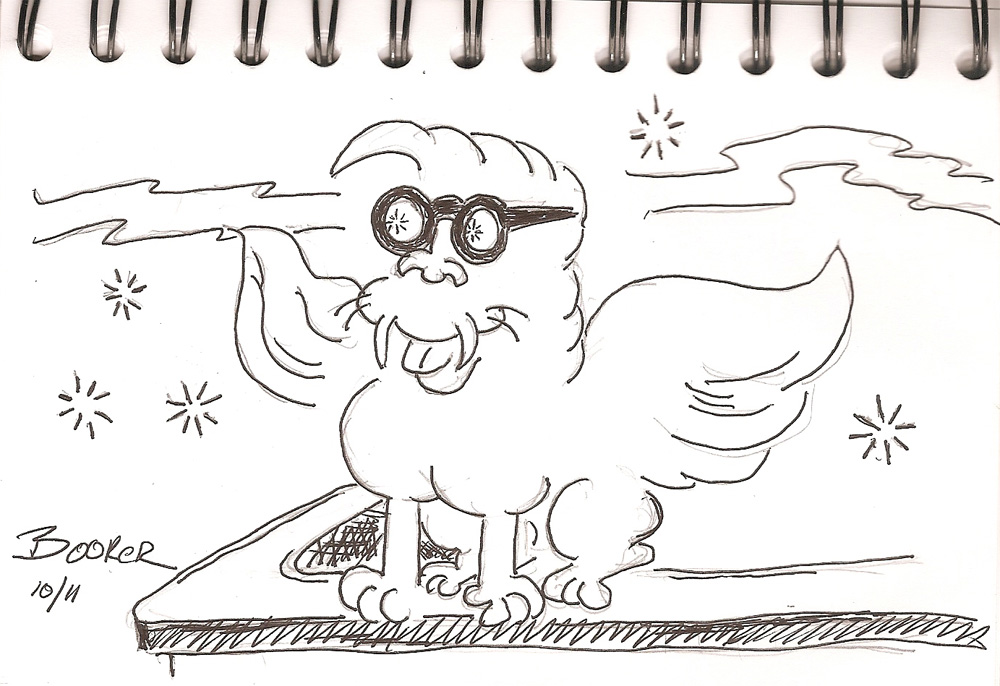
Gargoyle with his PPE gargles
Gargoyles with stare at their stargles
They will sit on their ledge
Whole worlds in their heads.
And nary burp, nor chirp, nor hargle.
Filed under abreviation, absurdity, animals, Cartoon, fargles, fun, gargles, gargoyle, Halloween, holiday, humor, imagination, poem, poetry, PPE, Random Access Thoughts, Random thought, story poem, word play, words, writing
Starting with the obvious
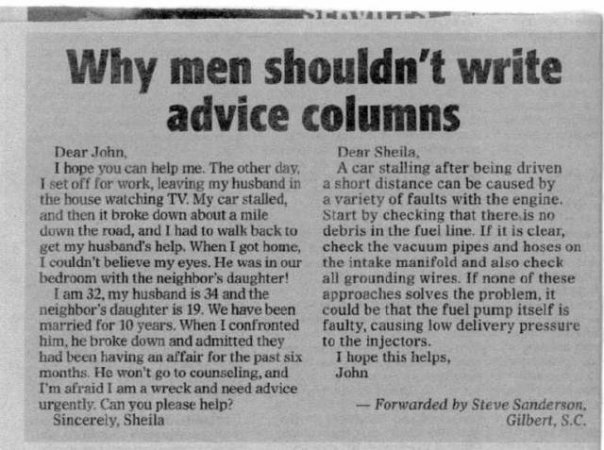
Some things need no commentary, but I have one below anyway.
Editor’s comment: Some say this is an example of why men should not write advice columns. I say it’s an example of missing the obvious. First, the advice guy should have told the writer to check to make sure there was enough gas in the car’s tank. An empty gas tank and a car will stall easily. Geez, some people never want to start with obvious.
The Kibitizer and the Kidd, part 3
888888
The apothecary was almost done making the cough drops, but the Kibitzer was tired of watching. He ho-hummed to himself, took another bite of some slightly stale popcorn, and decided watching was not always what he had pictured it would be. It was a very unpleasant observation and it did not sit well him or his stomach. The popcorn didn’t help. He belched once in hopes of relief.
It was during the descent of the belch out of his mouth that he heard what sounded like a pop, saw the delivery boy run out of the saloon, and then watched as lightning tripped the light fantastic across the kid’s body.
He then saw another two or three people scurry out of the saloon as if escaping an unpleasantry, like a distant relative’s interminable funeral or a spelling bee where they were next up and the word was interminable.
The Kibitzer forgot all about the cough drops and stepped outside, glancing toward the sky as if somehow he could observe a bolt of lightning before it hit him, and then considered running through the rain to the other side of the street.
That’s when a young lady came up and kneed him in the groin.
The Kibitzer dropped to the wooden sidewalk, balled up, and began rocking back and forth as if it might dissipate the pain.
“My name’s Bonnie,” she said, leaning over him. “No man leaves my apothecary without payin’ for what he ordered.”
“I wasn’t leaving,” the Kibitzer said, his teeth still clenched.
Finally, he rolled over onto all fours.
“Didn’t you see the kid out there? He got struck by lightning?”
Bonnie shrugged. “Happens a lot lately. He’ll be okay. Nobody in this town dies anymore. Been bad for my business, I tell you.”
The Kibitzer was again standing fully erect, if feeling a little tender. The rain had slackened to almost a light drizzle.
“We already lost two undertakers and the saw bones has gone back to yankin’ teeth. If it weren’t for medicinals for that, I’d probably be blowin’ in the wind, too.” She then slipped him the bill for the cough drops.
The Kibitzer looked at it. “What, no discount for the laying on of hands?”
She smiled at him, then raised her hand. In the muddled light of the evening, she still looked quite menacing. “I didn’t finish.”
The Kibitzer paid her and gave her a generous tip.
He then dashed out into the rain, forgetting the cough drops.
888888
There once was a man with waders
There once was a man with waders
Who thought he might find him some gators
down at his creek,
where the trash did seep
left often by unkind invaders.
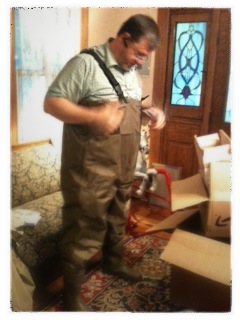
Man trying on waders, getting ready for First Creek Greenway Cleanup, Saturday, September 24th, 9 AM to noon,
It was Saturday, September 24th
when the man and his friends set a course.
from nine until noon
and not a moment too soon
to put an end to this trashy discourse.
So come to First Creek and discover
“treasures” left by some unkind others:
shopping carts and flat tires,
pay phones, couches, and wires
and stuff that the creek tries to smother.
Bring tools and gloves for your hands;
pick up trash for as long as you can.
Once done, we will eat
Magpies cupcakes, Three Rivers treats
and be glad we helped the creek and the land.

Magpies cupcakes and Three Rivers Market treats will be served up after the cleanup.
Filed under cleanup, creek, First Creek, fun, Greenway, humor, limerick, Magpies, Old North Knoxville, poem, poetry, story poem, Three Rivers Market, trash, waders, water, word play, words, writing


 Booker's Blog