
Writing a novel is …
Simple.
Deceptive.
Seductive.
And an Act of Defiance.
That’s why so many feel they can do it, and why so few do it successfully.
Writing a novel is …
Simple.
Deceptive.
Seductive.
And an Act of Defiance.
That’s why so many feel they can do it, and why so few do it successfully.
Filed under writing, writing tip
[Editor’s note: I have attended two Killer Nashville conferences and can say there is plenty to see and do and learn, even if what you write is not strictly thriller, suspense or mystery. To be clear, I have no stake in the conference, and will not make any money if you attend. I have written a few blog entries from my most recent attendance. You can find those by clicking on Killer Nashville in the tags below.]
Killer Nashville
A Conference for Thriller, Suspense, Mystery Writers & Literature Lovers
________________________________________
August 23-26, 2012
Thursday evening through Sunday afternoon
________________________________________
Nashville, TN
Guests of Honor for 2012 Killer Nashville are New York Times Bestselling Authors C.J. Box, Heywood Gould, & Peter Straub
Since 2006, Killer Nashville has become THE conference for mystery, thriller, and crime fiction authors and fans. Located in Nashville, Tennessee, Killer Nashville is held the fourth full weekend of every August.
Killer Nashville attracts bestselling authors from across the U.S., Canada, and beyond, plus scores of fans and budding authors.
Sponsored by numerous national organizations, attendees have included authors, screenwriters, playwrights, filmmakers, fans, attorneys, editors, agents, and publishers.
Killer Nashville’s objectives are to assist writers of all writing genres and formats; develop a better understanding of the craft of the mystery, thriller, suspense and true crime genres specifically; to discuss such topics as investigative techniques, verifying crime information, and submitting one’s manuscript for publication; and portray law enforcement and forensic science in a fair and accurate manner.
Killer Nashville is offered in five concurrent tracks including over 60 events ensuring the weekend has something for every lover of literature.
One track, the forensic/CSI track provides insight into the latest in forensic investigations and crime detection and is hosted by the TBI (Tennessee Bureau of Investigations), FBI, and other law enforcement branches. Event includes a realistic crime scene staged by the TBI and solved by conference guests.
Many writers have found agents, editors, and publication through networking at Killer Nashville.
Killer Nashville is a volunteer-produced event and was founded in 2006 by bestselling Franklin writer and filmmaker Clay Stafford.
Contact information:
Killer Nashville
P.O. Box 680759
Franklin, TN 37068-0759
(615) 599-4032
contact@killernashville.com
Website: killernashville.com.
Blog: http://killernashville.wordpress.com/
Filed under Killer Nashville, writing, writing conference
[Editor’s commentary: “It was a dark and stormy night.” How many times have you as a writer been told not to copy. Don’t copy somebody’s homework. Don’t copy the way somebody looks. Seems somewhere along the line may have changed. Or, at least, knock-offs of something may be okay. Or at least what publishers are looking for. That’s what this article suggests. So, maybe what you need to do is find some best selling novel and “spice” it up in some way, and see if an agent or publisher will buy it. I say it with a bit of tongue-in-cheek. Therefore, I don’t know that I so much say this is a writing tip and maybe a way to get started writing if you feel stuck. Take something out there, a classic maybe, and bend it some, change it in some way. Many of the stories of King Arthur’s knights of the round table were retold in just such a fashion. Each new writer taking what had been written before about a certain knight and adding his own inflections to it. In some ways, we may not be quite as far beyond the Middle Ages as we would like to think.]
Source: http://www.hlntv.com/article/2012/05/14/fifty-shades-grey-knock-offs?hpt=hp_c2
By Matthew Carey
updated 11:31 AM EDT, Mon May 14, 2012
An erotic bestseller has publishers fantasizing… about how to repeat its runaway success.
The “Fifty Shades of Grey” trilogy by author E. L. James has sold an amazing three million copies in just a few weeks, seducing readers with its sadomasochistic tale of virginal college student Anastasia Steele and her troubled billionaire lover Christian Grey. Universal snapped up the film rights for a reported $5 million.
The “Fifty Shades” boom “is a very big deal,” says Jim Milliot of Publishers Weekly. “I think it’s safe to say it’s a mini-phenomenon.” Milliot says publishing houses are pouring over ideas hoping to duplicate “Shades’” achievement.
“This is a notoriously copycat industry… This industry jumps on whatever big thing comes along,” Millot explains.
But it’s tricky to imitate what you don’t quite understand — and many industry pros are baffled by the trilogy’s success.
“A lot of people are kind of scratching their heads about what has made this thing pop,” Milliot says. “It’s not just the sex thing that’s selling. There’s way more explicit stuff out there if you want it. It’s more than that.”
Milliot credits word of mouth, plus “Shades’” distinctive cover art (a silver necktie) and what he calls a “secret sauce” — that mystery ingredient that can turn something ordinary into a big hit.
Already, some rival publishers are promoting titles with their own recipe for “secret sauce”:
• “Bared to You” by Sylvia Day is described as a compelling combo of “love, lust and secrets.” Heroine: Young Eva Tramell. Troubled, rich boyfriend: Gideon Cross.
• “Big Game”, the latest in the “Vampire Vacation Inn” series by C. J. Ellisson, which could be called a cross between “Twilight” and “Fifty Shades of Grey.” Heroine: 580-year-old vampire Vivian. Sexy soulmate: Rafe.
Like “Fifty Shades,” Ellisson’s books contain a “heavy erotic element,” the author told HLN (though she notes the hot action involves a married couple). Ellisson began publishing her series before the “Shades” explosion, but all the media attention on James’ trilogy may benefit her sales too.
“I love that [“Fifty Shades of Grey”] has brought erotic literature into the mainstream. I think that’s terrific,” says Ellisson.
There’s an irony in publishers trying to imitate “Fifty Shades of Grey,” because it basically began as an imitation itself of Stephanie Meyer’s “Twilight” series. E.L. James’ story originated on a Twilight “fan fiction” website, and her main characters were first called Bella and Edward (not Anastasia and Christian).
Milliot says — imitation or not — “Shades” is not in “Twilight”‘s league, despite those impressive sales figures and a movie in the early stages of development.
“I think you see how books two and three (in the series) do and you have to see how the movie gets made and if the books have legs. It’s not there (yet) to be compared to ‘Twilight’ and ‘Harry Potter.’”
But Milliot adds, “It has the foundation to do that.”
Filed under knock-off, writing, writing tip
Source: http://www.cnn.com/2012/05/11/tech/innovation/computer-assisted-writing/index.html?hpt=hp_bn11
By John Sepulvado, CNN
updated 3:21 PM EDT, Fri May 11, 2012
(CNN) — Computer applications can drive cars, fly planes, play chess and even make music.
But can an app tell a story?
Chicago-based company Narrative Science has set out to prove that computers can tell stories good enough for a fickle human audience. It has created a program that takes raw data and turns it into a story, a system that’s worked well enough for the company to earn its own byline on Forbes.com.
Kristian Hammond, Narrative Science’s chief technology officer, said his team started the program by taking baseball box scores and turning them into game summaries.
“We did college baseball,” Hammond recalled. “And we built out a system that would take box scores and historical information, and we would write a game recap after a game. And we really liked it.”
Narrative Science then began branching out into finance and other topics that are driven heavily by data. Soon, Hammond says, large companies came looking for help sorting huge amounts of data themselves.
“I think the place where this technology is absolutely essential is the area that’s loosely referred to as big data,” Hammond said. “So almost every company in the world has decided at one point that in order to do a really good job, they need to meter and monitor everything.”
Narrative Science hasn’t disclosed how much money is being made or whether a profit is being turned with the app. The firm employs about 30 people. At least one other company, based in North Carolina, is working on similar technology.
Meanwhile, Hammond says Narrative Science is looking to eventually expand into long form news stories.
That’s an idea that’s unsettling to some journalism experts.
Kevin Smith, head of the Society of Professional Journalists Ethics Committee, says he laughed when he heard about the program.
“I can remember sitting there doing high school football games on a Friday night and using three-paragraph formulas,” Smith said. “So it made me laugh, thinking they have made a computer that can do that work.”
Smith says that, ultimately, it’s going to be hard for people to share the uniquely human custom of story telling with a machine.
“I can’t imagine that a machine is going to tell a story and present it in a way that other human beings are going to accept it,” he said. “At least not at this time. I don’t see that happening. And the fact that we’re even attempting to do it — we shouldn’t be doing it.”
Other experts are not as concerned. Greg Bowers, who teaches at the Missouri School of Journalism, says computers don’t have the same capacity for pitch, emotion and story structure.
“I’m not alarmed about it as some people are,” Bowers said. “If you’re writing briefs that can be easily replicated by a computer, then you’re not trying hard enough.”
[Editor’s note: This is one half of an interesting set of articles. I will post the second one here soon. By story in this article, it doesn’t mean a fiction story or a poem. I’m not sure when, if ever, a computer application or program will be able to create a convincing fictional story. But it is something innate in humans, as the next article points out. The article deals with Alzheimer’s patience and their ability to tell stories even when they have problems with their memories.]
Filed under Hal, non-fiction, software application, technology, writing
By NATHAN BRANSFORD
Source: http://blog.nathanbransford.com/
I wrote the latter part of Jacob Wonderbar for President of the Universe and nearly all of Jacob Wonderbar and the Interstellar Time Warp while going through one of the hardest stretches of my life, and I felt very acutely how writing during hard times can be both a great blessing as well as a serious stressor.
It can be cathartic to block out everything going on in your life and lose yourself in your fictional world for a while, but stress can also make it extremely hard to focus.
Having made it to the other side, here are some things I learned about how to keep writing when life throws you a major curveball.
Take care of yourself first – You first, writing second. Get the help you need, take the time off you need, and don’t let your desire to write add to your stress. Life comes before writing every single time. Do what you need to do.
Don’t keep your situation a secret – You may feel like you don’t want to burden your writing/critique partners or your agent and editor with your personal life, but that’s not the right instinct when things are serious. Keep them in the loop and don’t be afraid to ask them for more time if you need it. Chances are they’re going to be awesome and tell you to take care of yourself, which will give you the breathing room you need to focus. I did just that with my agent and editor, and they were wonderfully supportive, which relieved a huge amount of stress.
Force yourself to get going – That very normal hump that you have to get over to force yourself to sit down and start writing when you don’t want to can feel like Mount Everest when you’re stressed out. So start climbing. Open up the computer, make yourself get started. Follow the steps for getting back to writing after a break, and once you really get going you’ll be amazed how nice it feels to lose yourself in your writing again.
Don’t be afraid to cut back – Even if you do power through and keep writing during a stressful time, chances are you’re not going to be as productive as you are normally. That’s just the nature of being distracted. Plan ahead for this and don’t put extra pressure on yourself to maintain the same pace.
Channel your emotion into your writing – Even though I was writing wacky children’s books, I still found a way to channel the things I was feeling into the stories. In Jacob Wonderbar for President of the Universe, Jacob starts wondering if he really even wants to win, and Jacob Wonderbar and the Interstellar Time Warp hinges on whether Jacob should change the past. Now, Jacob doesn’t get all cynical and depressed, but he does feel some of the things I was feeling in the past few years.
Let writing be a bright spot – At some point we’re all confronted with difficult stretches in life. But let your writing remind you of how great your future can be. You’re going to keep getting better, you’re going to keep writing books, and no one can take writing away from you. Savor it and enjoy that it’s yours.
Filed under words, writing, writing tip
The last bookshop man in the world sat alone in his small store. There was a knock on the door. Startled, he looked up from his science fiction book to find the woman of his dreams standing in the doorway, wearing very little at all. And though she was an android, it had been a long time, so he proposed something indecent to her.

The last bookshop
She then turned and left the room.
He put the book back on the shelf and went to another section.
#
The last bookshop man in the world sat alone in his store. There was a knock on his door.
Before he could answer, the door swung open and a man in a fedora with a tommy gun barged in and started spraying the room with bullets.
The man with the machine gun aimed high, but was bringing his aim lower and lower, yelling over the noise that “The Boss” had sent him to get “the dame.” So where was she?
The last man barely had time to dive to the floor and even then he heard one speeding over his head.
The gun ran out of bullets. The man with the fedora backed out of the room and disappeared.
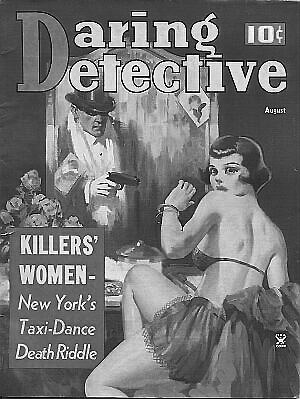
Old magazine from the shelves of the last bookshop
#
The last bookshop man in the world sat alone in his store.
This time a Conan-like brute with a broadsword did not bother to knock, but kicked the door open and charged into the room, swinging. He hit books, slicing the spines, knocking them off the shelves. He hit shelves, splintering wood, embedding his sword.
He yelled something about a woman, or that’s what the last man thought he heard.
Because the room was small, Conan-like was having trouble getting a full, strong swing of his massive sword. Still, as he stomped toward the last man, the last man was not sure how he would escape this one. The same thing preventing this Conan type from getting a complete swing of his sword was also prevent his escape.
The last bookshop man was sure this was going to be his last. Then the scantily clad android woman appeared in the door and announced, “I’m reformatted.”
The Conan-like man jerked his sword out of the shelf, turned, and lunged toward her.
She squealed in an almost mechanical way and ran away, the muscle-bound Conan-like in determined pursuit.
The last bookshop man slumped into his chair and waited for his heart rate to return to normal.
#
The last bookshop man in the world sat alone in his store. This time, there was a lock on his door. This time, he was reading haikus.
[Editor’s note: inspired by a visit to Central Street Books, dealer in old and rare books, in Knoxville, TN.]
Filed under bookshop, Found story, Photo by author, story, writing
by Jane Friedman
April 27, 2012
Source: http://writerunboxed.com/2012/04/27/should-you-focus-on-your-writing-or-your-platform/#more-14057
Craft!
Platform!
Craft!!
Platform!!
It’s a debate that might span eternity: how much time should you devote to writing versus platform building?
I don’t know if there was ever a real beginning to this debate, but if so, it was when editors and agents started telling nonfiction authors that their book was only viable if a platform was in place. Which made sense for technological and cultural reasons. Take the ease of word processing and affordable personal computers, add Baby Boomers with free time to pursue their dreams, and presto! Suddenly there were more people than ever trying to write a book and get it published, with limited skills and experience, and often no credentials.
So what does a well-meaning agent or editor say to one of these people? The easiest thing to say is: You need a platform.
Fast forward a decade or two, and we now live inside an unending media conversation wheel, where anyone can find a niche readership, do solid work on building a platform, and even put writing on the backburner—and still reasonably claim to be a writer.
I think there’s a backlash against some of these people, which I understand. It’s applying the entrepreneurial, get-rich-quick Tim Ferriss mindset to the world of literature, where we tend to believe that blood, sweat, and tears (and rejection) are demanded before you gain recognition.
Plus: Real writers write. (Right?) They don’t tweet, they don’t blog, they don’t connect with readers, at least not joyfully.
I exaggerate, but you know the people I’m talking about.
The horrible catch is—at least for beginning writers without fame and fortune, who are starting their careers in a transitioning industry—focusing on your writing work to the exclusion of all else can hamper you later down the road. If you shut yourself away and don’t learn to navigate the online world (the personalities, the flow of conversations, the tools), you’re terribly disadvantaged when it comes time to get a publisher, market your work, and find readers.
Excellent arguments reside on each side of this debate, which often boil down to: “Writing is all that matters,” and “audience is all that matters.”
But the truth is a little different for each of us, and that’s why it’s next to impossible to give general advice on platform. It necessarily varies based on the author and the work in question.
But it does rip me apart to hear very new writers feel anxious that they can’t figure out their platform, especially when they have not a single book or credit to their name.
Well, it’s not a mystery why platform is so confusing when you don’t know who you are yet as a writer!
This has been a very long preface to what I’d like to offer: a set of general guidelines to help any writer understand how to balance writing with platform building.
Balance is the key word here.
Focusing on your writing probably means spending 10%-25% of your available writing time on platform activities. I never recommend abandoning platform activities entirely, because you want to be open to new possibilities. Being active online—while still focused on your writing—could mean finding a new mentor or the perfect critique partner, connecting with an important influencer, or pursuing a new writing retreat or fellowship opportunity.
Without further ado, the list.
When to focus more on your writing:
If you are within the first five years of seriously attempting to write with the goal of publication
For novelists: If you have not yet completed and revised one or two full-length manuscripts
If you can tell that what you’re writing is falling short of where you want and need to be
If you see a direct correlation between the amount of writing you put out and the amount of money that comes into your bank account (the JA Konrath model)
If you are working on deadline.
When to focus more on your platform:
If you start to realize you’re on the verge of publication
If you have a firm book release date of any kind
If you want to sell a nonfiction book concept (non-narrative)
If you intend to profit from online/digital writing that you are creating, distributing, and selling on your own
If you need to prove to a publisher or agent that your work has an audience.
Brief Bio.: Jane Friedman is a professor of media and writing at the University of Cincinnati, and the former publisher of Writer’s Digest. Visit her at JaneFriedman.com, for regular insights into the future of publishing.
Filed under writer, writing, writing tip

She threw the book at me!
I’m a writer and I don’t get no respect. Just the other day I hired an editor to help me with my manuscript, and the first thing she did was throw the book at me! The unabridged book at me. The one that defines words. You know it. D-i-k something something something.
Filed under Cartoon, cartoon by author, no respect, writing
[Editor’s note: the essay below is taken from an e-mail newsletter sent out by the writer Bruce Hale. you can find his web site at: http://www.brucehalewritingtips.com/. You can also sign up for his e-newsletter at that site. Each electronic newsletter comes with other information, including a writing joke.]
By BRUCE HALE
When I wrote my first mystery, I hadn’t a clue. I tried writing it straight through, plotting as I went, and ended up falling flat on my face. Why? I hadn’t yet learned that backwards is best.
You see, contrary to the way most fiction is mapped out, mysteries are backwards creatures. They’re easiest to write when plotted backwards from the ending, rather than forward from the beginning. Mysteries, by their nature, are a complex tangle, and if you’re not careful, you’ll get stuck in it.
As I learned the hard way, if you write from the beginning, you’ll be left flatfooted with your detective, trying to figure out how to solve the mystery.
Better to go the easy way: work from the solution. Start from the ultimate revelation of whodunit and work your way backwards to mystery writing success. Here’s how:
– DECIDE WHODUNIT, WHY, AND HOW
First, pick the crime to be solved and the culprit. Suss out why they committed the crime – and the less obvious the reason, the better. Your villain (or clues from him) should be part of the story from fairly early on, but his motives and actions must remain hidden until the twist reveals them. Hide your villain in plain
sight – heck, you could even go so far as to make them a seeming ally of your hero.
– PLAN YOUR TWIST
This is the dramatic reveal, the “It’s not Snape, it’s Quirrell!” moment. (Sorry if I spoiled Harry Potter I for you.) The twist should occur at the least convenient moment, preferably when the hero is most vulnerable. Usually the twist occurs at or just before the climax.
To make the twist work, you need to come up with at least one or two plausible culprits, then show why they didn’t commit the crime.
– LAY OUT YOUR RED HERRINGS
These are the likely culprits, the leads your detective follows that turn out to be dead ends. Be sure the herrings are motivated as well, and if you can disguise their motivations or make them ambiguous, so much the better. Anything to make them *more* plausible, and your true villain *less* plausible.
– SCATTER YOUR CLUES
What tips your hero off to the fact that the villain is guilty? A latticework of little clues (usually connected much too late). You must always play fair with the reader, so be sure the clues are there, even if the detective and her trusty assistant initially dismiss them.
The key with clues is to use misdirection — have them seem insignificant, or be misinterpreted. You can’t make it too easy for the detective, or the reader!
– START WITH A BANG
And last, but not least, come up with a grabber of an opening that plunges us right into the heart of the mystery. Ideally, it should contain some small clue that points us toward the true culprit.
With all that in place, now you’re ready to write your first words. Happy mystery writing, and may the spirit of Chandler and Hammett be with you!
Filed under Bruce Hale, plot, writer, writing, writing blog, writing tip
“The pen is mightier than the sword, and considerably easier to write with.”
— Marty Feldman

Marty Feldman, comedian, writer, actor


 Booker's Blog