Category Archives: writing tips

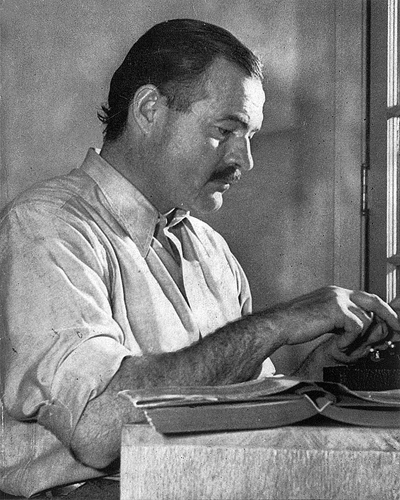
Writing Quotes from Hemingway

Ernest Hemingway at typewriter

Ernest Hemingway at typewriter

  1. If a writer knows enough about what he is writing about, he may omit things that he knows. The dignity of movement of an iceberg is due to only one ninth of it being above water.
  2. That is what we are supposed to do when we are at our best – make it all up – but make it up so truly that later it will happen that way.
  3. When writing a novel a writer should create living people; people not characters. A character is a caricature.
  4. All you have to do is write one true sentence. Write the truest sentence that you know.
  5. To F. Scott Fitzgerald: “Write the best story that you can and write it as straight as you can.”
  6. To an aspiring writer: “You shouldn’t write if you can’t write.”

Leave a comment

Filed under writing quotes, writing tip, writing tips

Writing tip Wednesday: “Flexible outline”

7 STEPS TO CREATING A FLEXIBLE OUTLINE FOR ANY STORY

Source: http://www.writersdigest.com/online-editor/7-steps-to-creating-a-flexible-outline-for-any-story?et_mid=682609&rid=239626420

The seven steps involve:
1. Craft your premise
2. Roughly sketch scene ideas
3. Interview your characters
4. Explore your settings
5. Write your complete outline
6. Condense your outline
7. Put your outline into action.

1. Craft your premise.

Your premise is the basic idea for your story. But it’s not enough to just have an idea. “Guy saves girl in an intergalactic setting” is a premise, but it’s also far too vague to offer much solid story guidance.

This is why your outline needs to begin with a tightly crafted premise sentence that can answer the following questions:

  • Who is the protagonist?
  • What is the situation? What is the hero’s personal condition at the beginning? How will that condition be changed, for better or worse, by the hero himself or by the antagonistic force?
  • What is the protagonist’s objective? At the beginning, what does the hero want? What moral (or immoral) choices will she have to make in her attempt to gain that objective?
  • Who is the opponent? Who or what stands in the way of the hero achieving his objective?
  • What will be the disaster? What misfortune will befall the hero as the result of her attempts to achieve her objective?
  • What’s the conflict? What conflict will result from the hero’s reaction to the disaster? And what is the logical flow of cause and effect that will allow this conflict to continue throughout the story?

Once you’ve answered these questions, combine them into one or two sentences:

Restless farm boy (situation) Luke Skywalker (protagonist) wants nothing more than to leave home and become a starfighter pilot, so he can live up to his mysterious father (objective). But when his aunt and uncle are murdered (disaster) after purchasing renegade droids, Luke must free the droids’ beautiful owner and discover a way to stop (conflict) the evil Empire (opponent) and its apocalyptic Death Star.

2. Roughly sketch scene ideas.

Armed with a solid premise, you can now begin sketching your ideas for this story. Write a list of everything you already know about your story. You’ll probably come to this step with a handful of scenes already in mind. Even if you have no idea how these scenes will play out in the story, go ahead and add them to the list. At this point, your primary goal is to remember and record every idea you’ve had in relation to this story.

Once you’ve finished, take a moment to review your list. Whenever you encounter an idea that raises questions, highlight it. If you don’t know why your character is fighting a duel in one scene, highlight it. If you don’t know how two scenes will connect, highlight them. If you can’t picture the setting for one of the scenes, highlight that, too. By pausing to identify possible plot holes now, you’ll be able to save yourself a ton of rewriting later on.

Your next step is to address each of the highlighted portions, one by one. Write out your ideas and let your thoughts flow without censoring yourself. Because this is the most unstructured step of your outline, this will be your best opportunity to unleash your creativity and plumb the depths of your story’s potential. Ask yourself questions on the page. Talk to yourself without worrying about punctuation or spelling.

Every time you think you’ve come up with a good idea, take a moment to ask yourself, “Will the reader expect this?” If the answer is yes, write a list of alternatives your readers won’t expect.

3. Interview your characters.

In order to craft a cast of characters that can help your plot reach its utmost potential, you’ll need to discover crucial details about them, not necessarily at the beginning of their lives but at the beginning of the story.

To do this for your protagonist, work backward from the moment in which he will become engaged in your plot (the “disaster” in your premise sentence). What events in your protagonist’s life have led him to this moment? Did something in his past cause the disaster? What events have shaped him to make him respond to the disaster in the way he does? What unresolved issues from his past can further complicate the plot’s spiral of events?

Once you have a basic idea of how your character will be invested in the main story, you can start unearthing the nitty-gritty details of his life with a character interview. You may choose to follow a preset list of questions (you can find a list of more than 100 such questions in my book Outlining Your Novel: Map Your Way to Success), or you may have better luck with a “freehand interview” in which you ask your protagonist a series of questions and allow him to answer in his own words.

For the rest, go to http://www.writersdigest.com/online-editor/7-steps-to-creating-a-flexible-outline-for-any-story?et_mid=682609&rid=239626420

Historical and speculative novelist K.M. Weiland writes the award-winning blog Helping Writers Become Authors (helping writersbecomeauthors.com). She is the author of Outlining Your Novel and Structuring Your Novel

1 Comment

Filed under writing tip, Writing Tip Wednesday, writing tips

Writing tip Wednesday: “Hero’s Adventure”

HOW TO MAP OUT YOUR HERO’S ADVENTURE IN YOUR MANUSCRIPT

Source: http://www.writersdigest.com/online-editor/how-to-map-out-your-heros-adventure-in-your-manuscript?et_mid=688770&rid=239626420

How do the most successful authors of our time construct their stories? If you read them, and if you also read some ancient myths, you will begin to see parallels. You will feel smacked upside the head with parallels. You’ll realize that the top authors of today use storytelling techniques that writers used back when plans were being drawn up for the pyramids.

An excellent book about ancient myths is The Hero With a Thousand Faces by Joseph Campbell. The title says it all. Across cultures and generations, some variation of a hero figures into every beloved story. And the typical story is about an individual who goes on a quest or a journey. By the end, the individual becomes a hero. This is called the Hero’s Adventure.

The Hero’s Adventure is the most archetypal story of all because it’s the basis for more novels than any other kind of story. Novels of all different genres, from romances to thrillers to sci-fi, are based on the Hero’s Adventure.

So what is the Hero’s Adventure? You know it already, and you may even have elements of it in the story you’re working on. But I suspect you haven’t yet methodically and thoroughly appropriated it for yourself.

The Hero’s Adventure Basic Recipe

Joseph Campbell

Joseph Campbell

Here is a basic recipe to demonstrate how the Hero’s Adventure plays out. This is a template you can apply to your own work-in-progress—you might be surprised by how closely it matches elements you already have in play.

  1. A messenger comes. The messenger might be human, or a message might come from an experience—like a brush with death or a dream. At any rate, something has gone wrong; the natural order of the world has been disturbed.
  2. A problem is presented. Perhaps something has been taken away from the tribe, or some misfortune or malfeasance has occurred.
  3. Someone is marked out as the person to solve this problem. She is chosen according to some past deed of her parents or by her own reputation or happenstance. This person, of course, emerges as the hero at the end.
  4. A challenge takes shape. The challenge may be refused, at first. “No way, I’m not going to risk my neck for that!”
  5. A refusal, often. But eventually the hero decides to accept the challenge. She might even be forced to accept it by circumstances.
  6. The challenge is accepted. The adventure begins.
  7. The hero leaves the familiar world. And she sets off into another world. It’s dangerous. The hero could use some help, and very often …
  8. Helpers materialize. A helper might have special skills the hero doesn’t have, or he might have special insights or wisdom, in which case he takes the form of a mentor.
  9. Setbacks occur. The hero is tested, she makes gains, she endures setbacks, she fights for what is right, she resists evil. The going’s tough!
  10. The hero regroups and gains some ground again. Maybe she needs another visit to a mentor, or maybe she makes a personal breakthrough and overcomes a great inner obstacle, perhaps her own fear.
  11. The foe is vanquished or the elixir is seized. Eventually she defeats the foe or comes into possession of something that will restore the natural order—a cure, or new knowledge that will bring justice or the return of prosperity.
  12. The hero returns to the familiar world. And the problem is fixed, or justice is done. The natural order is restored.

The person who accepts the challenge and prevails is elevated to a special position, somewhere above human, somewhere below god. She is the hero.

For examples of this in literature: http://www.writersdigest.com/online-editor/how-to-map-out-your-heros-adventure-in-your-manuscript?et_mid=688770&rid=239626420

Leave a comment

Filed under writing tip, Writing Tip Wednesday, writing tips

Writing tip Wednesday: “Two agents to consider”

Whitley Abell

Whitley Abell

Whitley Abell joined Inklings Literary Agency in 2013. Before joining Inklings, she completed successful internships with Carol Mann Agency and P.S. Literary Agency. She is based in St. Louis, MO, where she daylights as a production manager for several medical and S & T journals.

Whitley is primarily interested in Young Adult, Middle Grade, and select Upmarket Women’s fiction. She likes characters who are relatable yet flawed, hooks that offer new points of view and exciting adventures, vibrant settings that become active characters in their own right, and a story that sticks with the reader long after turning the last page, be it contemporary or historical, realistic or supernatural, tragic or quirky.

Details and how to contact at: http://www.writersdigest.com/editor-blogs/guide-to-literary-agents/new-literary-agent-alert-whitley-abell-of-inklings-literary?et_mid=680502&rid=239626420

Alexander Slater

Alexander Slater

Alexander Slater graduated from the University of Connecticut in 2007. He began his career in publishing that year with the Maria Carvainis Agency, first as an intern, and then as an assistant. He has been with Trident Media Group since 2010, where he started as the assistant to both agents Kimberly Whalen and Scott Miller.

Alexander is interested in children’s, middle grade, and young adult fiction and nonfiction, from new and established authors. As he says, “I’m looking for projects that will rise above the rest…characters you’ll remember well past childhood…books that translate well to film because within them contain incredible stories, not because they’re the latest trend.” He particularly loves authors like Frank Portman, Jim Shepard, Jenny Han, and Rainbow Rowell.

Details and how to contact at: http://www.writersdigest.com/editor-blogs/guide-to-literary-agents/new-literary-agent-alert-alexander-slater-of-trident-media-group?et_mid=680502&rid=239626420

Leave a comment

Filed under writing tip, Writing Tip Wednesday, writing tips

Writing tip Wednesday: “Very Short Fiction Contest”

Glimmer Train’s Very Short Fiction Award

Glimmer Train

Glimmer Train

Deadline: July 31, 2014

  • Prizes:
      1st place wins $1,500 and, of course, publication in Glimmer Train Stories.

      2nd place wins $500, or, if chosen for publication, $700.

      3rd place wins $300, or, if chosen for publication, $700.

  • Other considerations:
      Entries should not exceed 3,000 words, but any shorter lengths are welcome. (Writing Guidelines)
      Winners and finalists will be officially announced in the October 1 bulletin, and contacted directly the previous week.
      Reading fee is $15 per story. Please, no more than 3 submissions per category.
      Simultaneous submissions are okay. Please notify immediately if your submission is accepted elsewhere.
  • Details at: http://www.glimmertrainpress.com/writer/html/index2.asp

    1 Comment

    Filed under writing tip, Writing Tip Wednesday, writing tips

    Writing tip Wednesday: “Contest — ‘Still'”

    Source: http://www.stilljournal.net/contest.php

    Contest deadline is August 31, 2014.

    Contest deadline is August 31, 2014.

    The editors of Still: The Journal announce the fifth annual Writing Contests for fiction, poetry and creative nonfiction. Contest entries should be in keeping with our publishing philosophy which states: “Our emphasis is on the literature of the Southern Appalachian region, and we are committed to publishing excellent writing that does not rely on clichés and stereotypes. We want to feature writing that exemplifies the many layers and complexities of the region or that is written by an author with a connection to the region.”

    Contest Rules:
    Submitted contest entries must be unpublished and should not have previously appeared in print or online in any form, including personal blogs and websites.

    Simultaneous entries are accepted as long as you let us know if your submissions will be published elsewhere before the contest ends.

    We accept ONLY electronic submissions and fee payment through Submittable.

    The contest reading fee is $9 per entry, payable through Still’s Submittable account, which can be accessed below.

    An entry is defined as:
    one short story,
    or one creative nonfiction piece,
    or three poems.

    Multiple submissions in multiple genres are acceptable as long as you pay a separate entry fee for each submission. Contest entry fees cannot be refunded under any circumstances.

    Manuscripts should be typed in a standard 12-point font and should have numbered pages. Prose must be double spaced. Poetry should be single spaced. Prose entries must not exceed 6,500 words. Poetry entries should not exceed 80 lines per poem.

    All contest entries are processed and read on a “blind” basis; therefore, your name or any other identifying information must not appear anywhere on the manuscript(s).

    Submissions should be sent as a Word document, rich text file, or PDF file only.

    Deadline is 11:59 p.m., August 31, 2014.

    Winners will be notified by September 30, 2014. Winning entries and finalists will be announced publicly in Issue #16 Fall 2014, Still: The Journal.

    All entries will be acknowledged.

    Failure to follow any of the above guidelines will result in disqualification. No entry fees can be returned.

    Inquiries or questions should be directed to contest@stilljournal.net

    Contest Prizes:
    Winners of fiction, poetry, and creative nonfiction receive $150 each and publication in Still: The Journal #16: Fall 2014. All other contest entries will be considered for possible publication. Previous first prize contest winners are ineligible to enter 2014 contests in the same genre but may submit to other genres.

    1 Comment

    Filed under Photo by author, writing tip, Writing Tip Wednesday, writing tips

    7 Things Every Twenty-First Century Writer Needs To Do | PHOENIX Magazine

    7 Things Every Twenty-First Century Writer Needs To Do | PHOENIX Magazine.

    Writing can be a lonely business, and the fragmentation of the publishing industry can leave aspiring authors feeling unsure as to whether they’re got more or less opportunity of getting their work read than ever before.

    Last weekend’s Writing In The Digital Age conference – an event organised by leading manuscript assessment service The Literary Consultancy – was a rare opportunity for the UK’s leading publishers, editors, agents, writers and digital innovators to gather in an atmosphere of honesty and openness to swap experiences, perspectives and practical advice.

    From a blistering keynote by journalist and sci-fi author Cory Doctorow to a panel about what book reviewing means in the twenty-first century, it was a rollercoaster ride through the opportunities and challenges on offer for those of us mad enough to cobble together careers based on words.

    If you fall into that category, here are seven things you need to know.

    1. Take control of your own career.

    Whether you choose to self-publish or pursue the traditional route, it is no longer viable to shut yourself in a garret and expect the royalty cheques to come. Orna Ross, founder of The Alliance of Independent Authors, got it in one when she said that “every writer should be an indie [independent].” Define why you want to write, what sort of things you want to write, how much money you want to make, and the lifestyle you want to live while you’re doing it. Make it into a proper business plan, with a timeline, marketing strategy and KPIs. Then go out and find the tools and partners that are the best fit.

    2. Self-publish, at least once.

    Ross also insisted that even trade published writers should experiment with self-publishing at some point. It’ll give you a much better understanding of the full range of publishing services and tools out there, and will encourage you to get over the mental barrier of sharing your work. Beware of making anything public too early – you still want to thoroughly polish before you slap an ebook onto Amazon – but genre novels, specialist non-fiction, short stories and experimental formats might get more traction on niche platforms than in the traditional marketplace. You won’t learn until you start producing, and there’s real value in overcoming your ego and learning how to ‘ship.’

    Other points covered:

    3. Turn one manuscript into multiple streams of income.

    4. Think beyond books and experiment with multimedia storytelling.

    5. Get creative with funding.

    6. Don’t sacrifice editing for marketing.

    7. Never give away your DRM.

    Details at: http://www.phoenixmag.co.uk/culture/7-lessons-every-twenty-first-century-writer-needs-to-learn/

    1 Comment

    Filed under writing tip, Writing Tip Wednesday, writing tips

    Pulp Serenade: John D. MacDonald on Words and Writing (2)

    John D. MacDonald

    Pulp Serenade: John D. MacDonald on Words and Writing (2).

    Recently, I came across an in-depth article on John D. MacDonald from around the time of the movie adaptation of Darker Than Amber. “The man who writes those Travis McGee stories: A look at John D. MacDonald” was written by Mike Baxter and was published in The Washington Post Times Herald on Feb 1, 1970. It was a fairly lengthy article, but below are excerpts of some of the most insightful parts:

    [Mickey] Spillane visits [John D.] MacDonald’s home at intervals, and both write mysteries. As craftsmen, however, they are as close as Eldridge Cleaver and Sam Spade. Even Spillane can recognize the gulf. “I am a writer; you are an author,” The Mick once told MacDonald. There is more in that than semantic nonsense.

    MacDonald writes on a beige IBM Selectric as if Doom were about to unplug it in the last great denouement…He devotes a business-like seven-to-nine hours a day writing, doing it until the lunch hour, then doing it again until the cocktail hour. Fast subtraction shows that this leaves “too little time, dammit” for other pursuits.

    More at: http://www.pulpserenade.com/2011/10/john-d-macdonald-on-words-and-writing-2.html

    3 Comments

    Filed under John D. MacDonald, writing tip, writing tips

    6 Subtle Things Highly Productive People Do Every Day – Business Insider.

    Ever feel like you’re just not getting enough done?

    Know how many days a week you’re actually productive?

    About three:

    People work an average of 45 hours a week; they consider about 17 of those hours to be unproductive (U.S.: 45 hours a week; 16 hours are considered unproductive).

    We could all be accomplishing a lot more — but then again, none of us wants to be a workaholic, either.

    It’d be great to get tons done and have work-life balance. But how do we do that? I decided to get some answers.

    And who better to ask than Tim Ferriss, author of the international bestseller The 4-Hour Workweek.

    (Tim’s blog is here and his podcast is here.)

    Below are six tips Tim offered, the science behind why they work, and insights from the most productive people around.
    1. Manage Your Mood

    Most productivity systems act like we’re robots – they forget the enormous power of feelings.

    If you start the day calm it’s easy to get the right things done and focus.

    But when we wake up and the fray is already upon us — phone ringing, emails coming in, fire alarms going off — you spend the whole day reacting.

    Read more: http://www.bakadesuyo.com/2014/06/most-productive-people#ixzz36520CACY

    Leave a comment

    Filed under writing tip, writing tips

    Writing tip Wednesday: “Tips for tipping the creative scales you way”

    Writing Fiction: 5 Tips to Get More Creative

    Source: http://www.writersdigest.com/writing-fiction-5-tips-to-get-more-creative?et_mid=637949&rid=239626420

    1. Start with tension

    Time and time again you’ll hear fiction writers and instructors tell you to start with action. This is flawed advice. Why? What good is the action if it isn’t grounded in context that’s important to the story or draws you to the main character? It’s better to start with tension, like a character falling short on getting something he wants—can’t save the life of a loved one, can’t beat a rival in a race, etc.

    2. Know what your characters’ wants are

    Interesting stories come from characters who want something. Romeo and Juliet want each other. Harry Potter wants to beat Draco Malfoy and Slytherin in Quidditch. Hannah Baker wants the people who led her to commit suicide know how they hurt her. Writing a fiction book requires that you have compelling characters, and characters who have strong wants and desires are the most compelling kind there are.

    3. End each chapter on a cliff

    OK, you don’t have to end each chapter on an actual cliff, but you do need to leave them with unanswered questions. This doesn’t mean you can’t answer questions during the book, it just means you need to create new ones as you go along. Be creative. Fiction is built on the curiosity of readers. If you don’t spark their curiosity (especially at the end of a chapter), what incentive do they have to start the next one?

    4. Give your characters obstacles and 5. Understand your audience Information on these is available at: http://www.writersdigest.com/writing-fiction-5-tips-to-get-more-creative?et_mid=637949&rid=239626420

    Leave a comment

    Filed under writing tip, Writing Tip Wednesday, writing tips