Category Archives: Writing Tip Wednesday

Writing tip Wednesday: Setting the Scene

By David E. Booker

The earlier entry about scene writing covered one aspect of it. Here, for your consideration, are three other items related to scene description in a story or novel.

    1) Scene description is not a list of things in a room, valley, planet, or universe. The writer is not a cataloger for a moving company, listing everything or even most thing in a scene. Scene description is a description of the important items in that scene.

    2) Scene description is about movement. When describing clouds, describe them in motion. In The Great Gatsby, when F. Scott Fitzgerald describes what Nick sees, there is almost always something moving in the scene description.

    When describing grass, describe it as a breeze rustles through it, or if it’s brown with drought, describe how crunchy it feels and sounds to a character.

    Or give a sense of movement by describing something metaphorically or with simile. For example, describe an old, rundown house by writing: “The house slumped on its foundation like a tired old man struggling with a cane to keep upright. It creaked and smelled and sighed from its efforts, and the scaffolding along one side was not much of a cane.”

    3) Describe scenery from a character’s point of view. If you are writing a first person story, that is the only way to describe scenery. But consider it even when writing from a third person point of view. And when doing so, consider two questions:

      A) What is important enough for that character to notice? Focus, at least to start, on the two or three most important things.

      B) How does the character react of feel about the items in the scene? This does not necessarily have to be a straightforward mater, such as: It was night and he was afraid of the dark. It can be subtilized by writing: “The fading daylight always brought with it a feeling of apprehension. Mike didn’t know if it was childhood and bad dreams still lurking around, or if it was because he heard sounds he could not easily identify or dismiss with a nod and a shrug. No, the sounds of the night had an insidiousness about them that he was unable to pin down or run away from.”

    ,

And that brings us to a final thought on setting the scene in stories and novels: don’t forget the other senses: touching, hearing, tasting, smelling – all the tools that can help you tell the reader how a character feels about a scene and in doing so, set the scene dynamically for the reader.

Leave a comment

Filed under scene setting, setting the scene, Writing Tip Wednesday

Writing Tip Wednesday: 15 minutes

By David E. Booker

So, how much time to do you have a day to write? How much time a day do you spend?

I read about a noted short story writer who started out writing 15 minutes a day, between 11:45 PM and midnight. As a single mom of several kids, working very hard just to hold her family together, that was the only time she had after all her kids were in bed and before she went to bed.

I wish I could remember her name, but the point is not so much her name or even that she won awards for her short stories. It is that she wrote regularly, even if all she had was 15 minutes.

Fifteen (15) minutes.

If there is one piece of advice that I have heard over and over and over again, it is to develop a routine and stick to it. Show up for your writing just like you would for your job that you work to hold body and soul together so you can write. If all you have is 15 minutes a day, use it wisely and use it well. If you can spare more, or if you operate better by setting yourself a word quota, then do it that way.

The writer James Scott Bell doesn’t have a daily quota, but a weekly one, which he then breaks down into daily installments. He says having a weekly quota works better for him because it misses a day or doesn’t write the full amount one day, he can work to make it up on the other days and still hit his weekly quota.

Certainly, if having a daily quota, then set one. I believe the writer Graham Greene had a daily quota of 500 words a day. He would write 500 words and then stop.

The writer Harry Crews often rose at 4 AM to write before going to work as a professor. One of his students, the New York Times bestselling crime novelist Michael Connelly said recently of Crews, “The singular lesson I took from him was his simple adage that if you are going to be a writer then you must write every day, even if only for 15 minutes. The last part about the 15 minutes has served me well. I’m going on 30-plus years of writing every day, even sometimes for only 15 minutes.”

So, where are your 15 minutes?

[Editor’s note: Connelly quote taken from LA Times obituary article on Harry Crews, who died earlier this year. He was known to write from 4 AM to 9 AM and to begin each session with the same plea: “God, I’m not greedy. Just give me the next 500 words.”]

Leave a comment

Filed under fifteen minutes, writing tip, Writing Tip Wednesday

Writing tip Wednesday: three keys to dialogue

by David E. Booker

1) It’s not conversation. In his book, On Writing: Advice to Those Who Write to Publish (Or Would Like to), George V. Higgins, known for his dialogue, advises developing an ear for dialogue, but that dialogue in stories is not simply conversation lifted from daily life and dropped into a story.

Normal speech is full of too many “uhs, ahs, and other sounds that are verbal place holders and don’t really have any place in fictional dialogue. Also, normal speech is full of “small talk.” Things like, “Hi, how are you? How’s the husband and kids? It sure looks like the team will have a good season this year.” All things meant to keep the lines of communication open, psychologists might say, but are of little use in furthering your story. In short, good dialogue moves the story forward. Asking about the family or saying the team will have a good year only keeps the story in place.

A corollary to this is the “As you know, Fred” dialogue, which is dialogue between two people who know the information being conveyed, but they are conveying it, anyway, for the sake of the reader, who doesn’t know. Science fiction can many times be guilty of this when two scientists of the same discipline, say particle physics, “converse” with each other about what a particle is.

2) It’s often what you don’t say. Subtext is the hidden force of any scene of a story or movie. As the noted script writer and teacher, Robert McKee says, “If a scene is about what a scene is about, then the scene is dead.”

Good dialogue

Often, good dialogue is about what isn’t being said.

For example, if two people are engaged in changing a tire and all they talk about is tire changing, then the scene is dead. However, if during that scene, one member is gruff to the other one and eventually says the flat was his fault for not checking the tires to begin with, then you have an emotional charge running through the scene and dialogue is then used to convey that emotional charge, the subtext is the tug of war of one person trying to blame another and how the person being blamed reacts or handles the accusation.

3) It’s okay to only use “said” and “asked.” Many writers learning their craft try to spice up a scene by having their characters express their dialogue with: he espoused, she guffawed, he trumpeted, she queried, etc. This will only slow down a scene. It should be: he said, or he asked, if it is a question. One exception might be: she yelled. But other than these, if the scene does not convey the right intensity with which your characters should be speaking, then there is something amiss in the scene, and it won’t be fixed by exchanging “she said” for “she espoused.”

In fact there are some writers, such as the late Robert B. Parker, who use only “he said” or “she said,” even where there was a question. He figured the use of the question mark at the end of the spoken sentence was clue enough.

And please note, by saying “he” or “she,” I am not saying never use the speaker’s name. particularly when somebody is speaking for the first time in a scene, it is often recommended that the text read, “Bob said” or “Alice asked.”

There are certainly other suggestions for creating good dialogue, but mastering these three will put you on your way to having dialogue that moves the story forward and adds a good boast to your writing.

2 Comments

Filed under article by author, dialogue, writing tip, Writing Tip Wednesday

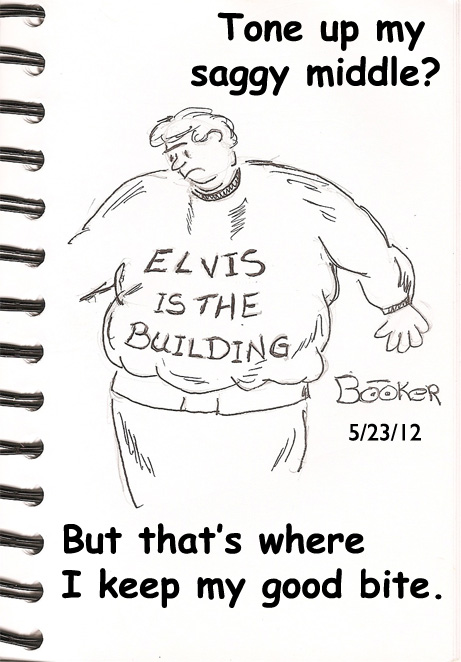
Writing Tip Wednesday: Tone those saggy middles

[Editor’s note: the essay below is taken from an e-mail newsletter sent out by the writer Bruce Hale. you can find his web site at: http://www.brucehalewritingtips.com/. You can also sign up for his e-newsletter at that site. Each electronic newsletter comes with other information, including a writing joke.]

5 TIPS FOR TONING SAGGY (STORY) MIDDLES

By Bruce Hale

I’ll be honest. I never thought that Pilates class at the Y would be good for anything other than kicking (and toning) my butt. Yet, Pilates, with its emphasis on tightening and strengthening the body’s core, has something to teach us writers.

Ever encountered a “saggy middle” in your story writing? Take a tip from Pilates and strengthen your story’s core.

In my experience, when the middle sags, I’ve either lost track of my main character’s goal, or I haven’t made it hard enough for him/her to achieve. If it feels like nothing’s at stake or the issue isn’t in doubt, then it’s hard to sustain that growing sense of suspense that all stories need.

How to tone up that saggy middle? Here are five suggestions:

1. Increase the tension

What keeps us reading is a sense of concern about the hero and doubt about whether he will achieve his goal. If your story’s middle section lacks excitement, look for ways to up the “uh-oh factor.”

Throw more obstacles into your hero’s path – whether internal or external. Internally, you could set two cherished goals at odds with each other (she has to choose between being in the school musical with that hot dude and playing soccer). Externally, you could hand the opposition a major victory that sets your hero back. Or you could stage a betrayal: Someone the hero (and reader) trusts suddenly turns out to be a bad guy.

2. Tighten up the action

Maybe the bones of your story are strong, but you’ve got a bit of flab on them — unnecessary scenes that bog down the action. Look closely at every scene. If you can trim or eliminate it without affecting the story’s forward momentum, maybe you didn’t need that scene in the first place.

3. Raise the stakes

Saggy Middle

Take a good bite out of the saggy middle of your story, if you have to.

This means making the consequences of failure even weightier. If your character has been working on solving a crime, for example, you could have
the authorities accuse her, or someone close to her, of committing the crime. That way, if she doesn’t succeed, she loses more than just her good track record in solving cases. You see this a lot in detective novels – because it works.

4. Spring a revelation

This is the unexpected discovery that casts new light on everything that’s gone before it. Often a revelation occurs just before the story enters its third act, as in HOLES, where we suddenly understand the connection between the past-day and present-day tales, and we get why Stanley
Yelnats is digging in the desert.

Tricky to pull off? Absolutely. But it sure packs a punch when you can do it right.

5. Pull a reverse play

Reversals tug the rug out from under your character just when it looks like he’s making serious progress. Reversals also up the tension and hook your reader. Need an example? In THE MALTESE FALCON, just when Sam Spade thinks he’s got everything figured out, the bad guy slips him a mickey, taking Sam out of the action while his enemies run off to claim the treasured falcon.

Above all, if your story middle is sagging, go back to focus on your main character and her goal. Be sure that throughout the middle, the hero is still actively pursuing (and passionate about) his goal, and that you are continuing to throw obstacles (ever-increasing, if possible) into his path. If those two elements are in place, and you stay focused on the core of your story, chances are that your saggy middle won’t need to take a trip to Pilates class.

5 Comments

Filed under cartoon by author, Saggy middle, writing tip, Writing Tip Wednesday