Category Archives: Writing Tip Wednesday

Writing tip Wednesday: “Getting rid of was”

PenPal says:

Here is one of the quickest and easiest ways to strengthen your writing:

1. Take a page of prose (or several pages at a time) and find how many times you used the word “was.” To do this on your computer, hold down both Control and the F key for a moment until a search box pops up. In that box, type the word “was” and then click the search button. Your computer will then highlight the word each time it appears in your manuscript. If you are handwriting or have printed out your page(s), take a highlighter and manually highlight the word “was” each time you find it.

2. Read through and choose an active verb to replace the word “was” in as many cases as possible (aim for replacing at least 50%, preferably about 90%).

Sometimes “was” is the best verb choice, but more often a stronger verb will help elevate your writing to a higher interest level. If getting rid of an unnecessary, boring “was” requires minor rewording, do it!

Examples:
A. The muddy dog was on his master’s clean bed.
B. The muddy dog sprawled on his master’s clean bed.

A. Behind the barn, there was a pile a leaves the children were jumping in.
B. Behind the barn, the children jumped in a pile of leaves.

A. Two thousand twelve was a very good year.
B. Two thousand twelve was a very good year. (Sometimes “was” really does work best.)

Keep writing and revising!

________

Cathy Kodra a/k/a PenPal

Cathy Kodra a/k/a PenPal

About PenPal…
Cathy Kodra works as an independent editor in Knoxville, TN. Her poetry and short stories have appeared in numerous journals and anthologies including Roanoke Review, New Millennium Writings, Common Ground Review, Now & Then, Cavalier Literary Couture, Slow Trains, Still Crazy, The Medulla Review, Prime Mincer, Yemassee, and others. She is a contributing editor for New Millennium Writings and past guest poetry editor for The Medulla Review. She was first runner up in Prime Mincer’s 2011 Poetry Contest, judged by Rodney Jones, and took first place in the 2012 Old Gray Cemetery Poetry Contest. Cathy’s first poetry chapbook, Thin Ice, was published in 2011 by Medulla Publishing.

Cathy is a member of the Knoxville Writers’ Guild and of two local writing groups. An avid reader and writer, she is currently working on two poetry collections and a collection of short stories. Her hobbies include gardening and vegan cooking, and she lives happily with her husband Ron, two dogs, and a cat. She can be reached at www.cathykodra.com.
Leave a comment

Filed under Writing Tip Wednesday

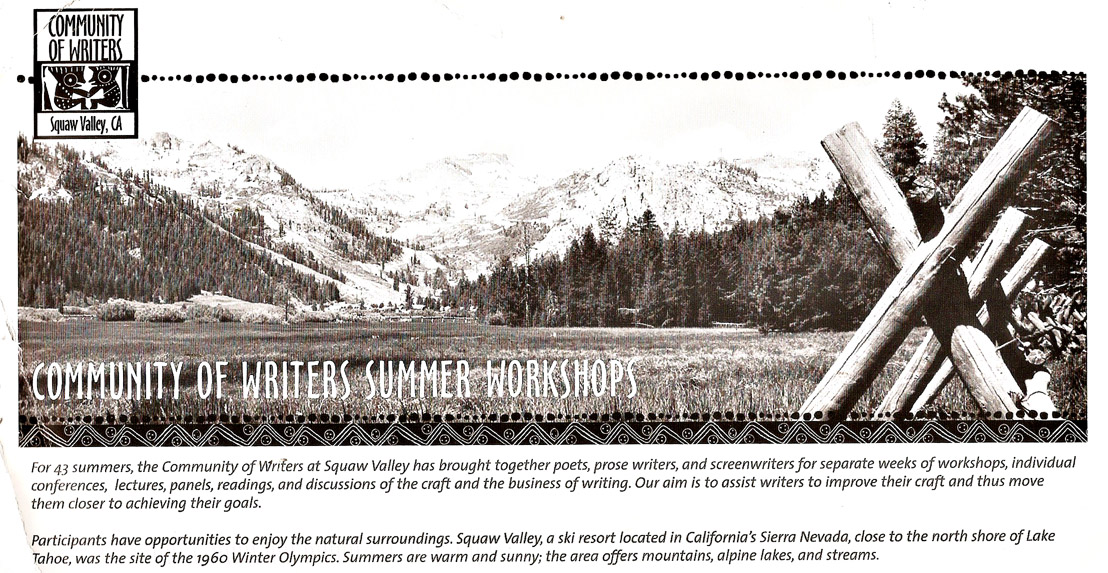
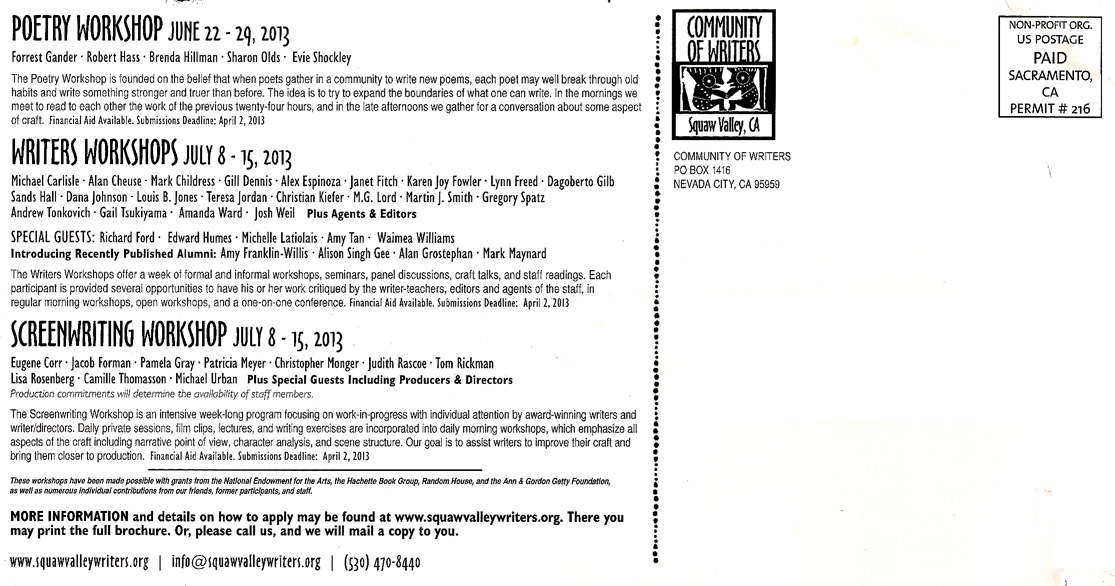
Writing Tip Wednesday: “Community of Writers”

Held in Squaw Valley, California

Held in Squaw Valley, California

Click on either graphic above to get an enlarged view of the information.

Leave a comment

Filed under Writing Tip Wednesday

Writing tip Wednesday: What lies at hand

Our main business is not to see what lies dimly at a distance but to do what lies clearly at hand.

—Thomas Carlyle

Thomas Carlyle, philosopher, satirist, essayist. 1795 - 1881

Thomas Carlyle, philosopher, satirist, essayist. 1795 – 1881

While not aimed at writers exactly, this quote is germane to the writing process. The end of a story, novel, essay, or poem may seem something dim and in the distance, and while we have to be mindful of it, we need to focus clearly on next words before us and how they fit and carry forward our thoughts, ideas, and emotions, how they advance the story at hand as it lies clearly before us on the page.

For example, writing three pages a day, you can have the entire draft of a 547 page novel written in six months. If you take off weekends off, that is still approximately 328 pages, double-spaced. Not a long novel, but certainly a respectable amount.

Granted, that doesn’t take in all the preparation work you have to do beforehand or along the way. Or the rewriting afterwards. But it is a way of thinking of a long piece of writing as manageable steps and helping you to see more clearly what lies at hand, or at the edge of your fingertips and imagination.

Leave a comment

Filed under Writing Tip Wednesday

Writing Tip Wednesday: “All right or alright?”

PenPal says:

Is it all right or alright?
All right is the correct spelling of this term.

Incorrect: It is alright to call me after 10:00 a.m.
Correct: It is all right to call me after 10:00 a.m.

Unfortunately, we’re now seeing more and more incorrect usage of the “alright” spelling. The reason? Inattentive writers have accidentally transferred the spelling pattern of the words “already,” “altogether,” and “almost” (correct spelling) to “all right” and merged the two words to “alright” (incorrect).

To be accurate and professional in your writing, please remember the following correct usage of all right: I have already used the words “all right” in this short article.

________

Cathy Kodra a/k/a PenPal

Cathy Kodra a/k/a PenPal

About PenPal…
Cathy Kodra works as an independent editor in Knoxville, TN. Her poetry and short stories have appeared in numerous journals and anthologies including Roanoke Review, New Millennium Writings, Common Ground Review, Now & Then, Cavalier Literary Couture, Slow Trains, Still Crazy, The Medulla Review, Prime Mincer, Yemassee, and others. She is a contributing editor for New Millennium Writings and past guest poetry editor for The Medulla Review. She was first runner up in Prime Mincer’s 2011 Poetry Contest, judged by Rodney Jones, and took first place in the 2012 Old Gray Cemetery Poetry Contest. Cathy’s first poetry chapbook, Thin Ice, was published in 2011 by Medulla Publishing.

Cathy is a member of the Knoxville Writers’ Guild and of two local writing groups. An avid reader and writer, she is currently working on two poetry collections and a collection of short stories. Her hobbies include gardening and vegan cooking, and she lives happily with her husband Ron, two dogs, and a cat. She can be reached at www.cathykodra.com.

Leave a comment

Filed under Writing Tip Wednesday

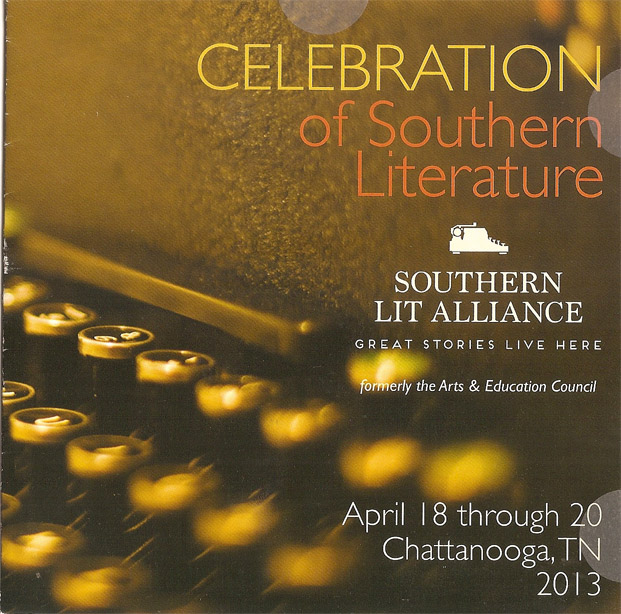
Writing tip Wednesday: “Southern Lit Alliance”

April 18 - 20, 2013

April 18 – 20, 2013

Basic information:
Southern Lit Alliance
3069 Broad St., Ste. 2,
Chattanooga, TN 37408
web: www.SouthernLitAlliance.org
Phone: 800-267-4232 or 423-267-1218
Thursday, April 18 – Saturday, April 20, 2013
Celebration of Southern Literature

Leave a comment

Filed under Writing Tip Wednesday

Writing tip Wednesday: “Tinker Mountain Writers’ Workshop”

The flyer I received on this workshop said: “Take your writing to amazing new places. (Thanks to a talented faculty and the Blue Ridge Mountains.)”

Tinker Mountain logo

Tinker Mountain logo

The quick bits:
Tinker Mountain Writers’ Workshop
June 9 – 14, 2013
Hollins University
P.O. Box 9552
Roanoke, VA 24020-1552
Fax: 540-561-2325
Phone: 540-362-6229
E-mail: cpowell@hollins.edu
Web: hollins.edu/tmww

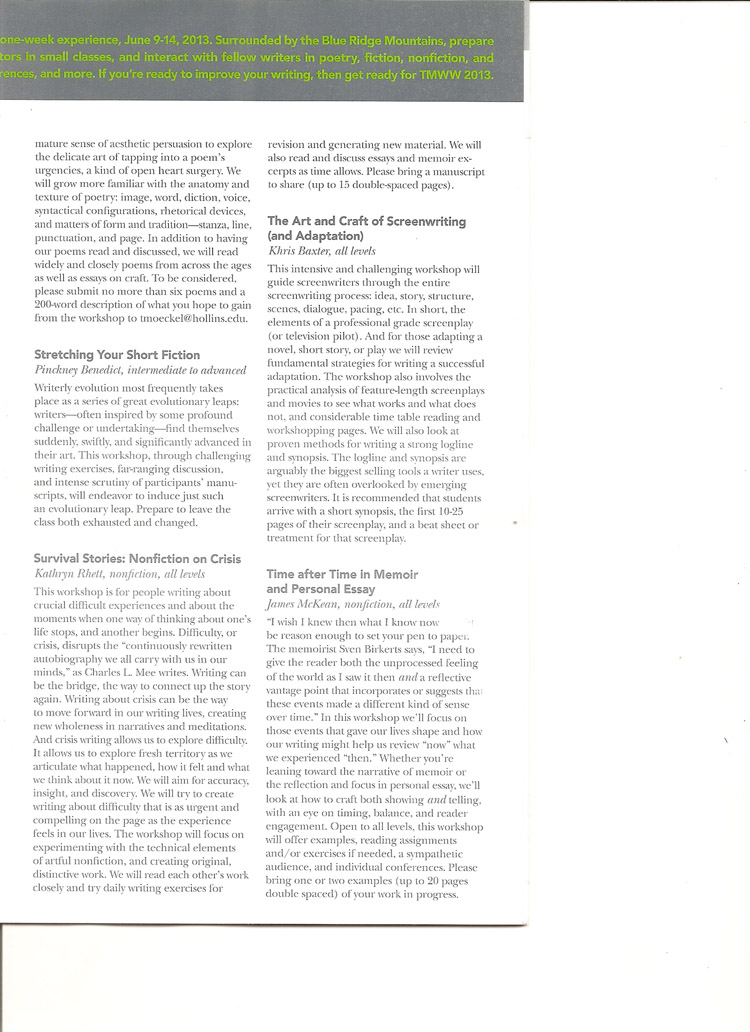
A little more information (Click on any of the graphics below to get a larger view of the information.):

2013 Workshops, part 1

2013 Workshops, part 1

2013 Writing Workshops, part 2

2013 Writing Workshops, part 2

2013 cost information

2013 cost information

Leave a comment

Filed under Writing Tip Wednesday

Writing tip Wednesday: “I or me?”

PenPal says…

I or me? How do we know which one to use? I often see the pronouns “I” and “me” used incorrectly in print, and I also hear the same errors in casual conversation. Examples:
1. Mary sent a birthday invitation to both you and I.
2. Joel and me decided to drive to the party.

Most computer grammar checks will pick this up, so if you see a wavy line under the word “I” or “me,” pay close attention. If you’re writing with pen and paper, try this: take out the “extra” words (both you and—sentence 1; Joe and—sentence 2), and listen to what sounds right:

Incorrect: Mary sent a birthday invitation to I.
Correct: Mary sent an invitation to me.

Incorrect: Me decided to drive to the party.
Correct: I decided to drive to the party.

Rule:
“I” is the subjective case (subject of the sentence – the who or what the sentence is about). “Me” is the objective case (object of the action / thought carried by the verb in the sentence).

________

Cathy Kodra a/k/a PenPal

Cathy Kodra a/k/a PenPal

About PenPal…
Cathy Kodra works as an independent editor in Knoxville, TN. Her poetry and short stories have appeared in numerous journals and anthologies including Roanoke Review, New Millennium Writings, Common Ground Review, Now & Then, Cavalier Literary Couture, Slow Trains, Still Crazy, The Medulla Review, Prime Mincer, Yemassee, and others. She is a contributing editor for New Millennium Writings and past guest poetry editor for The Medulla Review. She was first runner up in Prime Mincer’s 2011 Poetry Contest, judged by Rodney Jones, and took first place in the 2012 Old Gray Cemetery Poetry Contest. Cathy’s first poetry chapbook, Thin Ice, was published in 2011 by Medulla Publishing.

Cathy is a member of the Knoxville Writers’ Guild and of two local writing groups. An avid reader and writer, she is currently working on two poetry collections and a collection of short stories. Her hobbies include gardening and vegan cooking, and she lives happily with her husband Ron, two dogs, and a cat.

Leave a comment

Filed under Writing Tip Wednesday

Writing Tip Wednesday: “Marketing”

HOW TO MAKE TIME FOR MARKETING YOUR WORK

by BRUCE HALE

http://www.brucehalewritingtips.com/

Does this sound familiar to you? Sometime last year, in between crafting tweets, revising my LinkedIn profile, following up with editors, networking with librarians, researching publishers, and making all the promotional efforts expected of authors today, I found myself swamped.

How, I wondered, do I find time for all this publishing-related work, when all I want to do is create stories?

Then, one Saturday, on my usual morning rounds of the farmers market and sundry other errands, I hit upon the answer: Marketing Saturday. I already designate one day a week for buying fresh produce and such, so why not designate one day a *month* solely for promoting and marketing my work?

The concept behind Marketing Saturday (or whichever day you designate) is simple: No story writing or editing; only marketing and promotion. It’s as easy as three Ps in a pod (you should excuse the mixed metaphor):

1. PREP
To pave the way for a successful Marketing Saturday, I first create a file where I store all the random ideas on book promotion and marketing that come to me. Articles from SCBWI’s Kite Tales, posts from Publisher’s Weekly’s Children’s Bookshelf, to-do items like making flyers and postcards — all that stuff goes into the file.

Then, when my Saturday rolls around, I’m ready to address these things with a minimum of fuss and bother. Clearing the way for work is half the battle.

2. PLAN & PLUG
After reading through all that strikes me as relevant that day, I prepare a marketing plan and plug the to-do items into my calendar — otherwise they’ll never get done. Before you wonder whether one needs an MBA for that, know that my marketing plan is just a to-do list broken out by month. Nothing fancy.

For example, to promote my upcoming SCHOOL FOR S.P.I.E.S. book, I’ve got a list of activities like: write website copy, announce new website, post on listservs, email blast to friends, and so forth. Rather than becoming overwhelmed by the list, I just plug an item or three into each month on my iCal, breaking the whole thing down into bite-sized chunks.

3. PROMOTE
Sometimes I’ll do some actual promotional work during my Marketing Saturday — updating the website, creating the aforementioned flyers, or whatever. Other times it’s all about reading and planning.

But whether I do it then or later, the work must get done somehow. Inevitably, some of those marketing actions will slop over into my writing days — and that’s okay. Taking time to create the to-do list and plan it takes a lot of the sting out of giving up time from my writing, and actually makes that time shorter.

Want to get going on your own Marketing Saturday? Here are some starter ideas to point you in the right direction…

If you’re not published…
– read PW’s Children’s Bookshelf (subscribe for free at publishersweekly.com) or e-zines relevant to your writing
– refine your query letter (for tips, check out How To Write Irresistible Query Letters, from Writer’s Digest Books)
– send out query letters to five publishers
– research editors and agents on blogs, the SCBWI Market Survey, and other sources.

If you’re published…
– work on your school visit flyer
– post on children’s literature-related listservs (remembering to add value, not just promote your own books)
– plan your blog/newsletter/Twitter/Facebook posts
– create curriculum tie-in activities to promote your books
– research schools that might like a visit from you
– read Guerilla Marketing for Writers
– read 1001 Ways to Market Your Books and create to-do lists from it.

And whatever you do, keep on working that promotion. Consistency is key. Jack Canfield and Mark Victor Hansen reached the NY Times
bestseller list with their Chicken Soup books by doing five marketing actions every workday. Can you commit to at least one Marketing Saturday?

___________

Bruce Hale

Bruce Hale

About Bruce…
Bruce Hale began his career as a writer while living in Tokyo, and continued it when he moved to Hawaii in 1983. Before entering the world of children’s books, he worked as a magazine editor, surveyor, corporate lackey, gardener, actor, and deejay.

Bruce has written and illustrated over 25 books for kids. His Underwhere series includes Prince of Underwhere and Pirates of Underwhere. His Chet Gecko Mysteries series includes: The Chameleon Wore Chartreuse, The Big Nap, The Malted Falcon, Hiss Me Deadly, and others. More at http://www.brucehale.com/

Leave a comment

Filed under Writing Tip Wednesday

Writing Tip Wednesday: Should Character or Plot power your Synposis

SHOULD CHARACTER OR PLOT POWER YOUR SYNOPSIS?

By Teri Brown

www.teribrownbooks.com.

What is the difference between a character-based synopsis and a plot-based synopsis? That’s the question I asked myself early last spring, when opportunity came knocking unexpectedly on my door.

Six months prior, I’d landed a great contract with Balzer+Bray for a young adult series set in the twenties. I thought I was done pursuing new contracts for a while, but after watching, (and loving!), Downton Abbey, I mentioned in an email to my agent that we should pitch an Edwardian anthology. Two weeks later, I had an editor who didn’t want an anthology with different authors; she wanted a three book series and wanted me to write it.

Even though this is for a “new adult” series– which I had never written before– I told her I could do it. To make the series happen in the short time frame she wanted, she needed a synopsis and two chapters of the first book as soon as possible.

A BETTER WAY
I wondered how I could possibly write a synopsis for a book and characters that hadn’t even existed two weeks before. I usually write the synopsis after most of the book had been written. Like many authors, I dread the synopsis, and so I immediately went into research mode, because there HAD to be a better way than pulling my hair out and winging it like I usually did.

Turns out, there is, and unless instructed otherwise, this is how I’ll approach synopses from here on out.

As I discovered through the process, you have to have great characters no matter how good your concept is, so it makes perfect sense to start with the characters and not the concept/plot. For me, that is the fundamental difference between a plot-based synopsis and a character synopsis.

Instead of starting with a plot, I started out with characters, added in the events and social issues of the time period and hoped that somehow, miraculously, a book would emerge. To my surprise it did, and the experiment ended up in a very nice three book deal.

FOCUS ON CHARACTER
Here are some tips on how you can craft your own character synopsis:

— Who are your main characters? If you have three main characters, as I did, that is how many parts of the synopsis you will have. It’s all about telling the story from their point of view.

— Get to know them. I’m not talking about their favorite colors; I’m talking about the desires of their hearts. If he/she could have anything, what would it be? It’s important to know your characters because you (and the editor) need to know why they react to the plot the way they do.

— Pick a lead. Even though my book would have three main characters and three POV’s, one of the character’s journeys would be stressed more in this particular book. I began with her and told her story as simply as I could. Then I told the next character’s story and then the next. Their stories intersected, but each main event was told from differing points of view.

Each character reacts differently to the same event because they have different emotions, problems and issues. For instance, when an evil uncle forces Prudence into service, Prudence is devastated, Victoria is righteously angry, and Rowena feels guilty because she had made a bargain with their uncle to keep Prudence with them. One event, three different reactions followed by three different actions.

— Like a plot synopsis, make sure you have the main plot points, but stress how each character reacts.

For me, writing a character synopsis is simpler because I begin with people and write their story as opposed to starting with story and then creating characters–you’ll still end up with a novel outline, either way, but this way, the characters have breathed life into it.

About: Teri Brown is proud of her two children but coming in a close second is the fact that she parachuted out of a plane and beat the original Legend of Zelda video game. She is a word scribbler, head banger, math hater, book reader, rule breaker, food fixer, novel writer, kitty keeper, and city slicker. You can find her online at www.teribrownbooks.com.

The above is taken from the e-newsletter Bruce Hale’s THE INSIDE STORY, December 2012. To learn more about Bruce Hale or his newsletter, go to www.brucehalewritingtips.com/

Leave a comment

Filed under Writing Tip Wednesday

Writing Tip Wednesday: Deadbeat news

From a TV station web site:

KNOXVILLE, Tenn. (WVLT) — More people have already died on Tennessee roads this year than all of last year. We studied the numbers with state troopers and tells us the solution is simple.

The sign shows 941 people have died this year on Tennessee roadways that’s up from 937 last year. Kathy Smith says, “That’s an awful lot. An awful lot.”

The lighted billboards let drivers know how dangerous driving can be in Tennessee. Wayne Parker says, “To see a real number and compare it to the previous year it puts things in perspective.”

Just knowing the risk isn’t helping drivers stay alive mainly because they’re not buckling up. 60% of the people killed weren’t wearing a seat belt.(Emphasis mine.) Tennessee State Trooper Sgt. Randall Martin says, “That’s a large number of people dying on the roads who could just buckle up.”

Troopers say the warmer weather had more people out on the roads leading to the increase in deadly crashes. Sgt. Randall Martin says, “Distracted driving people just not paying attention not attentive in driving not looking in defensive mode not looking at driver.”

Remember we have three weeks left so buckle up and go the speed limit so the number doesn’t go up. We also found that 71 of those deaths this year were either walking or riding a bicycle. (Emphasis mine.)

Editorial comment:
Hmmm.

“60% of the people killed weren’t wearing a seat belt.”

My smart aleck response to this is: with ONE (a) seat belt for over 560 people, it was bound to happen that there would be at least one (and probably more) driving (and dying) without the one (a) seat belt. “A seat belt” can only stretch so far.

And then there is this:
“We also found that 71 of those deaths this year were either walking or riding a bicycle.”

So the dead can walk and ride bicycles now?

Zombies live! (Pardon the contradiction in terms.)

I grasp the meaning, but the grammar and syntax in this article is an “unbelted” wreck. It wouldn’t take much to fix either issue. It could have been written: “Sixty percent of the people killed weren’t wearing their seat belts.” And “We also found that 71 of those killed this year were either walking or riding a bicycle.”

Leave a comment

Filed under Writing Tip Wednesday