

Tip once, tip often.
Tip once, tip often.
Filed under 2015, writing tip, Writing Tip Wednesday
9 Practical Tricks for Writing Your First Novel
by JAN ELLISON
1. Get to the end of the story
One of the biggest mistakes I made writing my first novel was spending too much time polishing the language before I understood the story’s arc. I didn’t know if the words and sentences I was massaging supported the story, because I had no idea how it ended. I finally made a huge poster that read: “GET TO THE END OF THE STORY” and taped it to the wall behind my computer. This simple trick helped me push forward to the end.
2. Put the manuscript away for awhile and write something else
After five and a half years of steady work on my novel, I inadvertently set it aside for eighteen months to write 600 pages of material for a second novel. I thought my first novel was dead. Then I opened the file one day and started reading it from the beginning. What I discovered was that the time away allowed me to experience the manuscript as a reader instead of a writer. Not only did I find I liked what I’d written, I saw where the holes were, and how it might end. Ten months after its rediscovery, it was sold overnight to Random House.
3. Set a timer for forty-five minutes, then take a fifteen minute break
This is a trick that emerged out of creativity research, and that I first heard about from another writer, Ellen Sussman. When you sit down to write, set a timer for forty-five minutes. Force yourself to begin putting words on the page immediately, and don’t stop until the timer goes off, even if you have to write about the weather. Then reset the timer for a fifteen minute break. During the break, don’t check email; do something mindless like dishes or jumping jacks or cartwheels. This trick frees your subconscious to tackle bigger issues in the manuscript. You’ll find that when you sit down again for another forty-five minute session, you’ll have made breakthroughs without even trying.
4. Only set writing goals that are completely within your control
Some writers set daily word count or page goals; I find it simpler to commit to the amount of time I spend writing every day. If I get interrupted by my kids, I can always make the hours up at night when they’re asleep. I set a goal of three writing hours (45 minutes on, 15 minutes off) per day, five days a week. I keep track of the hours on a log next to my desk, and when I reach fifteen, I’ve met my goal.
Other tips include:
5. Keep a poem in progress on your desktop
6. Organize a self-styled writing retreat
7. Read other novels, not short stories
8. Write 1,200 pages to get 300
9. Find three trusted readers, not just one

Jan Ellison
Filed under 2015, writing tip, Writing Tip Wednesday
Amanda O’Connor of Trident Media

Amanda O’Connor
Amanda is continuously building her client list in general-interest and upmarket nonfiction, spirituality and wellness, and literary fiction. She looks for the “wisdom factor” across genres and disciplines, especially authors who have an expertise they are eager to share with the world. Her favored subjects include (but are not limited to) history, religion, popular science, sociology, culinary arts, and creativity. In spirituality, Amanda’s approach is truly ecumenical, seeking leaders of all faith communities from Catholic nuns to Sikh entrepreneurs, from practical self-help to inspirational memoir. Literary fiction is a pursuit of passion. She gravitates towards works that address timeless concerns of the soul through the lens of modern life. Above all else, Amanda loves a well-crafted sentence.
Please submit through Trident’s online form here: http://www.tridentmediagroup.com/contact-us, directing its attention to Amanda O’Connor. Unsolicited queries should include a paragraph about yourself, a concise and thoughtful summary of the proposal, and your contact information. Please do not send a manuscript or proposal until you have been requested to do so.
+++
Mallory C. Brown of TriadaUS

Mallory C. Brown
She is seeking: young adult, new adult, women’s fiction, and nonfiction. She is especially drawn to pieces with strong character-driven plots and witty humor. She loves contemporary fiction, low fantasy, and romance. Mallory also appreciates a well-placed comma and hopes you do, too.
How to submit: E-query mallory [at] triadaus.com. When querying, please include the first ten ms pages in the body of the e-mail after your query.
Filed under 2015, writing tip, Writing Tip Wednesday
by Carina Wolff
Ever notice how some days you’re brimming with ideas, while others you’re staring at a blank canvas or computer screen and wondering how you ever found inspiration in the first place? Unfortunately, a creative block can happen to the best of us, and it can strike at any time. Feeling unmotivated and uninspired can be a frustrating feeling, but just because you’re feeling stuck in the moment doesn’t mean you’re doomed to unoriginality forever.
When these debilitating moments strike, you can sit and stare aimlessly at the computer until your eyes hurt, or you can figure out a way to kickstart your mind and get those creative juices flowing. If you find yourself at a loss for good ideas, or just need an extra boost of creativity in your life, try the following six strategies that have been proven to help stimulate your thinking.
Source: http://www.simplemost.com/6-scientifically-proven-ways-boost-creativity/
Take a walk
Studies have found that walking, whether indoors or outdoors, increases creative thinking in the moment as well as the moments after. Even mild exercise can have a positive effect on cognition, so next time you feel yourself in a rut, consider taking even a brief stroll.
Daydream
Though it may seem counterintuitive, allowing your mind to wander actually boosts your creativity, and it can even help your working memory. Next time you’re feeling stuck, you may be better off letting yourself space out than trying to force yourself to focus, as studies have found that daydreaming does enhance your creative problem solving skills rather than hinder you.
Drink a little
Whip out that glass of wine! Turns out, having a drink or two can help loosen your mind and spark creativity. Researchers have found that having a blood alcohol level of just under the legal limit of .08 helps you perform creative tasks better, likely because it allows your mind to wander to solutions you may have never considered before.
Play some music
Many studies have found that listening to any type of music that you like helps your creative thinking and improves cognitive functioning. It doesn’t have to be just Mozart; as long as you enjoy what’s playing, the song will put you in a positive mood and increase arousal, both factors in how you perform creatively.
Doodle
Now you won’t have to feel so guilty about covering that work memo in smiley faces and flowers during a meeting. Doodling helps stimulate visual thinking, which helps bring you out of one brain mode and into another. It also frees up working memory space, allowing your mind to wander and access new ideas.
Take a power nap
Not only can a quick 20 minute nap refresh and restore you, but it can also help increase activity in the right side of the brain, which is generally associated with creative thinking and problem-solving tasks. As long as you slip into REM (rapid eye movement) sleep, your nap can help boost your cognitive thinking, improve memory, and enhance your problem solving skills.
More ideas at: http://www.simplemost.com/6-scientifically-proven-ways-boost-creativity/
Filed under 2015, writing tip, Writing Tip Wednesday
How to Improve Your Writing: 5 Secrets From Hollywood
by ERIC BARKER
Source: http://time.com/3955361/improve-writing-hollywood-secrets/
Read the full article: http://time.com/3955361/improve-writing-hollywood-secrets/
Filed under 2015, writing tip, Writing Tip Wednesday
Ohio appeals court ruling is a victory for punctuation, sanity
by SARAH LARIMER
Look, I know you’re all busy, but let’s just take a minute today and celebrate Judge Robert A. Hendrickson and the 12th District Court of Appeals in Ohio.
These defenders of punctuation.
These champions of copy editors everywhere.
That one court that totally called out a village ordinance for its comma-related failings.
(I know!!!)
(Pretty great, right?)
Here’s what happened, according to court documents. Back in February 2014, Andrea Cammelleri was cited for a violation when she left her pickup truck parked on a street in West Jefferson, Ohio.
That was because an ordinance in the village stated it was illegal to park “any motor vehicle camper, trailer, farm implement and/or non-motorized vehicle” on a street for more than 24 hours.
At a bench trial, Cammelleri argued that “the ordinance did not apply because the language prohibits a motor vehicle camper from being parked on the street for an extended period of time.”
That’s: Motor vehicle camper.
Not: Motor vehicle, camper.
“The trial court held that when reading the ordinance in context, it unambiguously applied to motor vehicles and ‘anybody reading [the ordinance] would understand that it is just missing a comma,’” court documents state.
Cammelleri was initially convicted, according to the Columbus Dispatch, but filed an appeal.
The Dispatch reports:
She pointed out that the ordinance prohibited “any motor vehicle camper, trailer, farm implement and/or non-motorized vehicle” from daylong parking and argued that her truck is not a “motor vehicle camper.”
The village argued that the lack of a comma separating motor vehicle from camper was a typo and did not invalidate her violation. But the court sided with Cammelleri. Grammar counts, the judges said.
“By utilizing rules of grammar and employing the common meaning of terms, ‘motor vehicle camper’ has a clear definition that does not produce an absurd result,” Hendrickson wrote in his ruling. “If the village desires a different reading, it should amend the ordinance and insert a comma between the phrase ‘motor vehicle’ and the word ‘camper.’”
Additional details: https://www.washingtonpost.com/news/post-nation/wp/2015/07/01/ohio-appeals-court-ruling-is-a-victory-for-punctuation-sanity/?tid=sm_fb
Filed under 2015, writing tip, Writing Tip Wednesday
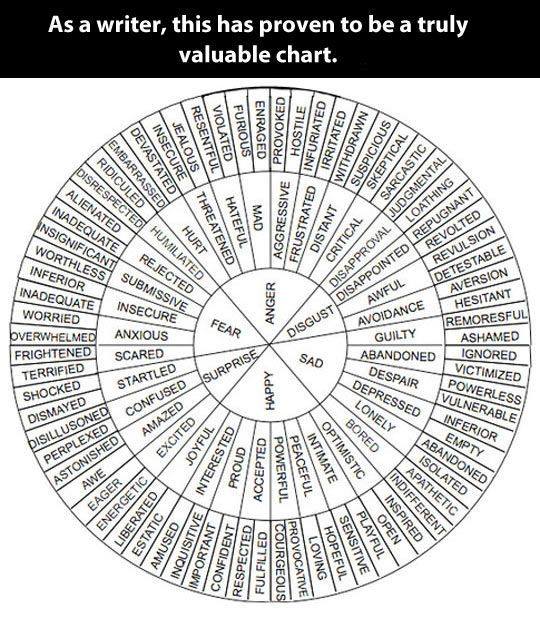
A quick chart that might help if you get stuck.
Filed under 2015, writing tip, Writing Tip Wednesday
Five Tips to Keep You Passionate About Your Writing
by M. SHANNON HERNANDEZ
Source: http://www.huffingtonpost.com/m-shannon-hernandez/five-tips-to-keep-you-pas_b_7537224.html
Tap, tap, tap — that is the sound of your creative fingertips hitting the keyboard.
As writers, we spend our days and nights hovering over our keyboards, pouring our ideas into a machine that will hopefully make sense of all that is going on in our brains. And don’t get me wrong — it is a wonderful life — but sometimes we look up to see that we have veered off track. Or perhaps we have worked so hard on a piece that maybe we aren’t quite so passionate about it anymore. I’ve been there before, and I am sure you have, too.
How can we stay on track, writing about those things which keep us passionate, when we must write for a living, day in and day out? Below you will find five tips to keep you passionate in your writing.
Arm yourself with these five strategies so you can continue living and writing passionately. Tap, tap, tap… your keyboard is waiting on you.
Details: http://www.huffingtonpost.com/m-shannon-hernandez/five-tips-to-keep-you-pas_b_7537224.html
Filed under 2015, writing tip, Writing Tip Wednesday
Don’t Muzzle (or Muffle) Your Writing Voice
By TOM BENTLEY
I think about the issue of voice in writing quite often. You know, your writing voice, that whiff of brimstone or reverberant cello note or cracked teeth and swollen tongue that stamps your writing as having been issued from you alone. Many writers, particularly younger ones, struggle to find their voice: the word choice, the cadence, the tone, the very punctuation—the stuff that slyly suggests or that screams that you wrote it.
You’d never mistake Donald Barthelme for Ernest Hemingway; the word blossoms gathered in Virginia Woolf’s garden would have flowers not found in the window-box plantings of Joan Didion. So your writing and your writing voice shouldn’t be confused with Schlomo Bierbaum’s—it should be yours alone.
One of the things that made me think of a person’s voice was a literal voice: a few years ago I saw Ricki Lee Jones in concert, and was so struck by her uniqueness as a performer (and possibly as a person). She was cuckoo and mesmerizing in the best of ways on stage: banging on the roof of the piano, exhorting the other players, talking to them in asides during some songs. She played a lunatic version of Don’t Fear the Reaper(!), beating out a slapclap on the top of her piano. The performance was so Rikki Lee Jones: singular, eccentric, passionate, moody. You wanted to be around her just to see what she might do or say (or sing) next. Her voice was hers and hers alone.
Your Writing Voice Is There for the Singing
When you’re developing your writing voice, you might be so painstakingly wrapped up in expressing yourself JUST SO that you drain the blood out of your writing, or pull the plug on the electricity of your ideas. You might have read an essay by Pico Iyer or a story by Alice Munro or a novel by Cormac McCarthy and you might be trying so hard to source and employ the rhythms, humors and tics of those gifted writers that you spill onto the page a fridge full of half-opened condiments that cancel each other’s flavors.
Be yourself behind the pen, be the channel between what cooks in your brain and what courses through the keyboard. Even if that self is one day the grinning jester and another the sentimental fool, be fully that person, unmasked, on the page. Maybe you grew up in a slum in Mumbai or have a pied-à-terre in every European capital, maybe your adolescence was a thing of constant pain, maybe you never made a wrong move, maybe you never moved at all—it should be in your writing, whether in its proclamations or its subtext. Your voice is all the Crayons in your box.
For instance, if you’re inclined to the confessional (like all us old Catholics), turn to your sins: I was a very enterprising shoplifter in high school, running a cottage resale business on the side. While I don’t recommend they teach my techniques in business school, I later forged my history of happy hands into an award-winning short story, and then turned the account of having won that short story contest into a published article in a Writer’s Market volume. Ahh, the just desserts of an empire of crime.
A Voice, and Its Chorus
Of course it’s no monotone: Sometimes I might write about Sisyphus and sometimes I might write about drool (and sometimes I might speculate whether Sisyphus drooled while pushing the rock up that endless hill). By that I mean your short stories might have a female narrators, male narrators, be set in a tiny town one time and in a howling metropolis the next. But you still must find the voice—your voice—for that story.
I like to write essays that often take a humorous slant, but at the same time, that isn’t the limit or restriction I put on my own expression. I published a piece on not actually knowing my father despite my years with him, and another that discusses never finding out what happened to my high school girlfriend after she vanished in Colombia. Both had a tone of pathos. That pensive tone is also one of my voices, and its sobriety doesn’t cancel the chiming of my comic voice. So your voice might be part of a choir.
Rest of the article: http://www.writersdigest.com/online-editor/dont-muzzle-or-muffle-your-writing-voice?et_mid=758567&rid=239626420
Filed under 2015, writing tip, Writing Tip Wednesday
Want to Succeed in Self-Publishing? Write for Yourself: Tips from an Indie Author
by DRUCILLA SHULTZ
 K.P. Ambroziak knows the sense of fulfillment and independence that going indie can bring. After self-publishing her vampire novel, The Journal of Vincent Du Maurier, Ambroziak received a positive review from Publishers Weekly, with our reviewer calling her book “fast-paced [and] suspenseful” and saying “science fiction and horror fans alike will anxiously race toward this journal’s end and eagerly request the next installment.”
Ambroziak has studied the indie market, but spends more time writing than promoting. The way she sees it, “without a good story, one that is polished and well-written, you’ve got nothing to sell.” Her response is also rooted in the fact that indie authors must fight against the stigma of “bad” writing. Still, Ambroziak says she was surprised by how good it felt to know someone had read her story. “The first review I received was unsolicited, and the thrill I felt at knowing I’d shared something intimate (my words) with someone (a stranger) was most surprising.”
We asked author K. P. Ambroziak if she had any tips for other self-published authors:
Mistakes are Part of the Process
“The lonely road of self-publishing has both advantages and disadvantages…For instance, you get to choose the cover page, decide if you agree with an edit, you get to name your book, pick your release date and whether there’ll be a second, third, or 11th book in your series. These can seem like daunting choices, but in fact they’re part and parcel of the road, and if you can embrace them, the control they offer bolsters up the whole of your self-publishing venture. You learn with each mistake you make, and self-publishing affords you the opportunity to correct those mistakes and apply them to future projects. Not knowing everything is a good thing.”
Write for Yourself
Reviews Aren’t Everything
Rest of the article: http://www.publishersweekly.com/pw/by-topic/authors/pw-select/article/66636-want-to-succeed-in-self-publishing-write-for-yourself-tips-from-an-indie-author.html
Filed under 2015, Writing Tip Wednesday, writing tips


 Booker's Blog