Category Archives: writer

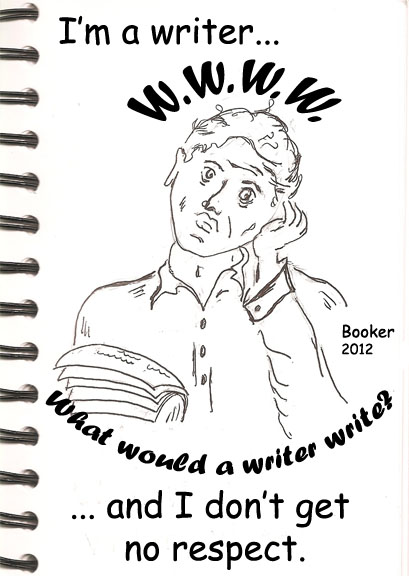
I’m a writer and I don’t get no respect

I'm a writer and I don't get no respect

Next time, I’ll just say E = mc2.

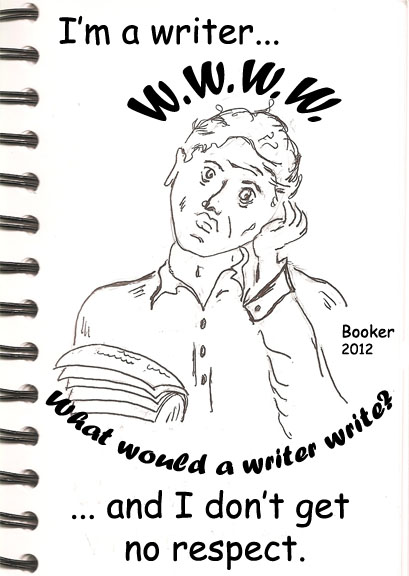
I’m a writer and I don’t get no respect. Just the other day I attended a party, and when somebody asked me what I did, I said I was a writer. He immediately began telling me his story that would “make a wonderful novel. So, I’ll tell it to you, you writer it up, and we’ll split the profits.”

Next time I go to a party and somebody asks me what I do for a living, I’ll say I’m a physicist. Nobody goes up to a physicist and says, “I have a wonderful theory. I’ll tell it to you, you write it down and put in all that math, and we’ll split the profits and the Nobel Prize.”

Leave a comment

Filed under cartoon by author, no respect, writer, writing humor

Ray Bradbury passes away

Ray Bradbury, Master of Science Fiction, Dies at 91

New York Times/

By GERALD JONAS

Source: http://www.nytimes.com/2012/06/07/books/ray-bradbury-popularizer-of-science-fiction-dies-at-91.html

Ray Bradbury, a master of science fiction whose lyrical evocations of the future reflected both the optimism and the anxieties of his own postwar America, died on Tuesday in Los Angeles. He was 91.

His death was confirmed by his agent, Michael Congdon.

By many estimations Mr. Bradbury was the writer most responsible for bringing modern science fiction into the literary mainstream. His name would appear near the top of any list of major science-fiction writers of the 20th century, beside those of Isaac Asimov, Arthur C. Clarke, Robert A. Heinlein and the Polish author Stanislaw Lem.

In Mr. Bradbury’s lifetime more than eight million copies of his books were sold in 36 languages. They included the short-story collections “The Martian Chronicles,” “The Illustrated Man” and “The Golden Apples of the Sun,” and the novels “Fahrenheit 451” and “Something Wicked This Way Comes.”

Though none won a Pulitzer Prize, Mr. Bradbury received a Pulitzer citation in 2007 “for his distinguished, prolific and deeply influential career as an unmatched author of science fiction and fantasy.”

Mr. Bradbury sold his first story to a magazine called Super Science Stories before his 21st birthday, and by the time he was 30 he had made his reputation with “The Martian Chronicles,” a collection of thematically linked stories published in 1950.

The book celebrated the romance of space travel while condemning the social abuses that modern technology had made possible, and its impact was immediate and lasting. Critics who had dismissed science fiction as adolescent prattle praised “Chronicles” as stylishly written morality tales set in a future that seemed just around the corner.

Mr. Bradbury was hardly the first writer to represent science and technology as a mixed bag of blessings and abominations. The advent of the atomic bomb in 1945 left many Americans deeply ambivalent toward science. The same “super science” that had ended World War II now appeared to threaten the very existence of civilization. Science-fiction writers, who were accustomed to thinking about the role of science in society, had trenchant things to say about this threat.

But the audience for science fiction, published mostly in pulp magazines, was small and insignificant. Mr. Bradbury looked to a larger audience: the readers of mass-circulation magazines like Mademoiselle and The Saturday Evening Post. These readers had no patience for the technical jargon of the science fiction pulps. So he eliminated the jargon; he packaged his troubling speculations about the future in an appealing blend of cozy colloquialisms and poetic metaphors.

“The Martian Chronicles” remains perhaps Mr. Bradbury’s best-known work. It became a staple of high school and college English courses. Mr. Bradbury himself disdained formal education. He went so far as to attribute his success as a writer to his never having gone to college.

Instead, he read everything he could get his hands on, by authors including Edgar Allan Poe, Jules Verne, H. G. Wells, Edgar Rice Burroughs, Thomas Wolfe and Ernest Hemingway. He paid homage to them in 1971 in the autobiographical essay “How Instead of Being Educated in College, I Was Graduated From Libraries.” (Late in life he took an active role in fund-raising efforts for public libraries in Southern California.)

Mr. Bradbury referred to himself as an “idea writer,” by which he meant something quite different from erudite or scholarly. “I have fun with ideas; I play with them,” he said. “ I’m not a serious person, and I don’t like serious people. I don’t see myself as a philosopher. That’s awfully boring.”

He added, “My goal is to entertain myself and others.”

He described his method of composition as “word association,” often triggered by a favorite line of poetry.

Mr. Bradbury’s passion for books found expression in his dystopian novel “Fahrenheit 451,” published in 1953. But he drew his primary inspiration from his childhood in Illinois. He boasted that he had total recall of his earliest years, including the moment of his birth. Readers had no reason to doubt him. In his best stories and in his autobiographical novel, “Dandelion Wine” (1957), he gave voice to both the joys and fears of childhood.

As for the protagonists of his stories, no matter how far they journeyed from home, they learned that they could never escape the past.

Raymond Douglas Bradbury was born Aug. 22, 1920, in Waukegan, Ill., a small city whose Norman Rockwellesque charms he later reprised in his depiction of the fictional Green Town in “Dandelion Wine” and “Something Wicked This Way Comes,” and in the fatally alluring fantasies of the astronauts in “The Martian Chronicles.” His father, a lineman with the electric company, numbered among his ancestors one of the women tried as a witch in Salem, Mass.

An unathletic child who suffered from bad dreams, he relished the tales of the Brothers Grimm and the Oz stories of L. Frank Baum, which his mother read to him. An aunt, Neva Bradbury, took him to his first stage plays, dressed him in monster costumes for Halloween and introduced him to Poe’s stories. He discovered the science-fiction pulps and began collecting the comic-strip adventures of Buck Rogers and Flash Gordon. A conversation with a carnival magician named Mr. Electrico that touched on immortality gave the 12-year-old Bradbury the impetus to become a writer.

In 1934 the family moved to Los Angeles, where Mr. Bradbury became a movie buff, sneaking into theaters as often as nine times a week. Encouraged by a high school English teacher and the professional writers he met at the Los Angeles chapter of the Science Fiction League, he began a lifelong routine of turning out at least a thousand words a day on his typewriter.

His first big success came in 1947 with the short story “Homecoming,” narrated by a boy who feels like an outsider at a family reunion of witches, vampires and werewolves because he lacks supernatural powers. The story, plucked from the pile of unsolicited manuscripts at Mademoiselle by a young editor named Truman Capote, earned the 27-year-old Mr. Bradbury an O. Henry Award in 1947 as one of the best American short stories of the year.

With 26 other stories in a similar vein, “Homecoming” appeared in Mr. Bradbury’s first book, “Dark Carnival,” published by a small specialty press in 1947. That same year he married Marguerite Susan McClure, whom he had met in a Los Angeles bookstore.

Having written himself “down out of the attic,” as he later put it, Mr. Bradbury focused on science fiction. In a burst of creativity from 1946 to 1950, he produced most of the stories later collected in “The Martian Chronicles” and “The Illustrated Man” and the novella that formed the basis of “Fahrenheit 451.”

While science-fiction purists complained about Mr. Bradbury’s cavalier attitude toward scientific facts — he gave his fictional Mars an impossibly breathable atmosphere — the literary establishment waxed enthusiastic. The novelist Christopher Isherwood greeted Mr. Bradbury as “a very great and unusual talent,” and one of Mr. Bradbury’s personal heroes, Aldous Huxley, hailed him as a poet. In 1954, the National Institute of Arts and Letters honored Mr. Bradbury for “his contributions to American literature,” in particular the novel “Fahrenheit 451.”

“The Martian Chronicles” was pieced together from 26 stories, only a few of which were written with the book in mind. The patchwork narrative spans the years 1999 to 2026, depicting a series of expeditions to Mars and their aftermath. The native Martians, who can read minds, resist the early arrivals from Earth, but are finally no match for them and their advanced technology as the humans proceed to destroy the remains of an ancient civilization.

Parallels to the fate of American Indian cultures are pushed to the point of parody; the Martians are finally wiped out by an epidemic of chickenpox. When nuclear war destroys Earth, the descendants of the human colonists realize that they have become the Martians, with a second chance to create a just society.

“Fahrenheit 451,” Mr. Bradbury’s indictment of book-burning in a near-future America (the title refers to the temperature at which paper ignites), is perhaps his most successful book-length narrative. It was made into a well-received movie by François Truffaut in 1966. The cautionary tale of a so-called fireman, whose job is to start fires, “Fahrenheit 451” has been favorably compared to George Orwell’s “1984.”

As Mr. Bradbury’s reputation grew, he found new outlets for his talents. He wrote the screenplay for John Huston’s 1956 film version of “Moby-Dick,” scripts for the television series “Alfred Hitchcock Presents” and collections of poetry and plays.

In 2004, President George W. Bush and the first lady, Laura Bush, presented Mr. Bradbury with the National Medal of Arts.

While Mr. Bradbury championed the space program as an adventure that humanity dared not shirk, he was content to restrict his own adventures to the realm of imagination. He lived in the same house in Los Angeles for more than 5o years, rearing four daughters with his wife, Marguerite, who died in 2003. For many years he refused to travel by plane, preferring trains, and he never learned to drive.

He is survived by his daughters, Susan Nixon, Ramona Ostergen, Bettina Karapetian, and Alexandra Bradbury, and eight grandchildren.

Though the sedentary writing life appealed to him most, he was not reclusive. He developed a flair for public speaking, which made him a sought-after figure on the national lecture circuit. There he talked about his struggle to reconcile his mixed feelings about modern life, a theme that animated much of the fiction that won him such a large and sympathetic audience.

And he talked about the future, perhaps his favorite subject, describing how it both attracted and repelled him, leaving him with apprehension and hope.

Leave a comment

Filed under obituary, Ray Bradbury, writer

I’m a writer and I don’t get no respect

Writer Gets No Respect

Critics are everywhere.

One reason the human race has such a low opinion of itself is that it gets so much of its wisdom from writers. –Wilfrid Sheed

All writing is garbage. People who come out of nowhere to try to put into words any part of what goes on in their minds are pigs. –Antonin Artaud

The noted writer Theodore Sturgeon was once asked why so much of science fiction writing was “crap.” He paused for a moment, nodded, and said, yes, 90 percent of science fiction was crap, but that “90 percent of everything is crap.” This is known as Sturgeon’s Law, and is just as true today as it was in the early 1950s when he first pronounced it.

Same is true for critics of writers and writing.

[Errata: I had originally and erroneously attributed this to Robert Heinlein, another noted writer of such classics as Stranger in a Strange Land. My apologies and thank to Tom Dupree for pointing out my error. It is good to have smarter readers dropping by to read your blog posts. May we all be so fortunate. Thank you to all who stop by, read, like, and comment. It is one of the advantages of this blog format. Thank you all. –Editor]

4 Comments

Filed under cartoon by author, no respect, writer

I’m a writer and I don’t get no respect

Sometimes I feel lower than a defeated politician....

Sometimes I feel lower than a defeated politician….

Next to the defeated politician, the writer is the most vocal and inventive griper on earth. He sees hardship and unfairness wherever he looks. His agent doesn’t love him (enough). The blank sheet of paper is an enemy. The publisher is a cheapskate. The critic is a philistine. The public doesn’t understand. His wife doesn’t understand him. The bartender doesn’t understand him. –PETER MAYLE

2 Comments

Filed under cartoon by author, no respect, writer, writing humor

W.W.W.W.: rejection

No Respect cartoon

Rejection might not be “forever.”

I’m a writer and I don’t get no respect. Just the other day I got a rejection notice. Not only was it a one-page form letter, photocopied cockeyed on the copy machine, the self-addressed stamped envelope came postage due — and I had used two forever stamps!

Leave a comment

Filed under cartoon by author, no respect, writer

Writing tip: a writer can’t just be a writer

Should You Focus on Your Writing or Your Platform?

by Jane Friedman

April 27, 2012

Source: http://writerunboxed.com/2012/04/27/should-you-focus-on-your-writing-or-your-platform/#more-14057

Craft!

Platform!

Craft!!

Platform!!

It’s a debate that might span eternity: how much time should you devote to writing versus platform building?

I don’t know if there was ever a real beginning to this debate, but if so, it was when editors and agents started telling nonfiction authors that their book was only viable if a platform was in place. Which made sense for technological and cultural reasons. Take the ease of word processing and affordable personal computers, add Baby Boomers with free time to pursue their dreams, and presto! Suddenly there were more people than ever trying to write a book and get it published, with limited skills and experience, and often no credentials.

So what does a well-meaning agent or editor say to one of these people? The easiest thing to say is: You need a platform.

Fast forward a decade or two, and we now live inside an unending media conversation wheel, where anyone can find a niche readership, do solid work on building a platform, and even put writing on the backburner—and still reasonably claim to be a writer.

I think there’s a backlash against some of these people, which I understand. It’s applying the entrepreneurial, get-rich-quick Tim Ferriss mindset to the world of literature, where we tend to believe that blood, sweat, and tears (and rejection) are demanded before you gain recognition.

Plus: Real writers write. (Right?) They don’t tweet, they don’t blog, they don’t connect with readers, at least not joyfully.

I exaggerate, but you know the people I’m talking about.

The horrible catch is—at least for beginning writers without fame and fortune, who are starting their careers in a transitioning industry—focusing on your writing work to the exclusion of all else can hamper you later down the road. If you shut yourself away and don’t learn to navigate the online world (the personalities, the flow of conversations, the tools), you’re terribly disadvantaged when it comes time to get a publisher, market your work, and find readers.

Excellent arguments reside on each side of this debate, which often boil down to: “Writing is all that matters,” and “audience is all that matters.”

But the truth is a little different for each of us, and that’s why it’s next to impossible to give general advice on platform. It necessarily varies based on the author and the work in question.

But it does rip me apart to hear very new writers feel anxious that they can’t figure out their platform, especially when they have not a single book or credit to their name.

Well, it’s not a mystery why platform is so confusing when you don’t know who you are yet as a writer!

This has been a very long preface to what I’d like to offer: a set of general guidelines to help any writer understand how to balance writing with platform building.

Balance is the key word here.

Focusing on your writing probably means spending 10%-25% of your available writing time on platform activities. I never recommend abandoning platform activities entirely, because you want to be open to new possibilities. Being active online—while still focused on your writing—could mean finding a new mentor or the perfect critique partner, connecting with an important influencer, or pursuing a new writing retreat or fellowship opportunity.

Without further ado, the list.

When to focus more on your writing:

If you are within the first five years of seriously attempting to write with the goal of publication
For novelists: If you have not yet completed and revised one or two full-length manuscripts
If you can tell that what you’re writing is falling short of where you want and need to be
If you see a direct correlation between the amount of writing you put out and the amount of money that comes into your bank account (the JA Konrath model)
If you are working on deadline.

When to focus more on your platform:

If you start to realize you’re on the verge of publication
If you have a firm book release date of any kind
If you want to sell a nonfiction book concept (non-narrative)
If you intend to profit from online/digital writing that you are creating, distributing, and selling on your own
If you need to prove to a publisher or agent that your work has an audience.

Brief Bio.: Jane Friedman is a professor of media and writing at the University of Cincinnati, and the former publisher of Writer’s Digest. Visit her at JaneFriedman.com, for regular insights into the future of publishing.

4 Comments

Filed under writer, writing, writing tip

Writing Tip: Plotting backwards

[Editor’s note: the essay below is taken from an e-mail newsletter sent out by the writer Bruce Hale. you can find his web site at: http://www.brucehalewritingtips.com/. You can also sign up for his e-newsletter at that site. Each electronic newsletter comes with other information, including a writing joke.]

WHY BACKWARDS IS BEST WHEN PLOTTING A MYSTERY

By BRUCE HALE

When I wrote my first mystery, I hadn’t a clue. I tried writing it straight through, plotting as I went, and ended up falling flat on my face. Why? I hadn’t yet learned that backwards is best.

You see, contrary to the way most fiction is mapped out, mysteries are backwards creatures. They’re easiest to write when plotted backwards from the ending, rather than forward from the beginning. Mysteries, by their nature, are a complex tangle, and if you’re not careful, you’ll get stuck in it.

As I learned the hard way, if you write from the beginning, you’ll be left flatfooted with your detective, trying to figure out how to solve the mystery.

Better to go the easy way: work from the solution. Start from the ultimate revelation of whodunit and work your way backwards to mystery writing success. Here’s how:

– DECIDE WHODUNIT, WHY, AND HOW
First, pick the crime to be solved and the culprit. Suss out why they committed the crime – and the less obvious the reason, the better. Your villain (or clues from him) should be part of the story from fairly early on, but his motives and actions must remain hidden until the twist reveals them. Hide your villain in plain
sight – heck, you could even go so far as to make them a seeming ally of your hero.

– PLAN YOUR TWIST
This is the dramatic reveal, the “It’s not Snape, it’s Quirrell!” moment. (Sorry if I spoiled Harry Potter I for you.) The twist should occur at the least convenient moment, preferably when the hero is most vulnerable. Usually the twist occurs at or just before the climax.

To make the twist work, you need to come up with at least one or two plausible culprits, then show why they didn’t commit the crime.

– LAY OUT YOUR RED HERRINGS
These are the likely culprits, the leads your detective follows that turn out to be dead ends. Be sure the herrings are motivated as well, and if you can disguise their motivations or make them ambiguous, so much the better. Anything to make them *more* plausible, and your true villain *less* plausible.

– SCATTER YOUR CLUES
What tips your hero off to the fact that the villain is guilty? A latticework of little clues (usually connected much too late). You must always play fair with the reader, so be sure the clues are there, even if the detective and her trusty assistant initially dismiss them.

The key with clues is to use misdirection — have them seem insignificant, or be misinterpreted. You can’t make it too easy for the detective, or the reader!

– START WITH A BANG
And last, but not least, come up with a grabber of an opening that plunges us right into the heart of the mystery. Ideally, it should contain some small clue that points us toward the true culprit.

With all that in place, now you’re ready to write your first words. Happy mystery writing, and may the spirit of Chandler and Hammett be with you!

2 Comments

Filed under Bruce Hale, plot, writer, writing, writing blog, writing tip

I’m a writer and I don’t get no respect

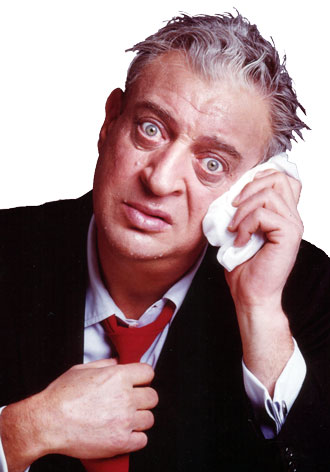
[Editor’s note: I believe it was the late Rodney Dangerfield who had a comedy routine based on “I don’t get no respect.” The lack of respect could come from anybody, anywhere, including his wife. Below is a playwright Rodney could empathize with. He writes to Dear Abby, and she responds. I have known one or two other writers in the same situation. Maybe you, do, too.]

Rodney Dangerfield

Sometimes respect is hard to come by for a writer, or a comic. Just ask Rodney Dangerfield.

DEAR ABBY: I am an amateur playwright. Our local theater sponsors an annual playwriting contest. The prize isn’t monetary, but something far more important to an author – full scale production of the play.

I have won this prize four times – more than any other writer in the history of the contest. But is my family impressed? Not at all! My wife told me she thinks I write everything the same way and have simply repeated myself four times.

I am up in years. It’s unlikely I will ever again win this prize. So how do I respond to such indifference? What do you do when you feel you have accomplished something important and the response is, “so what else is new?”

–Looking for Validation in Florida

DEAR LOOKING FOR VALIDATION: My hat’s off to you. That you have won this prize more than any other writer in the history of the contest is a notable achievement. Attend the production, take your well-earned bow in the spotlight, and accept that the less you look to your wife for validation, the happier your life will be.

Leave a comment

Filed under advice, Dear Abby, humor, respect, Rodney Dangerfield, writer, writing

Unwise wit: Pain of a different sort

Wise author Paul Coelho writes: Contrary to glasses and windows, a broken heart remains intact.

Unwise wit responds: That’s because it’s a pain of a different sort.

The window pain

The window pain ... in The Twilight Zone.

Leave a comment

Filed under pain, Paul Coelho, wit, Woirds to live by, word play, words, writer

Writing Tip: Successful Revision

[Editor’s note: the essay below is taken from an e-mail newsletter sent out by the writer Bruce Hale. you can find his web site at: http://www.brucehalewritingtips.com/. You can also sign up for his e-newsletter at that site. Each electronic newsletter comes with other information, including a writing joke.]

5 ELEMENTS OF A SUCCESSFUL REVISION

By Bruce Hale

So you’ve finished that first draft and let your story marinate in its own juices for a while, and now it’s time for revision. Only question is: where to start?

With a picture book, that’s not too terribly daunting. But with a longer novel, you’d be well served to devise a strategy before plunging into those narrative hickets that can swallow the unwary writer. I suspect everyone has his or her own favored approach to revision. Here’s the one I’ve found most useful…

1. FIRST READ
First time through, the hardest thing is to *just* read your story and take notes. No line edits, no grammar corrections, no paragraph revisions — just reading. But if you want to be able to see the whole forest, instead of the individual trees, this approach is vital.

By all means, take copious notes. “Tighten the opening on page 43;” “wonky sentence on page 12, first paragraph;” “fix the plot logic in Chapter 18.” These are all helpful. And they prepare the way for…

2. FIRST REVISION
Once you’ve waded through your story and taken copious notes, congratulate yourself. It’s not as bad as you thought, right? (We hope.) With this optimistic thought, it’s time to roll up the sleeves and plunge into wholehearted revision.

The first time through, work on larger issues: plot holes, character inconsistencies, gaps in story logic, slow scenes that need to be trimmed, and so forth. You can always do the fine polishing later.

Revise sequentially if you can, rather than skipping around. For any sections that require you to write new material, use the same method you would in a first draft: write it fast and sloppy. After all, you can always fix it in the NEXT revision.

3. READ-ALOUD REVISION
Taking the time to read your work aloud may seem redundant at this point, but it’s necessary. You won’t believe how many errors you’ll catch. Homonyms, awkward phrasing, missing words, echoes (unintentionally repeated words) — all these will pop out at you like Halloween skeletons at a haunted house.

This is the revision where you can really focus on the sound and rhythm of your writing. Listen for those areas that sound clunky and don’t really roll off the tongue — that’s your cue to break out the belt sander and make things smooooth.

4. DIALOG REVISION
Once the story is as good as you can make it, and you’ve read aloud to catch hidden glitches, it’s time to turn the microscope on your dialog. First, make sure each character speaks differently. Have them use different idioms, word choice and catch phrases — otherwise, they’ll all sound like each other (or like you).

Top-notch authors like Elmore Leonard vary their character dialog so deftly, they don’t even need attributions (he said/she said). It’s that clear who’s speaking. In real life, we all have our own ways of putting things. So just make sure your fictional characters possess that same distinction.

5. FINAL CHECK
Before I send my story off to agent or editor, I usually try to let it sit for a week or so, then do one last read-through, to make sure all my changes fit, and to smooth out any remaining rough edges. This is an ideal time to search for words you overuse. (And we *all* overuse certain pet words.)

For example, I know that I tend to drop in “just” and “only” too often, and I tend to have too many characters shrugging and nodding. A quick search for these words shows me where I’ve overdone it, and a quick fix guards against too much sameness in the manuscript.

And that’s about all I can bear to write on the subject of revision right now. I think you know why. Yes — time to get back to revising my latest story.

Leave a comment

Filed under advice column, Bruce Hale, revising, words, writer, writing, writing tip