
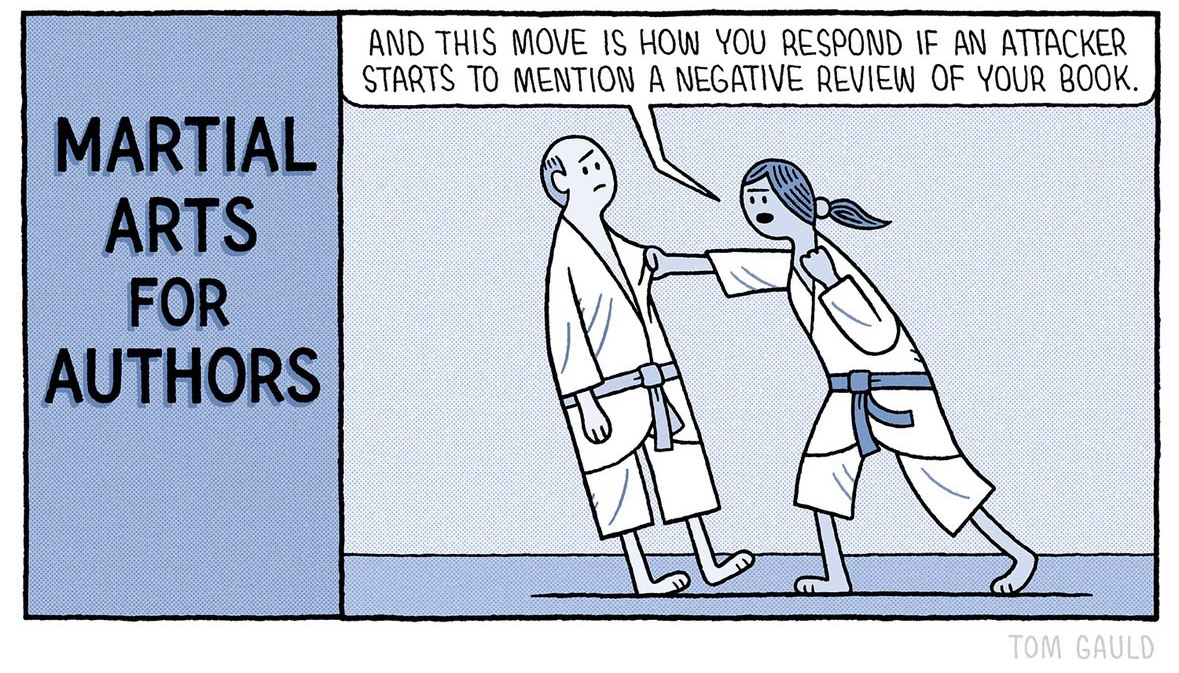
Author
Author, dear author, /
I relent, I repent, I plead: /
“Give me one more chance!”
.
.
#051125 #2025 #author #relent #repent #plead #chance #haiku #poem #poetry #haiga #tomgould #cartoonnotmine #may #sunday
Author
Author, dear author, /
I relent, I repent, I plead: /
“Give me one more chance!”
.
.
#051125 #2025 #author #relent #repent #plead #chance #haiku #poem #poetry #haiga #tomgould #cartoonnotmine #may #sunday
Filed under 2025, author, Cartoon, haiku, poem, poet, poetry, poetry by author, Poetry by David E. Booker, writer
Up the Amazon with the BS Machine,
or
Why I keep Asking You Not to Buy Books from Amazon
by Ursula K. Le Guin
Source: http://bookviewcafe.com/blog/2015/06/01/up-the-amazon/
Amazon and I are not at war. There are vast areas in which my peaceful indifference to what Amazon is and does can only be surpassed by Amazon’s presumably equally placid indifference to what I say and do. If you like to buy household goods or whatever through Amazon, that’s totally fine with me. If you think Amazon is a great place to self-publish your book, I may have a question or two in mind, but still, it’s fine with me, and none of my business anyhow. My only quarrel with Amazon is when it comes to how they market books and how they use their success in marketing to control not only bookselling, but book publication: what we write and what we read.
Best Seller lists have been around for quite a while. Best Seller lists are generated by obscure processes, which I consider (perhaps wrongly) to consist largely of smoke, mirrors, hokum, and the profit motive. How truly the lists of Best Sellers reflect popularity is questionable. Their questionability and their manipulability was well demonstrated during the presidential campaign of 2012, when a Republican candidate bought all the available copies of his own book in order to put it onto the New York Times Top Ten Best Seller List, where, of course, it duly appeared.
If you want to sell cheap and fast, as Amazon does, you have to sell big. Books written to be best sellers can be written fast, sold cheap, dumped fast: the perfect commodity for growth capitalism.
The readability of many best sellers is much like the edibility of junk food. Agribusiness and the food packagers sell us sweetened fat to live on, so we come to think that’s what food is. Amazon uses the BS Machine to sell us sweetened fat to live on, so we begin to think that’s what literature is.
I believe that reading only packaged microwavable fiction ruins the taste, destabilizes the moral blood pressure, and makes the mind obese. Fortunately, I also know that many human beings have an innate resistance to baloney and a taste for quality rooted deeper than even marketing can reach.
If it can find its audience by luck, good reviews, or word of mouth, a very good book may become a genuine Best Seller. Witness Rebecca Skloot’s Immortal Life of Henrietta Lacks, which for quite a while seemed to have immortal life among the Times Top Ten. And a few books work their way more slowly onto BS lists by genuine, lasting excellence — witness The Lord of the Rings, or Patrick O’Brian’s sea stories. Not products of the BS Machine, such books sell because people actually like them. Once they get into the BS Machine, they are of course treated as products of the BS Machine, that is, as commodities to exploit.
Making a movie of a novel is a both a powerful means of getting it into the BS Machine and a side-effect of being there.
Read the rest: http://bookviewcafe.com/blog/2015/06/01/up-the-amazon/
Mr. Scalzi said he hoped books like “Lock In” could draw more readers toward science fiction, since many, he said, are still “gun-shy” about the genre.
By JOHN SCHWARTZ
John Scalzi, a best-selling author of science fiction, has signed a $3.4 million, 10-year deal with the publisher Tor Books that will cover his next 13 books.
Mr. Scalzi’s works include a series known as the “Old Man’s War” and the more recent “Redshirts,” a Hugo-award-winning sendup of the luckless lives of nonfeatured characters on shows like the original “Star Trek.” Three of his works are being developed for television, including “Redshirts” and “Lock In,” a science-inflected medical thriller that evokes Michael Crichton. Mr. Scalzi’s hyper-caffeinated Internet presence through his blog, Whatever, has made him an online celebrity as well.
Mr. Scalzi approached Tor Books, his longtime publisher, with proposals for 10 adult novels and three young adult novels over 10 years. Some of the books will extend the popular “Old Man’s War” series, building on an existing audience, and one will be a sequel to “Lock In.” Mr. Scalzi said he hoped books like “Lock In” could draw more readers toward science fiction, since many, he said, are still “gun-shy” about the genre.
Patrick Nielsen Hayden, the executive editor for Tor, said the decision was an easy one. While Mr. Scalzi has never had a “No. 1 best seller,” he said, “he backlists like crazy.”
“One of the reactions of people reading a John Scalzi novel is that people go out and buy all the other Scalzi novels,” Mr. Nielsen Hayden said.
He said Mr. Scalzi sells “a healthy five-figure number of his books every month,” and that he “hasn’t even begun to reach his full potential audience.”
Science fiction films like “2001: A Space Odyssey” and “Star Wars” have been considered popular classics for decades, “but there’s a lot of work to be done,” Mr. Scalzi said, in bringing readers to the genre. He said the long-term contract would allow him to continue experimenting with different forms of publishing, including online serialization, a technique he has tried with some success.
Mr. Scalzi, who lives in Ohio, said he was still trying to come to grips with the size and scope of the deal. He said his wife, Kristine, had kept his ego from going supernova.
“My celebration, personally, has just been standing around,” exclaiming with profane expressions of delight, he said. “And my wife saying, ‘Yes, now go take out the trash.’ ”
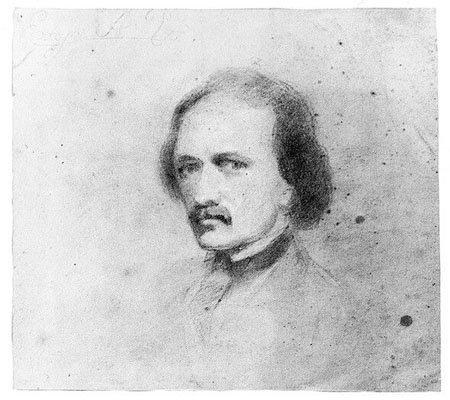
Edgar Allan Poe — self-portrait
Was the famous author killed from a beating? From carbon monoxide poisoning? From alcohol withdrawal? Here are the top nine theories
By Natasha Geiling
Source: http://www.smithsonianmag.com/history/still-mysterious-death-edgar-allan-poe-180952936/#vV6aWAfTgq8vGGWu.99
Give the gift of Smithsonian magazine for only $12! http://bit.ly/1cGUiGv
Follow us: @SmithsonianMag on Twitter
t was raining in Baltimore on October 3, 1849, but that didn’t stop Joseph W. Walker, a compositor for the Baltimore Sun, from heading out to Gunner’s Hall, a public house bustling with activity. It was Election Day, and Gunner’s Hall served as a pop-up polling location for the 4th Ward polls. When Walker arrived at Gunner’s Hall, he found a man, delirious and dressed in shabby second-hand clothes, lying in the gutter. The man was semi-conscious, and unable to move, but as Walker approached the him, he discovered something unexpected: the man was Edgar Allan Poe. Worried about the health of the addled poet, Walker stopped and asked Poe if he had any acquaintances in Baltimore that might be able to help him. Poe gave Walker the name of Joseph E. Snodgrass, a magazine editor with some medical training. Immediately, Walker penned Snodgrass a letter asking for help.
Baltimore City, Oct. 3, 1849
Dear Sir,There is a gentleman, rather the worse for wear, at Ryan’s 4th ward polls, who goes under the cognomen of Edgar A. Poe, and who appears in great distress, & he says he is acquainted with you, he is in need of immediate assistance.
Yours, in haste,
JOS. W. WALKER
To Dr. J.E. Snodgrass.
On September 27—almost a week earlier—Poe had left Richmond, Virginia bound for Philadelphia to edit a collection of poems for Mrs. St. Leon Loud, a minor figure in American poetry at the time. When Walker found Poe in delirious disarray outside of the polling place, it was the first anyone had heard or seen of the poet since his departure from Richmond. Poe never made it to Philadelphia to attend to his editing business. Nor did he ever make it back to New York, where he had been living, to escort his aunt back to Richmond for his impending wedding. Poe was never to leave Baltimore, where he launched his career in the early 19th- century, again—and in the four days between Walker finding Poe outside the public house and Poe’s death on October 7, he never regained enough consciousness to explain how he had come to be found, in soiled clothes not his own, incoherent on the streets. Instead, Poe spent his final days wavering between fits of delirium, gripped by visual hallucinations. The night before his death, according to his attending physician Dr. John J. Moran, Poe repeatedly called out for “Reynolds”—a figure who, to this day, remains a mystery.
Poe’s death—shrouded in mystery—seems ripped directly from the pages of one of his own works. He had spent years crafting a careful image of a man inspired by adventure and fascinated with enigmas—a poet, a detective, an author, a world traveler who fought in the Greek War of Independence and was held prisoner in Russia. But though his death certificate listed the cause of death as phrenitis, or swelling of the brain, the mysterious circumstances surrounding his death have led many to speculate about the true cause of Poe’s demise. “Maybe it’s fitting that since he invented the detective story,” says Chris Semtner, curator of the Poe Museum in Richmond, Virginia, “he left us with a real-life mystery.”
The nine theories include: beating, cooping (voter fraud), alcohol (related to cooping), poisoning (carbon monoxide or heavy metal), murder, and flu.
R. A. Montgomery 1936 – 2014
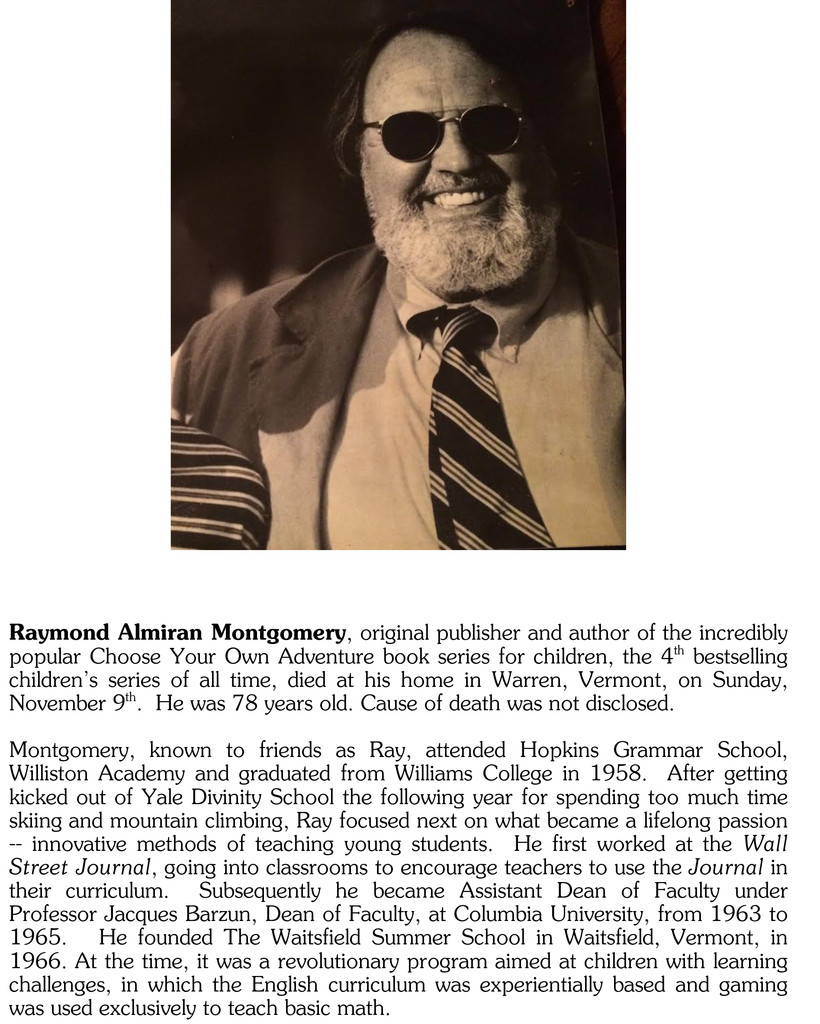
Rest of the obituary: http://www.cyoa.com/pages/r-a-montgomery-1936-2014
“…talent is like electricity. We don’t understand electricity. We use it.”
–Maya Angelou

Maya Angelou
(1928 – 2014)
Filed under writer, Writers on writing
BIG IN JAPAN
by David Gordon
You might not know me, but I’m famous. Don’t feel bad. Until recently, I didn’t know I was famous either, and most days, even now, it’s hard to tell.
In 2010 I published a novel, “The Serialist.” It did fine for a debut, which is to say well enough to warrant a second, but my daily life didn’t change much: I wrote, I ran, I hung out with my friends. Then a Japanese translation came out, and things got strange. My book won a major Japanese literary contest, which was nice. Then it won another. Then another. Apparently this was extraordinary: No one had ever won all three before. I received copies of articles, which were totally incomprehensible to me except for the picture of my face and a big No. 1. I tried Google Translate, which rendered it all into tantalizing gibberish. My book was not even called “The Serialist” in Japan: The character is a pulp writer, so they used the title “Niryuu Shousetsuka,” which translates back into English as “Second-Rate Novelist.” That was me!
The odd, or oddest, part, was that I had always been a fan of Japanese culture, its films, books and art, though I had never studied it, and it played no role in my books. It was like having a distant teenage crush on someone who suddenly wrote and said, “I like you, too.”
The culmination of this peculiar adventure, which I had observed only from afar, occurred when Toei Studio made “Niryuu Shousetsuka: Serialist,” a film based on my book. That is to say, a Japanese movie set in Tokyo, with Japanese actors speaking Japanese, rather than my version, which features non-Japanese people and takes place mostly in Queens.
They made the movie very fast, in about six months, and invited me to the premiere in June 2013. My Japanese publishers had contrived to release my new book, “Mystery Girl,” at the same time. The novel wouldn’t even be published in English until July. Maybe it had something to do with the international date line, the way emails from East Asia seem to come from tomorrow, but my Japanese life was clearly way ahead of my American life. So I went.
Rest of the article at:
http://www.nytimes.com/2014/01/12/magazine/big-in-japan.html?ref=lives&_r=1
[Editor’s note: thanks to Ashlie for sending this my way.]

Sometimes “coal” comes in strange forms.
I’m a writer and I don’t get no respect. Just the other day, I saw Santa Claus. I said, “Hey Santa, I want a best seller. Just one best seller. That’s all I ask. That’s all I work for. Can you help me out?”
On Christmas morning I found a Stephen King novel under my tree. A used one at that.
Filed under cartoon by author, Monday morning writing joke, no respect, writer


 Booker's Blog