
Open and empty
heart with a full measure of
empathy and love.
Category Archives: words
Empty: Full
Open and empty
heart with a full measure of
empathy and love.
Touching Nature

Top of young tree broken by human hand just leaves are budding out.
Touch Nature’s beauty;
even the hand that twists the
tree free of its growth.
Unwise wit: Pain of a different sort
Wise author Paul Coelho writes: Contrary to glasses and windows, a broken heart remains intact.
Unwise wit responds: That’s because it’s a pain of a different sort.
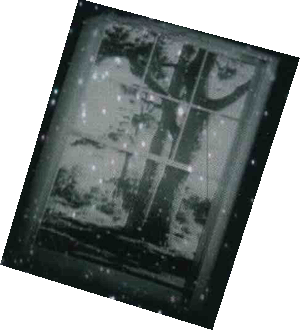
The window pain ... in The Twilight Zone.
Filed under pain, Paul Coelho, wit, Woirds to live by, word play, words, writer
The Kibitzer and The Kidd, part 6
888888
It wasn’t fair. Not only did he have a nickname he didn’t like – Kibbey – but he was also sleeping in the stable with the horses. Horse and hay, flatulence and flies, though it seemed odd that there were so many flies at night. He wondered if a fly got zapped by lightning, would it be resurrected.
Even the popcorn they delivered to him was stale and a little soggy from the humidity it picked up from the air. He had a bag of his own, but it had started raining again, so he couldn’t pop it outside. He looked around to see if the blacksmith’s workshop was part of the stables or nearby.
There was not a blacksmith’s forge, so he was on his own to create a fire.
He understood that the Kidd was the hero, having shot the pistol out of the floor-faced man’s hand. He knew that kibitzers were not easily or fully accepted into society. They were witnesses and scribes, and they reported to an authority most didn’t know about or understand. He certainly wasn’t sure why he had been selected. His family were not kibitzers. Nor any of his friends. And when they came in the middle of the night and told him he was selected, they did not give him a chance to say goodbye to his wife and two sons. Only a short note, quickly scribbled. It read: I’ve been selected. Don’t wait up.
He wasn’t sure how long ago that was, what his wife was like now, if his sons even remembered him.
The Kibitzer piled some hay in one area of mostly dirt. It was turning cold. He’d need the fire for more than popcorn.
Popcorn was his only solace. Bags of it turned up at the oddest times in the oddest places. He took it as a sign he was doing a good job.
He kept a book of matches dry and buried deep in a saddle bag. They were hard to get and he usually sparked a fire with a piece of flint and a piece of steel he carried; but they were both wet from rain. He was also too tired to try.
He added a piece of dried horse manure to the hay pile.
He found the matches, walked back to the pile of straw and dried other things and selected one from the box.
It was then somebody, head draped in a hood, stepped into the stable and tossed a torch on a larger pile of hay nearby. As the man left, he said, “Don’t wait up.”
At least that’s what the Kibitzer thought he said. The words were muffled by the hood. The words stunned him. By the time the Kibitzer recovered, the fire had spread to other parts of the stable, and the culprit was gone, and the Kibitzer was trapped.
(To be continued.)
Filed under humor, kibitzer, kidd, science fiction, story, storytelling, western, word play, words, writing
Found story: Frank and Ike
“Frank, what are we?”
“We’re pumpkins, Ike.”
“But if we’re pumpkins, how come we’re white?”

Frank (left) and Ike (right) discuss life as a pumpkin.
“Halloween came and went, and when Christmas came along, they decorated us up as snowmen. Or at least the heads of them.”
“Oh, nice, Frank.”
“If you say so.”
“What do you mean?”
“Ike, just wait and see.”
#
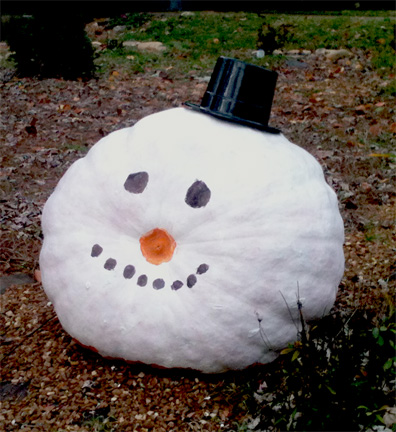
Ike tells Frank they're changing.
“Frank, are you still there?”
“Yes, Ike.”
“We’re changing. I feel it on the inside.”
“If you say so.”
#
“Frank, look at you.”
“I can’t see myself, Ike. I can’t even see you now.”
“Frank, I’m scared.”
“I know.”
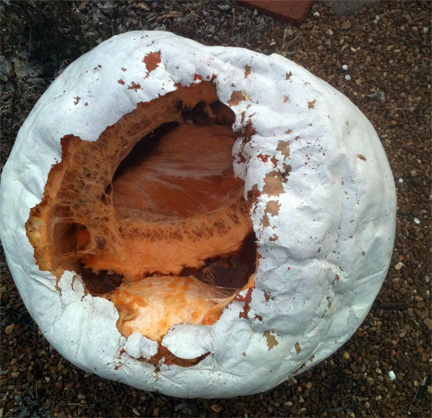
Ike becoming undone.
“Frank, what are we?”
“We’re friends.”
“I mean, what are we? What are we becoming?”
“We’re pumpkins, Ike. We’ve been pumpkins. We are pumpkins. We will always be pumpkins.”
“Are you sure?”
“I’m sure.”
“That’s good to know, Frank. Good to know.”
“Good bye, Ike.”
“Frank, don’t leave me.”
“Frank … Frank ….”
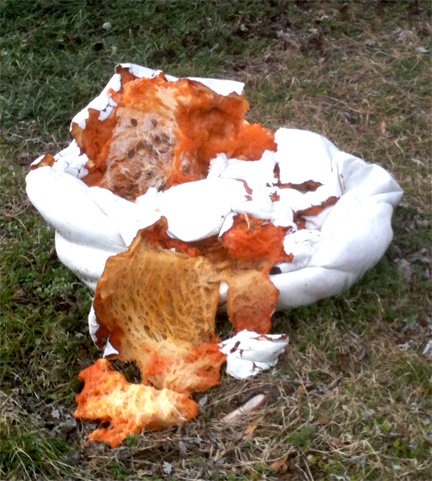
Frank undone.
Filed under Found story, pumpkins, story, storytelling, words, writing
Writing Tip: Successful Revision
[Editor’s note: the essay below is taken from an e-mail newsletter sent out by the writer Bruce Hale. you can find his web site at: http://www.brucehalewritingtips.com/. You can also sign up for his e-newsletter at that site. Each electronic newsletter comes with other information, including a writing joke.]
5 ELEMENTS OF A SUCCESSFUL REVISION
By Bruce Hale
So you’ve finished that first draft and let your story marinate in its own juices for a while, and now it’s time for revision. Only question is: where to start?
With a picture book, that’s not too terribly daunting. But with a longer novel, you’d be well served to devise a strategy before plunging into those narrative hickets that can swallow the unwary writer. I suspect everyone has his or her own favored approach to revision. Here’s the one I’ve found most useful…
1. FIRST READ
First time through, the hardest thing is to *just* read your story and take notes. No line edits, no grammar corrections, no paragraph revisions — just reading. But if you want to be able to see the whole forest, instead of the individual trees, this approach is vital.
By all means, take copious notes. “Tighten the opening on page 43;” “wonky sentence on page 12, first paragraph;” “fix the plot logic in Chapter 18.” These are all helpful. And they prepare the way for…
2. FIRST REVISION
Once you’ve waded through your story and taken copious notes, congratulate yourself. It’s not as bad as you thought, right? (We hope.) With this optimistic thought, it’s time to roll up the sleeves and plunge into wholehearted revision.
The first time through, work on larger issues: plot holes, character inconsistencies, gaps in story logic, slow scenes that need to be trimmed, and so forth. You can always do the fine polishing later.
Revise sequentially if you can, rather than skipping around. For any sections that require you to write new material, use the same method you would in a first draft: write it fast and sloppy. After all, you can always fix it in the NEXT revision.
3. READ-ALOUD REVISION
Taking the time to read your work aloud may seem redundant at this point, but it’s necessary. You won’t believe how many errors you’ll catch. Homonyms, awkward phrasing, missing words, echoes (unintentionally repeated words) — all these will pop out at you like Halloween skeletons at a haunted house.
This is the revision where you can really focus on the sound and rhythm of your writing. Listen for those areas that sound clunky and don’t really roll off the tongue — that’s your cue to break out the belt sander and make things smooooth.
4. DIALOG REVISION
Once the story is as good as you can make it, and you’ve read aloud to catch hidden glitches, it’s time to turn the microscope on your dialog. First, make sure each character speaks differently. Have them use different idioms, word choice and catch phrases — otherwise, they’ll all sound like each other (or like you).
Top-notch authors like Elmore Leonard vary their character dialog so deftly, they don’t even need attributions (he said/she said). It’s that clear who’s speaking. In real life, we all have our own ways of putting things. So just make sure your fictional characters possess that same distinction.
5. FINAL CHECK
Before I send my story off to agent or editor, I usually try to let it sit for a week or so, then do one last read-through, to make sure all my changes fit, and to smooth out any remaining rough edges. This is an ideal time to search for words you overuse. (And we *all* overuse certain pet words.)
For example, I know that I tend to drop in “just” and “only” too often, and I tend to have too many characters shrugging and nodding. A quick search for these words shows me where I’ve overdone it, and a quick fix guards against too much sameness in the manuscript.
And that’s about all I can bear to write on the subject of revision right now. I think you know why. Yes — time to get back to revising my latest story.
Filed under advice column, Bruce Hale, revising, words, writer, writing, writing tip
Parting shot: Mary Christmas

Mary Christmas, wherever you are.
Let us Harold in a New Year.
Commentary: in case you are wondering, this is an actual sign in the small city where I live. I could not win a spelling bee if thrown into one, but I do know that Merry can be Mary, and Mary Christmas could be the name of somebody, but usually it Merry before Christmas, and maybe after Christmas, too. I also know we all have our crosses to bare, and some of them can be more of a bear than others, but sometimes we bare our crosses in ways that might make Mary merry, especially with Harold around. Here’s hoping we can all find a dictionary in 2012 when we need one.
I, the mirror
There are days when I peek in the mirror
and see only the empty stare of a fallen reality….
I stand on the street corner outside a crooked church,
steeple cocked as if listening for a lost repent.
Dressed in a seek sucker suit,
the stripe in it as deep
as the cerulean sky above,
I cup brown rice in my hand,
my pockets bulging with it.
I hear the processional wedding march.
The battered door on the landing above me creaks.
I fling my rice high in the air
and it susurrates to the Earth
as rain and then as my tears.
Some words to live by
On the political front:
A member of Parliament to Disraeli: “Sir, you will either die on the gallows or of some unspeakable disease.”
“That depends, Sir,” said Disraeli, “whether I embrace your policies or your mistress.”
[Editor’s note: Only the line “Sir, I knew Jack Kennedy and you’re no Jack Kennedy” comes close to this in recent U.S. politics. Too bad we don’t have more of it.]
“He uses statistics as a drunken man uses lamp-posts… for support rather than illumination.”
Andrew Lang (1844-1912)
Do opposites attract?
“He had delusions of adequacy.”
Walter Kerr
“He is a self-made man and worships his creator.”
John Bright
“He has all the virtues I dislike and none of the vices I admire.”
Winston Churchill
Words for the dead and dying:
“I didn’t attend the funeral, but I sent a nice letter saying I approved of it.”
Mark Twain
“I have never killed a man, but I have read many obituaries with great pleasure.”
Clarence Darrow
“I’ve just learned about his illness. Let’s hope it’s nothing trivial.”
Irvin S. Cobb
On the literary front:
“He has never been known to use a word that might send a reader to the dictionary.”
William Faulkner (about Ernest Hemingway)
“Thank you for sending me a copy of your book; I’ll waste no time reading it.”
Moses Hadas
Literary point and counterpoint:
George Bernard Shaw to Winston Churchill:
“I am enclosing two tickets to the first night of my new play; bring a friend, if you have one.” –
Winston Churchill, in response:
“Cannot possibly attend first night, will attend second …. if there is one.”
Musical accompaniment:
“He has Van Gogh’s ear for music.”
Billy Wilder
Instead of saying your mother wears army boots:
“His mother should have thrown him away and kept the stork.”
Mae West
“He loves nature in spite of what it did to him.”
Forrest Tucker
For the man (or woman) who has everything:
“He has no enemies, but is intensely disliked by his friends.”
Oscar Wilde
“I feel so miserable without you; it’s almost like having you here.”
Stephen Bishop
“He is not only dull himself; he is the cause of dullness in others.”
Samuel Johnson
“He is simply a shiver looking for a spine to run up.”
Paul Keating
“In order to avoid being called a flirt, she always yielded easily.”
Charles, Count Talleyrand
When the evening has come and gone not the way you hoped:
“Some cause happiness wherever they go; others, whenever they go.”
Oscar Wilde
“I’ve had a perfectly wonderful evening. But this wasn’t it.”
Groucho Marx
The last word, or not:
“Why do you sit there looking like an envelope without any address on it?”
Mark Twain
Filed under humor, Mark Twain, quote, Woirds to live by, word play, words


 Booker's Blog