Category Archives: words

Pitch aside: some resources

Research and reference books

Some pitch reference sites to consider

Below are a few links with information on pitches. Not all the information here is going to agree with all the other information. And some of these links focus on “one line pitches,” or distilling your novel into one sentence. Sometimes a one-sentence pitch might also be called a log line.

This blog entry from agent Nathan Bransford is one of many of Nathan Bransford’s blog entries. He is interesting and you can certainly sign up to receive his blog entries yourself: One sentence pitch.

Another blog entry about pitching, this time called the One-Sentence Hook.

Some information from another agent, Rachelle Gardner. This blog entry focuses on longer pitches. Notices that she says she wants a little information about the author up front, which is something that Michael Hauge says should be at the last, if at all. He even says it is not necessary to start with the title.

Here is additional information on the Guide to Literary Agents blog. Note the information about such things as practicing and attire.

I’m sure there are other blog entries and web sites with information as well as books and articles in magazines. After all, writers write, and sometimes writers write about writing.

Pen up.

Leave a comment

Filed under agents, conference, editor, humor, Killer Nashville, Perils of writing, pitches, publishers, words, writing, writing tip

Agents (and editors) are like “a box of chocolates” …

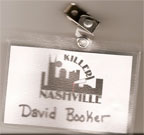
Killer Nashville badge

Killer Nashville badge


… ‘cause you “never know what you’re going to get.” And I’m sure the agents and editor’s who came to Killer Nashville to hear pitches probably felt the same way when authors sat down across from them to make their pitches.

Pitches, for those who may not be aware of them, are where the author becomes salesman (or saleswoman). It’s an oral query letter, delivered in person, by you — and on the other side of the small table with the too-long table cloth is the agent or editor.

This person, whom you may have researched and read about, taken notes and taken the time to find out if he or she is on Facebook or LinkedIn is rarely going to match up with what you’ve gleaned, at least for the five to ten minutes you have to pitch to them. The World Wide Web makes products of us all and the flesh and blood, breathing and gleaning version now across the table from you, waiting on you to try to entice her or him is not going to match up. Similarly, you will feel that your pitch is not going to match up with your novel, your pride and joy that you’ve written and rewritten and rewritten again, cursed at and crumpled up papers over for months, if not years. From the moment you sit down, you are in a Twilight Zone where the pieces of reality don’t quite fit.

I guess you could pay somebody to pitch for you, or beg your best friend or a family member to do, but this ringer is probably not going to know the book as well as you, and you have to know it, to be prepared to answer questions beyond your oral presentation. And if an agent or editor is interested, there will probably be questions. For example, I was asked, “How many words is you novel?” “Have you had it critiqued by a critique group?” “Have you written anything else?” “Have you approached any other agents or editors with this novel?”Having written more than the novel you are pitching shows you are serious about writing. Having a critique group look at it is a sign that you are willing to take criticism and possibly willing to make changes in response to it.

First hard fact to deal with: a pitch is where your novel – your magical, wondrous world created out of imagination and toil, and conjured up with mysterious black marks on a white page – becomes a “product.”

And in case you’re wondering, I recoil at writing the above sentence. But the fact is, publishing is a business, and even more so today than ever before. As the community services manager for Barnes and Noble said during one of the panels at Killer Nashville, “Over 200,000 titles are published each year, and we only have space in our store for about 100,000 titles.” And not all that space is available for new books. There are some standards and classics they carry. The owner and manager of Mysteries and More, an independent bookstore of 1,000 sq. ft. in Nashville has even less space for books, recently published or not.

Second hard fact to deal with: You have 10 minutes or less to sell (pitch) your “product” to an agent or editor, and what you are hoping for is that the agent or editor will want to see the manuscript or some part of it.

Sometimes you have less than 10 minutes. For example, if the guy before you gobbled up more than his allotted time and the monitor had to go pry him out of the chair across the table from the agent you’re scheduled to pitch to. There are several key elements that make up a good pitch, which I may go into in another entry, but for now, I will recommend this book: Selling Your Story in 60 Seconds: The Guaranteed Way to Get Your Screenplay or Novel Read by Michael Hauge.

The idea of the pitch comes from Hollywood where pitches are used to sell screenplays to producers and directors. There are even pitch festivals, where you can pay to go inside and pitch you screenplay to one or many people who can make the screenplay a screen presentation. Pitches are writing conferences are usually free, assuming you have paid to enter the conference.

I signed up to pitch to three agents. My times were back to back to back, as were most other people’s who had multiple pitches. So, dry mouth, parched lips (It’s amazing how quickly my lips can dry out.), and clumsy-footed, I gracelessly stepped into the room. There were six small tables, three on each side of the room. Each table was the same small round table with the too, too long ivory table cloth draped over it. And, of course, the first agent I was assigned to pitch to was in the back of the room. Plenty of opportunity to pratfall before reaching my destination.

Third hard fact to deal with: Asking to see some part or all of your wondrous world created with mysterious black marks on white paper is not a promise to represent it or publish it. It is not even a promise to like it.

Now, that doesn’t mean the agent or editor does not want to like your novel. They have come to conferences like Killer Nashville in search of the next novel or novels they can fall in love with and want to represent or publish. They want to be taken away to wondrous worlds by way of the mysterious black marks on white paper. I’ll even include in that the one agent who said on a panel that when he receives a query letter (a written pitch), he looks for a reason to say no, but that is simply because he says he receives so many of them. Still, he was at this conference and he was taking pitches, so even he was looking for the magic that only a novel good novel can bring.


5 Comments

Filed under agents, editor, Killer Nashville, novel, Perils of writing, pitches, publishers, Random Access Thoughts, the perils of writing, words, writing, writing tip

The Perils of Writing: character hook

Writing tip: character hook

Butterfly on feet

Sometimes even the largest story still needs a little touch

Once upon a time, I attended the Harriette Austin Writers Conference in Athens, GA. At that time, one of the speakers was an editor with a large publishing firm in New York City. He was a University of Georgia graduate, who had come back to the conference to dispense nuggets of experience and wisdom in his bare feet.

As was my biological predilection, my internal clock being generously out of step with the atomic one that governs the external world, I arrived a little late to the auditorium and found a seat along the aisle but not too far forward so as not to disturb the editor who was about to speak.
After the good morning pleasantries, he said that he often received manuscripts in which the subject matter was as grand as the universe itself (which was understandable since he was an editor of this publisher’s science fiction line of books), but that there was often something missing. He said the little telling character details were often missing. He said the main character could be an important negotiator at an intergalactic conference of species trying to save their galaxy from destruction and time was running. Despite the importance of the conference and the importance of the main character, there was nothing the reader could easily identify with, because there was no “character hook,” something small, even banal, that the reader could identify with. He then asked, what if the main character’s feet hurt? What if this character’s feet hurt because his shoes were too tight and that was what he was focused on at the start of this important conference. The editor said it is this small, telling detail that would provide the hook that would make the rest of the story believable. In this case, the protagonist had a problem the reader could easily identify with. But it could also be a small character detail, such as unruly red hair or preference for the color purple that could provide a hook for the reader.

This editor then stepped around from behind the lectern. He stood on the stage before us in his bare feet. With the microphone in his hand, he looked down at this toes and wiggled them. Then, he looked back up at us.

“Now,” he said, “you may not remember a single thing I say up here today. But I bet you’ll remember I was barefoot.”

Leave a comment

Filed under how to, words, writing, writing tip

The Perils of Writing: Tension

Writing tip: Building a better story: tension

Bookends to death

Tension, what is it, how to get it.

In the last installment, I said there was a difference between conflict and tension. Conflict, as Bob McKey pointed out, is the gap between expectation and result. The gap can be small, such as being overcharged a dime or great, such as losing a loved one when you thought he would survive.

The best way to explain tension is to refer to a small book on writing by the writer and editor Algis Budrys, Lithuanian for “Gordon John Sentry, more or less.” His book, Writing to The Point: A complete guide to selling fiction is only 64 pages long, and may be hard to get. But this Strunk and White-sized guide to writing is worth your time (and it even covers manuscript formatting).

For Gordon John Sentry, more or less, a story consists of seven parts: 1) a character 2) in a context with a 3) problem, who 4) makes an intelligent attempt to solve the problem and 5) fails, tries a second time and fails, tries a third time and finally 6) succeeds or completely fails, and whose actions are then 7) validated by another character in the story.

Sounds simple, doesn’t it? That is the allure of telling a good story. But the execution is often more difficult, for writer as well as story character. Step 4 – 6 above is where in a story you find tension. The key is that the character makes an intelligent attempt and fails. With increased knowledge, he or she tries again, and fails. The increased knowledge increases the stakes in the attempt and thus increases the tension. After all, it should succeed, right? Then there is a third and final attempt. This is, in essence, all or nothing, so the tension should be at its highest here.

Tension, then, is something that builds over the life of the story, fueled by and feeding into the conflict. A well known love story may provide the clearest example. Romeo and Juliet loved each other. Their families, however, were adversaries. Romeo and Juliet attempted to find a way to manifest their love in the midst of this conflict, each time failing until each makes one last effort that leads to both their deaths. In this example, the tension builds in opposition to the conflict, which is fairly clever if you think about, and because of that opposition, the conflict works to heighten the tension.

Leave a comment

Filed under humor, story, the perils of writing, words, writing, writing tip

The Supercilious Door

Didn’t you know, there’s a secret marketing department office called SuDoo? Their job is to make things super-silly-to-us, or supercilious when said fast enough. They once had a sign that hung on their door that said “Supercilious Department.” Others called it “the SD door” for short. The sign was so heavy that it kept falling off. At first, people walking by would pick it up, knock on the door, and give the sign to whomever answered. Eventually, people got tired of this, especially since the people inside never said thank you. Finally, the sign fell down and nobody picked it up or knocked on the door to tell the SD their sign was down. The work day ended and as the first SD member stepped through the door, he stepped on the sign. It shattered under his weight and shot out in different directions, one piece wedging under the door to the Supercilious Department, preventing them from closing it. Because he had shattered the sign and the door couldn’t be fixed for several weeks, the sign breaker was stationed at the door to keep people out. He became known as the Supercilious Department Door Keeper, which was too long for people in the office to say, so it became shorted to the Supercilious Door Keeper, and eventually SDK. But the head of the Supercilious Department didn’t like that and insisted that the first time people greeted the door keeper, they had to refer to him as the Supercilious Department Door Keeper. Subsequent references during the day could be shorted to Supercilious Door Keeper. One day, a new employee from another department had a package that needed to go immediately to the Supercilious Department Head, but when he got to the door, he found the Supercilious Department Door Keeper would not let him in. The Door Keeper told him he could send a note inside the department, and the person for whom the package was addressed, could come forward and get it. The new employee pulled and pen and a scrap piece of paper out of his pocket and began his note. Unfortunately, the pen ran out of ink, and so the employee couldn’t finish his note, and since this employee was late for another meeting, he left the package outside the door. The Door Keeper forgot about the package, and eventually it was time to leave work. As the head of the department left, he saw the package, picked it up, recognized its importance, and looked around. When he spotted the Door Keeper making his way to the elevator, he yelled out, “Hey, you, Supercilious Door K—.” It was then that the package exploded. The Department head lost his, and as it turned out, the package was not what he thought it was, but in loving tribute to the Department head who lost his, the rest of the department and eventually those throughout the building referred to the Supercilious Door Keeper as the Supercilious Dork. Over time, the Supercilious Dork rose to be head of the department and because he was so stigmatized and traumatized by what happened that day, he has forever more made it his mission to shorten the names of things. And he never picks up strange packages, especially ones addressed to Supercilious Dork.

Leave a comment

Filed under story, words, writing

The Painted Beast

There once was an ex-cop who did poorly
At being a father and what’s more he
Killed his ex-wife
But then offered up his life
To save his daughter from a life in pornography.

[Editor’s note: this is a distillation of my novel The Painted Beast into a short limerick form. It does not capture all the twists and turns of the novel, but if I had to describe at least one main feature of it in 50 words or less, this would probably do.]

1 Comment

Filed under limerick, poem, poetry, story, words, writing

And out will waltz a little girl to Strauss

But at night in that big ol’ house,
When everybody’s in bed, even a mouse,
The portmanteau will open,
As if magic words were spoken,
And out will waltz a little girl to Strauss.

#The End#

Leave a comment

Filed under characters, hero, humor, limerick, poem, poetry, portmanteau, Random Access Thoughts, story poem, words, writing

To guess at what happened or posit

Now the portmanteau sits in a closet
Like a gift awaiting a deposit.
The once-Lady from Kent
Won’t even relent
To guess at what happened or posit.

Leave a comment

Filed under hero, humor, limerick, poem, poetry, portmanteau, Random Access Thoughts, story poem, words, writing

A portmanteau whose latch was bent

So, there was a once-Lady from Kent
Who stole the suitcase and went
Under the cover of night
On a single-engine flight
With a portmanteau whose latch was bent.

Leave a comment

Filed under hero, humor, poem, poetry, portmanteau, Random Access Thoughts, story poem, words, writing

The suitcase he called a valise

The old man looked like Sleaze,
Wearing a brown coat against the breeze.
He shook his head slow
And wouldn’t let go
Of the suitcase he called “a valise.”

Leave a comment

Filed under hero, humor, limerick, poem, poetry, portmanteau, Random Access Thoughts, story poem, words, writing