Category Archives: the perils of writing

The Blathering Idiot and the Box of Everlasting Life

The blathering idiot saw the ad on the Internet, click on it, and was transported to a web site where the promoted product promised to…

Build a new, high-efficiency body:
Say NO to Memory loss
Say NO to Arthritis
Say NO to Pain
Say NO to short lives of 75 years max
Say NO to Ugliness.

Activate your dormant codes for advanced human ability and appearance.
Override the death code based on the carbon grid.
Make dominant your crystalline grid.
Make your DNA perfect again.

“I will show you how to self-heal,” Dr. Ben T. Err said. “My secret product formula, Dunthat, helps you create a new advanced physical form!”

Err then went on to talk about his advanced studies as an, Iridologist, Nutritionist, and Herbologist.

Best If Used By label on bottle

Best If Used By...


“Order today and learn how to upgrade your cellular character by releasing density, carbon congestion, primitive DNA, and by moving to crystalline dominance the natural way.”

The blathering idiot placed an order, which eventually arrived. When he opened the box, it contained a DVD, an instruction booklet, and a series of containers containing a series of products, all very herbal looking. And on the bottom of each container there was a sticker that read: “Best if used by” and a date. They all had the same date and that date had already passed.

1 Comment

Filed under blathering idiot, Cartoon, humor, story, the perils of writing, words, writing

One size fits

The blathering idiot bought a ball cap at the store. It had the symbol and colors of his favorite team. He was proud of the cap and what it stood for. He felt he was part of something larger than himself.
Then he took the cap off and looked under the lip and saw a tag that read: One Size fits most.

The blathering idiot was upset. He had thought for sure that he had bought the deluxe model of this type of cap. It had cost him enough, and it even said “Limited Deluxe Edition” on another tag under the lip.

There was only one thing the blathering idiot could do: He immediately went to that store and demanded that they fix his purchase.

When ask what the problem was, the blathering idiot stammered: “The cap. It doesn’t fit all.”
The clerk, thinking the blathering idiot meant “at all,” asked him to try it on. The cap fit perfectly.
The blathering idiot immediately jumped to his feet, knocking the hat off.

“I am not in the all,” he said, and then he demanded to see the store manager.

Eventually, when the store manager came out to see him, the blathering idiot was clearly irritated. He shoved the tag up almost into the manager’s nose.

“This tag,” the blathering idiot said, “says one size fits most. It should say one size fits all.”

“But it won’t fit all,” the manager said. Then he asked, “Does it fit you?”

“That’s not the point. I paid for a one-size-fits-all hat of my favorite team, and instead I get a one-size-fit-most hat.”

After trying a few more times to convince the blathering idiot that as long as the hat fit, there shouldn’t be a problem, the manager reluctantly refunded the blathering idiot’s money.

As he left the store, the blathering idiot muttered, “How can I belong to something larger than myself when nothing is no longer one-size-fits all? What’s this world coming to?”

Leave a comment

Filed under blathering idiot, humor, Perils of writing, the perils of writing, word play, words, writing

A beautiful day

The blathering idiot had heard the weather forecast before he went to bed. He set his alarm to rise before the sun.

The next day, he arose, dressed in his best clothes, and went outside to run up and down the streets until he came to the edge of town. His calves hurt. He was not used to running in his good boots, but if he didn’t hurry, he would not make it in time.

The blathering idiot ran into the country until he came to a field at the bottom of the east ridge. He crossed the fence and raced, as fast and as hard as he could, up the ridge until he reached the top. The sun was already peaking above the ridge top. In the town below, people would be rising, stretching, yawning, and going to their windows to see the sunrise. As it rose more, he approached it and then, without saying anything, tried kicking it like a ball.

The sun continued rising. The blathering idiot continued kicking at it. He kicked more and more and more until the sun was up over his head like a bright balloon on its way to the heavens. He couldn’t understand. He was sure he had heard correctly. The weather forecaster had said “It will be unseasonably warm with a slight breeze, and sunshine from dawn to dusk. It will be a great day for Christmas shopping and a beautiful day to boot.”

The blathering idiot’s calves sized up and he fell down.

Leave a comment

Filed under blathering idiot, humor, puns, the perils of writing, words, writing

Pictures at an exhibition

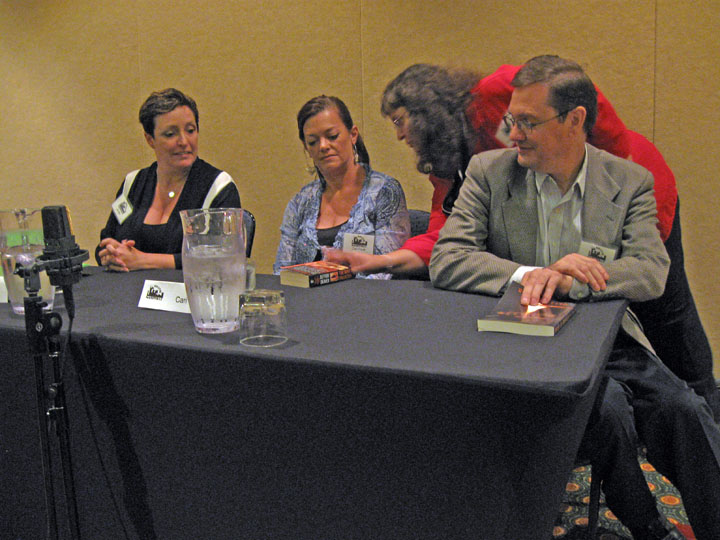
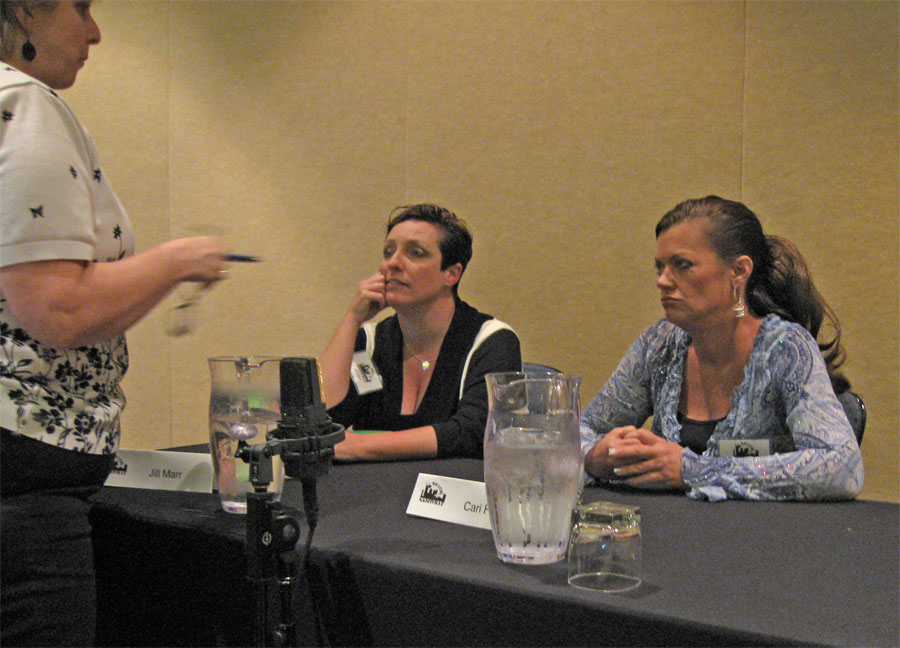
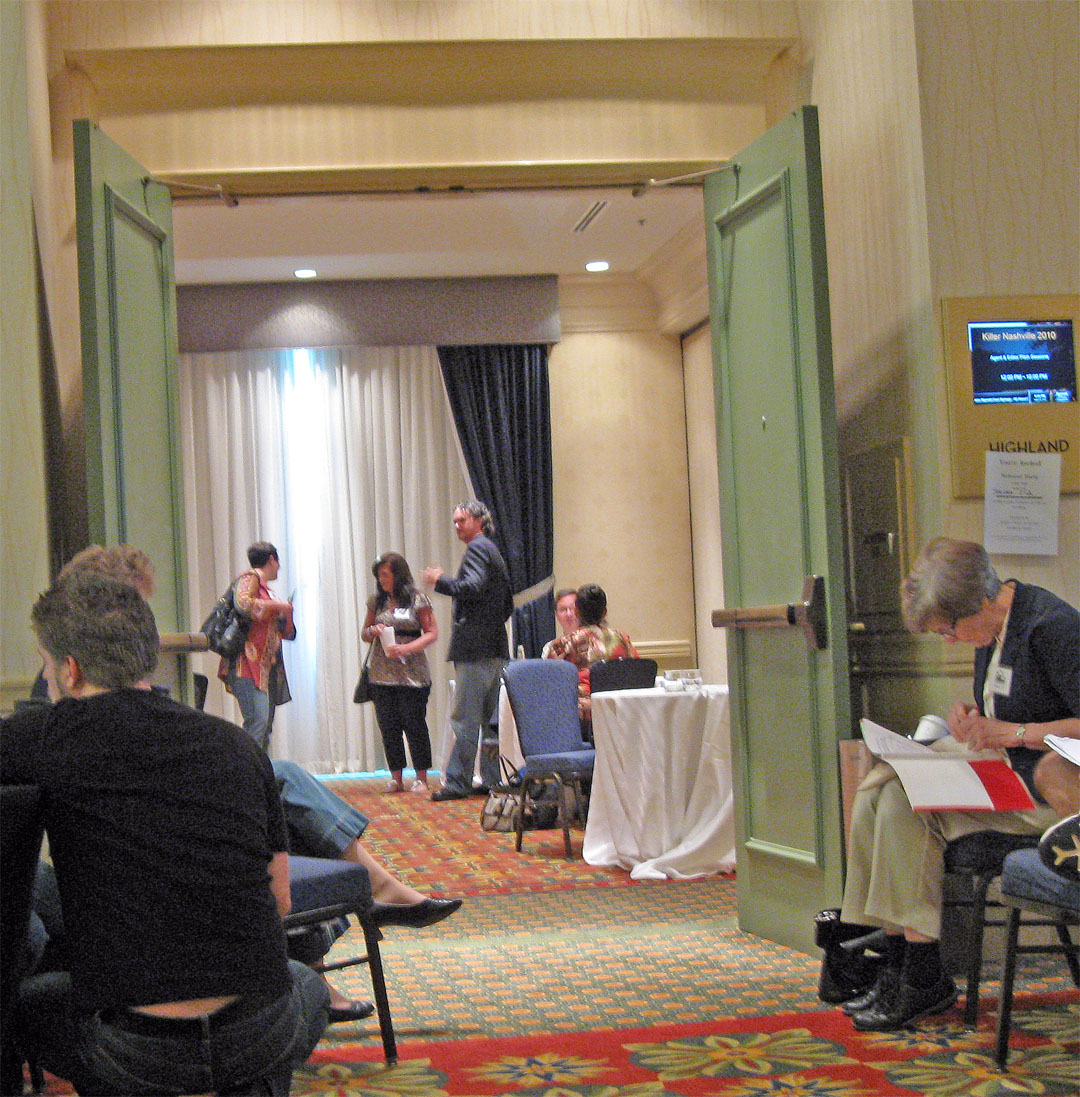
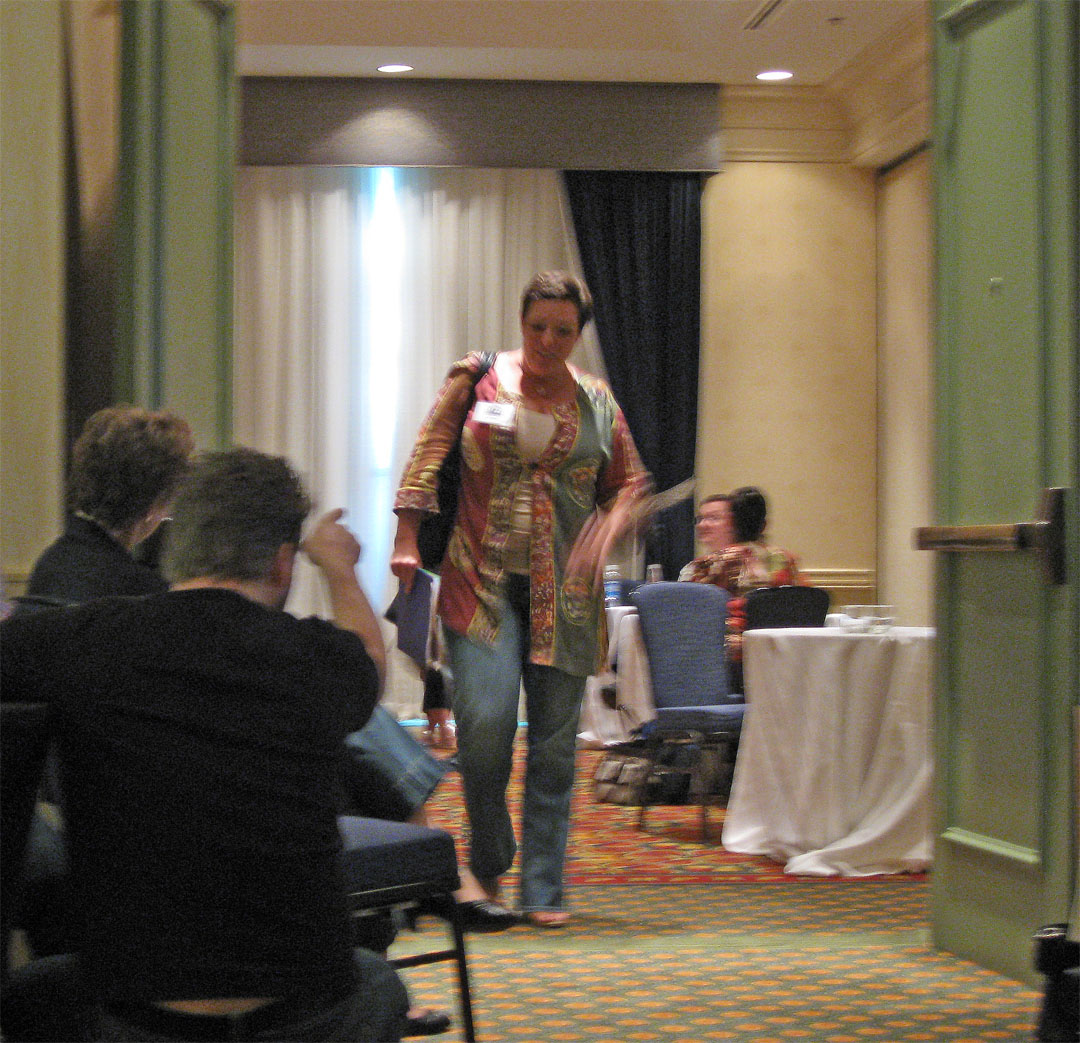
Below are a few photos of agents and editors taken while at Killer Nashville this past August 20 – 22, 2010. Consider this visual reference for the names of people mentioned in some of my earlier posts on pitching your novel to editors or agents.

From left, agents Jill Marr, Cari Foulk, and Jeff Gerecke. Beth Terrell, author and Killer Nashville Executive Driector, leaning over behind them.

Jill Marr (seated left) and Cari Foulk listening to a question at Killer Nashville 2010.

Jill Marr (seated left) and Cari Foulk listening to a question at Killer Nashville 2010.

Agents Jill Marr (left) and Cari Foulk standing for a few moments after listening to pitches.

Agents Jill Marr (left) and Cari Foulk standing for a few moments after listening to pitches.

Agent Jill Marr walking out of the Pitch Room.

Agent Jill Marr walking out of the Pitch Room at Killer Nashville 2010.

Leave a comment

Filed under agents, editor, Killer Nashville, Perils of writing, publishers, Random Access Thoughts, the perils of writing, writing, writing conference, writing tip

The pitches

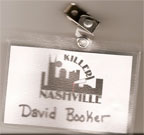
Killer Nashville badge

Killer Nashville badge

Below are two of my pitches. I used the The Painted Beast pitch on all the agents and editors I talked with at Killer Nashville. I was able to use The Small Resurrection pitch once or twice.

Two pieces of advice, one I have said before: Practice the pitch and make it as natural as you can. Two: Think of a pitch as a spoken version of the back-cover blurb you read on many paperback books.

The Painted Beast

Ex-cop Stephen York was once a hero. Decorated and lionized from uncovering corruption in the police department and bringing down a criminal enterprise, he now works two or three menial jobs in order to hold body and soul together, not only for himself but also his thirteen-year-old step-daughter and eight-year-old daughter. One night his ex-wife, who has escaped from prison, returns home and terrorizes him. He escapes from her and she from him, but shortly thereafter she kidnaps their daughters. In order to save them, Stephen has to kill her, which puts him under suspicion for murder and under the thumb of a police detective who has personal as well as professional reasons for wanting to grind Stephen down further. In addition, his step-daughter’s biological father steps forward to kidnap her with the intention of leading her into a life of child pornography and prostitution in order to get money to help re-establish the criminal empire that Stephen had helped take down. This time, in order to save his step-daughter, Stephen, who has not been a particularly good father, has to offer his life in order to save his step-daughter’s. In so doing, he learns another definition of hero. At its core this novel’s theme asks and answers the question: Can a fallen hero be a hero again?

Limerick version:
There once was an ex-cop who did poorly
At being a father and what’s more he
Killed his ex-wife,
Then offered up his life
To save his daughter from a life in pornography.

***

A Small Resurrection

Is believing in what you see the same thing as seeing what you believe in?

Knoxville, Tennessee, is the last place T. Xavier Gabriel wants to be. But the director of the 8th highest grossing film in Hollywood has come to town to ask his ex-wife for forbearance in paying the large alimony and possibly also for a loan to help restart his fallen career. She, however, has other plans. She wants him to

Pitching your novel

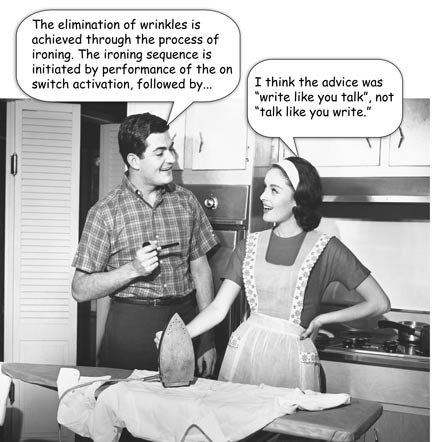
Use conversational voice when talking about your novel

rescue their 22-year-old daughter from the undue influences of a 24-year-old evangelical preacher. Gabriel wants nothing to do with that, having already admitted to be a failure once as a father, he doesn’t want a second bite of the apple. But when he finds his daughter keeping company with a resurrected Rod Serling, he sees a chance to use this Serling look-alike to resurrect his own career. But getting Serling away from his daughter puts her in jeopardy, and Gabriel must decide if he is going to save her or save his career. To save her, he must enlist the aid of Serling, who is not quite sure who he is or why he has been resurrected, and in saving her he puts an end ever resurrecting his career.

Limerick version:
There once was a director named Gabriel
Whose life was a broken down fable
Then along came Rod Serling
And an offer so sterling
That it could save Gabe if he was able.

Two final notes:
1) The limerick versions were not something I pitched, though I thought about it. It was my way of have a pitch that could be done in 15 seconds or less.

2) Some pitch advice says you need to have antecedents as part of your pitch. Antecedents are novels that are like yours. Something similar to your novel. This is supposed to show that you know about your novel’s market and where it might fit. While I had that prepared for The Painted Beast, it did not seem to be something those I pitched to at Killer Nashville were interested in. That could have been a mistake on my part. But I had the feeling that these agents wanted to be the ones to decide where it belongs.

Leave a comment

Filed under advice, agents, characters, Killer Nashville, limerick, Perils of writing, pitches, publishers, story, the perils of writing, words, writing, writing conference, writing tip

Pitch aside: dealing with contradictory information

This information comes from agent Nathan Bransford, and while he is aiming the information at query letters, I think the same advice can apply for pitches, with a little modification:

1. Take a Deep Breath: As long as you’re getting the big stuff right, you’re going to be fine. You don’t need to have every single little teeny tiny thing perfect. You can get my name or gender wrong and I still might request your pages (just did this last week in fact). I’m not going to reject you because you sent me the first five pages of Chapter 1 instead of your Prologue if I like the idea and your writing. Don’t sweat the small stuff. Because really: if an agent is going to reject your query over some small niggling detail, are they someone you’d want to work with anyway?

2. Remember That Agent Blogs Are Just Trying to Help: I know how tempting it is to throw up your hands and just think that literary agents are so many Goldilocks with completely different ideas of how hot the porridge should be. Please just remember that we offer so much advice because people ask. We get e-mails and comments all the time asking about everything from paper size to fonts to anglicized spelling to serial commas. So we try to help, and we’re not always going to agree on everything. Personally, when I’m wearing my author hat I’d rather have too much information than too little, so I tend to err on the side of dispensing too much agent advice. It’s up to you to decide which advice you agree with and which you don’t. Just remember that we’re trying to help, not trying to make your life miserable.

3. Not All Publishing Advice is Created Equal: I went back and looked at some of my early blog posts, and holy cow after just four years they’re already wildly out of date. Consider the source, consider the freshness of the advice, and beware of anyone who tries to tell you that there’s one way and only one way to find successful publication. Occasionally an author out there somewhere will have a sense that the way they found success is The Way That Should Work For Everyone, whereas people who have worked across the publishing spectrum have seen the proverbial cat skinned in an impossibly vast number of ways.

4. Try As Best You Can to Meet an Agent’s Specifications, But Don’t Go Crazy Trying to Do It: If you happen to remember that Rachelle wants you to query with your pen name and I want to hear from the real you: great! Query accordingly. But don’t go creating a massive spreadsheet with every agent’s particular individual preferences. No agent expects you to do that.

5. If You Think the Contradictory Query Advice is Mind Boggling, Just Wait Until You Reach the Publication Stage: In case you haven’t noticed, this business is an art, not so much a science. There’s no one way to do things, and you’re going to face conflicting advice and opinions about your manuscript, cover art, marketing plan, you name it. There are even more opinions out there than people (sometimes people can’t even decide what they think and have multiple opinions). At the end of the day, all you can do is just take all the advice into account, and choose the route that works best for you.

Leave a comment

Filed under advice, agents, editor, Killer Nashville, novel, Perils of writing, pitches, publishers, Random Access Thoughts, the perils of writing, words, writing, writing conference, writing tip

Agents (and editors) are like “a box of chocolates” …

Killer Nashville badge

Killer Nashville badge


… ‘cause you “never know what you’re going to get.” And I’m sure the agents and editor’s who came to Killer Nashville to hear pitches probably felt the same way when authors sat down across from them to make their pitches.

Pitches, for those who may not be aware of them, are where the author becomes salesman (or saleswoman). It’s an oral query letter, delivered in person, by you — and on the other side of the small table with the too-long table cloth is the agent or editor.

This person, whom you may have researched and read about, taken notes and taken the time to find out if he or she is on Facebook or LinkedIn is rarely going to match up with what you’ve gleaned, at least for the five to ten minutes you have to pitch to them. The World Wide Web makes products of us all and the flesh and blood, breathing and gleaning version now across the table from you, waiting on you to try to entice her or him is not going to match up. Similarly, you will feel that your pitch is not going to match up with your novel, your pride and joy that you’ve written and rewritten and rewritten again, cursed at and crumpled up papers over for months, if not years. From the moment you sit down, you are in a Twilight Zone where the pieces of reality don’t quite fit.

I guess you could pay somebody to pitch for you, or beg your best friend or a family member to do, but this ringer is probably not going to know the book as well as you, and you have to know it, to be prepared to answer questions beyond your oral presentation. And if an agent or editor is interested, there will probably be questions. For example, I was asked, “How many words is you novel?” “Have you had it critiqued by a critique group?” “Have you written anything else?” “Have you approached any other agents or editors with this novel?”Having written more than the novel you are pitching shows you are serious about writing. Having a critique group look at it is a sign that you are willing to take criticism and possibly willing to make changes in response to it.

First hard fact to deal with: a pitch is where your novel – your magical, wondrous world created out of imagination and toil, and conjured up with mysterious black marks on a white page – becomes a “product.”

And in case you’re wondering, I recoil at writing the above sentence. But the fact is, publishing is a business, and even more so today than ever before. As the community services manager for Barnes and Noble said during one of the panels at Killer Nashville, “Over 200,000 titles are published each year, and we only have space in our store for about 100,000 titles.” And not all that space is available for new books. There are some standards and classics they carry. The owner and manager of Mysteries and More, an independent bookstore of 1,000 sq. ft. in Nashville has even less space for books, recently published or not.

Second hard fact to deal with: You have 10 minutes or less to sell (pitch) your “product” to an agent or editor, and what you are hoping for is that the agent or editor will want to see the manuscript or some part of it.

Sometimes you have less than 10 minutes. For example, if the guy before you gobbled up more than his allotted time and the monitor had to go pry him out of the chair across the table from the agent you’re scheduled to pitch to. There are several key elements that make up a good pitch, which I may go into in another entry, but for now, I will recommend this book: Selling Your Story in 60 Seconds: The Guaranteed Way to Get Your Screenplay or Novel Read by Michael Hauge.

The idea of the pitch comes from Hollywood where pitches are used to sell screenplays to producers and directors. There are even pitch festivals, where you can pay to go inside and pitch you screenplay to one or many people who can make the screenplay a screen presentation. Pitches are writing conferences are usually free, assuming you have paid to enter the conference.

I signed up to pitch to three agents. My times were back to back to back, as were most other people’s who had multiple pitches. So, dry mouth, parched lips (It’s amazing how quickly my lips can dry out.), and clumsy-footed, I gracelessly stepped into the room. There were six small tables, three on each side of the room. Each table was the same small round table with the too, too long ivory table cloth draped over it. And, of course, the first agent I was assigned to pitch to was in the back of the room. Plenty of opportunity to pratfall before reaching my destination.

Third hard fact to deal with: Asking to see some part or all of your wondrous world created with mysterious black marks on white paper is not a promise to represent it or publish it. It is not even a promise to like it.

Now, that doesn’t mean the agent or editor does not want to like your novel. They have come to conferences like Killer Nashville in search of the next novel or novels they can fall in love with and want to represent or publish. They want to be taken away to wondrous worlds by way of the mysterious black marks on white paper. I’ll even include in that the one agent who said on a panel that when he receives a query letter (a written pitch), he looks for a reason to say no, but that is simply because he says he receives so many of them. Still, he was at this conference and he was taking pitches, so even he was looking for the magic that only a novel good novel can bring.

5 Comments

Filed under agents, editor, Killer Nashville, novel, Perils of writing, pitches, publishers, Random Access Thoughts, the perils of writing, words, writing, writing tip

The Perils of Writing: Tension

Writing tip: Building a better story: tension

Bookends to death

Tension, what is it, how to get it.

In the last installment, I said there was a difference between conflict and tension. Conflict, as Bob McKey pointed out, is the gap between expectation and result. The gap can be small, such as being overcharged a dime or great, such as losing a loved one when you thought he would survive.

The best way to explain tension is to refer to a small book on writing by the writer and editor Algis Budrys, Lithuanian for “Gordon John Sentry, more or less.” His book, Writing to The Point: A complete guide to selling fiction is only 64 pages long, and may be hard to get. But this Strunk and White-sized guide to writing is worth your time (and it even covers manuscript formatting).

For Gordon John Sentry, more or less, a story consists of seven parts: 1) a character 2) in a context with a 3) problem, who 4) makes an intelligent attempt to solve the problem and 5) fails, tries a second time and fails, tries a third time and finally 6) succeeds or completely fails, and whose actions are then 7) validated by another character in the story.

Sounds simple, doesn’t it? That is the allure of telling a good story. But the execution is often more difficult, for writer as well as story character. Step 4 – 6 above is where in a story you find tension. The key is that the character makes an intelligent attempt and fails. With increased knowledge, he or she tries again, and fails. The increased knowledge increases the stakes in the attempt and thus increases the tension. After all, it should succeed, right? Then there is a third and final attempt. This is, in essence, all or nothing, so the tension should be at its highest here.

Tension, then, is something that builds over the life of the story, fueled by and feeding into the conflict. A well known love story may provide the clearest example. Romeo and Juliet loved each other. Their families, however, were adversaries. Romeo and Juliet attempted to find a way to manifest their love in the midst of this conflict, each time failing until each makes one last effort that leads to both their deaths. In this example, the tension builds in opposition to the conflict, which is fairly clever if you think about, and because of that opposition, the conflict works to heighten the tension.

Leave a comment

Filed under humor, story, the perils of writing, words, writing, writing tip

The Perils of Writing: Building a better story: Conflict

Writing tip: conflict

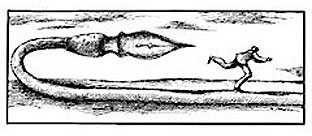
Pen chasing writer

Conflict: expectation vs result

In the last installment of this feature, I put forth a little paradigm about writing that started off with “Drama is conflict….” But what is conflict? Is it open hostilities between two armies? It can be. It is the harsh words a husband has for a wife? It can be that, too. It is dealing with opposing desires or wants, such as deciding between love and honor? Yes, it can be that as well.

But all three examples listed above and in a host of others there is a common thread, something unspoken, and as important as words are, it is often the unspoken or unwritten element that defines a scene in a story and sometimes the story itself.

As I said in the previous article, I learned the paradigm that begins “Drama is conflict …” in 1993. Some twelve years later, and even though I wasn’t looking, I learned from author, screen writer, and teacher Steven Womack a definition of conflict that adds depth and, dare I say, meaning to the word conflict and the entire paradigm. He credits learning it from Bob McKey, a script doctor. McKey has made a living and a small fortune fixing other people’s scripts though he often doesn’t get screen credit for it. All scripts need conflict; conflict drives the story forward. How will the protagonist react? What will she do? But conflict is not car chases, gun battles, or galaxies spiraling out of control. Conflict, McKey said, is the gap between expectation and result. That’s it.

Conflict can be as small as being overcharged a dime and how your protagonist reacts or as great as losing a battle when the protagonist fought hard to win. In both examples, there is a gap between expectations and results. How your protagonist deals with that gap and what steps he takes to close it are what drives a story forward, whether the story is a script, a short story, or a novel. The obstacles in the way preventing the protagonist from easily closing that gap are what are called tension, but that is a discussion for another time.

Leave a comment

Filed under the perils of writing, writing, writing tip

The perils of writing: building a better story

Writing tips

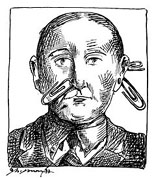
Man with paperclips in his nose and ears.

The perils of writing

My writing is distinctly middle brow. Just ask anybody who has suffered through it. Still, I like to think that even in my middling way, I can still offer some helpful advice when I stumble across it. Therefore, from time to time, I will post some writing advice, but not from me. The advice will come from established sources. I will endeavor not to make it overlong or overreaching, and sometimes it will simply be reminders of what we all probably already know, but it will be some tips I have picked up from reading, from attending writing conferences, or it may even come from you.

The first bit of advice comes from a writing course the Writers’ Guild sponsored way back in 1993. The teacher was Joseph Gunnels and the cost was $75. It was two-day event, May 15 and 16, and we spent part of a pleasant afternoon sitting on the grass outside the Candy Factory on The World’s Fair site in Knoxville, TN. I took over 30 pages of notes, but rather than bore you with details, here is the essence of what I took away from the seminar:

Drama is conflict;
Without conflict no action;
Without action no character;
Without character no story;
Without story, who cares?

In a future issue of this newsletter, I’ll give you a short, crisp definition for conflict that I learned at a more recent one-day writing seminar. It comes from a very highly regarded script doctor in Hollywood, but applies just as well to other forms of fiction writing. Stay turned.

Leave a comment

Filed under how to, the perils of writing, word play, writing, writing tip