
Category Archives: storytelling
Storytelling
John Berger (RIP) and Susan Sontag Take Us Inside the Art of Storytelling (1983)
“Somebody dies,” says John Berger. “It’s not just a question of tact that one then says, well, perhaps it is possible to tell that story,” but “it’s because, after that death, one can read that life. The life becomes readable.” His interlocutor, a certain Susan Sontag, interjects: “A person who dies at 37 is not the same as a person who dies at 77.” True, he replies, “but it can be somebody who dies at 90. The life becomes readable to the storyteller, to the writer. Then she or he can begin to write.” Berger, the consummate storyteller as well as thinker about stories, left behind these and millions of other memorable words, spoken and written, when he yesterday passed away at age 90 himself.
This conversation aired 35 years ago as “To Tell a Story,” an hourlong episode of Channel 4’s Voices, “a forum of debate about the key issues in the world of the arts and the life of the mind.” Though Berger and Sontag surely agreed in life on more than they disagreed (“not since [D.H.] Lawrence has there been a writer who offers such attentiveness to the sensual world with responsiveness to the imperatives of conscience,” the latter once said of the former), they here enter into a kind of debate about storytelling itself: why we do it, how we do it, when we can do it. Berger, for his part, characterizes all fiction as “a fight against the absurd,” against “that endless, terrifying space in which we live.”
Sontag, in the words of Lily Dessau at Berger’s publisher Verso, “considers the storyteller as inventor, in control of the material, out of which the ‘people come.’ Berger conversely takes the form of the story as the result of the language coming out of the people — but he does characterize their differing views as arriving at the same place — the scene of the text.” While both of them wrote fiction as well as essays, “Berger considers the story and essay in one breath, both as a form of struggle to model the unsayable,” while “for Sontag the two are entirely separate, although the struggle persists in both.”
Or, as Berger puts it in highlighting another aspect of the difference in their perspectives, “You say you want to be carried away by the story. I want the story to stop things being carried away into oblivion, into indifference.” The many tributes already paid to him, especially by influential creators formed in part by the influence of his work, indicate that Berger’s legacy hardly finds itself now on the brink of an indifferent oblivion. Now that his long life has reached the end of its final chapter, well, perhaps we can begin to read, and to tell, his story.
Filed under 2017, storytelling
Eleanor and Rose, and “The Case of the Fleaing Colors,” part 20

Part 20: Paws to re-consider a clue.
Filed under cartoon by author, Eleanor and Rose, Story by author, storytelling
“Hal, tell me a story.”
[Editor’s note: this is the second half of the “Hal” articles. The first article appears under “Hal, open the keyboard. Hal….” and is about a computer application writing non-fiction articles. I am not sure what to fully make of either article, but they seemed oddly linked to each other. It seems storytelling is something genetic in humans. We are born to tell stories. maybe in some strange way Alzheimer’s is a “revenge” on humans for not valuing storytelling enough.]
Alzheimer’s Patients Turn To Stories Instead Of Memories
by Joanne Silberner, NPR
May 14, 2012
Ask family members of someone with Alzheimer’s or another dementia: Trying to talk with a loved one who doesn’t even remember exactly who they are can be very frustrating.
But here at a senior center in Seattle, things are different.
On one recent day, 15 elderly people were forming a circle. The room is typical — linoleum floors, cellophane flowers on the windows, canes and wheelchairs, and walkers lined up against the wall.
Linda White is leading a session based on a program called TimeSlips. The idea is to show photos to people with memory loss, and get them to imagine what’s going on — not to try to remember anything, but to make up a story.
Storytelling is one of the most ancient forms of communication — it’s how we learn about the world. It turns out that for people with dementia, storytelling can be therapeutic. It gives people who don’t communicate well a chance to communicate. And you don’t need any training to run a session.
White walks around the circle holding up a stock photo of a fit elderly man. He’s wearing a banana-yellow wet-suit vest and is water-skiing.
The man is smiling broadly at the camera, perfectly framed by a big arc of water.
“He’s experienced and he’s cool; he’s happy,” says White. “Look at the grin on his face.”
Many of the people in this group don’t talk much on their own. But they’re enthusiastic about making up a life story for the water-skier — he’s a retired guy who’s been divorced several times. He’s got four children and a wife onshore, waiting to be taken out to dinner.
Most people with dementia live at home and don’t have the opportunity for this kind of session, run by someone who’s been trained to do it. But storytelling can be done at home, according to the founder of the program, Anne Basting.
“Anybody can do this,” says Basting.
She directs the Center on Age and Community at the University of Wisconsin, Milwaukee. She started work on storytelling as a way to give people with dementia a low-stress way to communicate, one that did not rely on their memories. She sees it as giving caregivers a chance to reconnect with their loved ones.
“People with dementia start to forget their social role; they might not remember they’re a spouse … a parent,” says Basting. “They need a social role through which they can express who they are, and the role of storyteller really supplies that.”
One study co-authored by Basting in The Gerontologist, a journal, found that storytelling made people more engaged and alert, and that staff members at residential facilities had more positive views of their patients. An independent study published in Nursing Research showed participants were happier and better able to communicate in general.
Basting says one of the biggest hurdles to getting the program going has been skeptical family members.
“Resistance comes when people say, ‘My dad would never do that; he’s a very distinguished man. It’s beneath him; it’s childish,’ ” says Basting.
And then Dad hops right in.
Basting tells of one man who came to her in tears of thanks. For the past three years, he had been driving his wife crazy, trying to get her to talk about shared memories. He tried her on storytelling so they could talk about the story and play with the plot line. And eventually, he was able to communicate with her again.
Filed under Hal, make believe, storytelling
The Kibitzer and The Kidd, part 7
[Editor’s note: Parts 1 – 6 of The Kibitzer and the Kidd are available by clicking on “Kidd” or “Kibitzer” in the tag section. This is science fiction western with more than dollop of humor and satire.]
888888
Al Wayne handed the Cough Drop Kidd a hot toddy. They were in Wayne’s private office off the mezzanine in the saloon.
Given the scuffed look of the saloon, this office was opulent with upholstered seats and an intricately carved fireplace mantel. There was no fire in the fireplace, and the Kidd wondered if it worked. Wayne assured him that it did, but that he rarely used it because it was an inefficient way to heat and added to the carbon footprint.
Wayne handed the Kidd a copy of his book, Global Warning. The Kidd wasn’t quite sure what to do, a warm drink in one hand and a cold tome in the other.
He laid the book on a side table by the chair, He was almost certain he heard the table sigh and mutter, “Oh, no, not another one.”
“Drink up,” Wayne said, raising his own drink to his lips and taking a sip. “It’s not often we get a toddy drinker in this town. It’s good to have a little sophistication every now and then.”
The Kidd didn’t think of himself as a sophisticate, only somebody with a sore throat from coughing too much.
“What about what the Kibitzer said. Is it true?”
Wayne smiled.
“That Bonnie can whip up some mighty powerful cough drops. Sometimes a whiff of those apothecary fumes can make you say things you normally wouldn’t.”
“So, it’s not true?”
Wayne shrugged. “Many folk around here have claimed they’ve been struck by lightning and then resurrected some time later. I don’t put much stock in it myself.”
The smile on Wayne’s face didn’t ease the feeling of disquiet the Kidd felt rippling just under his skin. Particularly since it was at Wayne’s insistence that the Kibitzer had to sleep I the stable on the edge of town. Not that it was a large town, and a few of the buildings only had facades and nothing behind them. One or two had signs that read: “Coming soon,” but nothing else. At one point in their travels together, the Kidd had heard the Kibitzer use the term Potemkin Village and he wondered if this might be that. The name of this place was Potomac. But there was no river nearby.
“You haven’t touched your toddy.”
The Kidd quickly took a sip. It was tepid now, but still tasted amazingly good. He took a second, long sip.
“Now, I have a question for you, Mr. Kidd.”
Kidd smiled. He rarely heard anybody call him Mr. Kidd. Kidd or hey you was more likely. For the moment, he couldn’t remember what the Kibitzer called him. Probably nothing he wanted to repeat.
Kidd wasn’t his real name, at least not the real name his parents gave him. But he abandoned that name shortly after he abandoned them.
“My question is in your travels have you heard anyone mention or met anyone by the name of John Gore?”
At that moment, the floor-faced man barged into the room. He spotted The Kidd and curled his lip.
“Fire. There’s fire down at the livery.” He said it breathlessly, but not in a good breathless way.
The Kibitzer, the Kidd thought.
“Save my horses. My prize Walkers,” Wayne said.
Wayne was at the door, shoving the floor-faced man out in front of him.
The Kidd put down his toddy on the book and headed for the door.
“Don’t forget your book,” the table said.
The Kidd hesitated.
“Take it, fool,” the table said.
The Kidd snatched it from under the toddy. The cup tipped over and smashed against the floor. Breaking china and escaping toddy skittered and splashed about.
“Oh, Mr. Wayne’s going to be mad. That’s not eco-friendly.”
The Kidd didn’t hear the table. He was down the stairs and almost to the saloon’s swinging front doors when two dark figures stepped in front of him, blocking his way. The Kidd tried going around them, but they would have none of it.
(To be continued…)
The Kibitzer and The Kidd, part 6
888888
It wasn’t fair. Not only did he have a nickname he didn’t like – Kibbey – but he was also sleeping in the stable with the horses. Horse and hay, flatulence and flies, though it seemed odd that there were so many flies at night. He wondered if a fly got zapped by lightning, would it be resurrected.
Even the popcorn they delivered to him was stale and a little soggy from the humidity it picked up from the air. He had a bag of his own, but it had started raining again, so he couldn’t pop it outside. He looked around to see if the blacksmith’s workshop was part of the stables or nearby.
There was not a blacksmith’s forge, so he was on his own to create a fire.
He understood that the Kidd was the hero, having shot the pistol out of the floor-faced man’s hand. He knew that kibitzers were not easily or fully accepted into society. They were witnesses and scribes, and they reported to an authority most didn’t know about or understand. He certainly wasn’t sure why he had been selected. His family were not kibitzers. Nor any of his friends. And when they came in the middle of the night and told him he was selected, they did not give him a chance to say goodbye to his wife and two sons. Only a short note, quickly scribbled. It read: I’ve been selected. Don’t wait up.
He wasn’t sure how long ago that was, what his wife was like now, if his sons even remembered him.
The Kibitzer piled some hay in one area of mostly dirt. It was turning cold. He’d need the fire for more than popcorn.
Popcorn was his only solace. Bags of it turned up at the oddest times in the oddest places. He took it as a sign he was doing a good job.
He kept a book of matches dry and buried deep in a saddle bag. They were hard to get and he usually sparked a fire with a piece of flint and a piece of steel he carried; but they were both wet from rain. He was also too tired to try.
He added a piece of dried horse manure to the hay pile.
He found the matches, walked back to the pile of straw and dried other things and selected one from the box.
It was then somebody, head draped in a hood, stepped into the stable and tossed a torch on a larger pile of hay nearby. As the man left, he said, “Don’t wait up.”
At least that’s what the Kibitzer thought he said. The words were muffled by the hood. The words stunned him. By the time the Kibitzer recovered, the fire had spread to other parts of the stable, and the culprit was gone, and the Kibitzer was trapped.
(To be continued.)
Filed under humor, kibitzer, kidd, science fiction, story, storytelling, western, word play, words, writing
Found story: Frank and Ike
“Frank, what are we?”
“We’re pumpkins, Ike.”
“But if we’re pumpkins, how come we’re white?”

Frank (left) and Ike (right) discuss life as a pumpkin.
“Halloween came and went, and when Christmas came along, they decorated us up as snowmen. Or at least the heads of them.”
“Oh, nice, Frank.”
“If you say so.”
“What do you mean?”
“Ike, just wait and see.”
#
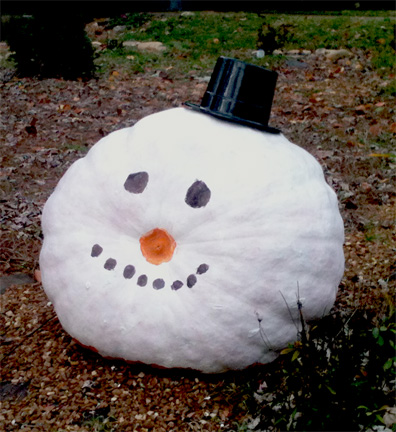
Ike tells Frank they're changing.
“Frank, are you still there?”
“Yes, Ike.”
“We’re changing. I feel it on the inside.”
“If you say so.”
#
“Frank, look at you.”
“I can’t see myself, Ike. I can’t even see you now.”
“Frank, I’m scared.”
“I know.”
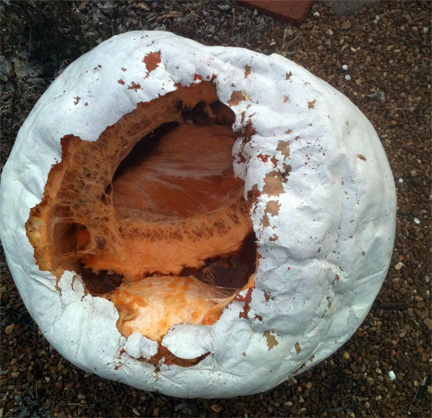
Ike becoming undone.
“Frank, what are we?”
“We’re friends.”
“I mean, what are we? What are we becoming?”
“We’re pumpkins, Ike. We’ve been pumpkins. We are pumpkins. We will always be pumpkins.”
“Are you sure?”
“I’m sure.”
“That’s good to know, Frank. Good to know.”
“Good bye, Ike.”
“Frank, don’t leave me.”
“Frank … Frank ….”
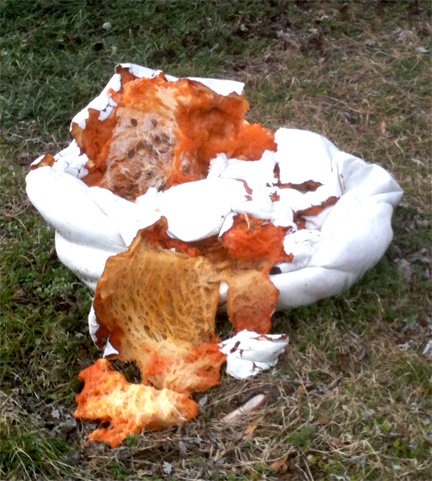
Frank undone.
Filed under Found story, pumpkins, story, storytelling, words, writing


 Booker's Blog