

Contrast
Butterfly and tire, /
flapping and round. Lantana /
colors fall contrast.
.
.
#contrast #butterfly #tire #lantana #fall #colors #photo #poem #poetry #haiku #oldnorthknoxville #davidebooker #november #wednesday #110922 #2022
Contrast
Butterfly and tire, /
flapping and round. Lantana /
colors fall contrast.
.
.
#contrast #butterfly #tire #lantana #fall #colors #photo #poem #poetry #haiku #oldnorthknoxville #davidebooker #november #wednesday #110922 #2022

Wont
Oz left the tin man, /
as wizards are wont to do. /
Autumn eats metal.
.
.
#wizards #tinman #oz #autumn #metal #poem #poetry #haiku #photo #davidebooker #oldnorthknoxville #october #friday #102822 #2022

The Devil’s Tongue
Silent in beauty /
Fiery as a summer day /
Speak now, Devil’s Tongue.
.
.
#haiku #poem #poetry #devilstongue #flower #summer #june #saturday #2020 #photo #davidebooker #oldnorthknoxville #knoxville #tennessee #061320
Filed under 2020, haiku, Old North Knoxville, photo, photo by David E. Booker, poem, poet, poetry, Poetry by David E. Booker
Kindness
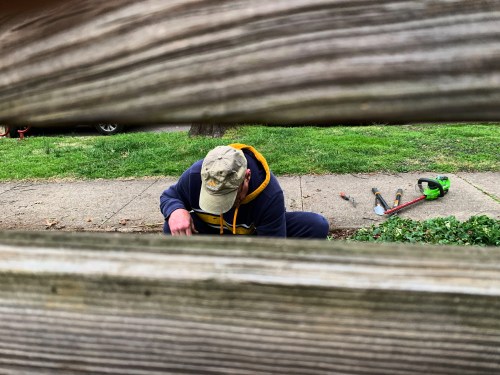
Kindness sometimes means /
ripping up what is there to /reveal nature’s gifts.
.
.
#kindness #gifts #reveal #nature #poem #poetry #haiku #senryu #photo #davidebooker #oldnorthknoxville #march #wednesday #030922 #2022
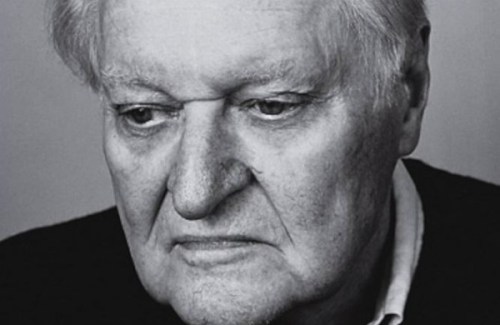
Picked by Karin Roffman, author of ‘The Songs We Know Best: John Ashbery’s Early Life.’
Source: The 10 Best John Ashbery Poems
By Karin Roffman
John Ashbery, who turns 90 next month, published Commotion of the Birds, his 28th volume of poetry, last October. Choosing the 10 “best” volumes from this vast and remarkable oeuvre would be a challenge. Choosing the 10 “best” poems seems well-nigh impossible.
Recently, however, a student asked me: “Which John Ashbery poem would you read first?” Her question offered an approach to this assignment that I particularly liked. So I have decided to pick 10 Ashbery poems that I suggest reading early and often.
I have not ordered the poems chronologically; instead, I’ve arranged them loosely following the arc of a day. In writing the biography of Ashbery’s early life, I constantly returned to these poems for they remind me of how the poet is drawn to familiar moments when we sleep, dream, eat, think, feel bored, see movies, fear death, and fall in love. Taken together, these 10 poems create the experience of a life—from the mundane to the profound—a reading path that I hope will send you back to his poems for more.
This poem begins at the end of a dream, in that moment when one is awake but still partially in the dream. As a young poet, Ashbery found this sensation conducive to writing and kept paper and a pen by his bed. (He wrote “The Painter” in this state.) As the speaker awakens, “[L]ittle by little the idea of the true way returned to me.” The statement sounds like a restoration of consciousness, but, in fact, the speaker is tunneling deeper into his dream-like mood because its sense of unreality sharpens his perception. In this altered state, he has a vision: “A gavotte of dust-motes / came to replace my seeing.” These musical, dancing dust specks are beautiful, and we can suddenly imagine this indoor sight to be as sublimely lovely and inspiring as Wordsworth’s golden daffodils.
Ashbery grew up in upstate New York near Lake Ontario, in an area full of dramatic shifts in weather and a lot of snow, which he observed closely in a diary he kept for four years in high school. I choose this poem less for its climate references than for its clear expression of an idea Ashbery first conveyed quite simply in these daily diary entries, the notion that the ordinary and the extraordinary exist side-by-side in our mind. “Adam Snow” shifts between these states of thinking, and it also demonstrates how we constantly move between them without even noticing: “That you may be running through thistles one moment / And across a sheet of thin ice the next and not be aware / of any difference, only that you have been granted an extension.”
The poem is a cento, a form made up entirely of quotations. This one consists exclusively of movie titles that begin with “They,” a list both absurd and surprisingly coherent. Ashbery wrote the poem a decade ago during a period when he was indulging in Turner Classic Movies and busy making collages, something he had started doing for fun in college. These whimsical pieces look like visual poems; this cento is also a kind of poetic collage with so many different movie references stuck together. A movie buff from an early age (“The Lonedale Operator” recounts his very first movie-going experience as a kindergartner), Ashbery’s delight in film titles, character names, witty dialogue and even minor plot points has infiltrated his poetry since he was eight.
The title is a shortened proverb: “Least Said, Soonest Mended.” A young John Ashbery heard it said by his strict Victorian grandparents, and he learned to keep things to himself. Following this precept, the poem avoids making a direct complaint, and the speaker says “we” and not “I.” The poem is, however, an explanation of what it feels like to be an outsider; the first 35 lines describe struggling to grow up and fit in, being conscious of not belonging. Then the poem offers an understated and moving summary of the opening section: “These then were some hazards of the course.” Ashbery once described this poem as his “one-size-fits-all confessional poem,” which is a way of saying that the poem is aware of both the author’s own childhood miseries—growing up gay and artistic in a family and small town that valued none of those things—and that every person has his or her own story, their own “hazards of the course.”
Poetry illuminates the shadowy world of the “interior life,” but its finest feature may be that it has no use at all: “this afternoon / Those delicious few words spread around like jam / Don’t matter.” Of Ashbery’s many ars poeticas (including “What is Poetry”), this one is my favorite.
“Syringa” turns the story of Orpheus’s grief into a familiar and devastating tale. In the classic myth, Eurydice suddenly dies and Orpheus uses his exceptional lyric gifts to convince the gods to let him bring her back from the underworld, but when he looks back to make sure she’s still behind him—something the gods tell him he must not do—he loses her again forever. The tragic tale has inspired many artists since Ovid to retell it, but in Ashbery’s unsentimental version, Orpheus is just a guy who doesn’t get that his problem is insoluble, even with the help of art, gods or heroism. Ashbery writes: “Of course Eurydice vanished into the shade; / She would have even if he hadn’t turned around.” Eurydice is the past, and the past always disappears. How could Orpheus forget something so obvious? Ashbery’s reading reminds us of the pedestrian and brutal facts of time, which no one escapes.
While perusing Ashbery’s class notes from college, I found a reference to the 15th-century painter, Francesco Parmigianino—the subject of this intimate and luminous poem written 30 years later—misspelled in the margin. Ashbery quickly forgot about this early encounter, and years later rediscovered the painter’s work as if for the first time. It seems fitting that a poem about the entangling of life and art—or, as Ashbery concisely puts it, “life englobed”—would have a misremembered origin. The poet examines Parmigianino’s process of creation and his own, recognizing that as an artist makes something new from life, he also loses something in the process: “Often he finds / He has omitted the thing he started out to say / In the first place.” The residue of these absent words still exists through art, however, and provides a catalyst for the artist and audience to rediscover life and self.
Ensconced in the “moonlight,” the speaker reflects on all he has thought and felt before this moment, and he finds new confidence in the possibility that this waning hour actually offers him a chance for renewal. He realizes that the questions he has been asking repeatedly about life ever since “the fuzzy first thought that gets started in you,” are, in fact, the right ones, and that he must continue. Almost quivering with excitement, he begins “a new journey.”
The poem imagines a bridge—“a breezeway”—to the world beyond this one. It literalizes the idea of life after death and, in doing so, makes the extraordinary seem ordinary. Those in this world are full of thoughts of the next, but how does one get there? You walk, of course. But why would one ever want to leave this world? This life has comic book heroes and weather and amusing misunderstandings, but it is often also rather dull and meaningless. Batman is bored watching mere mortals try to get through their day. Yet even those moments of tedium can have a transcendent rhythm and spirit, which Batman, for all his godlike qualities, just can’t quite perceive.
Written in 1948 when Ashbery was only 21 and a senior at Harvard College, this brief lyric has everything that his later, much longer, poems will advance. It is a love poem that never mentions love directly, but a feeling of being in love infuses the way the speaker sees, feels, and thinks about everything. It makes him feel both small and big, a tiny piece of a greater universe, but nonetheless connected to a world full of mystery and grandeur. A sense of the universe comes from gazing up at those huge trees from the ground while in love and remembering the immensity of that experience of feeling and thinking.
Karin Roffman’s The Songs We Know Best: John Ashbery’s Early Life is the first in-depth biography of one of the 20th century’s greatest poets. The narrative follows Ashbery, who was born in 1927, up to 1955, when W.H. Auden awarded Ashbery’s debut collection, Some Trees, the Yale Younger Poets prize. In addition to providing insight into Ashbery’s personal life and work, Roffman provides wonderful analysis of his poems. Roffman picks 10 of the best Ashbery poems. Links to the poems are provided.
Poet Michael Derrick Hudson was published in The Best American Poetry 2015 anthology under the name “Yi-Fen Chou.” Hudson claims to use this name as a “strategy” for getting poems published.
by Isaac Fitzgerald
Source: http://www.buzzfeed.com/isaacfitzgerald/yi-fen-chou-is-michael-derrick-hudson#.ljkm9RZAe1
The poetry world was shocked Monday to discover that Yi-Fen Chou, a poet who appears in the anthology The Best American Poetry 2015, is actually the pen name of Michael Derrick Hudson.

Michael Derrick Hudson a/k/a Yi-Fen Chou via poetryfoundation.org
Hudson’s poem “The Bees, the Flowers, Jesus, Ancient Tigers, Poseidon, Adam and Eve” was both originally published in Prairie Schooner and reprinted in The Best American Poetry 2015 under the name Yi-Fen Chou.

In his bio for the anthology, Hudson admits that he used the pen name of Yi-Fen Chou as a strategy for getting his poems accepted by literary journals:
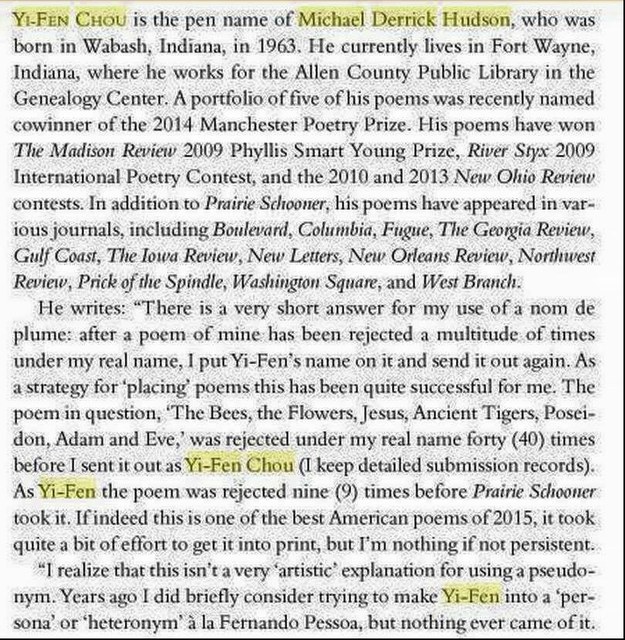
Many in the literary community took to social media to raise their concerns about the publication of Hudson’s poem in light of his nom de plume.
But Sherman Alexie, guest editor of The Best American Poetry 2015 — and in some sense originally a victim of a hoax — defended his decision to publish the poem, even after learning that Yi-Fen Chou was a pseudonym.
Details at: http://www.buzzfeed.com/isaacfitzgerald/yi-fen-chou-is-michael-derrick-hudson#.ljkm9RZAe1
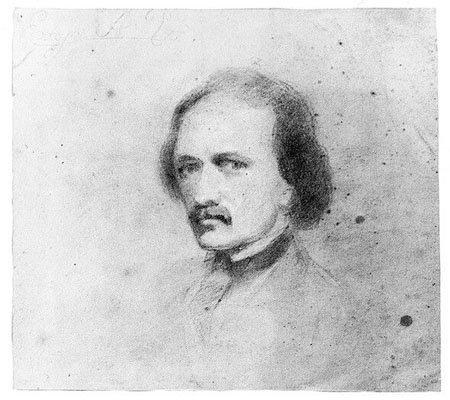
Edgar Allan Poe — self-portrait
Was the famous author killed from a beating? From carbon monoxide poisoning? From alcohol withdrawal? Here are the top nine theories
By Natasha Geiling
Source: http://www.smithsonianmag.com/history/still-mysterious-death-edgar-allan-poe-180952936/#vV6aWAfTgq8vGGWu.99
Give the gift of Smithsonian magazine for only $12! http://bit.ly/1cGUiGv
Follow us: @SmithsonianMag on Twitter
t was raining in Baltimore on October 3, 1849, but that didn’t stop Joseph W. Walker, a compositor for the Baltimore Sun, from heading out to Gunner’s Hall, a public house bustling with activity. It was Election Day, and Gunner’s Hall served as a pop-up polling location for the 4th Ward polls. When Walker arrived at Gunner’s Hall, he found a man, delirious and dressed in shabby second-hand clothes, lying in the gutter. The man was semi-conscious, and unable to move, but as Walker approached the him, he discovered something unexpected: the man was Edgar Allan Poe. Worried about the health of the addled poet, Walker stopped and asked Poe if he had any acquaintances in Baltimore that might be able to help him. Poe gave Walker the name of Joseph E. Snodgrass, a magazine editor with some medical training. Immediately, Walker penned Snodgrass a letter asking for help.
Baltimore City, Oct. 3, 1849
Dear Sir,There is a gentleman, rather the worse for wear, at Ryan’s 4th ward polls, who goes under the cognomen of Edgar A. Poe, and who appears in great distress, & he says he is acquainted with you, he is in need of immediate assistance.
Yours, in haste,
JOS. W. WALKER
To Dr. J.E. Snodgrass.
On September 27—almost a week earlier—Poe had left Richmond, Virginia bound for Philadelphia to edit a collection of poems for Mrs. St. Leon Loud, a minor figure in American poetry at the time. When Walker found Poe in delirious disarray outside of the polling place, it was the first anyone had heard or seen of the poet since his departure from Richmond. Poe never made it to Philadelphia to attend to his editing business. Nor did he ever make it back to New York, where he had been living, to escort his aunt back to Richmond for his impending wedding. Poe was never to leave Baltimore, where he launched his career in the early 19th- century, again—and in the four days between Walker finding Poe outside the public house and Poe’s death on October 7, he never regained enough consciousness to explain how he had come to be found, in soiled clothes not his own, incoherent on the streets. Instead, Poe spent his final days wavering between fits of delirium, gripped by visual hallucinations. The night before his death, according to his attending physician Dr. John J. Moran, Poe repeatedly called out for “Reynolds”—a figure who, to this day, remains a mystery.
Poe’s death—shrouded in mystery—seems ripped directly from the pages of one of his own works. He had spent years crafting a careful image of a man inspired by adventure and fascinated with enigmas—a poet, a detective, an author, a world traveler who fought in the Greek War of Independence and was held prisoner in Russia. But though his death certificate listed the cause of death as phrenitis, or swelling of the brain, the mysterious circumstances surrounding his death have led many to speculate about the true cause of Poe’s demise. “Maybe it’s fitting that since he invented the detective story,” says Chris Semtner, curator of the Poe Museum in Richmond, Virginia, “he left us with a real-life mystery.”
The nine theories include: beating, cooping (voter fraud), alcohol (related to cooping), poisoning (carbon monoxide or heavy metal), murder, and flu.


 Booker's Blog
