Category Archives: novel

“The Maltese Falcon”

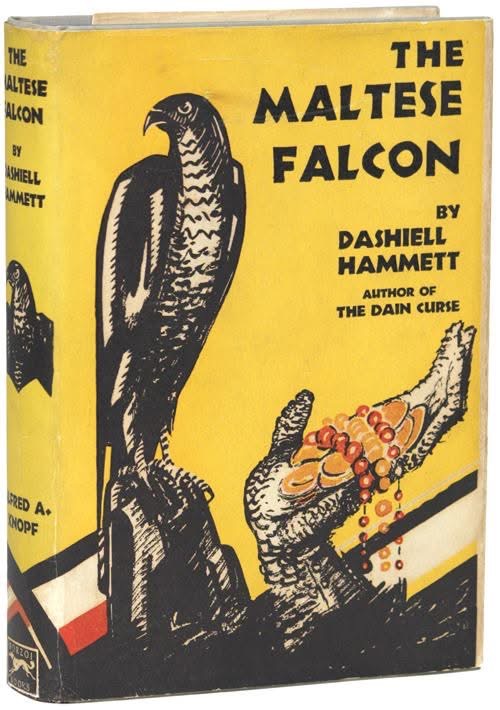
Dashiell Hammett’s THE MALTESE FALCON was first published by Alfred A. Knopf on this day in 1930.

“Samuel Spade’s jaw was long and bony, his chin a jutting v under the more flexible v of his mouth. His nostrils curved back to make another, smaller v. His yellow-grey eyes were horizontal. The v motif was picked up again by thickish brows rising outward from twin creases above a hooked nose, and his pale brown hair grew down-from high flat temples-in a point on his forehead. He looked rather pleasantly like a blonde Satan.”

–from THE MALTESE FALCON

A treasure worth killing for. Sam Spade, a slightly shopworn private eye with his own solitary code of ethics. A perfumed grafter named Joel Cairo, a fat man name Gutman, and Brigid O’Shaughnessy, a beautiful and treacherous woman whose loyalties shift at the drop of a dime. These are the ingredients of Dashiell Hammett’s coolly glittering gem of detective fiction, a novel that has haunted three generations of readers.

The dead partner in this story “comes alive” as the main character of another detective series.

Leave a comment

Filed under fiction, noir, novel, Uncategorized

Paul Beatty wins Man Booker prize 2016 | Books | The Guardian

Author wins for The Sellout, a satire of US racial politics, making him the first American writer to win award

Source: Paul Beatty wins Man Booker prize 2016 | Books | The Guardian

By Mark Brown

Paul Beatty has become the first American writer to win the Man Booker prize, for a caustic satire on US racial politics that judges said put him up there with Mark Twain and Jonathan Swift.

The 54-year-old Los Angeles-born writer won for The Sellout, a laugh-out-loud novel whose main character wants to assert his African American identity by, outrageously and transgressively, bringing back slavery and segregation.

Beatty has admitted readers might find it a difficult book to digest but the historian Amanda Foreman, who chaired this year’s judging panel, said that was no bad thing.

“Fiction should not be comfortable,” Foreman said. “The truth is rarely pretty and this is a book that nails the reader to the cross with cheerful abandon … that is why the novel works.

“While you’re being nailed, you’re being tickled. It is highwire act which he pulls off with tremendous verve and energy and confidence. He never once lets up or pulls his punches. This is somebody writing at the top of their game.”

Foreman called it a “novel for our times”, particularly in the context of the Black Lives Matter movement.

“The Sellout is one of those very rare books: which is able to take satire, which is a very difficult subject and not always done well, and plunges it into the heart of contemporary American society with a savage wit of the kind I haven’t seen since Swift or Twain.

“It manages to eviscerate every social taboo and politically correct nuance, every sacred cow. While making us laugh, it also makes us wince. It is both funny and painful at the same time.”

The £50,000 win, announced at a black tie dinner at London’s Guildhall, represented a particular success for Beatty’s publisher Oneworld, a small independent that also represented last year’s winner Marlon James and his novel A Brief History of Seven Killings.

Beatty was overcome by emotion as he accepted the award. He told the audience: “I don’t want to get all dramatic, like writing saved my life … but writing has given me a life.”

At a short press conference afterwards he said winning meant a lot, that he was as “happy as hell”. He did not call his book a satire, he said, but was happy for it be described that way.

The book may be set for success across the world, but Beatty, who said he was told by one of his college professors that he would never be a success as a writer, said it was not something he enjoyed. “I don’t like writing. It’s hard. You’ve got to sit down … I’m a perfectionist, I guess, and I get easily disgruntled and discouraged with what I’m doing. I am really hard with myself and I tend to sabotage myself, but when I’m writing I try not to do that, I try to be in the moment, to be confident.”
Anyone offended by early Richard Pryor might think twice about reading The Sellout. There is lots of swearing and frequent use of the n-word.
But Beatty says in the book that being offended is not an emotion.

“That’s his answer to the readers and I would say the same,” said Foreman.
Judges took almost four hours to reach what Foreman said was a unanimous decision. While it was something of a bookmakers’ outside bet – Ladbrokes offered odds of 6/1 – it had been tipped by many pundits and was adored by most critics with the Guardian’s critic calling it “daring and abrasive” and “a joy to read.”

The Wall Street Journal called it a “Swiftian satire of the highest order. Like someone shouting fire in a crowded theatre, Mr Beatty has whispered ‘Racism’ in a postracial world”.

The books losing out on the prize were Eileen by Ottessa Moshfegh (US), Do Not Say We Have Nothing by Madeleine Thien (Canada), All That Man Is by David Szalay (Canada-UK), His Bloody Project by Graeme Macrae Burnet (UK) and Hot Milk by Deborah Levy (UK).

Levy was arguably the best known writer on a list strikingly short of big literary names. She had also been shortlisted in 2012 for Swimming Home.

Beatty, who lives in New York, is the first American to win in the prize’s 48-year history and it comes three years after eligibility rules were changed to allow writers of any nationality writing in the English language and being published in the UK.

Sales for all six books have already increased significantly, particularly for His Bloody Project, published by the tiny Scottish crime imprint Contraband.

Frances Gertler, web editor at Foyles bookshops, said The Sellout was brave and funny. “It takes a bit of getting into but once there, you don’t want to leave. A smart satire with a memorable narrator.”

Foreman’s fellow judges this year, who have waded through 155 books over 10 months, were the critic and lecturer Jon Day, novelist and academic Abdulrazak Gurnah, poet and academic David Harsent and the actor Olivia Williams.

Foreman said the criteria used by judges in deciding the winner were: aesthetic, quality and depth of ideas, the craftsmanship of the writing and whether it transported the reader.

Beatty, the author of three previous novels and two books of poetry, was presented with his trophy by the Duchess of Cornwall.

Leave a comment

Filed under 2016, awards, novel

Should Novels Aim for the Heart or the Head? – The New York Times

Is it a good thing for a novel to stimulate our emotions? Montaigne, Brecht and others thought not.

Source: Should Novels Aim for the Heart or the Head? – The New York Times

The devil is in the detail. Talking about moments when excruciating gallstone pains made him believe he was soon to die, Montaigne remarks: “When I looked upon death as the end of my life, universally, then I looked upon it with indifference. Wholesale, I could master it: Retail, it savaged me; the tears of a manservant, the distributing of my wardrobe, the known touch of a hand, a routine word of comfort discomforted me and made me weep.”

It is the details that attach us to life and arouse our emotions. “A hound, a horse, a book, a wineglass and whatnot,” Montaigne observes, all “had their role in my loss.” Reasoning and accumulated wisdom, he goes on, may give us some insight into human grief, but it is the small things, picked up by ears and eyes — “organs which can be stirred by inessentials only” — that will really have an impact. So we might be aware of, but not greatly moved by, the plight of Syrian refugees until the photograph of a dead child face down in the sand triggers our emotions and has us bursting into tears.

Having made these observations, Montaigne embarks on what might best be described as a creative writing lesson in reverse. Literature, he points out, is adept at exploiting this aspect of our psychology; it focuses on evocative inessentials to stimulate our emotional response. Generally unmoved by the human condition, we nevertheless “disturb our souls with fictional laments.” It hardly even matters that they are invented: “The plaints of Dido and Ariadne in Virgil and Catullus arouse the feelings of the very people who do not believe in them.”

And he asks a question that no one asks these days: “Is it right for the arts to serve our natural weakness and to let them profit from our inborn animal-stupidity?” Aside from its astute selection of moving detail, art is constantly in the business of manipulating our emotions, as if this were an end in itself. This, after all, was Plato’s objection to the arts and every kind of artistic effect — that it was manipulative and potentially mendacious. Or simply a waste: “How often,” Montaigne asks, “do we encumber our spirits with yellow bile or sadness by means of such shadows?”

If we apply these ideas to narrative fiction as it is today, what do we find? First, the idea that a book, or film for that matter, stimulates extreme emotions is constantly deployed as a promotional tool. Terrifying, hair-raising, profoundly upsetting, painfully tender, heartbreaking, devastating, shocking, are all standard fare in dust-jacket blurbs and newspaper reviews; it is as if the reader were an ectoplasm in need of powerful injections of adrenaline. Anything that disturbs us, arouses us, unsettles us, is unconditionally positive. “You will be on the edge of your seat.” “Your heart will be thumping.” “Your pulse will be racing.” Aristotle’s response to Plato, that arousing emotion could be positive so long as the emotion was clarified, cathartically contained and understood, is rarely invoked. At best there is the implication that arousing emotions fosters sympathy, perhaps even empathy, with fictional characters and that such sympathy then breaks down our prejudices and hence is socially useful. So readers will frequently be invited to contemplate the sufferings of threatened minorities or discriminated-against ethnic groups, or the predicament of those who are young, helpless and preferably attractive. But this is an alibi and we all know it; what matters is stimulating emotion to sell books.

Similarly, creative writing courses, as far as I am able to judge, are obsessed with technique — how to arrive at that powerful detail, how to give it prominence, how to grab the reader, not why we want to grab the reader or to what end. Traditional literature courses used to reflect on the way detail was used inside a novel’s overall vision. The present zeitgeist invites us only to contemplate how the trigger can be pulled, not where the bullet is going, because the purpose of creative writing courses — especially when the fees are high — is to teach the would-be writer how to produce a publishable narrative, not a “good,” let alone a “responsible” narrative.

Montaigne is hardly alone in criticizing an overeasy excitement of the sentiments. In recent times, Bertolt Brecht objected to the stimulation of emotional identification with fictional characters, and Muriel Spark argued strongly against arousing compassion in novels; it allowed readers, she complained, to “feel that their moral responsibilities are sufficiently fulfilled by the emotions they have been induced to feel.” She advocated satire and ridicule instead as more effective tools of social criticism.

Samuel Beckett entirely rejected the idea of narrative as a vehicle for arousing emotion. Again and again he blocks any sympathy for his characters, drawing attention to their fictional status, making their suffering grotesque and comic rather than endearing. Yet even he understands how naturally narrative moves in this direction, admitting that in the final analysis even the struggle to avoid arousing emotions will confer a kind of pathos on the author.

But does it actually matter? Why not let novels stimulate emotions all they will and readers buy into them as intensely as they wish? The hell with it. What on earth could be wrong with that?

Montaigne’s comments on the evocative power of detail are not isolated. He lived in an age of division and dogmatism; the religious wars between Catholics and Huguenots lasted almost 40 years and caused countless deaths. In 1572 the St. Bartholomew’s Day Massacre alone saw thousands of Huguenots killed by their Catholic enemies. Montaigne’s position was always that we must be extremely careful about our emotions, in particular our tendency to get emotional about ideas. He didn’t advise neutrality, but simply that “we should not nail ourselves so strongly to our humors and complexions.” To foster emotions deliberately and habitually was dangerous, because once a strong emotion had kicked in it was very difficult to find a way back. Certainly, had he been alive today, he would have seen a continuity not just between violent fiction and real violence, war films and war, but also more generally between a culture that has turned the stimulation of emotion into a major industry and a society torn apart by heated conflicts of all kinds.

No civilization has ever produced as much narrative as our own, and with so little collective control. Thousands upon thousands of stories and novels are published worldwide every month. Not to mention TV series and films. There is intense competition: competition to get published, competition to win prizes, competition to reach a national audience, competition to reach an international audience. Of course there are various cards to play in that competition: wit, creativity, ideology, comedy, savviness; but the factor most frequently stressed, the one no one can do without, is emotional impact. When was the last time you heard a novel praised because it invited the reader to a higher level of intellectual engagement with complex issues? Or because it retreated from spicy detail to offer a balanced view of life overall? Or because its characters managed to handle potentially dangerous conflicts without arriving at a destructive showdown? Often as we read it seems that all the energy and creativity of the writer has been channeled into conjuring up those piquant, lurid or simply shocking details that will unleash the reader’s emotions.

How can we suppose that this state of affairs, this constant rush for the most disturbing, the most poignant, the most emphatic, the most terrifying, has no effect on the way we respond to the dramas of our lives? As I write this morning, three months after Brexit, two months after the Republican Convention nominated Donald Trump, following a summer that has seen scores of deaths from terrorism and with Aleppo still under relentless bombing, all I hear around me is violent, overheated, highly emotional rhetoric, ferocious discrediting of all adversaries, poignant details of the lives of unlucky victims, horror for the future and, beneath it all, a complacent excitement about our own capacity for feeling life intensely.

***
Tim Parks’s most recent book is “The Novel: A Survival Skill.”

Leave a comment

Filed under 2016, novel

Book sequel

The 5 best sequels to classic novels

Author Chet Williamson has written an authorised sequel to Robert Bloch’s Psycho. Here, he looks at other sequels that honour the original works while bringing new life to them

Source: http://www.independent.co.uk/arts-entertainment/films/features/my-five-favourite-sequels-to-classic-novels-from-the-further-adventures-of-huckleberry-finn-to-the-a6970976.html

Having just written an authorised sequel to Psycho, Robert Bloch’s original tale of Norman Bates, I was asked by The Independent to come up with what I considered the five best sequels to other classic novels. I’m not so sure about the “best”, but these are certainly my favourites, ones that honour and respect the original works while bringing different perspectives and new life to them:

The Further Adventures of Huckleberry Finn by Greg Matthews (1988)

The author of the western epics, Power in the Blood and Heart of the Country, takes up Sam Clemens’ pen and picks up the story as though channelling Mark Twain. A perfect sequel to a book that’s as close as anyone’s come to the Great American Novel.

Pym by Mat Johnson (2010)

It seems that Edgar Allan Poe’s Arthur Gordon Pym, a story of weird adventure in the Antarctic, is based on fact, and it’s up to a professor of American literature to confirm it with a trip to the South Pole. Johnson deals with race, history, and literature trenchantly and often humorously, while retaining the cosmic mystery of Poe’s original.

Grendel by John Gardner (1971)

Grendel John_GardnerNot so much a sequel as a retelling of the ancient epic, Beowulf, seen from the monster’s point of view. Gardner was an extraordinary writer, and his depiction of Grendel is tender, haunting, empathetic, and terrible.

A Feast Unknown by Philip Jose Farmer (1969)

First published by an “erotica” house, this novel is the great-grandfather of literary mash-ups, and still far superior to most of them. Farmer creates his own versions of Tarzan (Lord Grandith) and pulp hero Doc Savage (Doc Caliban), makes them half-brothers (their father was Jack the Ripper), and sets them against each other in a violent and homoerotic grudge match. A masterpiece of absurdity.

The Hours by Michael Cunningham (1998)

From the ridiculous to the sublime. Cunningham’s tripartite exploration of Virginia Woolf’s Mrs Dalloway is too complex in plot and character to begin to discuss here, but this bold and experimental novel sets the bar for what can be accomplished by treading in the footsteps of an earlier work of literary brilliance.

Psycho: Sanitarium is published on 12th April by Canelo, price £3.99 in eBook

Leave a comment

Filed under 2016, books, novel

The byte may destroy the book but the novel isn’t over yet

Technology has always had an effect on the form of the novel, but the story remains.

by Camilla Nelson

Source: http://theconversation.com/the-byte-may-destroy-the-book-but-the-novel-isnt-over-yet-42556?utm_medium=email&utm_campaign=Latest+from+The+Conversation+for+3+June+2015+-+2901&utm_content=Latest+from+The+Conversation+for+3+June+2015+-+2901+CID_d9aa7eed4583444a6198564d2fce1b93&utm_source=campaign_monitor&utm_term=The

In This Will Destroy That, also known as Book V, Chapter 2 of Notre Dame de Paris, Victor Hugo presents his famous argument that it was the invention of the printing press that destroyed the edifice of the gothic cathedral. Stories, hopes and dreams had once been inscribed in stone and statutory, wrote Hugo. But with the arrival of new printing technologies, literature replaced architecture.

Today, “this” may well be destroying “that” again, as the Galaxy of the Internet replaces the Gutenberg Universe. If a book is becoming something that can be downloaded from the app store, texted to your mobile phone, read in 140-character installments on Twitter, or, indeed, watched on YouTube, what will that do to literature – and particularly Hugo’s favourite literary form, the novel?

At one time, the typewriter was the cutting edge technology for novel writing.

At one time, the typewriter was the cutting edge technology for novel writing.

Debates about the future of the book are invariably informed by conversations about the death of the novel. But as far as the digital novel is concerned, it often seems we’re in – dare I say it – the analogue phase. The publishing industry mostly focuses on digital technologies as a means for content delivery – that is, on wifi as a replacement for print, ink, and trucks. In terms of fictional works specifically created for a digital environment, publishers are mostly interested in digital shorts or eBook singles.

At 10,000 words, these are longer than a short story and shorter than a printed novel, which, in every other respect, they continue to resemble.

Digital editions of classic novels are also common. Some, such as the Random House edition of Anthony Burgess’s A Clockwork Orange (1962), available from the App store, are innovatively designed, bringing the novel into dialogue with an encyclopedic array of archival materials, including Burgess’ annotated manuscript, old book covers, videos and photographs.

Also in this category is Faber’s digital edition of John Buchan’s 39 Steps (2013), in which the text unfolds within a digital landscape that you can actually explore, albeit to a limited degree, by opening a newspaper, or reading a letter.

But there is a strong sense in which novels of this sort, transplanted into what are essentially gaming-style environments for which the novel form was not designed, can be experienced as deeply frustrating. This is because the novel, and novel reading, is supported by a particular kind of consciousness that Marshall McLuhan memorably called the “Gutenberg mind”.

Novels are linear and sequential, and post-print culture is interactive and multidimensional. Novels draw the mind into deeply imagined worlds, digital culture draws the mind outward, assembling its stories in the interstices of a globally networked culture.

For the novel to become digital, writers and publishers need to think about digital media as something more than just an alternative publishing vehicle for the same old thing. The fact of being digital must eventually change the shape of the novel, and transform the language.

Far from destroying literature, or the novel genre, digital experimentation can be understood as perfectly in keeping with the history of the novel form. There have been novels in letters, novels in pictures, novels in poetry, and novels which, like Robinson Crusoe (1719), so successfully claimed to be factual accounts of actual events that they were reported in the contemporary papers as a news story. It is in the nature of the novel to constantly outrun the attempt to pin it down.

So too, technology has always transformed the novel. Take Dickens, for example, whose books were shaped by the logic of the industrial printing press and the monthly and weekly serial – comprising a long series of episodes strung together with a cliffhanger to mark the end of each installment.

So what does digital media do differently? Most obviously, digital technology is multimodal. It combines text, pictures, movement and sound. But this does not pose much of a conceptual challenge for writers, thanks, perhaps, to the extensive groundwork already laid by graphic novel.

Rather, the biggest challenge that digital technology poses to the novel is the fact that digital media isn’t linear – digital technology is multidimensional, allowing stories to expand, often wildly and unpredictably, in nonlinear patterns.

Rest of the article at: http://theconversation.com/the-byte-may-destroy-the-book-but-the-novel-isnt-over-yet-42556?utm_medium=email&utm_campaign=Latest+from+The+Conversation+for+3+June+2015+-+2901&utm_content=Latest+from+The+Conversation+for+3+June+2015+-+2901+CID_d9aa7eed4583444a6198564d2fce1b93&utm_source=campaign_monitor&utm_term=The

Leave a comment

Filed under 2015, novel

The Real Lolita

By Sarah Weinman

The story of 11-year-old Sally Horner’s abduction changed the course of 20th-century literature. She just never got to tell it herself.

Sally Horner and Frank La Salle

Sally Horner and Frank La Salle

Sally Horner walked into the Woolworth’s on Broadway and Federal to steal a five-cent notebook. She had to, if the girls’ club she desperately wanted to join were to accept her into its ranks. She’d never stolen anything in her life; usually she went to that particular five-and-dime for school supplies and her favorite candy. But with days to go before the end of fifth grade, Sally was looking for a ticket to the ruling class, far removed from the babies below her at Northeast School in Camden, New Jersey.

It would be easy, the girls told her. Nobody would suspect a girl like Sally as a thief. Despite her mounting dread at breaking the law, she believed them. On the afternoon of June 13, 1948, she had no idea a simple act of shoplifting would destroy her life.

Once inside, she reached for the first notebook she could find on the gleaming white nickel counter. She stuffed it into her bag and sprinted away, careful to look straight ahead to the exit door. Then, right before the getaway, came a hard tug on her arm.

Sally looked up. A slender, hawk-faced man loomed above her, iron-gray hair peeking out from underneath a wide-brimmed fedora. His eyes, set directly upon Sally’s, blazed a mix of steel blue and gray. A scar sliced across his cheek by the right side of his nose, while his shirt collar shrouded another mark on his throat. The hand gripping Sally’s arm bore the traces of an even older, half-moon stamp forged by fire. Any adult would have sized him up as well past 50, but he looked positively ancient to Sally, who had turned 11 just two months before. Sally’s initial nerves dissipated, replaced by the terror of being caught.

“I am an FBI agent,” the man said to Sally. “And you are under arrest.”

Sally did what many young girls would have done in a similar situation: She cried. She cowered. She felt immediately ashamed.

As the tears fell, the man froze her in place with his low voice. He pointed across the way to City Hall, the tallest building in Camden, and said that girls like her would be dealt with there. If it went the way they normally handled thieving youths, he told her, Sally would be bound for the reformatory.

Sally didn’t know that much about reform school, but what she knew was not good. She kept crying.

But his manner brightened. It was a lucky break he caught her and not some other FBI agent, the man said. If she agreed to report to him from time to time, he would let her go. Spare her the worst. Show some mercy.

Sally felt her own mood lift, too. He was going to let her go. She wouldn’t have to call her mother from jail—her poor, overworked mother, Ella, still grappling with the suicide of her alcoholic husband, Sally’s father, five years earlier; still tethered to her seamstress job, still unsure how she felt about her older daughter Susan’s pregnancy, which would make Ella a grandmother for the first time. Sally looked forward to becoming an aunt, whatever being an aunt meant. But she couldn’t think about that. The man was going to let her go.

On her way home from school the next day, though, the man sought her out again. Without warning, the rules had changed: Sally had to go with him to Atlantic City—the government insisted. She’d have to convince her mother he was the father of two school friends, inviting her to a seashore vacation. He would take care of the rest with a phone call and a convincing appearance at the Camden bus depot.

His name was Frank La Salle, and he was no FBI agent—rather, he was the sort G-men wanted to drive off the streets, though Sally didn’t learn that until it was far too late. It took 21 months to break free of him, after a cross-country journey from Camden, New Jersey, to San Jose, California. That five-cent notebook didn’t just alter Sally Horner’s own life, though: it reverberated throughout the culture, and in the process, irrevocably changed the course of 20th-century literature.

*

Rest of the story can be found at: http://penguinrandomhouse.ca/hazlitt/longreads/real-lolita

[Editor’s note: thank you to Ashlie for sending this my way.]

1 Comment

Filed under inspiration, novel

17 Brilliant Short Novels You Can Read in a Sitting

17 Brilliant Short Novels You Can Read in a Sitting | Electric Literature.

This week author Ian McEwan expressed his love of short novels, saying “very few [long] novels earn their length.” Certainly it seems like a novel has to be a minimum of 500 pages to win a major literary award these days, and many genre novels have ballooned to absurd sizes.

Child of God

Child of God

I love a good tome, but like McEwan many of my favorite novels are sharpened little gems. It’s immensely satisfying to finish a book in a single day, so in the spirit of celebrating quick reads here are some of my favorite short novels. I’ve tried to avoid the most obvious titles that are regularly assigned in school (The Stranger, Heart of Darkness, Mrs Dalloway, Of Mice and Men, Frankenstein, The Crying of Lot 49, etc.). Hopefully you’ll find some titles here you haven’t read before.

The rest of the article at: http://electricliterature.com/17-brilliant-short-novels-you-can-read-in-a-sitting/

Some of these brilliant short novels include Child of God by Cormac McCarthy, The Lathe of Heaven by Ursula K. Le Guin and The Third Policeman by Flann O’Brien.

1 Comment

Filed under novel

The Graphic details of the Gothic novel

Source: http://www.theguardian.com/books/interactive/2014/may/09/reading-gothic-novel-pictures?CMP=fb_gu

How to tell you’re reading a gothic novel – in pictures

When Horace Walpole published his ‘gothic story’ The Castle of Otranto, he launched a literary movement which has sired monsters, unleashed lightning and put damsels in distress for 250 years. A horde of sub-genres has followed, from southern gothic to gothic SF, but are some novels more gothic than others? We return to the genre’s roots in the 18th century for this definitive guide.

Gothic novels, the villain

Gothic novels, the villain

For the rest of the “graphic” story:
http://www.theguardian.com/books/interactive/2014/may/09/reading-gothic-novel-pictures?CMP=fb_gu

Thank you Ashlie for the suggestion.

Leave a comment

Filed under novel

Brain function ‘boosted for days after reading a novel’ – Science – News – The Independent

Brain function 'boosted for days after reading a novel' – Science – News – The Independent.

Leave a comment

Filed under brain, friction, novel

What I am working on

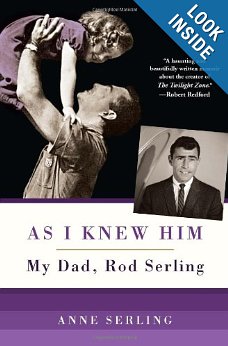
One of the recent books about Rod Serling to be published.

One of the books published recently about Rod Serling.

With the recent publication of Serling: The Rise and Twilight of TV’s Last Angry Man by Gordon F. Sander, and As I Knew Him: my Dad, Rod Serling by his youngest daughter Anne Serling, it seems the interest in Rod Serling and his seminal work on the TV show The Twilight Zone will not go away.

For several years I have been working on a novel entitled A Small Resurrection. Below is brief pitch for the novel and below that the first Act (chapter) of the novel:

Is believing in what you see the same thing as seeing what you believe in?

Knoxville, Tennessee, is the last place T. Xavier Gabriel wants to be. But the director of the 8th highest grossing film in Hollywood has come to town to ask his ex-wife for forbearance in paying the large alimony and possibly also for a loan to help restart his fallen career. She, however, has other plans. She wants him to rescue their 22-year-old daughter from the undue influences of a 24-year-old evangelical preacher. Gabriel wants nothing to do with that, having already admitted to be a failure once as a father, he doesn’t want a second bite of the apple. But when he finds his daughter keeping company with a resurrected Rod Serling, he sees a chance to use this Serling look-alike to resurrect his own career. But getting Serling away from his daughter puts her in jeopardy, and Gabriel must decide if he is going to save her or save his career. To save her, he must enlist the aid of Serling, who is not quite sure who he is or why he has been resurrected, and in saving her he puts an end ever resurrecting his career.

A SMALL RESURRECTION

by DAVID E. BOOKER

Act I: One More Pallbearer

A prop woman readied the coffin. At the behest of the director, she walked up and down the length of the three-foot deep grave, adjusting the bier’s position by the hole and trying not to knock free any of the flat-black paint sprayed on the soil to give it depth.

“No, no. A little more to the right, babe. There you go, that’s it.” T. Xavier Gabriel glanced through the camera’s viewfinder and clapped his hands. “Okay, people, places everybody. Time is on the short.” He checked the filter on one of the cameras as four banks of Klieg lights were turned on and three separate lights repositioned.

“Hey, dim the lights,” Gabriel said. “This is supposed to be a night scene: Night scene. See the stars.” He pointed skyward, but saw instead that it was overcast with lightning dancing among the clouds.

“Damn,” he muttered.

Several of the crew laughed lowly.

He shook his head. Another snafu in the making. “Damn. Goddamn.”

Gabriel glanced at his watch: 11:47 p.m. Post mortem. Pre migraine. Petty and mundane. He stomped his foot. It was a child-like gesture, but nothing adult-like seemed to be working now or for any part of 1985 that he’d directly had a hand in.

“Places everybody. Places. We shoot in fifteen minutes. Fifteen minutes. Places.” The assistant director walked around waving a flashlight and a clipboard. “Time is on the short.”

Gabriel smiled. It was a stiff, brittle, unsure smile: a guest at the funeral home smile. “Time is on the short” was his personal euphemism for running into overtime, something he had already been crucified for more than once. He rubbed his forehead and wondered if he’d ever get back to Hollywood, or if he’d spend the rest of his life in commercials, talking to semi trained mammals and now mimics of a dead man.

He glanced at the crumpled note still wadded in his hand. His ex-wife could find him anywhere. Two hours earlier he’d made the mistake of answering the phone.

#

“Wanda—”

“My name’s Drucilla. Sister Drucilla now. Wanda was my pagan name.”

“Whatever.”

“Don’t take that tone with me!”

“And don’t pester me about coming to Tennessee. Or alimony.”

“Prick that you are – Lord forgive me my wicked mouth – you might be the only one who can save her.”

“She’s not back into drugs, is she?”

“Worse.”

“Worse?”

“She’s into religion.”

“But you’re into religion.”

“Hers is the wrong kind.”

To Gabriel they were all the wrong kind.

“Listen, Gabe, you come and get here away from this cult and I’ll forgive you all the back alimony you owe me. Deal?”

As he paused to consider her offer, he could, again, smell the scent of her lilac perfume as if she were standing near him. The memory of the sent was so immediate that he glanced around the small room in the small trailer, expecting to see her standing nearby … glaring at him. Fortunately, she wasn’t.

“I’ll think about it,” Gabriel said

“It’s a more generous offer than you deserve.”

“I’ll think about it.”

“It’s only on the table for two days.”

“I said I’ll think about it.” He racked the receiver. There was no satisfaction in it.

#

Thunder rumbled from the edge of the horizon.

A production assistant walked up to him and handed him a message. Gabriel glanced at it.

Acid poured into his stomach.

#

“Fourteen minutes, people.”

Three prop men tested the rainheads, readying them to make rain. This would be the forty seventh attempt. One fourth of an inch of water stood in several places where it had not rained naturally in two and a half months. A gust of wind shook a bank of lights.

“Somebody anchor that damn thing down,” Gabriel said. He wished he had a drink. Something long and tall and cool to take The Edge off. Or even something stout and rolled and fiery. Or maybe even something white and powdery and inhaled. He had learned to be less picky recently in several areas of his life.

The Klieg lights died: flickering, then fading like the headlights of two dozen cars. A swath of lightning, as in a 1940s film noir, flashed over Gabriel’s shoulder, highlighting him in silhouette and casting his shadow among the trampled brown grass in front of him. It was exactly the effect he had been trying for in the past forty six attempts.

Part of the lights came back on. Technicians scurried to bring the others back to life. The mimic was standing near a single light draped with spun glass to diffuse its glare. Its position to him and his to the other lights cast his face and body in predominant dimness, smudging even further his strongly derivative features. But even in total darkness, Gabriel doubted he could see the similarity between this man and the dead host of The Twilight Zone: Rod Serling.

But the owners of Walton’s Funeral Homes insisted there was similarity, especially since they had chosen him from a list of sixty four candidates. “Besides, he has that sort of all American patriotic look, too,” Walton’s representative to the set had said. “And we want to work that aspect into the commercial. After all, our caskets are made in America.”

The other besides, the one not mentioned was that this mimic was the best they could afford on the budget they had. Gabriel had insisted on and won the battle for a complete professional crew and the better mimics had all been signed by an advertising conglomerate. Ten years after his death, imitating Rod Serling was a lively business. Imitators had been appearing everywhere, selling almost everything from late-night hamburgers to children’s board games to trips through a car wash. Even people who only knew about The Twilight Zone second- or third-hand recognized the clones, though many of them were referred to as Sterlings.

A large rain drop hit Gabriel squarely in the middle of his mostly bald head. His hair had started falling out in droves since he had turned fifty.
The rest of the lights flickered on. Gabriel grabbed a bull horn. “Okay, everybody. We start in five minutes. Five minutes. Get the mimic.”
Maybe this time they could get it right. Then get the hell out of here. He wasn’t superstitious, or so he told himself. He had made a conscientious effort to rid himself of that when he rid himself of his religious convictions. Still, the idea of being in a graveyard at midnight sent little twinges up the small of his back.

The mimic moved toward Gabriel, his hands clasped in front of him, his head cocked slightly to one side, trying desperately to take staccato steps. It wasn’t working.

A seemingly endless network of wires and cables from portable generators and control equipment preceded the mimic, web like, along the ground. It curled toward the casket, then away, into the night, as if afraid of the light. A technician picked up a trunk line and moved it out of the way.
Gabriel turned around, the bull horn near his lips. “Places everyone, the mimic has arrived. All prepare to receive him and pay him homage.”

“Hosannah. Hosannah in the highest,” the assistant director said, drawing disembodied laughter from the darkness behind the lights.

A jet rumbled by, low and directly overhead. The graveyard echoed briefly with its presence. Lightning flashed as it passed, its fuselage, as if photographed, briefly glowing an eerie bright blue. Its image hung in the air well into the first peal of thunder.

John Wilson Johnson, the mimic, moved toward the coffin, taking his time, stepping over electric wire spider boxes as if he were a hero on parade to the guillotine.

Johnson passed Gabriel and flashed the broadest smile his face would allow. “It is fixed.”

Gabriel nodded and flashed back a smile, his jaw muscles tight with the pressure of wanting to get it over with. Though he couldn’t see her, he knew the Walton’s representative was somewhere in the dark, spying, keeping an eye on him, on the time, on the cost.

Johnson walked around the coffin twice, touched it, then closed his eyes and began reciting Shakespeare. A workman finished soaking up the last puddles of water next to the casket and hurried out of Johnson’s way.

A smattering of raindrops splattered against the equipment. Everything held. Workman rushed in and wiped off the coffin, quickly checking the ground around it.

The crew quieted, except for the goosh goosh goosh of a tapping foot against a thin film of water.

“Silence! I must get into my role.”

Gabriel stopped tapping. Instead, he crossed his arms first one way, then another.

Johnson looked down at the coffin and stroked it gently, as if attempting to tame it. “‘There is a history in all men’s lives, Figuring the nature of the times deceas’d.’”

He glanced at the dummy hole. “‘A little, little grave, an obscure grave.’”

Then Johnson turned to the crowd. “‘No longer mourn for me when I am dead/ Than you shall hear the surly sullen bell.’”

First one, then two bolts of lightning snapped through the air.

“Get in the coffin.” Gabriel stepped toward the mimic: then stopped. Yelling at this guy only served to make him leave the scene. He lowered his voice to barely above a whisper. “Get in the box. It’s about to rain and we would all like to get out of here. Pleeessse.” The please squeaked as if spoken by a rusty gate.

“‘Good night, good night! parting is such sweet sorrow.’”

Gabriel took another step toward Johnson, his voice still restrained. “‘Youth’s a stuff will not endure.’”

Johnson backed away, waving his hands in a flourish as if throwing off chains. “‘O! that this too too solid flesh would melt, Thaw, and resolve itself into a dew.’”

“‘Nothing in his life/ Became him like the leaving it.’” Gabriel rushed forward and grabbed Johnson by the coat sleeve. “Claustrophobia or no claustrophobia, get in the damn box: now!”

Johnson turned toward Gabriel, reached down and gently removed his hand. “I was only trying to get into the role. Rodman Edward Sterling, after all, was a great admirer of the Bard. There could be a Clio in this, if it is done right.”

“Undoubtedly.” Gabriel pointed to the coffin. “But enough is enough. Get in the box.”

“But–”

“No buts. Do as I say.” Gabriel clenched his teeth. He tasted bile in the back of his throat. Undoubtedly this commercial was not going to win a Clio, or any other advertising award.

Johnson stepped toward the casket, hesitated, then climbed down inside, mumbling something about “‘The strain of man’s bred…,’” and finally saying as he crossed his arms: “‘But now I am cabin’d, confin’d, bound in/ To saucy doubts and fears.’”

Gabriel waited, then walked over and closed the lower lid. “Uncross your arms.”

“You’ll lose the effect if I uncross my arms.” Johnson averted his glance to Gabriel’s right hand resting on the lip of the upper lid. “It … it won’t be visually grabbing.”

“Let me worry about that.” He worked the lid, partly without thinking, then realizing that he had the mimic’s undivided attention. The lid had accidentally closed three times already, and it wasn’t easy for someone inside the small space to get it back open by himself.

“I think–”

“Don’t! You’re not paid to. Do as you’re told and we can all go home for a very late supper.” Gabriel worked the lid down and up until he had it and Johnson in the positions he wanted. “Now uncross your arms and clasp your hands in front of you at belt level. Like this.” Gabriel demonstrated and Johnson followed suit. “Very good.” He stepped back and turned to the crew. “Okay, everybody, places. Places. Let’s see if we can get this right this time.” He wiped his hand across his face and looked skyward. For a moment, he crossed his fingers.

Gabriel hoped to instill the sensation of the ground curving upward (created by the distortion in a wide angle lens) and opening as if it was going to swallow the viewer. It was the reverse of what Hitchcock had done in Vertigo. Hitchcock had had the luxury of a very good model. Gabriel did not. He only hoped the sensation, which would last only a few seconds — then the commercial would hard cut to a medium close up, the job of the second camera, which would then move into a tight shot — would obscure his use of a cheap clay and plastic creation.

Finally, the commercial would end on a long shot with a voice over dissolving into the muffled patter of cold, heavy, special effects created raindrops. Even the sound would be created. But only the opening shot had been filmed, in a small corner of a rented studio, and that had taken twenty seven tries.

It began pouring rain.

The ground shook for a moment.

The coffin lid snapped shut.

Gabriel stood in the rain as the rest of the crew scurried about, trying to save as much of the delicate equipment as they could. Two Klieg lights popped and died. Water dripped down their faces, almost tears.

It had all seemed so easy when he started. After all, how hard could it be to find, in New York, a Rod Serling look alike? Somebody who looked a little like him, who sounded a little like him, a sort of human palimpsest who could say, in plain, staccato English: “Submitted for your approval … the need to face the inevitable. The need to plan for the day when you can no longer play, when the endless turmoil of life has reached its final quietude. Don’t you deserve your day of rest? Don’t your loved ones? Then why don’t you make your arrangements, today, at Walton’s Funeral Homes.” Not parlors. They were no longer called parlors. Parlors were passé. “Sixteen convenient locations in the Greater New York Metropolitan Area to serve you. Ask about our American Plan, where your tax refund automatically goes to establish yours and your family’s day of rest. Or you, too, may be left out … in The Twilight Zone.”

#

The Walton’s representative, decked in a black raincoat, sinewed toward him. Gabriel slipped his hands into his pants pockets. The woman reminded him of a childhood teacher: nice looking (thinking back on it), but definitely a knuckle rapper.

At the last moment, he darted over to the coffin, figuring he could use the excuse of helping the mimic as a reason to avoid the rep. He gripped the lid and pulled it open.

Inside lay Rod Serling … the real Rod Serling.

Gabriel let go of the lid and it slapped shut again.

He almost didn’t re-open it.

#

He had not seen the real Rod Serling, Gabriel told himself, two hours later, sitting in a dry, dilapidated bar about to close. Dead men don’t rise from the dead: not now, not ever.

He raised his glass, curling it back toward himself as if to examine it. “Alas, poor Rodman, I knew him well.” He had, in a “former” life, a younger, enthusiastic life, directed two Zone episodes.

He tasted his first drink. He was sure there was plaster dust mixed in it. The rain had let up in intensity, but not in intent. Ask for Serling and you get….

Gabriel looked around. The room was peopled with tired, sad faces that matched the decor. Both looked as if they were on the lip of the real world. It was then he noticed the awkwardly hand lettered Going Out of Business sign behind the bar.

A middle aged man in a rumbled suit plunked down across from him. “Crying, fucking shame they’re closing this place down, ain’t it?”
“Huh?” Gabriel felt the man’s weight hit the faded red booth seat before he turned and saw him.

“Place’s been open nearly fifty years.” The man leaned slightly toward Gabriel as if Gabriel had a hearing problem. “You know, friend, when my father opened this place, farmers used to drink here when it first opened. Farmers for Chrissake. They’d come and have a drink or two and talk about things. Really talk. It was a neighborhood bar then.” The more he spoke, losing words and repeating others, the louder he got, and the more drunk Gabriel realized he was. “Now, just ’cause I’m in a pinch, they’re going to turn this into some fucking yuppie thing or other. A glorified pick up joint.”
”Fast food and fast bars.” Gabriel wished the man would go away: fast.

The man snorted. “You got that right, friend. And you know what, I hear they have one of those Sterling impersonators lined up to promote the place, even before it’s open.” He then got up and walked to another table, where he sat down and began his sermon again.

Gabriel finished the drink and ordered another one. Unfortunately, his last. The waitress told him the place was closing early so the workers could have one last private cry before going home for good. Then she apologized for the owner: the man in the gray rumbled suit. “He started early.”

She reached for the glass, but Gabriel refused to relinquish it until he had another full one. It was his assurance “Cutie” would return. She had told him her name, but he liked “Cutie” better, easier to remember.

He held the empty glass, staring at the bottom. He felt surer than ever, though he no longer believed in them, that it would take a miracle to save his flagging career. “Lord, ‘…Take away this cup from me….’” He snickered and then cursed himself for backsliding. His ex-wife would say there was yet hope for him; his daughter would be ecstatic. Both wanted to see him for their own reasons. For his own reasons, he had avoided going to Tennessee to see them.

The last drink arrived. It was double the size he expected. Gabriel raised himself in his booth and turned his head to thank the bartender. Standing behind the bar was a short man with dark hair in jacket and tie. He looked like—

He snatched the glass from the waitress.

He slumped in his booth and gulped his drink before trying to look at the bar again. If the inevitable was coming, it certainly wasn’t going to catch him sober.

When he looked again, what he saw behind the bar was not Rod Serling. At least not now.

Leave a comment

Filed under novel, What I am working on