
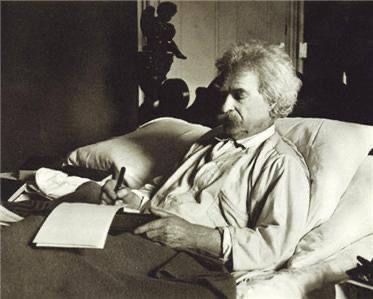
“My books are water; those of the great geniuses is wine. Everybody drinks water.” – Notebook, 1885
“My books are water; those of the great geniuses is wine. Everybody drinks water.” – Notebook, 1885
Filed under 2021, books, Mark Twain
Bill Murray Gives a Delightful Dramatic Reading of Twain’s Huckleberry Finn (1996) | Open Culture.
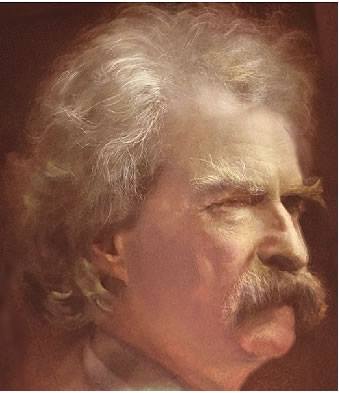
Mark Twain
Just above see Murray read an excerpt from American great Mark Twain’s The Adventures of Huckleberry Finn. Murray’s appearance at the 1996 Barnes & Noble event apparently came as a surprise to the audience—and to himself. The excerpt he reads might also surprise many readers of Twain’s classic, who probably won’t find it in their copies of the novel. These passages were originally published in Life on the Mississippi but reinserted—“correctly, I guess,” Murray shrugs—into Huck Finn in Random House’s 1996 republication of the novel, marketed as “the only comprehensive edition.” (Read a publication history and summary of the changes in this brief, unsympathetic review of the re-edited text.)
1996 was an interesting year for Twain’s novel. Long at the center of debates over racial sensitivity in public education, and banned many times over, the book figured prominently that year in a tense but fruitful meeting between parents and teachers in Cherry Hill, New Jersey. These discussions produced a new curricular approach that PBS outlines in its teaching guide “Huck Finn in Context,” which offers a variety of responses to the thorny pedagogy of “the ‘n’ word,” racial stereotyping, and reading satire. Beyond the issue of derogatory language, there also arose that year a pugnacious challenge to the book’s place in the American literary canon from novelist Jane Smiley. Smiley’s polemic prompted a lengthy rebuttal in The New York Times from Twain scholar Justin Kaplan.
[Editor’s note: the over hour-long video contains much more than Murray’s reading and is worth watching for its own merits and authors on the panel.]
Filed under Huckleberry Finn, Mark Twain
The radical of one century is the conservative of the next. The radical invents the views. When he has worn them out the conservative adopts them.
–Mark Twain, Notebook, 1898
So, go and create a new view with your writing. Show the world something it has not sen before.
–Editor
Filed under Mark Twain, Writers on writing
In our continuing quest to revisit a classic, or even a curiosity from the past and see how relevant it is, we continue with The Devil’s Dictionary by Ambrose Bierce. Originally published in newspaper installments from 1881 until 1906. You might be surprised how current many of the entries are.
For example, here is a definition for the words Corporation and Congress. The Old definitions are Bierce’s. The New definition is mine. From time to time, just as it was originally published, we will come back to The Devil’s Dictionary, for a look at it then and how it applies today. Click on Devil’s Dictionary in the tags below to bring up the other entries.
OLD DEFINITION
Corporation, n. An ingenious device for obtaining individual profit without individual responsibility.
Congress, n. A body of men who meet to repeal laws.
NEW DEFINITION
Corporation, n.The only think I could add to corporation is: An ingenious device for obtaining individual profit without individual responsibility. Peopled with overcompensated executives whose sole purpose is to privatize the profit and socialize the debt. In the vernacular: heads, I win (I get to keep the profit); tails you lose (You have to cover the bad debts).
Congress, n. A body of men and women who meet to repeal laws, generally at the behest of a corporation. This is now true of both the federal Congress and the state Congresses throughout the U.S.
Lobbyist, n. Paid influence peddler, bag man for the corporation, general thief in the night whose sole purpose on behalf of corporations is to see that Congress understands which laws are to be repealed or weakened, and how this should be done, particularly since too many lobbyists are former elected officials. Lobbyists can promote on behalf of other entities and not only corporations, but the goal is generally the same.
[Editor’s note: lobbyist was not a term long in use when The Devil’s Dictionary was created.]
Final word:
“It could probably be shown by facts and figures that there is no distinctly native American criminal class except Congress.” –MARK TWAIN
Filed under Ambrose Bierce, Devil's Dictionary, Mark Twain, satire
DEAR ABBY: I am a middle-aged woman who is Baptist by faith. I believe that when I die I will go to heaven, My problem is, if going to heavean means being reunited with my parents and other family members, then I don’t want to go! The idea of spending eternity with them is more than I can stand, but I don’t want to go to hell, either. Any thoughts? –Eternally Confused in Mississippi
DEAR ETERNALLY CONFUSED: Yes. When you reach the pearly gates, talk this over with St. Peter. Perhaps he would be willing to place you in a different wing than the one your parents and other family members are staying in. And in the meantime, discuss this with your minister.
&&&
Sometimes, you just can’t make things up. The entry above appeared in the Dear Abby column of my local paper in November of this year. In one sense, it needs no commentary, though it does remind me of the quote from mark Twain: “Heaven for climate and hell for society.” This also seems like a question the writer should have been asking of her minister before asking Dear Abby or even instead of Dear Abby, whose response is interesting and yet odd in its own way. “Wings” to heaven? Is this an attempt at a pun?
On the political front:
A member of Parliament to Disraeli: “Sir, you will either die on the gallows or of some unspeakable disease.”
“That depends, Sir,” said Disraeli, “whether I embrace your policies or your mistress.”
[Editor’s note: Only the line “Sir, I knew Jack Kennedy and you’re no Jack Kennedy” comes close to this in recent U.S. politics. Too bad we don’t have more of it.]
“He uses statistics as a drunken man uses lamp-posts… for support rather than illumination.”
Andrew Lang (1844-1912)
Do opposites attract?
“He had delusions of adequacy.”
Walter Kerr
“He is a self-made man and worships his creator.”
John Bright
“He has all the virtues I dislike and none of the vices I admire.”
Winston Churchill
Words for the dead and dying:
“I didn’t attend the funeral, but I sent a nice letter saying I approved of it.”
Mark Twain
“I have never killed a man, but I have read many obituaries with great pleasure.”
Clarence Darrow
“I’ve just learned about his illness. Let’s hope it’s nothing trivial.”
Irvin S. Cobb
On the literary front:
“He has never been known to use a word that might send a reader to the dictionary.”
William Faulkner (about Ernest Hemingway)
“Thank you for sending me a copy of your book; I’ll waste no time reading it.”
Moses Hadas
Literary point and counterpoint:
George Bernard Shaw to Winston Churchill:
“I am enclosing two tickets to the first night of my new play; bring a friend, if you have one.” –
Winston Churchill, in response:
“Cannot possibly attend first night, will attend second …. if there is one.”
Musical accompaniment:
“He has Van Gogh’s ear for music.”
Billy Wilder
Instead of saying your mother wears army boots:
“His mother should have thrown him away and kept the stork.”
Mae West
“He loves nature in spite of what it did to him.”
Forrest Tucker
For the man (or woman) who has everything:
“He has no enemies, but is intensely disliked by his friends.”
Oscar Wilde
“I feel so miserable without you; it’s almost like having you here.”
Stephen Bishop
“He is not only dull himself; he is the cause of dullness in others.”
Samuel Johnson
“He is simply a shiver looking for a spine to run up.”
Paul Keating
“In order to avoid being called a flirt, she always yielded easily.”
Charles, Count Talleyrand
When the evening has come and gone not the way you hoped:
“Some cause happiness wherever they go; others, whenever they go.”
Oscar Wilde
“I’ve had a perfectly wonderful evening. But this wasn’t it.”
Groucho Marx
The last word, or not:
“Why do you sit there looking like an envelope without any address on it?”
Mark Twain
Filed under humor, Mark Twain, quote, Woirds to live by, word play, words
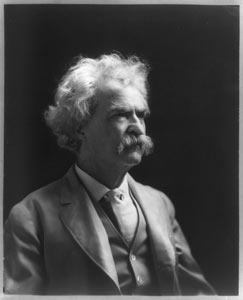
photo of Mark Twain
Unfortunately, there are fewer editors around these days, the victims of corporate downsizing many of them, so you will probably have to do this yourself, but it might just work. Every time you want to write “very,” write “damn” instead, then read the story out loud. Just don’t do it at an open mike night.
To learn more about Mark Twain: Mark Twain.
Filed under advice, editor, humor, Mark Twain, words, words to be wary of, writer, writing, writing tip
photo of Mark Twain
And somehow, if you don’t know who Mark Twain is, here’s where you can get a clue: Mark Twain.
Filed under advice, humor, Mark Twain, quote, Quote of the day, words, writer, writing, writing tip
http://www.nytimes.com/2011/01/07/books/07huck.html?_r=1&nl=books&emc=booksupdateemb5
January 6, 2011
Light Out, Huck, They Still Want to Sivilize You
By MICHIKO KAKUTANI
“All modern American literature,” Ernest Hemingway once wrote, “comes from one book by MarkTwain called ‘Huckleberry Finn.’ ”
Being an iconic classic, however, hasn’t protected “Adventures of Huckleberry Finn” from being banned, bowdlerized and bleeped. It hasn’t protected the novel from being cleaned up, updated and “improved.”
A new effort to sanitize “Huckleberry Finn” comes from Alan Gribben, a professor of English at Auburn University, at Montgomery, Ala., who has produced a new edition of Twain’s novel that replaces the word “nigger” with “slave.” Nigger, which appears in the book more than 200 times, was a common racial epithet in the antebellum South, used by Twain as part of his characters’ vernacular speech and as a reflection of mid-19th-century social attitudes along the Mississippi River.
Filed under Huckleberry Finn, insanity, Mark Twain, Perils of writing, publishers, Random Access Thoughts, story, words, writing


 Booker's Blog