Category Archives: library

Protect Your Library the Medieval Way, With Horrifying Book Curses | Atlas Obscura

Medieval scribes protected their work by threatening death, or worse.

Source: Protect Your Library the Medieval Way, With Horrifying Book Curses | Atlas Obscura

by Sarah Laskow

In the Middle Ages, creating a book could take years. A scribe would bend over his copy table, illuminated only by natural light—candles were too big a risk to the books—and spend hours each day forming letters, by hand, careful never to make an error. To be a copyist, wrote one scribe, was painful: “It extinguishes the light from the eyes, it bends the back, it crushes the viscera and the ribs, it brings forth pain to the kidneys, and weariness to the whole body.”

Given the extreme effort that went into creating books, scribes and book owners had a real incentive to protect their work. They used the only power they had: words. At the beginning or the end of books, scribes and book owners would write dramatic curses threatening thieves with pain and suffering if they were to steal or damage these treasures.

They did not hesitate to use the worst punishments they knew—excommunication from the church and horrible, painful death. Steal a book, and you might be cleft by a demon sword, forced to sacrifice your hands, have your eyes gouged out, or end in the “fires of hell and brimstone.”

“These curses were the only things that protected the books,” says Marc Drogin, author of Anathema! Medieval Scribes and the History of Book Curses. “Luckily, it was in a time where people believed in them. If you ripped out a page, you were going to die in agony. You didn’t want to take the chance.”

Drogin’s book, published in 1983, is the most thorough compendium of book curses ever compiled. A cartoonist and business card designer, Drogin had taken an adult-education class in Gothic letters and became entranced with medieval calligraphy. While researching his first book, he came across a short book curse; as he found more and more, hidden in footnotes of history books written in the 19th century, his collection grew to include curses from ancient Greece and the library of Babylon, up to the Renaissance.

To those historians, the curses were curiosities, but to Drogin they were evidence of just how valuable books were to medieval scribes and scholars, at a time when even the most elite institutions might have libraries of only a few dozen books.

The curse of excommunication—anathema—could be simple. Drogin found many examples of short curses that made quick work of this ultimate threat. For example:

May the sword of anathema slay
If anyone steals this book away.

Si quis furetur,
Anathematis ense necetur.

If a scribe really wanted to get serious, he might threaten “anathema-maranatha”—maranatha indicating “Our Lord has Come” and serving as an intensifier to the basic threat of excommunication. But the curses could also be much, much more elaborate. “The best threat is one that really lets you know, in specific detail, what physical anguish is all about. The more creative the scribe, the more delicate the detail,” Drogin wrote. A scribe might imagine a terrible death for the thief:

“If anyone take away this book, let him die the death; let him be fried in a pan; let the falling sickness and fever size him; let him be broken on the wheel, and hanged. Amen.”

Or even more detailed:

“For him that stealeth, or borroweth and returneth not, this book from its owner, let it change into a serpent in his hand & rend him. Let him be struck with palsy & all his members blasted. Let him languish in pain crying aloud for mercy, & let there be no surcease to his agony till he sing in dissolution. Let bookworms gnaw his entrails in token of the Worm that dieth not, & when at last he goeth to his final punishment, let the flames of Hell consume him for ever.”

Drogin’s book had dozens of such curses in it, and he had collected at least a dozen more to include in the second edition, which was never published. Inside his copy of the book, he still has a baggie of antique file cards, full of book curses.

As Drogin collected curses, he started to find repeats. Not all scribes were creative enough to write their own curses. If you’re looking for a good, solid book curse, one that will serve in all sorts of situations, try this popular one out. It covers lots of bases, and while it’s not quite as threatening as bookworms gnawing at entrails, it’ll get the job done:

“May whoever steals or alienates this book, or mutilates it, be cut off from the body of the church and held as a thing accursed.”
Leave a comment

Filed under 2017, books, library

Librarians take up arms against fake news | Family | herald-review.com

Source: Librarians take up arms against fake news | Family | herald-review.com

SEATTLE — Janelle Hagen is a school librarian whose job goes far beyond checking out books. She and many other librarians are equipping students to fight through lies, distortion and trickery to find their way to truth.
Helping students become smarter evaluators of the information that floods into their lives has become increasingly necessary in an era in which fake news is a constant.

Two University of Washington professors recently announced a new class that will focus on the ways data are misused to mislead the public. Younger students may need guidance even more.

Hagen, the middle-school librarian at Lakeside School in Seattle, said the students she serves are online every day, and they need to be able to figure out what’s trustworthy and what isn’t.

Besides running the library, Hagen said, she teaches a class called “digital life.” She meets with fifth-graders twice a week and with eighth-graders once a week. The classes are a mix of technology and information-literacy skills, but since the presidential election, she’s increased the focus on the latter.”It was because of all of the buzz (about fake news). You can look at the Google analytics, and the search for ‘fake news’ was unprecedented.” she said. “It’s our job as teachers to address what’s going on in the world.”

One Monday morning, her eighth-graders took a group quiz in which they were asked to identify different kinds of information — advertising, publicity, propaganda, news, opinion pieces. They worked on their laptops choosing from multiple options, and their choices showed up on a big screen at the front of the classroom. There was discussion after each question, especially when not everyone got the answer right.

Hagen introduced the new focus to students by showing them the results of a Stanford History Education Group study in which students from college, high school and middle school were tested on their understanding of various types of information.

Most middle-school students were able to distinguish advertisements from news stories, but more than 80 percent confused native advertisements with news stories. Native advertisements are designed to look like news stories, but they carry a label that sets them apart, usually “sponsored content.” That wasn’t enough.

There is a great need for more education in the critical-thinking skills that are part of information literacy.

Remember when many people thought librarians were going to become obsolete because the world of information was migrating to the web? But then we became enthralled by the possibilities of big data, and library schools became information schools, turning out people who could help navigate vast troves of online data. That’s where the discipline was when Hagen graduated from the University of Washington Information School in 2011.

Librarians and libraries are still with us, and those new data skills are increasingly valuable, but an older skill is now rising in importance. Hagen said librarians have always helped people sort fact from fiction, reliable sources from deceptive ones. Usually that happened as students worked on research papers, but now those lessons need to cover daily life.

“It’s a difficult time to work in education because we are seeing what’s happening in the world and how opinions are really first and foremost rather than facts,” Hagen said.

Lakeside’s high-school librarians put up a display in the entrance to their building that offers several tips for spotting fake news. One says: “What’s the evidence?” Underneath a flap there’s more detail: “As you read an article, make sure to see if they have any evidence to back up their claims. Furthermore, research the evidence to see if it is real, made up, or used in a way not intended by its creators.”

Are claims in an article backed up by verifiable facts? Check the authors’ backgrounds to see if they have credibility on the topic they are writing about.

Hagen likes The News Literacy Project, a collaboration between journalists and educators to improve students’ information literacy through lessons in the classroom and its online program Checkology.

Hagen’s eighth-graders use AllSides, a website that rates the bias of news stories and other articles, labeling them according to where they fit on a political spectrum from left to center to right. And it posts multiple versions of major stories and their ratings. Readers can test their own biases on the site.

As the site says, “if you have a pulse, you have a bias.” And Hagen tells her students that even the most honest media have biases, but they also try hard to be fair, and articles must past muster with layers of editors, so a reader or viewer is more likely to get a more reliable version of a given story.
Awareness is the key, she said. And it is. Read, listen, watch with an active, questioning mind.

Leave a comment

Filed under 2017, library

Fighting Fake News | American Libraries Magazine

Librarians can play a vital role in helping everyone, of any age, fight fake news and become critical and reflective media consumers.

Source: Fighting Fake News | American Libraries Magazine

Librarians—whether public, school, academic, or special—all seek to ensure that patrons who ask for help get accurate information.

Given the care that librarians bring to this task, the recent explosion in unverified, unsourced, and sometimes completely untrue news has been discouraging, to say the least. According to the Pew Research Center, a majority of US adults are getting their news in real time from their social media feeds. These are often uncurated spaces in which falsehoods thrive, as revealed during the 2016 election. To take just one example, Pope Francis did not endorse Donald Trump, but thousands of people shared the “news” that he had done so.

Completely fake news is at the extreme end of a continuum. Less blatant falsehoods involve only sharing the data that puts a proposal in its best light, a practice of which most politicians and interest group spokespeople are guilty.

The news-savvy consumer is able to distinguish fact from opinion and to discern the hallmarks of evasive language and half-truths. But growing evidence suggests that these skills are becoming rarer. A November 2016 study by the Stanford History Education Group (SHEG) showed that students have difficulty separating paid advertising from news reporting, and they are apt to overlook clear evidence of bias in the claims they encounter. These challenges persist from middle school to college.

According to SHEG Director Sam Wineburg, professor at Stanford Graduate School of Education, “nothing less than our capacity for online civic reasoning is at risk.”

Librarians and journalists: natural allies
Librarians can help change this trend. “Librarians are natural allies for educators in helping students become critical news consumers,” says Wineburg. The profession’s deep commitment to verified sources and reliable information mirrors similar values—accountability for accuracy, careful research before drawing firm conclusions, and a willingness to correct errors—that drive responsible journalism.

One emerging solution among journalists is the Trust Project, an initiative of the Markkula Center for Applied Ethics at Santa Clara (Calif.) University.

Headed by longtime reporter Sally Lehrman, director of Santa Clara’s journalism ethics program, the Trust Project has partnered with nearly 70 media organizations to develop a collection of color-coded digital “Trust Indicators” that signify reliable and responsible reporting. Indicators include a commitment to seeking diverse perspectives, linking out to credible sources of further information, offering clear markers regarding whether an article presents opinion or news, and providing information about an article’s author. The complete set is available at the Trust Project website.

Still in the works for the project is computer code that will allow partner media organizations to note when they have achieved a Trust Indicator, which serves as a proxy for reliable journalism. This code should be broadly available by mid-2017. Services such as Facebook and Google would surface these materials more prominently in news feeds and search results, while readers would see clear visual icons that demonstrate fulfillment of the Trust Indicators. As Lehrman explains, “These icons would be cognitive shortcuts to route readers to more reliable sources of news.”

She also notes a strong desire by consumers to be active participants in the shaping of the news, rather than merely a passive audience. In that spirit, she welcomes input and feedback from librarians about how to best achieve the aims of the Trust Project.

Direct collaboration with journalists is another route to increasing media literacy. For example, the Dallas Public Library (DPL) will host an eight-week training course in community journalism for high school students. Its “Storytellers without Borders” project, one of the winners of the 2016 Knight News Challenge, includes oversight from professional librarians as well as reporters at the Dallas Morning News. Students will rotate among three DPL branch locations that represent the socioeconomic and cultural diversity of the city. Journalists will mentor students on how to ask focused questions, while librarians will describe how to use research databases to find accurate information. Library staffers will also provide instruction on how to use multimedia editing tools. In April 2017 these budding digital journalists, with their new skills in the art of providing credible and engaging content, will showcase their efforts at the Dallas Book Festival.

Information literacy at your library
The Trust Project and “Storytellers without Borders” are high-profile efforts, but any library can lead educational programs about the importance of media literacy.

As the SHEG study reveals, this training should begin with young students and continue through college. Resources that range from free LibGuides to enhanced school curricula are available for libraries around the country.
Librarians at Indiana University East in Richmond have developed a LibGuide about how to identify fake news, complete with detailed images of what questions to ask while perusing a site. The News Literacy Project, founded by former Los Angeles Times reporter Alan Miller, offers a comprehensive curriculum of classroom, after-school, and e-learning programs for middle and high school students; the Center for News Literacy at Stony Brook (N.Y.) University offers similar resources for teaching college students.

Despite the clear need for increased media literacy, one risk is that this topic will always be perceived as optional—nice to know but not essential. Wineburg argues that this is misguided. “Online civic literacy is a core skill that should be insinuated into the warp and woof of education as much as possible,” he says. In a paper for College & Research Libraries News, Brian T. Sullivan, information literacy librarian, and Karen L. Porter, sociology professor, of Alfred (N.Y.) University map out how to convert those one-shot information literacy training sessions into full programs with embedded librarians.

Librarians can play a vital role in helping everyone, of any age, become critical and reflective news consumers. One positive outcome of the current furor about fake news may be that information literacy, for media and other types of content, will finally be recognized as a central skill of the digital age.

Leave a comment

Filed under 2017, library

Library cat fur-loughed

Library Cat is Being Taken Away from the Place He Calls Home After 6 Years

Source: http://www.lovemeow.com/save-library-cat-browser-1889260522.html

Browser being evicted from only home he's known.

Browser being evicted from only home he’s known.

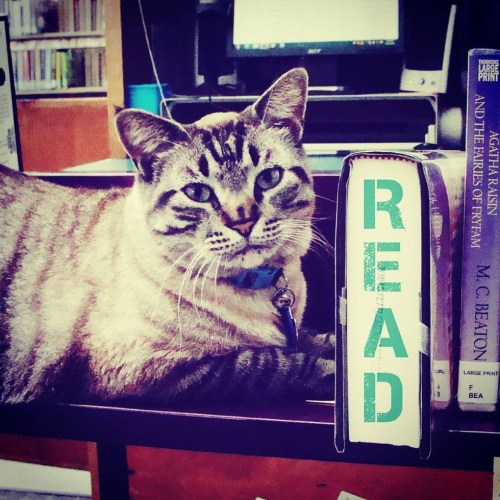
A cat that has been a loyal worker and family to a library for six years is being taken away from the place he calls home.

Browser has been living at the Friends of the White Settlement Public Library (White Settlement, TX) for six years. He’s done great to contribute to fixing the library’s rodent problem and is loved by everyone there. However, things took a different turn, when suddenly he was asked to move out of the place he calls home.

This friendly feline has been a fixture at the library and people from all ages adore him and his purrsonality.

“I don’t have any animals. But this cat is so gentle and so lovable and he brings so much comfort to so many people, it seems like a shame to take him away,” Lillian Blackburn, president of the library, told Star Telegram.

It all happened after a city employee complained to the city council that they weren’t allowed to bring their puppy to work, but also pointed out the fact that Browser was allowed to stay at the library.

Despite “an outpouring of support for the cat”, the White Settlement City Council voted to evict the cat.

Ironically, it was the city council that voted to allow the library to have a cat to help them with pest control.

Mayor Ron White, a nonvoting council moderator, also wants Browser to stay.

“That cat doesn’t have anything to do with whether somebody can have their puppy at City Hall. That cat doesn’t hurt anybody,” he said to Star-Telegram.

Browser is a wonderful cat and always so helpful around the library.

Not only does he keep the rodents at bay, he helps his humans with their work too.

Browser, the supercat, protecting the library from rodents.

What a hero!

He helps kids and adults pick good reads and brings a big smile to everyone that walks in.

Mayor White hopes they could reconsider its decision at the next council meeting on July 12, two days before Browser has to move out.

“Browser is still at the library for now,” White Settlement Public Library told Love Meow.

If you’d like to show your support in favor of keeping Browser the cat at the library, you can contact White Settlement council members at this link.

Leave a comment

Filed under 2016, library

Libraries: the hauntingly beautiful and the beautifully haunted

The World’s Most Beautiful Library Is In Prague, Czech Republic

Source: http://www.boredpanda.com/beautiful-library-prague-czech-clementinum/

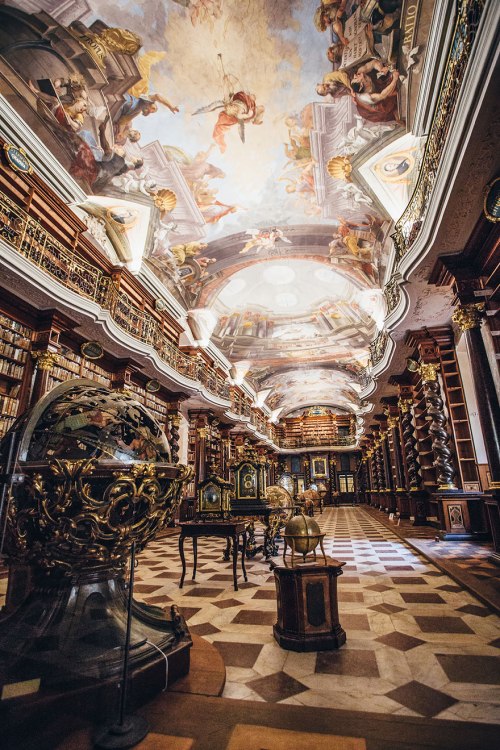
The Klementinum library

The Klementinum library

The Klementinum library, a beautiful example of Baroque architecture, was first opened in 1722 as part of the Jesuit university, and houses over 20,000 books. It was voted as one of the most beautiful and majestic libraries in the world by our readers!

The ceiling frescoes were painted by Jan Hiebl. In 1781, director Karel Rafael Ungar established Biblioteca Nationalis, a collection of Czech language literature. Some of the rare historical books from this collection have been sent to Google for scanning and will eventually be available on Google Books.

Just as the library is a rare and little-known treasure, so is it associated with several little-known facts: the Klementinum used to be the third largest Jesuit college in the world; recording of local weather began there in 1775 and has continued ever since; it is featured in a novel by famous Spanish-language writer Jorge Luis Borges.

Photos of the library can be seen here: http://www.boredpanda.com/beautiful-library-prague-czech-clementinum/

***

Phantoms among the Folios: A Guide to Haunted Libraries

Source: http://americanlibrariesmagazine.org/2015/10/28/phantoms-among-folios-guide-to-haunted-libraries/

In the fall, a journalist’s fancy lightly turns to thoughts of ghosts. Newspapers and magazines that haughtily refrain from printing news of the paranormal for 11 months of the year eagerly jump on the Halloween coach in October to regale their audiences with dubious tales of the preternatural.

American Libraries is no exception. However, unlike less reputable media, we go to original sources whenever possible to ascertain whether or not our spooks are spurious. And in so doing we have uncovered a hauntful of genuinely eerie events hiding amid the folktales.

Libraries are haunted?

Bleak mansions and somber castles usually spring to mind when we think of haunted places. But ghostly phenomena—whatever the cause—can manifest in well-lit, modern offices as well as crumbling Carnegies. Of course, it helps if you inadvertently build your library on top of a graveyard.

Haunted libraries fall into two types. First, there is the “building with a reputation,” where a convenient murder, curse, or other tragedy has occurred. Library staff can then blame the odd noise, the occasional book falling off the shelf, or glitches in the air conditioning on the resident “scapeghost.” No one reports anything too spooky, and the children’s librarians have a good time with it at story hour.

Second, there are libraries where credible, responsible people observe enigmatic human shapes, hear disembodied voices, and witness other classic parapsychological events. Glib explanations about how the building must be settling ring about as hollow as those mysterious footsteps late at night on the upper floorboards. The library staff learns to live with its wraith, usually by accepting the paranormal as a normal working condition.

Both categories of haunted libraries are described here. Like a good journalist I will begin with Type One, forcing you to read through to the end to get the good stuff. Just make sure you don’t finish this article alone in bed, late at night, during a violent thunderstorm.

’Tis the curse of service

As if library directors didn’t have enough to worry about, a curse would be sufficient to send stress levels over the line. Fortunately, the curse on Peoria (Ill.) Public Library directors seem to have lifted long ago. Uttered in 1847 by the lawyer-plagued woman who owned the land where the library now stands, the curse is said to have been responsible for the untimely deaths of three directors: The first was killed in a streetcar accident in 1915, the second died from a heart attack suffered after a heated debate at a library board meeting in 1921, and the third committed suicide in 1924 by swallowing arsenic. Since then, Peoria directors have lived long, fruitful lives.

Trisha Noack, ‎manager of Public Relations at Peoria Public Library, said their Main Library was remodeled and reopened in December 2010.

“Most of these reports came from the stacks area, now known as LL1 and the home of our Art Gallery and Local History and Genealogy Room,” Noack said. “Since the stacks were eliminated (and) the entire library building (was) stripped down to the bare walls, there has been no further activity.”

Ruth did it

On October 11, 1947, Ruth Cochran, assistant librarian at the Umatilla County Public Library in Pendleton and president of the Eastern Oregon Library Association, suffered a cerebral hemorrhage as she was closing the building. She went to the basement to rest, but soon became too weak to move or summon help. The next day the custodian’s wife found her, still conscious, and she was taken to the hospital where she died, according to the Pendleton East Oregonian. Ever since, spooky events in the library have been blamed on Ruth’s ghost.

Harvey Thompson, a library patron who took an interest in Ruth, said there is “something in the building that makes people nervous.” Once a custodian was alone in the building painting the children’s room when the intercom system buzzed repeatedly. “The folklore was that Ruth was suffering in the basement trying to summon someone,” Thompson said.

The library, now called the Pendleton Public Library, moved to into a vacant remodeled junior high school building in November 1996, according to library director Mary Finney. Ruth’s old building has been converted into the Pendleton Center for the Arts. Former executive director Tom Hilliard said that he never saw or heard anything he couldn’t explain: “It was an old building [a Carnegie built in 1916]. Noises turned out to be pipes expanding or a bird in the attic.”

Rockin’ wraith

The Cairo (Ill.) Public Library boasts of a ghost that one young library patron has dubbed Toby. Director Monica Smith noted that Toby usually hangs out in the special collections room on the second floor of this 1884 building. “I’m here a lot of times by myself at night, and I do hear many different sounds like someone walking around upstairs,” Smith said. “Many times I come back and find the lights on that we turned off in that room. I definitely think there is a presence here.”

Former librarian Louise Ogg once saw a ghostly light rise up from behind a desk, pass slowly by her office, and disappear into the book stacks. Another staff member was with her and saw the same thing. There used to be a rocking chair in the library that made creaking noises by itself, as if someone were rocking in it. “You kind of get used to it,” Smith said.

More available at: http://americanlibrariesmagazine.org/2015/10/28/phantoms-among-folios-guide-to-haunted-libraries/

Leave a comment

Filed under 2015, library

The Case For Libraries

When it comes to books, libraries and publishers should be in it together, argues a leading marketing expert

Source: http://www.publishersweekly.com/pw/by-topic/industry-news/libraries/article/66106-the-case-for-libraries.html

By David Vinjamuri

Publishers are running out of space. Not in their headquarters, some of which are larger and more imposing than ever, but in retail. The number of booksellers has been dwindling since the demise of Borders, and the largest book retailer today is Amazon, which has no physical space at all.

So the question is, where can publishers showcase new books? If only there were a space dedicated primarily to reading that hundreds of millions of Americans visit annually. If only there existed a trusted space, free of the revenue pressure that necessitates displaying lightly pornographic books of debatable quality. If only there were a space largely inhabited by active readers, where publishers could showcase new authors or shine new light on talented mid-listers.

That space exists in the 16,000 public library branches in America. They’re trusted and willing, and they welcome your attention. But libraries receive surprisingly little coordinated help from publishers beyond lip service—in fact, they’re still in the middle of a very public dispute with publishers about the high prices and restrictive access libraries must contend with to lend e-books to their patrons.

The tension between libraries and publishers seems odd in a market where physical space for displaying books is quickly disappearing. How did we get here? And could libraries actually represent a much better opportunity for publishers than they are given credit for?

A History of Indifference

In the beginning, publishers and libraries were interdependent. When modern publishing houses emerged from printers in the late 19th century, public libraries in the U.S. and U.K. were often the first and only guaranteed customer for a title.

Even as late as 1950, libraries were indispensable customers for publishers. The entire output of the domestic publishing industry in that year was 11,000 titles, and the average branch of a public library purchased 14,000 titles annually. The most reliable market for many books was the 11,135 library branches operating then.

Things are different today. Publishers produced nearly half a million new ISBNs in 2013 (with self-publishers included, that total nearly doubles), though increasingly cash-strapped libraries are purchasing fewer titles. According to industry stats, the library market now represents just over 1.3% of publishers’ trade sales. But just as the crucible of the book superstore transformed publishing in the 1980s, the advent of online sellers—particularly Amazon—is remaking it today. And as the conflict between Hachette and Amazon last year proved, Amazon is both indispensable and despised as a partner to publishers.

But a new challenge has emerged from the transformation of sales channels in the past three decades: discovery. Five years, ago in 2010, just under a third of all frequent readers (who purchase 80% of all books and number 43 million) found the last book they bought at a bookstore. This year, that number is down to 17%, according to Peter Hildick-Smith, of the Codex Group—a change that gives Amazon more power than ever.

“A small group of authors control the bestseller lists,” Hildick-Smith observes. “When we indexed the New York Times hardcover fiction and mass market bestseller lists from June 2008 through June 2014, nearly 16,000 spots in total, we found that all those places were occupied by fewer than 650 authors.”

That concentration has created a problem for publishers, which Amazon has ruthlessly exploited. By promoting both self-published and Amazon-signed authors on the Kindle platform, the online retailer has come to exert tremendous pricing pressure on the entire industry. Amazon can now manipulate the products of hundreds of thousands of other authors through price reduction.

Meanwhile, the dominance of bestsellers has also put the squeeze on the marketing budgets of debut and midlist authors. Since publishers can only afford to make a few big bets per year, the route to building new franchise authors is more uncertain than ever.

Author Brands Matter

A great deal of attention has been paid to the question of so-called platform size for new authors. How large is the social media footprint of the author? How active is she on Facebook, Twitter, and

Continued at: http://www.publishersweekly.com/pw/by-topic/industry-news/libraries/article/66106-the-case-for-libraries.html

Leave a comment

Filed under 2015, library

“Book ’em, Dano”

The Danger of Being Neighborly Without a Permit

All over America, people have put small “give one, take one” book exchanges in front of their homes. Then they were told to tear them down.

by Conor Friedersdorf

Source: http://www.theatlantic.com/national/archive/2015/02/little-free-library-crackdown/385531/

Local Little Library box.

Local Little Library box.

Three years ago, The Los Angeles Times published a feel-good story on the Little Free Library movement. The idea is simple: A book lover puts a box or shelf or crate of books in their front yard. Neighbors browse, take one, and return later with a replacement. A 76-year-old in Sherman Oaks, California, felt that his little library, roughly the size of a dollhouse, “turned strangers into friends and a sometimes-impersonal neighborhood into a community,” the reporter observed. The man knew he was onto something “when a 9-year-old boy knocked on his door one morning to say how much he liked the little library.” He went on to explain, “I met more neighbors in the first three weeks than in the previous 30 years.”

Since 2009, when a Wisconsin man built a little, free library to honor his late mother, who loved books, copycats inspired by his example have put thousands of Little Free Libraries all over the U.S. and beyond. Many are displayed on this online map. In Venice, where I live, I know of at least three Little Free Libraries, and have witnessed chance encounters where folks in the neighborhood chat about a book.

I wish that I was writing merely to extol this trend. Alas, a subset of Americans are determined to regulate every last aspect of community life. Due to selection bias, they are overrepresented among local politicians and bureaucrats. And so they have power, despite their small-mindedness, inflexibility, and lack of common sense so extreme that they’ve taken to cracking down on Little Free Libraries, of all things.

Last summer in Kansas, a 9-year-old was loving his Little Free Library until at least two residents proved that some people will complain about anything no matter how harmless and city officials pushed the boundaries of literal-mindedness:

The Leawood City Council said it had received a couple of complaints about Spencer Collins’ Little Free Library. They dubbed it an “illegal detached structure” and told the Collins’ they would face a fine if they did not remove the Little Free Library from their yard by June 19.

Rest of the article: http://www.theatlantic.com/national/archive/2015/02/little-free-library-crackdown/385531/

Leave a comment

Filed under 2015, library

The Ferguson Public Library

In the midst of what is happening in Ferguson, MO, the library has remained open to all.

A Nationwide Outpouring Of Support For Tiny Ferguson Library

Source: http://www.npr.org/blogs/thetwo-way/2014/11/27/366811650/a-nationwide-outpouring-of-support-for-tiny-ferguson-library

The Ferguson Public Library is just a block away from the center of demonstrations at the Ferguson Police Department. As we’ve reported, when violent protests this week led to the burning of more than a dozen businesses and the uncertainty caused schools to close, the library stayed open.

It has become a quiet refuge for adults and children alike in this St. Louis suburb. And the nation has taken notice. The outpouring of support for the library has reached “orders of magnitude” more than any previous amount, says library Director Scott Bonner.

He’s the only full-time librarian there — and he started his job in July, just weeks before the town became an internationally known name. Bonner says the donations may allow him to hire another person to help.

Source: http://www.npr.org/blogs/thetwo-way/2014/11/27/366811650/a-nationwide-outpouring-of-support-for-tiny-ferguson-library

The Ferguson Public Library could use our support

Source: http://www.reddit.com/r/books/comments/2nfocf/the_ferguson_public_library_could_use_our_support/

Hey, all! I’m the director of the Ferguson Municipal Public Library. Thank you, everyone, for the praise and encouragement for us and for libraries in general!

One advantage of a small, independent library like ours is that we have the luxury of being able to be all about the local community. So, when Ferguson needs us, we do our best to be there. And, yup, Ferguson needs us. One thing that doesn’t get out much in the media is that this community will come together when they have a common cause. We saw it at the library. When the kids needed help, everyone from every side came running to do all they could, and built an ad-hoc school in our building. That, right there, gives me hope that Ferguson can – and will – come together in the end.

For those asking how best to donate: 1) Go to your local public library and help them. 2) Use the paypal and bitcoin links in the original post if you want to help us. Thanks, AdamBertocci! 3) If you want to send us books, the Powell’s list is the place to start. http://www.powells.com/cgi-bin/wishlist?email=booksforferguson@gmail.com&list=Books%20for%20Ferguson%20III Thanks, Wonderland01, for the Powell’s link. That book list was put together by Angie Manfredi, a New Mexico librarian who knows her stuff.

We appreciate the hell out of anything you want to do to help us. At least one person was worried about the money going to bad guys. If that was paranoia talking, well, I can’t help that. But I will say that librarians are famous for making the most of every dollar. We’re frugal to a fault, and I am worse than most. I can guarantee that every penny will be spent to help the library help Ferguson. While you’re at it, take a look at Operation Food Search, some of the local churches, and the local public schools for groups that are saving the day, every day.

If you’ve got 8 minutes to waste, here’s a tour of our library (watch on computer so the annotations work – they’re the best part): https://www.youtube.com/watch?v=XtrUgdJZMQQ

Question: would there be interest in me doing an AMA, as a librarian/library director, and someone who works in Ferguson? Or are the questions basically pre-answered, as it were?

Source: http://www.reddit.com/r/books/comments/2nfocf/the_ferguson_public_library_could_use_our_support/

Leave a comment

Filed under library