

Category Archives: language
Why Do We Gesture When We Talk?
 We all know people who talk with their hands. Turns out there’s quite a bit of research around the relationship between language and gestures.
Source: Why Do We Gesture When We Talk?
In the early 1970s, David McNeill, a psychology professor at the University of Chicago, was giving a talk in a Paris lecture hall when something odd caught his eye. There was a woman in the back of the room moving her arms in a way that seemed to convey exactly what he was saying. It took him a moment to realize that she was speaking, too, and another to realize that she was an interpreter, translating his words into French. For McNeill, that moment of confusion sparked an insight that would lead to a lifetime of research: Gesture and speech are not as separate as they seem.
Gesture researchers have spent the past 40+ years uncovering how movements (like a cupped hand rotating in space or a finger tracing a path through the air) are intimately tied to speech. Regardless of their spoken language or culture, humans gesture when they talk. They gesture even if they have never seen gestures before—people who have been blind since birth do it—and they gesture even if they’re talking to someone on the phone and know no one can see them. When speech is disrupted—by stuttering, for example—so is gesture.
In fact, gesture is so tightly bound to language that differences between languages show up as subtle differences in gesture. Whether a language puts information on the verb (“He flies out” in English), or on a particle outside the verb (“He exits flying,” in Spanish) will affect where the gesture for “flying” appears. In English, it will last only for the duration of the spoken verb: flies. But in Spanish, it will spread over the whole sentence, or even multiple sentences. In other words, the way you package your thoughts into speech is also how you package them into movement.
Researchers are especially interested in the times when gestures don’t match speech. The mismatch can be a valuable window to what’s going on in the mind. Susan Goldin-Meadow, another University of Chicago psychologist, has led a decades-long investigation of so-called speech-gesture mismatches. For example, until about 7 years of age, children don’t understand that if you pour a tall glass of water into a shorter, wider glass, the amount of water stays the same. They think the shorter glass contains less water. When asked to explain their reasoning, some children will say, “This one is shorter,” while gesturing that the glass is wider. That discrepancy shows they subconsciously grasp that both dimensions are important. Teachers who can spot these mismatches can tell when a student is ready to understand the relationship between height, width, and volume.
When we speak, we put our thoughts into words, and when we gesture, we put our thoughts into our hands. But gestures don’t just show what we’re thinking—they actually help us think. Toddlers who are encouraged to gesture tend to start producing more words. Adults involved in various problem-solving tasks do better when they are encouraged to gesture. There is something about putting ideas into motions that brings us closer to grasping what we need to grasp. In a way, what really caught McNeill’s attention in that Paris auditorium was a sideways glimpse, filtered through another language and another mind, of his very own thoughts.
Arika Okrent is a linguist, and author of In the Land of Invented Languages. She is living in Chicago, doing her part to fight off the cot-caught merger and keep “gym shoes” alive.
English in 100 years
Hear What Scholars Think English Will Sound Like In 100 Years
Today’s English is the result of hundreds of years of evolution, so why would we not expect it to keep changing? Here’s what it might become by the 22nd century.
By Michael Erard
You might think of English, which is spoken by the largest number of people on the planet, as a mighty, never-ending river, full of life and always churning and changing. If you speak the language, it’s natural to wonder where this river is headed. And who will shape the sounds that bubble out of it in the future — 20, 50, or even 100 years from now?
Feeding the river are two tributaries that determine its direction. One of these carries the influence of the estimated two billion people who speak English as a non-native language. They are influential not just because of their number but also because the majority of interactions in English in the world occur between non-native speakers — as many as 80 percent, according to linguists. This is English playing its role as a global lingua franca, helping speakers of other languages connect with each other.
The other tributary carries the changes that English has been undergoing for hundreds of years. Between the 12th and 16th centuries, for example, English underwent the “great vowel shift,” which shortened some vowels, like “ee” to “aye,” and pushed others up and to the front of the mouth, so that the Middle English vowel pronounced “oh” is now pronounced “oo,” as in “boot.”

What will this sound like once I am done?
On the other hand, he predicted that English consonants would remain largely the same, although some have already changed. For instance, the “k” in “knife” was once pronounced, “nature” was “natoor,” and “special” was “spe-see-al.” But for the most part, Marckwardt said, we shouldn’t expect to see much change in English consonants.
The success of English — especially the fact that it is used by many non-native English speakers — means, among other things, that the history of the language is no longer a reliable map about how its pronunciation might change. Consider, for instance, that a number of distinct regional variations of English are emerging around the world.
While all of this research gives us some tantalizing ideas about how English might sound in the future, it doesn’t tell us very much about when we might expect those changes. It could happen within a generation, but it could take another century. It mostly depends on which regional version of English becomes dominant, says Jennifer Jenkins. “Beyond that, I’d need a crystal ball to be able to say more.”
All this assumes that English will remain as predominant as it has been, even as it diverges into multiple Englishes, each one carving its own meandering path toward the sea.
One of them is in Southeast Asia. More than 10 years ago, linguist David Deterding recorded English teachers from Singapore, Vietnam, Laos, and Myanmar in order to identify notable features of their English. The first sound from the word “thing” was a popping “t,” “maybe” sounded like “mebbe,” and “place” became “pless.” Deterding also noticed that speakers laid more stress at the end of sentences (in the UK and U.S., such heavy stress marks new information in a sentence).
These sound changes were influenced by those teachers’ mother tongues. To some people’s ears, particularly those who speak British or American English, these pronunciations might sound wrong, as if the speakers had simply not worked hard enough to get rid of their accents. However, as Deterding pointed out, the teachers could still understand each other. So in what sense are these non-native accents a problem, especially if the speakers are mainly going to be talking to other non-native speakers?
All over the world, this question is something that teachers of English are working out for themselves. Is it better practice to promote intelligibility or should learners reproduce American- or British-accented English? The direction that is taken will determine how the English of the future sounds.
Interestingly, where Albert Marckwardt predicted that English vowels would see the biggest changes, others think it will be certain consonants that are drastically altered.
Jennifer Jenkins, a linguist at Southhampton University in the UK, has studied the communication breakdown between non-native speakers of English to see what pronunciations they stumble over. These provide a clue as to how English may change. The aspects of English pronunciation that promote intelligibility would tend to spread, she has said, while those that promote misunderstanding would wither away.
In contrast to Marckwardt, Jenkins’ findings suggest some severe changes ahead for consonants. For instance, she says the “th” of “thus” and “thin” are often dropped and replaced with either “s” and “z” or “t” and “d.” (In Europe, it’s looking like the “s” and “z” may win out.) Another consonant that causes problems is the “l” of “hotel” and “rail,” which speakers replace with a vowel or what’s known as a “clear l,” as in “lady.” (This is a pronunciation change that Chinese speakers of English often make.)
Jenkins also predicts that some clusters of consonants will simplify. At the beginning of words, they will survive, but at the end of words they may vanish. This means you may hear “bess” for “best” and “assep” for “accept.”
In the short term, these new pronunciations could become part of how English sounds on the tongues of people who use it as a lingua franca. But in the long term, they could filter into standard English in other parts of the world — even its homelands — if the innovations seem worth adopting.
Barbara Seidlhofer, a linguist at the University of Vienna in Austria who studies verbal interactions between non-native English speakers, has made some predictions about how words formed in these regional English varieties will affect how they sound. She has noted that non-native speakers do not distinguish between mass and count nouns, so someday we might talk about “informations” and “furnitures.”
Also, the third person singular (such as “she runs” or “he writes”) is the only English verb form with an “s” at the end. Seidlhofer has found non-native speakers drop this. They also simplify verb phrases, saying “I look forward to see you tomorrow” instead of “I am looking forward to seeing you tomorrow.”
The origins of English
25 maps that explain the English language
Source: http://www.vox.com/2015/3/3/8053521/25-maps-that-explain-english
English is the language of Shakespeare and the language of Chaucer. It’s spoken in dozens of countries around the world, from the United States to a tiny island named Tristan da Cunha. It reflects the influences of centuries of international exchange, including conquest and colonization, from the Vikings through the 21st century. Here are 25 maps and charts that explain how English got started and evolved into the differently accented languages spoken today.
1. Where English comes from
 English, like more than 400 other languages, is part of the Indo-European language family, sharing common roots not just with German and French but with Russian, Hindi, Punjabi, and Persian. This beautiful chart by Minna Sundberg, a Finnish-Swedish comic artist, shows some of English’s closest cousins, like French and German, but also its more distant relationships with languages originally spoken far from the British Isles such as Farsi and Greek.
2. Where Indo-European languages are spoken in Europe today
Saying that English is Indo-European, though, doesn’t really narrow it down much. This map shows where Indo-European languages are spoken in Europe, the Middle East, and South Asia today, and makes it easier to see what languages don’t share a common root with English: Finnish and Hungarian among them.
3. The Anglo-Saxon migration
 Here’s how the English language got started: After Roman troops withdrew from Britain in the early 5th century, three Germanic peoples — the Angles, Saxons, and Jutes — moved in and established kingdoms. They brought with them the Anglo-Saxon language, which combined with some Celtic and Latin words to create Old English. Old English was first spoken in the 5th century, and it looks incomprehensible to today’s English-speakers. To give you an idea of just how different it was, the language the Angles brought with them had three genders (masculine, feminine, and neutral). Still, though the gender of nouns has fallen away in English, 4,500 Anglo-Saxon words survive today. They make up only about 1 percent of the comprehensive Oxford English Dictionary, but nearly all of the most commonly used words that are the backbone of English. They include nouns like “day” and “year,” body parts such as “chest,” arm,” and “heart,” and some of the most basic verbs: “eat,” “kiss,” “love,” “think,” “become.” FDR’s sentence “The only thing we have to fear is fear itself” uses only words of Anglo-Saxon origin.
Rest of the article and illustrations: http://www.vox.com/2015/3/3/8053521/25-maps-that-explain-english
The root of over 400 languages?
Mysterious Indo-European homeland may have been in the steppes of Ukraine and Russia
by Michael Balter
What do you call a male sibling? If you speak English, he is your “brother.” Greek? Call him “phrater.” Sanskrit, Latin, Old Irish? “Bhrater,” “frater,” or “brathir,” respectively. Ever since the mid-17th century, scholars have noted such similarities among the so-called Indo-European languages, which span the world and number more than 400 if dialects are included. Researchers agree that they can probably all be traced back to one ancestral language, called Proto-Indo-European (PIE). But for nearly 20 years, scholars have debated vehemently when and where PIE arose.
Two long-awaited studies, one described online this week in a preprint and another scheduled for publication later this month, have now used different methods to support one leading hypothesis: that PIE was first spoken by pastoral herders who lived in the vast steppe lands north of the Black Sea beginning about 6000 years ago. One study points out that these steppe land herders have left their genetic mark on most Europeans living today.
The studies’ conclusions emerge from state-of-the-art ancient DNA and linguistic analyses, but the debate over PIE’s origins is likely to continue. A rival hypothesis—that early farmers living in Anatolia (modern Turkey) about 8000 years ago were the original PIE speakers—is not ruled out by the new analyses, most agree. Although the steppe hypothesis has now received a major boost, “I would not say the Anatolian hypothesis has been killed,” says Carles Lalueza-Fox, a geneticist at Pompeu Fabra University in Barcelona, Spain, who participated in neither of the new studies.
Up until the 1980s, variations of the steppe hypothesis held sway among most linguists and archaeologists tracking down Indo-European’s birthplace. Then in 1987, archaeologist Colin Renfrew of the University of Cambridge in the United Kingdom proposed that PIE spread with farming from its origins in the Fertile Crescent of the Middle East, moving west into Europe and east further into Asia; over time the languages continued to spread and diversify into the many Indo-European languages we know today.
Traditional linguists, meanwhile, painstakingly reconstructed PIE by extrapolating back from modern languages and ancient writings. (Listen to a short fable spoken in PIE here: http://news.sciencemag.org/2015/02/sound-proto-indo-european.) They disdained Renfrew’s idea of an Anatolian homeland, arguing for example that the languages were still too similar to have begun diverging 8000 years ago.
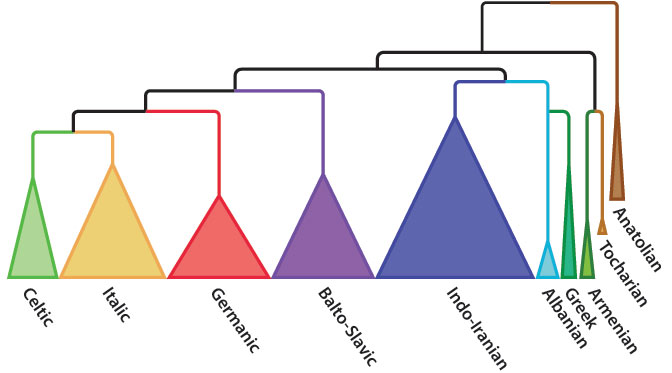
More than 400 Indo-European languages diverged from a common ancestral tongue; the earliest ones (top right), Anatolian and Tocharian, arose in today’s Turkey and China, respectively.
Rest of the article: http://news.sciencemag.org/archaeology/2015/02/mysterious-indo-european-homeland-may-have-been-steppes-ukraine-and-russia?utm_source=facebook&utm_medium=social&utm_campaign=facebook
What Do Y’All, Yinz, and Yix Call Stretchy Office Supplies? : The New Yorker
What Do Y'All, Yinz, and Yix Call Stretchy Office Supplies? : The New Yorker.
Sample of quiz:
How well does this test of regional slang reveal where you’re from? Answer the questions below to find out.
What do you call sweetened carbonated beverages?
a. Soda
b. Pop
c. Coke
d. Dope
e. Horse
f. Fizz-bang
g. Explodo
h. Gentleman’s seltzer
i. Heaven bubbles
What do you call the stretchy office supplies used to hold items together?
a. Rubber bands
b. Elastics
c. Flippos
d. Snapshooters
e. Wigglers
f. Stretchums
g. Satan’s bracelets
How Y’all, Youse and You Guys Talk – Interactive Graphic – NYTimes.com
How Y’all, Youse and You Guys Talk – Interactive Graphic – NYTimes.com.
Take the quiz. See if the answers match up with your “dialect.”
Words to be Wary of
In an effort to help those who may have been hit by the onslaught of marketing slurry that passes through the English language, every now and then, I will post some words or phrases that are absurd, unless you are in marketing, sales, or some other line of work where junking up the language is simply a way of life. To start, I submit two:
Free Gift. By its definition, a gift is free, at least to the recipient. If somebody gives you a gift that’s not free, then it is not a gift.
Truly Unique. Can something be falsely unique? Unique means one of a kind. Doesn’t matter if it is a good one of a kind, or a bad one of a kind, it is a one of a kind. If it is unique, by its definition it is true to itself because it is one of a kind.


 Booker's Blog