Category Archives: how to

“Life is like a box of chocolates,” but …

Killer Nashville badge

Killer Nashville badge


… but don’t send one to your agent.

At least don’t send one to an agent you are trying to get to represent you.

I recently attended a writing conference, Killer Nashville (www.killernashville.com) and will be posting some of what I learned, along with some impressions and comments.

One agent talked about receiving a query for representation that included an Indian charm in it. He said he didn’t know what to do with it. While he was not superstitious, he was afraid to give it away or even throw it away. In the end, he tossed into the back of his desk drawer, where it still resides.

Other items received by agents included a large plastic cockroach wrapped up and included in envelope along with a letter saying how the author was just buggy to have the agent represent him. Another writer sent a query letter in a large envelope “bulked up” with shredded paper to increase the chances the agent would see it.

Photoshoping the agent’s head on top of the body of a friend, with your arm draped over your agent/friend doesn’t work either.

Also, sending in a query on colored or scented paper, or in envelopes marked “urgent” or “time sensitive” won’t help you.

And lest you think that it is only the magical or the madcap you shouldn’t send, don’t send the more mundane or mouth-watering either. No homemade goodies; no store-bought ones. And certainly don’t send cash.

Life might be like a box of chocolates, and your mama might have told you that, but also remember the rest of the quote, particularly from the agent’s point of view: “You never know what you’re going to get.”

So, surprise the agent with a memorable query letter pitch he or she can’t forget, and not a surprise the agent will pitch into the trash or back of the desk drawer.

4 Comments

Filed under agents, how to, humor, Killer Nashville, Perils of writing, publishers, writing, writing tip

The Perils of Writing: character hook

Writing tip: character hook

Butterfly on feet

Sometimes even the largest story still needs a little touch

Once upon a time, I attended the Harriette Austin Writers Conference in Athens, GA. At that time, one of the speakers was an editor with a large publishing firm in New York City. He was a University of Georgia graduate, who had come back to the conference to dispense nuggets of experience and wisdom in his bare feet.

As was my biological predilection, my internal clock being generously out of step with the atomic one that governs the external world, I arrived a little late to the auditorium and found a seat along the aisle but not too far forward so as not to disturb the editor who was about to speak.
After the good morning pleasantries, he said that he often received manuscripts in which the subject matter was as grand as the universe itself (which was understandable since he was an editor of this publisher’s science fiction line of books), but that there was often something missing. He said the little telling character details were often missing. He said the main character could be an important negotiator at an intergalactic conference of species trying to save their galaxy from destruction and time was running. Despite the importance of the conference and the importance of the main character, there was nothing the reader could easily identify with, because there was no “character hook,” something small, even banal, that the reader could identify with. He then asked, what if the main character’s feet hurt? What if this character’s feet hurt because his shoes were too tight and that was what he was focused on at the start of this important conference. The editor said it is this small, telling detail that would provide the hook that would make the rest of the story believable. In this case, the protagonist had a problem the reader could easily identify with. But it could also be a small character detail, such as unruly red hair or preference for the color purple that could provide a hook for the reader.

This editor then stepped around from behind the lectern. He stood on the stage before us in his bare feet. With the microphone in his hand, he looked down at this toes and wiggled them. Then, he looked back up at us.

“Now,” he said, “you may not remember a single thing I say up here today. But I bet you’ll remember I was barefoot.”

Leave a comment

Filed under how to, words, writing, writing tip

The perils of writing: building a better story

Writing tips

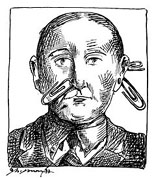
Man with paperclips in his nose and ears.

The perils of writing

My writing is distinctly middle brow. Just ask anybody who has suffered through it. Still, I like to think that even in my middling way, I can still offer some helpful advice when I stumble across it. Therefore, from time to time, I will post some writing advice, but not from me. The advice will come from established sources. I will endeavor not to make it overlong or overreaching, and sometimes it will simply be reminders of what we all probably already know, but it will be some tips I have picked up from reading, from attending writing conferences, or it may even come from you.

The first bit of advice comes from a writing course the Writers’ Guild sponsored way back in 1993. The teacher was Joseph Gunnels and the cost was $75. It was two-day event, May 15 and 16, and we spent part of a pleasant afternoon sitting on the grass outside the Candy Factory on The World’s Fair site in Knoxville, TN. I took over 30 pages of notes, but rather than bore you with details, here is the essence of what I took away from the seminar:

Drama is conflict;
Without conflict no action;
Without action no character;
Without character no story;
Without story, who cares?

In a future issue of this newsletter, I’ll give you a short, crisp definition for conflict that I learned at a more recent one-day writing seminar. It comes from a very highly regarded script doctor in Hollywood, but applies just as well to other forms of fiction writing. Stay turned.

Leave a comment

Filed under how to, the perils of writing, word play, writing, writing tip