Category Archives: Commentary

Life is like a box of … politicians

http://www.knoxnews.com/news/2013/mar/13/wine-in-grocery-stores-bill-dies-by-1-vote-in/?partner=popular

Wine-in-grocery-stores bill dies by 1 vote in House committee

Why is it in my state, Tennessee, I can walk into a Super Wal-Mart and buy a rack of lamb and a box of bullets, but I can’t go in a buy a rack of lamb and box of wine?

Tennessee State flag

Tennessee State flag

Somehow, according to the fine, upstanding, bought and paid for, public servants in Nashville, it’s my God-given right if I want to buy something to potentially blow somebody else away, but heaven forbid if I want to buy something in a Super Wal-Mart, or even a “regular” grocery story, that might be used to “blow” myself away for a little while.

This in a state with a super-Republican majority in both the state House and Senate. This in the face of the Republican manta of less government. This in the thrall of hypocrisy about competition being the life blood of a “free market.”

It’s only less government if you buy it.

It’s only less government for you if you can make somebody else pay with a little less choice.

It’s only less government if you are the one defining it as so.

It’s only a box of … GOP politicians.

Yep, less government. Just big enough to fit in your bedroom.

Leave a comment

Filed under Commentary, political humor, politics, satire

Wealthy, motivated by greed, are more likely to cheat, study finds

People of higher status are more prone to cheating, taking candy from children and failing to wait their turn at four-way stops, a UC Berkeley experiment finds.

http://www.latimes.com/news/science/la-sci-0228-greed-20120228,0,5965885.story?track=icymi

By Eryn Brown, Los Angeles Times

7:07 PM PST, February 27, 2012

The rich really are different from the rest of us, scientists have found — they are more apt to commit unethical acts because they are more motivated by greed.

People driving expensive cars were more likely than other motorists to cut off drivers and pedestrians at a four-way-stop intersection in the San Francisco Bay Area, UC Berkeley researchers observed. Those findings led to a series of experiments that revealed that people of higher socioeconomic status were also more likely to cheat to win a prize, take candy from children and say they would pocket extra change handed to them in error rather than give it back.

Because rich people have more financial resources, they’re less dependent on social bonds for survival, the Berkeley researchers reported Monday in Proceedings of the National Academy of Sciences. As a result, their self-interest reigns and they have fewer qualms about breaking the rules.

“If you occupy a more insular world, you’re less likely to be sensitive to the needs of others,” said study lead author Paul Piff, who is studying for a doctorate in psychology.

But before those in the so-called 99% start feeling ethically superior, consider this: Piff and his colleagues also discovered that anyone’s ethical standards could be prone to slip if they suddenly won the lottery and joined the top 1%.

“There is a strong notion that when people don’t have much, they’re really looking out for themselves and they might act unethically,” said Scott Wiltermuth, who researches social status at USC’s Marshall School of Business and wasn’t involved in the study. “But actually, it’s the upper-class people that are less likely to see that people around them need help — and therefore act unethically.”

In earlier studies, Piff documented that wealthy people were less likely to act generously than relatively impoverished people. With this research, he hoped to find out whether wealthy people would also prioritize self-interest if it meant breaking the rules.

The driving experiments offered a way to test the hypothesis “naturalistically,” he said. Trained observers hid near a downtown Berkeley intersection and noted the makes, model years and conditions of bypassing cars. Then they recorded whether drivers waited their turn.

It turned out that people behind the wheels of the priciest cars were four times as likely as drivers of the least expensive cars to enter the intersection when they didn’t have the right of way. The discrepancy was even greater when it came to a pedestrian trying to exercise a right of way.

There is a significant correlation between the price of a car and the social class of its driver, Piff said. Still, how fancy a car looks isn’t a perfect indicator of wealth.

So back in the laboratory, Piff and his colleagues conducted five more tests to measure unethical behavior — and to connect that behavior to underlying attitudes toward greed.

For instance, the team used a standard questionnaire to get college students to assess their own socioeconomic status and asked how likely subjects were to behave unethically in eight different scenarios.

In one of the quandaries, students were asked to imagine that they bought coffee and a muffin with a $10 bill but were handed change for a $20. Would they keep the money?

In another hypothetical scenario, students realized their professor made a mistake in grading an exam and gave them an A instead of the B they deserved. Would they ask for a grade change?

The patterns from the road held true in the lab — those most willing to engage in unethical behavior were the ones with the highest social status.

One possible explanation was that wealthy people are simply more willing to acknowledge their selfish side. But that wasn’t the issue here. When test subjects of any status were asked to imagine themselves at a high social rank, they helped themselves to more candies from a jar they were told was meant for children in another lab.

Another experiment recruited people from Craigslist to play a “game of chance” that the researchers had rigged. People who reported higher social class were more likely to have favorable attitudes toward greed — and were more likely to cheat at the game.

“The patterns were just so consistent,” Piff said. “It was very, very compelling.”

Piff, who is writing a paper about attitudes toward the Occupy movement, said that his team had been accused of waging class warfare from time to time.

“Berkeley has a certain reputation, so yeah, we get that,” he said.

But rather than vilify the wealthy, Piff said, he hopes his work leads to policies that help bridge the gap between the haves and have-nots.

Acts as simple as watching a movie about childhood poverty seem to encourage people of all classes to help others in need, he said.

eryn.brown@latimes.com

Copyright © 2012, Los Angeles Times

==========================================

Conclusions:

And these are my own.

1) I particularly like the comment about the wealthy being more likely to take candy meant for a kid. The cartoons and comedies I saw as a kid showing just this sort of act weren’t that far off target.

2) With enough wealth, as the article states, we could be just like most of the wealthy in the study: more unethical than we are.

3) Seems to me the beginnings of a good case for some sort of — dare I say it — wealth redistribution. Seems it might just be good for a democratic republic like ours. Do it until we at least get the candy back, and maybe a little while longer.

4) Maybe the Occupy Wall Street people are on to something.

5) Cartoon commentary:
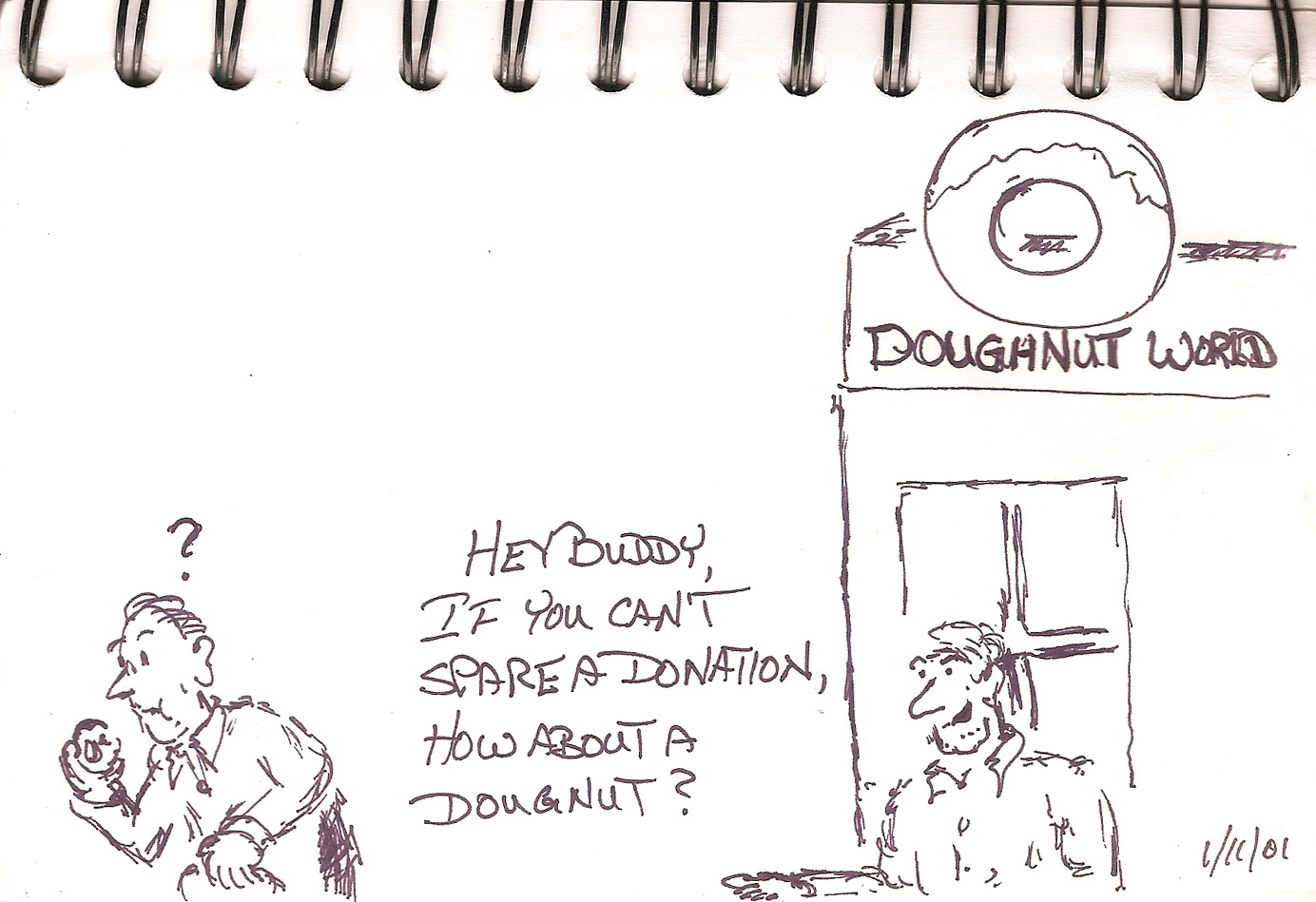
If you can't spare a donation...

The emptiness you feel may be real.

2 Comments

Filed under Cartoon, Commentary, L.A. Times, Random thought, redistribution, wealth

The Darwin Awards: The true blathering idiots

On days when you don’t feel as bright or with it as you normally do, consider these folks, nominees and winner of the Darwin Awards. The Darwin Awards is given annually to the person who did the gene pool the biggest service by killing himself in the most extraordinarily stupid way.

Some of these may make you both laugh and cry.

Semifinalist #1
A young Canadian man, searching for a way of getting drunk cheaply, because he had no money with which to buy alcohol, mixed gasoline with milk. Not surprisingly, this concoction made him ill, and he vomited into the fireplace in his house. This resulting explosion and fire burned his house down, killing both him and his sister.

[Editor’s comment: at the price of gas, wouldn’t cheap mouthwash have been a better choice?]

Semifinalist #2
Three Brazilian men were flying in a light aircraft at low altitude when another plane approached. It appears that they decided to moon the occupants of the other plane, but lost control of their own aircraft and crashed. They were all found dead in the wreckage with their pants around their ankles.

[Editor’s comment: This is not what is meant by the moon over San Paulo.]

Semifinalist #3
A 22-year-old Reston , VA , man was found dead after he tried to use octopus straps to bungee jump off a 70-foot rail road trestle. Fairfax County police said Eric Barcia, a fast-food worker, taped a bunch of these straps together, wrapped an end around one foot, anchored the other end to the trestle at Lake Accotink Park, jumped and hit the pavement. Warren Carmichael, a police spokesman, said investigators think Barcia was alone because his car was found nearby. “The length of the cord that he had assembled was greater than the distance between the trestle and the ground,” Carmichael said. Police say the apparent cause of death was “Major trauma.”

[Editor’s comment: clearly a case of gravity assisted suicide. If only the earth hadn’t gotten in the way.]

Semifinalist #4
A man in Alabama died from rattlesnake bites. It seems that he and a friend were playing a game of catch, using the rattlesnake as a ball. The friend – no doubt a future Darwin Awards candidate – was hospitalized.

[Editor’s comment: clearly the snake was being a spoiled sport.]

Semifinalist #5
Employees in a medium-sized warehouse in west Texas noticed the smell of a gas leak. Sensibly, management evacuated the building, extinguishing all potential sources of ignition; lights, power, etc.. After the building had been evacuated, two technicians from the gas company were dispatched. Upon entering the building, they found they had difficulty navigating in the dark. To their frustration, none of the lights worked. Witnesses later described the sight of one of the technicians reaching into his pocket and retrieving an object that resembled a cigarette lighter. Upon operation of the lighter-like object, the gas in the warehouse exploded, sending pieces of it up to three miles away. Nothing was found of the technicians, but the lighter was virtually untouched by the explosion. The technician suspected of causing the blast had never been thought of as ”bright” by his peers.

[Editor’s comment: Clearly an example of a career-limiting move.]

And Now, for the winner of this year’s Darwin Award –
(As always, awarded posthumously):

The Arizona Highway Patrol came upon a pile of smoldering metal embedded in the side of a cliff rising above the road at the apex of a curve. The wreckage resembled the site of an airplane crash, but it was a car. The type of car was unidentifiable at the scene. Police investigators finally pieced together the mystery. An amateur rocket scientist had somehow gotten hold of a JATO unit (Jet Assisted Take Off, actually a solid-fuel rocket) that is used to give heavy military transport planes an extra ‘push’ for taking off from short airfields. He had driven his Chevy Impala out into the desert and found a long, straight stretch of road. He attached the JATO unit to the car, jumped in, got up some speed and fired off the JATO!

The facts as best could be determined are that the operator of the 1967 Impala hit the JATO ignition at a distance of approximately 3.0 miles from the crash site. This was established by the scorched and melted asphalt at that location.

The JATO, if operating properly, would have reached maximum thrust within 5 seconds, causing the Chevy to reach speeds well in excess of 350 mph and continuing at full power for an additional 20 – 25 seconds. The driver, and soon-to-be pilot, would have experienced G-forces usually reserved for dog-fighting F-14 jocks under full afterburners, causing him to become irrelevant for the remainder of the event.

However, the automobile remained on the straight highway for about 2.5 miles (15-20 seconds) before the driver applied and completely melted the brakes, blowing the tires and leaving thick rubber marks on the road surface, then becoming airborne for an additional 1.4 miles and impacting the cliff face at a height of 125 feet, leaving a blackened crater 3 feet deep in the rock. Most of the driver’s remains were not recoverable.

Epilogue: It has been calculated that this “rocket scientist” attained a ground speed of approximately 420-mph, though much of his voyage was not actually on the ground.

[Editor’s comment: Apparently, some things still do take a rocket scientist.]

4 Comments

Filed under absurdity, awards, blathering idiot, Commentary, Darwin, Darwin Awards, fun, humor, rocket scientist, true story

Sign of times: Quality Used Furniture

While the photo is not the clearest it could be, in its own way it may match the hand-painted sign that reads “Quality Used Furniture,” and underneath it are sections of firewood. Could the sign be referring to the birds that once nested in the tree’s branches? To the squirrels, rodents though they may be, that once frolicked about from sturdy limb to sturdy limb as they ventured forth from their squirrel nest? Or is this type of furniture what is meant by rustic or roughing it? Possibly this is a Platonic set of furniture. Furniture glimpsed obliquely and incompletely in its state of perfection.

What do you think it is? Make up your own caption and send it my way. I may list the most interesting ones.

Quality Used Furniture

The sign read: Quality Used Furniture

1 Comment

Filed under bird, Commentary, furniture, humor, nature, Plato, sign of the times, tree, Uncategorized, word play, words, writing

The Blathering Idiot and Discovery

The blathering idiot went to work for an advanced scientific and technology firm. One day, when he passes the door of a leading scientist of the firm, he found a note tacked to the door.

Upon further examination, he saw it was not a note, but a memo, on official company letterhead, from the legal firm that this company used when discussing patent and invention issue.

In short, the memo said: All discoveries must be registered with this firm before they are discovered. All inventions must be registered with this firm before they are invented. No patents will be issued unless the proper form has been filled out in triplicate and registered with this firm. We must be notified at least six months in advance of any discoveries, inventions, ideas, or potentially patentable issues. Those who fail to follow this memo will be properly punished.

The Blathering Idiot and Discovery

After all, he needed the work.

The blathering idiot then had an idea. He wondered if his idea was a patentable issue he had to register with the firm. But since he already had the idea, it was too late to file it without being violation of the memo. Therefore, he decided from that day forward that he would see no ideas, hear no ideas, and speak no ideas. After all, he needed the work.

Leave a comment

Filed under absurdity, blathering idiot, Cartoon, Commentary, discovery, humor, idea, satire, words, writing

Ripped from the Headlines, no. 2: GOP carrying for wildlife

Congress just voted for a Republican amendment to cut all federal funding from Planned Parenthood health centers, one of the most trusted providers of basic health care and family planning in our country.

And if that wasn’t enough, Republicans are pushing to eliminate all funds for the only federal family planning program. (For humans. But Republican Dan Burton has a bill to provide contraception for wild horses.)

So, if you’re a wild horse and you sow wild oats, there’s help from the GOP; but if you’re human, well that’s a different bucket of oats.

I didn’t know the GOP cared so much for wildlife.

Or maybe they just want to make sure there’s more cannon fodder for the war machine.

Leave a comment

Filed under Commentary, Planned Parenthood, true story, wild horses