Category Archives: books

Netflix for books

The woman who is trying to create a Netflix for books

By Neelam Raaj

http://timesofindia.indiatimes.com/tech/tech-news/The-woman-who-is-trying-to-create-a-Netflix-for-books/articleshow/51959813.cms

Chiki Sarkar hates being called a disruptor but that’s exactly what she’s doing to the opaque, incestuous world of Indian publishing. Along with Durga Raghunath, who brings the digital smarts, Sarkar has co-founded Juggernaut, a digital publishing house. She spoke to Neelam Raaj on why she wants to use tech to give dead-tree books a new lease of life.

You’re pitching Juggernaut as India’s first phone publisher. Did you have to rethink the book for the small screen?

When the idea of Juggernaut first came to me in December 2014, I thought about what the phone can do that the book can’t, and I thought Sunny Leone – delicious stories on the screen. But we’re also turning her stories into a physical book. The idea is – Can the physical and digital talk to each other? Can I take the knowledge of who is going to buy our books on the phone and sell them other books?

Sunny will be appointment reading – one story on your mobile at 10pm every night for a week. But there’s a range of reading on the app, including short works of non-fiction, long serialized forms, and a set of short stories that you can buy one of. The cost will be around half of a physical book’s.

What will be your physical vs digital mix?

If we bring 100 books to digital, about 30 or 40 of those will have physical copies too. It will depend mostly on the book and the writer. When we publish authors Arundhati Roy, Prashant Kishore, Twinkle Khanna, Svetlana Alexievich, we’ll publish both physical and digital. But young authors will be tried and tested on digital first. On the phone, we think, people will come for areas around love, sex and romance – stuff you want privacy for. Crime and fantasy tend to naturally move to electronic so it will be a big part of our list. And there’s always going to be a big component of celebrities. Also, I think the only way to get great books in India is to make them up – I did that in Penguin (she was editor-in-chief) too. For instance, I knew I wanted a book on Aarushi so I went in search of a writer.

Do you see yourself as a disruptor in publishing?

I hate this word. Like any other publisher, I think of only one thing – how can I sell more books? Physical books will never die but can I add another way of thinking about publishing books, and can I use it to get more people to read more of my physical list? I’d be very happy if my physical sales go up because of digital.

But I’ll admit I have become increasingly impatient with the status quo. I’m 38, and not 60. I don’t want to be a copout. India is full of people who have good ideas and are following them. Thirty years down the line, I would kick myself silly if I didn’t do this.

Why would an author publish with Juggernaut and not self-publish with Amazon?

The question you should be asking is: why is an author coming to me and not, say a Penguin, Harper or a Picador? We’re not competing with Amazon; we’re a traditional publisher who is asking interesting questions about digital.

How did you get Sunny Leone to write erotica?

We wanted her to write on sex. She told us, ‘Look I don’t want to go all the way erotic. I’ll be sexy, but not pornographic.’ So we kept Fifty Shades of Grey as a marker but we wanted the stories to be empowering for women.

Her stories have a wife asking her husband for sex and being turned down; an overweight girl who fancies a guy who ignores her but things change when she loses weight, and then she changes her mind too.

What is more exciting now – Indian fiction or non-fiction?

Non-fiction, and it’s been that way for the last 6-7 years. We’re in that stage in the life of the country that we want to tell stories about ourselves. The more interesting fiction is coming from Indian languages, Gujarati, Marathi and Tamil.

Leave a comment

Filed under 2016, books, e-book, ebook publishing

The return of the printed book

Books are back. Only the technodazzled thought they would go away

The hysterical cheerleaders of the e-book failed to account for human experience, and publishers blindly followed suit. But the novelty has worn off

by Simon Jenkins

Source: http://www.theguardian.com/commentisfree/2016/may/13/books-ebook-publishers-paper?CMP=fb_gu

At last. Peak digital is at hand. The ultimate disruptor of the new information age is … wait for it … the book.

Chair in the last bookshop

Books are back

Shrewd observers noted the early signs. Kindle sales initially outstripped hardbacks but have slid fast since 2011. Sony killed off its e-readers. Waterstones last year stopped selling Kindles and e-books outside the UK, switched shelf space to books and saw a 5% rise in sales.

Amazon has opened its first bookshop.

Now the official Publishers’ Association confirms the trend. Last year digital content sales fell last year from £563m to £554m. After years on a plateau, physical book sales turned up, from £2.74bn to £2.76bn.

They have been boosted by the marketing of colouring and lifestyle titles, but there is always a reason. The truth is that digital readers were never remotely in the same ballpark. The PA regards the evidence as unmistakable, “Readers take a pleasure in a physical book that does not translate well on to digital.” Virtual books, like virtual holidays or virtual relationships, are not real. People want a break from another damned screen.

What went wrong? Clearly publishing, like other industries before (and since), suffered a bad attack of technodazzle: It failed to distinguish between newness and value. It could read digital’s hysterical cheerleaders, but not predict how a market of human beings would respond to a product once the novelty had passed. It ignored human nature. Reading the meaning of words is not consuming a manufacture: it is experience.

As so often, the market leader was the music business. Already, by the turn of the 21st century, its revenues were shifting dramatically from reproduction to live. This was partly because recording and distributing music became so cheap there was no profit margin, but it was largely because the market had changed. Buyers, young and old, wanted to witness music played in the company of like minds, and were prepared to pay for the experience – often to pay lots. Soon the same was true for live sport, live theatre, even live talks. The festival has become king. The money is back at the gate.

Books must be the ultimate test. Admittedly some festivals now give away books for free and charge instead to hear the writers speak.

But just buying, handling, giving and talking about a book seems to have caught the magic dust of “experience”. A book is beauty. A book is a shelf, a wall, a home.

The book was declared dead with the coming of radio. The hardback was dead with the coming of paperbacks. Print-on-paper was buried fathoms deep by the great god, digital. It was rubbish, all rubbish. Like other aids to reading, such as rotary presses, Linotyping and computer-setting, digital had brought innovation to the dissemination of knowledge and delight. But it was a means, not an end.

Since the days of Caxton and Gutenberg, print-on-paper has shown astonishing longevity. The old bruisers have seen off another challenge.

Leave a comment

Filed under 2016, book publishing, books

Book sequel

The 5 best sequels to classic novels

Author Chet Williamson has written an authorised sequel to Robert Bloch’s Psycho. Here, he looks at other sequels that honour the original works while bringing new life to them

Source: http://www.independent.co.uk/arts-entertainment/films/features/my-five-favourite-sequels-to-classic-novels-from-the-further-adventures-of-huckleberry-finn-to-the-a6970976.html

Having just written an authorised sequel to Psycho, Robert Bloch’s original tale of Norman Bates, I was asked by The Independent to come up with what I considered the five best sequels to other classic novels. I’m not so sure about the “best”, but these are certainly my favourites, ones that honour and respect the original works while bringing different perspectives and new life to them:

The Further Adventures of Huckleberry Finn by Greg Matthews (1988)

The author of the western epics, Power in the Blood and Heart of the Country, takes up Sam Clemens’ pen and picks up the story as though channelling Mark Twain. A perfect sequel to a book that’s as close as anyone’s come to the Great American Novel.

Pym by Mat Johnson (2010)

It seems that Edgar Allan Poe’s Arthur Gordon Pym, a story of weird adventure in the Antarctic, is based on fact, and it’s up to a professor of American literature to confirm it with a trip to the South Pole. Johnson deals with race, history, and literature trenchantly and often humorously, while retaining the cosmic mystery of Poe’s original.

Grendel by John Gardner (1971)

Grendel John_GardnerNot so much a sequel as a retelling of the ancient epic, Beowulf, seen from the monster’s point of view. Gardner was an extraordinary writer, and his depiction of Grendel is tender, haunting, empathetic, and terrible.

A Feast Unknown by Philip Jose Farmer (1969)

First published by an “erotica” house, this novel is the great-grandfather of literary mash-ups, and still far superior to most of them. Farmer creates his own versions of Tarzan (Lord Grandith) and pulp hero Doc Savage (Doc Caliban), makes them half-brothers (their father was Jack the Ripper), and sets them against each other in a violent and homoerotic grudge match. A masterpiece of absurdity.

The Hours by Michael Cunningham (1998)

From the ridiculous to the sublime. Cunningham’s tripartite exploration of Virginia Woolf’s Mrs Dalloway is too complex in plot and character to begin to discuss here, but this bold and experimental novel sets the bar for what can be accomplished by treading in the footsteps of an earlier work of literary brilliance.

Psycho: Sanitarium is published on 12th April by Canelo, price £3.99 in eBook

Leave a comment

Filed under 2016, books, novel

Some current mysteries to consider

The best recent crime novels – review roundup

by Laura Wilson

Source: http://www.theguardian.com/books/2016/feb/19/the-best-recent-crime-novels-review-roundup?CMP=share_btn_fb

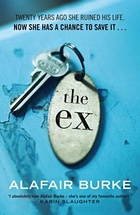
The Ex book coverA pleasingly suspenseful mixture of legal thriller and whodunnit, Alafair Burke’s latest novel, The Ex (Faber, £12.99), introduces us to lippy, take-no‑prisoners New York City district attorney Olivia Randall, who receives a panicky phone call from the teenage daughter of her former fiance, Jack Harris, begging for help. Harris, whose wife was killed in a mass shooting three years earlier, has been charged with triple homicide, which the police are treating as a revenge attack because one of the victims is the father of the boy who shot his wife. For Olivia, representing Jack is a way to make up for the hurt she caused him in the past, but his alibi is flimsy and there is corroborating evidence, and she begins to wonder if he may, after all, be guilty. Burke’s writing has always been intelligent and often funny, and her female protagonists sharp and engaging – The Ex is her best yet.

Other books in the round-up include:

Icelandic author Ragnar Jonasson’s excellent debut novel, Snowblind, was widely praised for its distinctive blend of Nordic noir and golden age detective fiction. Nightblind (translated by Quentin Bates, Orenda Books, £8.99), also featuring police officer Ari Thor Arason and set in Siglufjörður, an isolated fishing village hard by the Arctic Circle, certainly lives up to the promise of its predecessor.

A Masterpiece of Corruption (Constable, £19.99) is the second of LC Tyler’s novels set during the Interregnum and featuring law student John Grey. The year is 1657, and a case of mistaken identity results in Grey, who has republican sympathies, finding himself in the middle of a plot by the Sealed Knot, a secret royalist association, to assassinate Oliver Cromwell in order that Charles Stuart may return from exile to take his place on the throne.

To see these and the other books being offered, go to http://www.theguardian.com/books/2016/feb/19/the-best-recent-crime-novels-review-roundup?CMP=share_btn_fb

Leave a comment

Filed under 2016, books

Books and lovers

15 Reasons You Should Date a Fellow Book Lover

by Elisabeth Delp

All you single book lovers out there: If you’ve been hitting the romance shelves with gusto in preparation for Valentine’s Day, we have just one piece of advice for you… look around! And we don’t mean just at the books — we mean at the potential eye candy scanning the titles down the aisle. That’s right; the bookstore or library might just be the best place to meet that special someone you’ve been waiting for. Why? Because dating a fellow book lover is just plain better!

Source: https://media.bookbub.com/blog/2016/02/10/its-better-to-date-a-book-lover/

Reason number 4: The pun potential is just incredible.

Reason number 4: The pun potential is just incredible.

Reason number 8. They know better than to drag you to walks along the beach without taking you to the bookstore first.

Reason number 8. They know better than to drag you to walks along the beach without taking you to the bookstore first.

Reason number 12. Books can be a part of your wedding cake topper.

Reason number 12. Books can be a part of your wedding cake topper.

To see the rest of the reasons you should date a fellow book lover, go to: https://media.bookbub.com/blog/2016/02/10/its-better-to-date-a-book-lover/

Leave a comment

Filed under 2016, books

The aroma of books

What Causes the Smell of New & Old Books?

Source: http://www.compoundchem.com/2014/06/01/newoldbooksmell/

The smell of books.

The smell of books.

Everyone’s familiar with the smell of old books, the weirdly intoxicating scent that haunts libraries and second-hand book stores. Similarly, who doesn’t enjoy riffling through the pages of a newly purchased book and breathing in the crisp aroma of new paper and freshly printed ink? As with all aromas, the origins can be traced back to a number of chemical constituents, so we can examine the processes and compounds that can contribute to both.

As far as the smell of new books goes, it’s actually quite difficult to pinpoint specific compounds, for a number of reasons. Firstly, there seems to be a scarcity of scientific research that’s been carried out on the subject – to be fair, it’s understandable why it might not exactly be high up on the priority list. Secondly, the variation in the chemicals used to manufacture books also means that it’s an aroma that will vary from book to book. Add to this the fact that there are literally hundreds of compounds involved, and it becomes clearer why it evades attribution to a small selection of chemicals.

It’s likely that the bulk of ‘new book smell’ can be put down to three main sources: the paper itself (and the chemicals used in its manufacture), the inks used to print the book, and the adhesives used in the book-binding process.

The manufacture of paper requires the use of chemicals at several stages. Large amounts of paper are made from wood pulp (though it can also be made from cotton and textiles) – chemicals such as sodium hydroxide, often referred to in this context as ‘caustic soda’, can be added to increase pH and cause fibres in the pulp to swell. The fibres are then bleached with a number of other chemicals, including hydrogen peroxide; then, they are mixed with large amounts of water. This water will contain additives to modify the properties of the the paper – for example, AKD (alkyl ketene dimer) is commonly used as a ‘sizing agent’ to improve the water-resistance of the paper.

Many other chemicals are also used – this is just a very rough overview. The upshot of this is that some of these chemicals can contribute, through their reactions or otherwise, to the release of volatile organic compounds (VOCs) into the air, the odours of which we can detect. The same is true of chemicals used in the inks, and the adhesives used in the books. A number of different adhesives are used for book-binding, many of which are based on organic ‘co-polymers’ – large numbers of smaller molecules chemically chained together.

As stated, differences in paper, adhesives, and inks used will influence the ‘new book smell’, so not all new books will smell the same – perhaps the reason why no research has yet attempted to definitively define the aroma.

An aroma that has had much more research carried out around it, however, is that of old books. There’s a reason for this, as it’s been investigated as a potential method for assessing the condition of old books, by monitoring the concentrations of different organic compounds that they give off. As a result, we can be a little more certain on some of the many compounds that contribute to the smell.

Generally, it is the chemical breakdown of compounds within paper that leads to the production of ‘old book smell’. Paper contains, amongst other chemicals, cellulose, and smaller amounts of lignin – much less in more modern books than in books from more than one hundred years ago. Both of these originate from the trees the paper is made from; finer papers will contain much less lignin than, for example, newsprint. In trees, lignin helps bind cellulose fibres together, keeping the wood stiff; it’s also responsible for old paper’s yellowing with age, as oxidation reactions cause it to break down into acids, which then help break down cellulose.

‘Old book smell’ is derived from this chemical degradation. Modern, high quality papers will undergo chemical processing to remove lignin, but breakdown of cellulose in the paper can still occur (albeit at a much slower rate) due to the presence of acids in the surroundings. These reactions, referred to generally as ‘acid hydrolysis’, produce a wide range of volatile organic compounds, many of which are likely to contribute to the smell of old books. A selected number of compounds have had their contributions pinpointed: benzaldehyde adds an almond-like scent; vanillin adds a vanilla-like scent; ethyl benzene and toluene impart sweet odours; and 2-ethyl hexanol has a ‘slightly floral’ contribution. Other aldehydes and alcohols produced by these reactions have low odour thresholds and also contribute.

Other compounds given off have been marked as useful for determining…

Details at: http://www.compoundchem.com/2014/06/01/newoldbooksmell/

1 Comment

Filed under 2016, books

Banned book backfire

Parents call cops on teen for giving away banned book; it backfires predictably

Source: http://www.deathandtaxesmag.com/219767/parents-call-cops-on-teen-for-giving-away-banned-book-it-backfires-predictably/?utm_source=share-fb&utm_medium=button

Parents in Idaho called the cops last week on junior-high student Brady Kissel when she had the nerve to help distribute a book they’d succeeded in banning from the school curriculum.

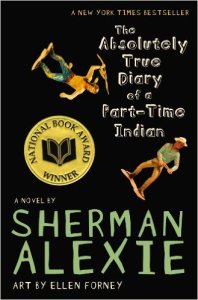
Absolute True DiaryThe book in question was Sherman Alexie’s young adult novel The Absolutely True Diary of a Part-Time Indian. Published in 2007, it won the National Book Award and has become popular with young teens, supposedly for its universal themes of fitting in, making sense of race, and sexual discovery.

The sex part (and let’s face it—probably the race part) led parents to lobby Junior Mountain High School to remove it from the syllabus, citing its sexual content (it discusses masturbation) and supposedly anti-Christian content.

Local teens then started a petition to have the book reinstated. They collected 350 signatures, which is an impressive number of kids to rally around a cause like reading.

In response, a local bookstore Rediscovered Books started a crowdfunding campaign to buy a book for each of the 350 kids who signed the petition. It worked—the campaign raised $3,400, enough for a book per kid.

Rediscovered Books worked with a student involved in the petition, Brady Kissel, to distribute the books on World Book Night, an initiative to turn reluctant young readers onto reading with free, super-readable books.

They distributed all but 20 books to kids who came in to claim them, but not before parents called the cops to shut down the operation. Police told local news channel KBOI they had been called by “someone concerned about teenagers picking up a copy of the book without having a parent’s permission.”

Even police seemed to have no idea what they were doing there, and let the book giveaway proceed as planned.

Not only did it go as planned, but when Alexie’s publisher Hachette got word of the incident, they sent Rediscovered an additional 350 copies on the house. So while the book may still be banned in the school curriculum, it’s available free of cost for any kid who wants to stop into Rediscovered and pick one up.

Leave a comment

Filed under 2016, books

Give the gift of reading

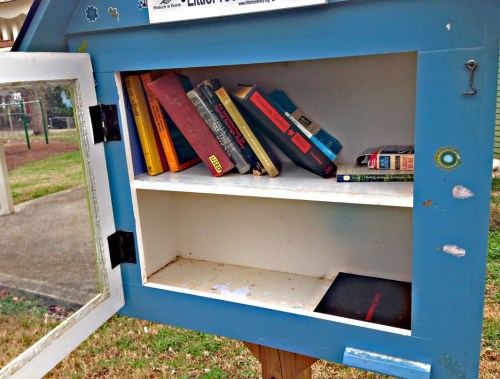
This holiday season, consider donating books you've read to the Little Free Library in your neighborhood.

This holiday season, consider donating books you’ve read to the Little Free Library in your neighborhood.

There are many ways to share the gift of reading with friends you know and even folks you might not ever meet. Giving books is always a good idea. Donating books you’ve read but don’t have room for is another way.

Where to donate? How about a local Little Free Library. It’s based on the idea or bring a book, take a book. Bring something you want to share and if you see something you like, borrow it to read.

This exchange idea is what keeps these free little libraries going. In my neighborhood, there have even been folks from outside the neighborhood who have donated books, people who will probably never make it by to borrow one, but still want to see this Little Free Library remain open and available to those who can use it.

Give the gift of reading this holiday season. Donate a book or two to your local Little Free Library, especially children and young adult books. Start them early on the adventure of reading.

Thank you to all those who have helped to keep the Little Free Library in my neighborhood going.

Thank you to all those who have helped to keep the Little Free Library in my neighborhood going.

1 Comment

Filed under 2015, books

PW Picks: Books of the Week, December 7, 2015

This week at Publisher’s Weekly: a bibulous Southern preacher’s perverse quest for sainthood, plus how human perception is changing.

Source: http://www.publishersweekly.com/pw/by-topic/industry-news/tip-sheet/article/68840-pw-picks-books-of-the-week-december-7-2015.html?utm_source=Publishers+Weekly&utm_campaign=9e2d958a01-UA-15906914-1&utm_medium=email&utm_term=0_0bb2959cbb-9e2d958a01-304545489

Sophia

Sophia

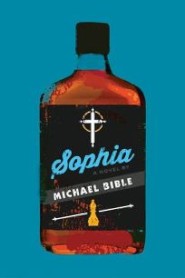
Sophia by Michael Bible (Melville House) – Bible’s short, comic novel, which relates a bibulous Southern preacher’s perverse quest for sainthood, is full of small miracles. The Reverend Alvis T. Maloney is a Rabelaisian figure, the “lazy priest of [the] town’s worst church,” whose irrepressible appetites lead him into distinctly unholy alliances with his parishioners and the Holy Ghost, about whom he has recurring erotic dreams that would make John Donne blush. Whether he is a man more sinned against than sinning is an open question, but his desire to follow his own unorthodox righteous path is undisputed. The plot is almost secondary, though there is an excess of it: a cross-country chess tournament tour with Eli, a prodigy and Maloney’s “redneck Virgil”; an attack on a suburban house involving a hot air balloon; and a game of wits with a blind bounty hunter chasing Maloney and his pregnant lover from “the great Southern Bohemia” to New York City. Bible shrewdly pairs his maximalist comic style with a minimalist form. The novella is composed of short, paragraph-long scenes that are variously poetic, bawdy, and zany.

The Verdict

The Verdict

The Verdict by Nick Stone (Pegasus Crime) – This propulsive legal thriller from Thriller Award–winner Stone (Mr. Clarinet) centers on the arrest and impending trial—seemingly a certain prosecutorial slam dunk—of multimillionaire hedge funder Vernon James, a poor West Indian immigrant’s son, for the murder of the young blond whose strangled body is found in his luxury suite at the London hotel where only hours earlier he accepted an award from the Hoffmann Trust, a liberal umbrella organization, as “Ethical Person of the Year.” James’s predicament should come as catnip to Terry Flynt—at 38 hanging on by his fingernails to a job as a lowly legal clerk—who blames James, his former childhood best friend, for getting him booted out of Cambridge and starting him on the downward spiral of booze and depression that nearly destroyed his life. But, as Flynt is stunned to discover when he’s tapped to work on the defense team, his feelings are significantly more complicated, especially once the evidence he starts to uncover suggests that James might be innocent.

To see other picks: http://www.publishersweekly.com/pw/by-topic/industry-news/tip-sheet/article/68840-pw-picks-books-of-the-week-december-7-2015.html?utm_source=Publishers+Weekly&utm_campaign=9e2d958a01-UA-15906914-1&utm_medium=email&utm_term=0_0bb2959cbb-9e2d958a01-304545489

Leave a comment

Filed under 2015, book review, books

Reviewer of 31,000 books dies

Not exactly a household name, she attracted fans and detractors.

http://motherboard.vice.com/read/woman-who-reviewed-31000-books-on-amazon-dies

Harriet Klausner is not exactly a household name. But in the weird subculture of Amazon reviewers, she was either a legend or a legendarily bad shill. Klausner amassed more than 31,000 reviews of books under one username, seeming to sell just as many on Half.com after she finished them. Now Klausner, a former librarian and self-proclaimed speedreader, is reportedly dead at age 63.

The Age of the Internet review.

The Age of the Internet review.

Entire blogs were kept for her alleged reading, tabulating her “fake reviews.” Few, if any, of the reviews were negative. Her bio claimed she read two books a day, and said, “I was an acquisitions librarian in Pennsylvania and wrote a monthy (sic) review column of recommended reads. I found I liked reviewing went on to freelance after my son was born.”

The three paragraph reviews often introduced a plot summary (often inaccurately) for the first two paragraphs before a brief summary of praise, and a four or five star review. Many of the reviews were of mass market romance books and other pulp genres. Many reviews cropped up on the day the book was released, with many of the books showing up on her son’s Half.com account before the actual release date, according to a blog post of the cheekily named Harriet Klausner Appreciation Society (which was anything but.) This led to allegations that the reviews were planted and paid for.

Read the rest: http://motherboard.vice.com/read/woman-who-reviewed-31000-books-on-amazon-dies

A posting in Time magazine from 2006.

http://content.time.com/time/magazine/article/0,9171,1570726,00.html

Without the web, Harriet Klausner would be just an ordinary human being with an extraordinary talent. Instead she is one of the world’s most prolific and influential book reviewers. At 54, Klausner, a former librarian from Georgia, has posted more book reviews on Amazon.com than any other user—12,896, as of this writing, almost twice as many as her nearest competitor. That’s a book a day for 35 years.

Klausner isn’t paid to do this. She’s just, as she puts it, “a freaky kind of speed-reader.” In elementary school, her teacher was shocked when Klausner handed in a 31⁄2-hour reading-comprehension test in less than an hour. Now she goes through four to six books a day. “It’s incomprehensible to me that most people read only one book a week,” she says. “I don’t understand how anyone can read that slow.” All TIME 100 Best Novels

Klausner is part of a quiet revolution in the way American taste gets made. The influence of newspaper and magazine critics is on the wane. People don’t care to be lectured by professionals on what they should read or listen to or see. They’re increasingly likely to pay attention to amateur online reviewers, bloggers and Amazon critics like Klausner. Online critics have a kind of just-plain-folks authenticity that the professionals just can’t match. They’re not fancy. They don’t have an agenda. They just read for fun, the way you do. Publishers treat Klausner as a pro, sending her free books—50 a week—in hopes of getting her attention. Like any other good critic, Klausner has her share of enemies. “Harriet, please get a life,” someone begged her on a message board, “and leave us poor Amazon customers alone.”

Klausner is a bookworm, but she’s no snob. She likes genre fiction: romance, mystery, science fiction, fantasy, horror. One of Klausner’s lifetime goals—as yet unfulfilled—is to read every vampire book ever published. “I love vampires and werewolves and demons,” she says. “Maybe I like being spooked.” Maybe she’s a little bit superhuman herself.

Read the rest: http://content.time.com/time/magazine/article/0,9171,1570726,00.html

Leave a comment

Filed under 2015, books