Category Archives: books

Harry Potter vs. Huckleberry Finn: Why the British Tell Better Children’s Stories Than Americans – The Atlantic

Their history informs fantastical myths and legends, while American tales tend to focus on moral realism.

Source: Harry Potter vs. Huckleberry Finn: Why the British Tell Better Children’s Stories Than Americans – The Atlantic

[Editor’s note: I found this an interesting article. I don’t agree with every assertion or conclusion in it, but thought it was worth passing along. You decide.]

By Colleen Gillard

If Harry Potter and Huckleberry Finn were each to represent British versus American children’s literature, a curious dynamic would emerge: In a literary duel for the hearts and minds of children, one is a wizard-in-training at a boarding school in the Scottish Highlands, while the other is a barefoot boy drifting down the Mississippi, beset by con artists, slave hunters, and thieves. One defeats evil with a wand, the other takes to a raft to right a social wrong. Both orphans took over the world of English-language children’s literature, but their stories unfold in noticeably different ways.

The small island of Great Britain is an undisputed powerhouse of children’s bestsellers: The Wind in the Willows, Alice in Wonderland, Winnie-the-Pooh, Peter Pan, The Hobbit, James and the Giant Peach, Harry Potter, and The Lion, the Witch, and the Wardrobe. Significantly, all are fantasies. Meanwhile, the United States, also a major player in the field of children’s classics, deals much less in magic. Stories like Little House in the Big Woods, The Call of the Wild, Charlotte’s Web, The Yearling, Little Women, and The Adventures of Tom Sawyer are more notable for their realistic portraits of day-to-day life in the towns and farmlands on the growing frontier. If British children gathered in the glow of the kitchen hearth to hear stories about magic swords and talking bears, American children sat at their mother’s knee listening to tales larded with moral messages about a world where life was hard, obedience emphasized, and Christian morality valued. Each style has its virtues, but the British approach undoubtedly yields the kinds of stories that appeal to the furthest reaches of children’s imagination.

It all goes back to each country’s distinct cultural heritage. For one, the British have always been in touch with their pagan folklore, says Maria Tatar, a Harvard professor of children’s literature and folklore. After all, the country’s very origin story is about a young king tutored by a wizard. Legends have always been embraced as history, from Merlin to Macbeth. “Even as Brits were digging into these enchanted worlds, Americans, much more pragmatic, always viewed their soil as something to exploit,” says Tatar. Americans are defined by a Protestant work ethic that can still be heard in stories like Pollyanna or The Little Engine That Could.

Americans write fantasies too, but nothing like the British, says Jerry Griswold, a San Diego State University emeritus professor of children’s literature. “American stories are rooted in realism; even our fantasies are rooted in realism,” he said, pointing to Dorothy who unmasks the great and powerful Wizard of Oz as a charlatan.

American fantasies differ in another way: They usually end with a moral lesson learned—such as, surprisingly, in the zany works by Dr. Seuss who has Horton the elephant intoning: “A person’s a person no matter how small,” and, “I meant what I said, and I said what I meant. An elephant’s faithful one hundred percent.” Even The Cat in the Hat restores order from chaos just before mother gets home. In Oz, Dorothy’s Technicolor quest ends with the realization: “There’s no place like home.” And Max in Where the Wild Things Are atones for the “wild rumpus” of his temper tantrum by calming down and sailing home.

Landscape matters: Britain’s antique countryside, strewn with moldering castles and cozy farms, lends itself to fairy-tale invention. As Tatar puts it, the British are tuned in to the charm of their pastoral fields: “Think about Beatrix Potter talking to bunnies in the hedgerows, or A.A. Milne’s Winnie-the-Pooh wandering the Hundred Acre Wood.” Not for nothing, J.K. Rowling set Harry Potter’s Hogwarts School of Witchcraft and Wizardry in the spooky wilds of the Scottish Highlands. Lewis Carroll drew on the ancient stonewalled gardens, sleepy rivers, and hidden hallways of Oxford University to breathe life into the whimsical prose of Alice in Wonderland.

America’s mighty vistas, by contrast, are less cozy, less human-scaled, and less haunted. The characters that populate its purple mountain majesties and fruited plains are decidedly real: There’s the burro Brighty of the Grand Canyon, the Boston cop who stops traffic in Make Way for Ducklings, and the mail-order bride in Sarah, Plain and Tall who brings love to lonely children on a Midwestern farm. No dragons, wands, or Mary Poppins umbrellas here.

Popular storytelling in the New World instead tended to celebrate in words and song the larger-than-life exploits of ordinary men and women.

Britain’s pagan religions and the stories that form their liturgy never really disappeared, the literature professor Meg Bateman told me in an interview on the Isle of Skye in the Scottish Highlands. Pagan Britain, Scotland in particular, survived the march of Christianity far longer than the rest of Europe. Monotheism had a harder time making inroads into Great Britain despite how quickly it swept away the continent’s nature religions, says Bateman, whose entire curriculum is taught in Gaelic. Isolated behind Hadrian’s Wall—built by the Romans to stem raids by the Northern barbarian hordes—Scotland endured as a place where pagan beliefs persisted; beliefs brewed from the religious cauldron of folklore donated by successive invasions of Picts, Celts, Romans, Anglo-Saxons, and Vikings.

Even well into the 19th and even 20th centuries, many believed they could be whisked away to a parallel universe. Shape shifters have long haunted the castles of clans claiming seals and bears as ancestors. “Gaelic culture teaches we needn’t fear the dark side,” Bateman says. Death is neither “a portal to heaven nor hell, but instead a continued life on earth where spirits are released to shadow the living.” A tear in this fabric is all it takes for a story to begin. Think Harry Potter, The Chronicles of Narnia, The Dark Is Rising, Peter Pan, The Golden Compass—all of which feature parallel worlds.

These were beliefs the Puritans firmly rejected as they fled Great Britain and religious persecution for the New World’s rocky shores. America is peculiar in its lack of indigenous folklore, Harvard’s Tatar says. Though African slaves brought folktales to Southern plantations, and Native Americans had a long tradition of mythology, little remains today of these rich worlds other than in small collections of Native American stories or the devalued vernacular of Uncle Remus, Uncle Tom, and the slave Jim in Huckleberry Finn.

Popular storytelling in the New World instead tended to celebrate in words and song the larger-than-life exploits of ordinary men and women: Daniel Boone, Davy Crockett, Calamity Jane, even a mule named Sal on the Erie Canal. Out of bragging contests in logging and mining camps came even greater exaggerations—Tall Tales—about the giant lumberjack Paul Bunyan, the twister-riding cowboy Pecos Bill, and that steel-driving man John Henry, who, born a slave, died with a hammer in his hand. All of these characters embodied the American promise: They earned their fame.

British children may read about royal destiny discovered when a young King Arthur pulls a sword from a stone. But immigrants to America who came to escape such unearned birthrights are much more interested in challenges to aristocracy, says Griswold. He points to Mark Twain’s The Prince and the Pauper, which reveals the two boys to be interchangeable: “We question castles here.”

In Scotland, Bateman in turn suggests the difference between the countries may be that Americans “lack the kind of ironic humor needed for questioning the reliability of reality”—very different from the wry, self-deprecating humor of the British. Which means American tales can come off a bit “preachy” to British ears. The award-winning Maurice Sendak-illustrated book of etiquette: What Do You Say, Dear? comes to mind. Even Little Women is described by Bateman as something of a Protestant “parable about doing your best in trying circumstances.”

Maybe a world not fixated on atonement and moral imperatives is more conducive to a rousing tale. In Edinburgh—an old town like Rome built on seven hills, where dark alleys drop from cobbled streets, dive under stone buildings, and descend crooked stairs to make their way to the sea—8-year-old Caleb Sansom is one kid who thinks so. Digging with his mum through the stacks of the downtown library, he said he likes stories with “naughty animals, doing people things.” Like Mr. Toad in The Wind in the Willows “who drives fast, gets in accidents, sings, and goes to jail.” As for American books such as The Little House in the Big Woods: “There’s a bit too much following the rules. ‘Do this. Stop doing that.’ Can get boring.”

Pagan folktales are less about morality and more about characters like the trickster who triumphs through wit and skill: Bilbo Baggins outwits Gollum with a guessing game; the mouse in The Gruffalo avoids being eaten by tricking a hungry owl and fox. Griswold calls tricksters the “Lords of Misrule” who appeal to a child’s natural desire to subvert authority and celebrate naughtiness: “Children embrace a logic more pagan than adult.” And yet Bateman says in pagan myth it’s the young who possess the qualities needed to confront evil. Further, each side has opposing views of naughtiness and children: Pagan babies are born innocent; Christian children are born in sin and need correcting. Like Jody in The Yearling who, forced to kill his pet deer, must understand life’s hard choices before he can forgive his mother and shoulder the responsibility of manhood.

It turns out that fantasy—the established domain of British children’s literature—is critical to childhood development.

Ever since Bruno Bettelheim wrote The Uses of Enchantment about the psychological meaning of fairy tales, child psychologists have looked at storytelling as an important tool children use to work through their anxieties about the adult world. Fairy-tale fantasies are now regarded as almost literal depictions of childhood fears about abandonment, powerlessness, and death.

Most successful children’s books address these common fears through visiting and revisiting the same emotional themes, says Griswold. In his book, Feeling Like a Kid: Childhood and Children’s Literature, he identifies five basic story mechanisms children find particularly compelling—snug spaces, small worlds, scary villains, lightness or flying, as well as animated toys and talking animals—all part of the serious business of make-believe.

“Kids think through their problems by creating fantasy worlds in ways adults don’t,” Griswold says. “Within these parallel universes, things can be solved, shaped and understood.” Just as children learn best through hands-on activities, they tend to process their feelings through metaphorical reenactments. “Stories,” Griswold noted, “serve a purpose beyond pleasure, a purpose encoded in analogies. Story arcs, like dreams, have an almost biological function.”

It turns out that fantasy—the established domain of British children’s literature—is critical to childhood development. With faeries as voices from the earth, from beyond human history, with a different take on the meaning of life and way of understanding death, Bateman says there’s wisdom in recognizing nature as a greater life force. “Pagan folklore keeps us humble by reminding us we are temporary guests on earth—a true parable for our time.”

Today there may be more reason than ever to find solace in fantasy. With post-9/11 terrorism fears and concern about a warming planet, Griswold says American authors are turning increasingly to fantasy of a darker kind—the dystopian fiction of The Hunger Games, The Giver, Divergent, and The Maze Runner. Like the collapse of the Twin Towers, these are sad and disturbing stories of post-apocalyptic worlds falling apart, of brains implanted with computer chips that reflect anxiety about the intrusion of a consumer society aided by social media. This is a future where hope is qualified, and whose deserted worlds are flat and impoverished. But maybe there’s purpose. If children use fairy tales to process their fears, such dystopian fantasies (and their heroes and heroines) may model the hope kids need today to address the scale of the problems ahead.
Source: http://www.theatlantic.com/entertainment/archive/2016/01/why-the-british-tell-better-childrens-stories/422859/

Leave a comment

Filed under 2017, books

Watch a Book Being Made the Old-Fashioned Way | Atlas Obscura

Slowly, and by hand.

Source: Watch a Book Being Made the Old-Fashioned Way | Atlas Obscura

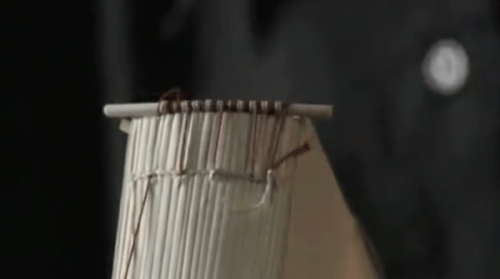
Books were once made by hand, one by one, with patience and perfection. In this video, you can watch each step of the process—from the setting of the type, to the application of ink, to the impression onto paper, to the folding, cutting, hammering, sewing, binding, clamping, and trimming. And all of this is still after metal type was invented, replacing painstakingly handwritten script.

Bookmaking, though it now enjoys newer and faster forms technology, is still an art. And though these days, books are much easier to make and acquire, we still think that they are objects of great value. Perhaps we’re biased, since we just finished making our own book, Atlas Obscura: An Explorer’s Guide to the World’s Hidden Wonders. And though we may not have sewn the binding ourselves, it sometimes feels as though we might have.

Let us never forget that books are treasures.

Leave a comment

Filed under 2016, books

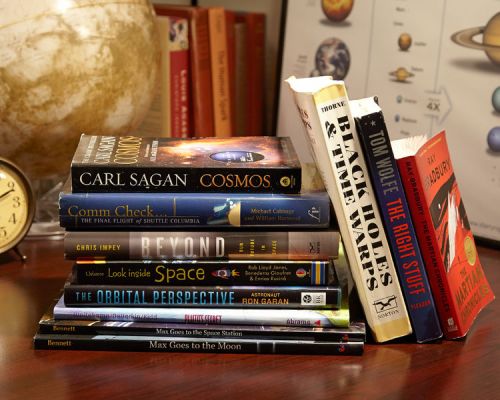
Best Space Books and Sci-Fi: A Space.com Reading List

Space.com’s editors present a reading list for space and sci-fi lovers, as well as children who are interested in astronomy and spaceflight.

Source: Best Space Books and Sci-Fi: A Space.com Reading List

There are plenty of great books out there about space — so many, in fact, that it can feel a little overwhelming to figure out where to start. So the editors and writers at Space.com have put together a list of their favorite books about the universe. These are the books that we love — the ones that informed us, entertained us and inspired us. We hope they’ll do the same for you.

We’ve divided the books into five categories, which each have their own dedicated pages. On this page, we feature books we’re reading now and books we’ve recently read, which we will update regularly. Click to see the best of:

  • Astronomy and Astrophysics
  • Spaceflight and Space History
  • Space Photography
  • Space Books for Kids
  • Science Fiction

We hope there’s something on the list for every reader of every age. We’re also eager to hear about your favorite space books, so please leave your suggestions in the comments, and let us know why you love them. You can see our ongoing Space Books coverage here.

Leave a comment

Filed under 2016, books

Sci-Fi & Fantasy Library Sweepstakes – Unbound Worlds

Source: Sci-Fi & Fantasy Library Sweepstakes – Unbound Worlds

A chance to build your science fiction and fantasy library.

Leave a comment

Filed under 2016, books

“Airship” for literature

Czech center builds giant ‘airship’ for literature

http://www.knoxnews.com/news/394430431.xhtml

 Leos Valka, a co-creator, sits on a rooftop overlooking a giant object resembling a zeppelin airship at an arts center in Prague, Czech Republic. The 42-meter long and 10-meter wide ship is planned to seat some 120 people on its cascade steps. It will be used for authors' reading and debates about literature to complement exhibitions at the DOX Centre for Contemporary Art, one of the most innovative and challenging galleries in the Czech capital. (AP Photo/Petr David Josek)

Leos Valka, a co-creator, sits on a rooftop overlooking a giant object resembling a zeppelin airship at an arts center in Prague, Czech Republic. The 42-meter long and 10-meter wide ship is planned to seat some 120 people on its cascade steps. It will be used for authors’ reading and debates about literature to complement exhibitions at the DOX Centre for Contemporary Art, one of the most innovative and challenging galleries in the Czech capital. (AP Photo/Petr David Josek)

By Karel Janicek, The Associated Press

PRAGUE (AP) – Is that a zeppelin on the roof?

The huge object appears to have landed on the roof of the DOX Centre for Contemporary Art in the Czech capital.

The wooden and metal structure, envisioned as a home for literature, is another project of the center known for its challenging exhibitions and installations.

The center’s founder and director, Leos Valka, joined forces with architect Martin Rajnis, who won the 2014 Global Award for Sustainable Architecture, to give the gallery another dimension.

“Our aim for the world of contemporary art is to spread and get partially interconnected with the world of literature,” Valka said at a preview this week.

The 42-meter (138-feet) long and 10-meter (33-feet) wide ship is planned to seat 120 people on its cascade steps inside for authors’ readings, performances, workshops and public debates to complement the exhibitions.

That’s all to be in line with the gallery’s mission “to create a space for research, presentation, and debate on important social issues, where visual arts, literature, performing arts, and other disciplines encourage a critical view of the so-called reality of today’s world.”

Numerous obstacles had to be overcome to get approval from authorities for the 55-metric-ton (60-ton) project.

The ship was finally qualified as a “watchtower” – a bit of absurdity which Prague native Franz Kafka might have appreciated.

The airship is named Gulliver, the hero of Jonathan Swift’s classic, who visited a flying island of Laputa during his adventurous travels.

“It’s a world of pure imagination,” Valka said about the project. “A children’s world.”

“You should get an impression that some 10-12-years-old boys escaped from the houses of parents to board their makeshift aircraft and by accident crash-landed in Holesovice,” the Prague district where the center is located.

“It’s an elegant intruder,” Valka said. “It’s a concrete, fully authentic, giant object whose message is that things can be done differently.”

The literature space is scheduled to open in late November or early December.

Leave a comment

Filed under 2016, books, literature

Science Fiction Books For People Who Don’t Read Science Fiction

In case you thought the genre wasn’t for you.

By Tobias Carroll

Source: http://www.readitforward.com/bookshelf/science-fiction-books-people-dont-read-science-fiction/

Science fiction can be an acquired taste. Some readers grew up on it; others never quite saw the appeal of stories involving time travel, alien contact, space exploration, or the ways in which these concepts can be used to explore moral and intellectual debates. But if you’re a reader who’d like to ease their way into the genre, there are a few great places to begin. Some provide a well-written introduction to key science fictional tropes and concepts, while others juxtapose intensely human stories with headier conceptual elements. Here’s a look at fourteen books that introduce big ideas in accessible ways and present readers with a host of directions they can go from there.

Example:

Use of Weapons

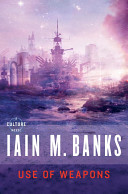
IainBanks UseofWeaponsMuch of Iain M. Banks’s science fiction was set in the world of The Culture, a utopian society that encompasses massive amounts of space, and includes artificial intelligence, alien species, simulated afterlives, and more. But for all of that, Banks is also adept at writing memorable characters, and at the center of Use of Weapons, readers will find exactly that, in the person of the memorably-named Cheradenine Zakalwe—along with a structurally innovative method of telling the story.

Other books include:

  • The Water Knife by Paolo Bacigalupi
  • The Book of Strange New Things by Michel Faber
  • Bloodchild and Other Stories by Octavia E. Butler
  • Embassytown by China Miéville
  • Elvissey by Jack Womack
  • Definitely Maybe by Arkady Strugatsky & Strugatsky Boris
  • Midnight Robber by Nalo Hopkinson
  • Oryx and Crake by Margaret Atwood
  • The Einstein Intersection by Samuel R. Delany.

Details: http://www.readitforward.com/bookshelf/science-fiction-books-people-dont-read-science-fiction/

Leave a comment

Filed under 2016, books

Live long and prosper … by reading books

Read Books, Live Longer?

By Nicholas Bakalar

Source: http://well.blogs.nytimes.com/2016/08/03/read-books-live-longer/?smid=fb-nytimes&smtyp=cur&_r=2

Reading books is tied to a longer life, according to a new report.

Researchers used data on 3,635 people over 50 participating in a larger health study who had answered questions about reading.

Chair in the last bookshop

Live longer by reading.

The scientists divided the sample into three groups: those who read no books, those who read books up to three and a half hours a week, and those who read books more than three and a half hours.

The study, in Social Science & Medicine, found that book readers tended to be female, college-educated and in higher income groups. So researchers controlled for those factors as well as age, race, self-reported health, depression, employment and marital status.

Compared with those who did not read books, those who read for up to three and a half hours a week were 17 percent less likely to die over 12 years of follow-up, and those who read more than that were 23 percent less likely to die. Book readers lived an average of almost two years longer than those who did not read at all.

They found a similar association among those who read newspapers and periodicals, but it was weaker.

“People who report as little as a half-hour a day of book reading had a significant survival advantage over those who did not read,” said the senior author, Becca R. Levy, a professor of epidemiology at Yale. “And the survival advantage remained after adjusting for wealth, education, cognitive ability and many other variables.”

Leave a comment

Filed under 2016, books

21 Great Novels Worth Finding the Time to Read

21 Must-Read Novels

by Jacquelyn Mitchard

Source: http://www.aarp.org/entertainment/books/info-03-2012/21-must-read-novels.html?cmp=SNP-DSO-FB-ENT-FB_CONTENT_2016_ENT&s_kwcid=AL!4520!45!0bfd56f43fb133993b259a359113b691&ef_id=VtxKvwAABHGV34xO:20160722131844:o#slide1

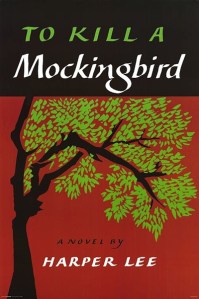
Kill a Mocking Bird 100dpi_4x6_4cI began to list a dozen novels that everyone should read before age 50, but quickly realized that if all you want is a dozen, you should ask an economist, not a novelist. Still, stories are what help us best understand why we are how we are. So after consulting people I admire and my own mental file, I included only novels that I believe you really ought to read. Here are the novels picked, starting with the 21st place selection …

Books range from Charlotte’s Web by E.B. White to The Great Gatsby by F. Scott Fitzgerald to To Kill a Mockingbird by Harper Lee. To see the full list, go to: 21 Great Novels Worth Finding the Time to Read

Leave a comment

Filed under 2016, books

X-rays reveal 1,300-year-old writings inside later bookbindings

The words of the 8th-century Saint Bede are among those that have been found by detecting iron, copper and zinc – constituents of medieval ink

By Dalya Alberge

Source: https://www.theguardian.com/books/2016/jun/04/x-rays-reveal-medieval-manuscripts

Ancient book reveraled 100dpi_6x4_4c

Medieval manuscripts that have been hidden from view for centuries could reveal their secrets for the first time, thanks to new technology.

Dutch scientists and other academics are using an x-ray technique to read fragments of manuscripts that have been reused as bookbindings and which cannot be deciphered with the naked eye. After the middle ages manuscripts were recycled, with pages pasted inside bindings to strengthen them. Those fragments may be the unique remains of certain works.

Dr Erik Kwakkel, a medieval book historian at Leiden University, told the Observer: “It’s really like a treasure trove. It’s extremely exciting.”
Professor Joris Dik, of the Delft University of Technology, described the potential for finding new material with clues to the past as “massive”. The technology does not just make hidden texts visible, but legible.

Access to such “hidden libraries” has been made possible by macro x-ray fluorescence spectrometry (MA-XRF), which allows pages to be read without removing the bookbinding.

Bindings made between the 15th and 18th centuries often contain hidden manuscript fragments that can be much older. Bookbinders used to cut up and recycle handwritten books from the middle ages, which had become old-fashioned following the invention of printing. These fragments, described by Kwakkel as “stowaways from a distant past”, are within as many as one in five early modern age printed books.

Kwakkel added: “Much of what we’re finding is 15th or 14th century, but it would be really nice to have Carolingian material, so from the ninth century or even older. It would be great to find a fragment of a very old copy of a Bible, the most important text in the middle ages. Every library has thousands of these bindings, especially the larger collections. If you go to the British Library or the Bodleian [in Oxford], they will have thousands of these bindings. So you can see how that adds up to a huge potential.”

Experiments have found a fragment from a 12th-century manuscript that includes excerpts from the work of Bede, the 8th-century monk and scholar. The researchers were even able to disassemble multiple pages that had been pasted on to one another, making the text legible. In one case, they could read each of three medieval pages that had been glued together. Elsewhere, they found two fragments stuck together underneath the cover of a 16th-century binding.

Dik’s team originally developed the technology, in collaboration with others, to “visualise” hidden layers in Old Master paintings. In 2011, for example, they discovered a previously unknown self-portrait by Rembrandt beneath another work. Although faint and unfinished, it dispelled doubts about the surface picture’s attribution to the 17th-century Dutch master, to the excitement of art historians.

Now the technology has proved to be “equally efficient in the visualisation of hidden medieval inks,” he said. “A thin beam of x-rays is used to scan the object, charting the presence and abundance of various elements below the surface. That is how iron, copper and zinc, the main element constituents of medieval inks, could be viewed, even when covered by a layer of paper or parchment.”

The problem, though, is that the current methodology is painfully slow, with scans sometimes taking more than 24 hours. Faster techniques are being explored. Dik said: “Right now, we’ve shown that it works.”

The research has been subsidised by the Young Academy, a branch of the Royal Netherlands Academy of Arts and Sciences.

Last year it emerged that techniques had been developed to decipher ancient papyrus scrolls that were burned black and buried in ash when Mount Vesuvius erupted 2,000 years ago. Vito Mocella, a scientist in Naples, found that they could read some of the scrolls without unravelling them by peering inside with x-rays.

Referring to Mocella’s technology, Dik said: “It’s different. The papyrus texts are hidden inside papyrus. We’re looking at stuff that is covered by something that is much thicker. Parchment and papyrus are quite different. Parchment is a much thicker, denser material.”

Leave a comment

Filed under 2016, books

Please read

James Patterson Would Like You to Read

By Troy Patterson

Source: http://www.newyorker.com/books/page-turner/james-patterson-would-like-you-to-read?mbid=rss

Author James Patterson would like you to read.

Author James Patterson would like you to read.

In the tradition of Don DeLillo, Salman Rushdie, and Joseph Heller, James Patterson drafted his early books by moonlight while holding a day job as an advertising copywriter. But none of those other guys ever won a Clio, much less rose to an executive suite at J. Walter Thompson, where the storytellers stoke mass desire on an industrial scale.

Patterson became the best-selling novelist of the twenty-first century on the strength of his superlative skills as an adman—his knack for the art of the sale, his gift for managing creative talent. Relying on a retinue of co-authors, he is the chief executive of an unsleeping pulp mill perpetually boosting capacity. He has placed nineteen books on the Times’ best-seller lists since January. He has three hundred and twenty-five million books in print and an annual income of something like ninety million dollars. He has a new pitch.

One recent afternoon, Patterson summoned this interviewer (no relation) to an expense-account joint in midtown. He inhabited his corner banquette with no airs, drank his Diet Coke with mild thirst, and spoke with a lot of Hudson Valley in his voice. Patterson was born sixty-nine years ago in Newburgh, New York—the town across from Beacon on the wrong side of the river—and his accent did something untranscribable when he mentioned his filing drawers. The drawers are in the home office at his winter palace, in Palm Beach. Very deep, they hold a hundred and seventeen fresh manuscripts, slender but all good to go.

Patterson has enticed Hachette Book Group to grant him reign over a new imprint called BookShots. Each volume runs twenty-five to thirty thousand words, or a hundred and twenty-five to a hundred and fifty pages, or somewhere between one full “Double Indemnity” and two-thirds a “Gatsby.” Tolstoy is a full meal; Turgenev is a fabulous dessert; a BookShot is a bag of Funyuns. “We have this convention of the novel that you have to know everything about the frigging characters,” Patterson said. “Like: What? You know, a lot of people don’t know their spouses that well.”

Patterson “grew up being a little literary snob” who matured into knowing his limits. “At a certain point, it occurred to me I couldn’t write ‘One Hundred Years of Solitude,’ but at that point I read ‘The Day of the Jackal.’ “ This he could maybe manage. He settled on a practical poetics: “Action reveals character even more than ‘bullshit, bullshit, bullshit’ in our heads.” BookShots is the natural extension of this philosophy. Why muck around with interiority? Why must a mass-market paperback aspire to the thickness of a foam travel pillow? Why not test the demand for low-commitment narratives priced at five dollars a hit? “I’m certainly not trying to break any new ground in terms of the structure of the novel,” Patterson said. “I just find that less seems to be more.”

One of the first BookShots—published this week, precisely a year after Patterson presented the concept—is “Cross Kill.” An installment of Patterson’s Alex Cross series, it is one of the few productions to flow from his solitary pen. Controlled prose, confirmed audience, a first printing of five hundred thousand copies, great. And Patterson plainly relishes collaborating with reporters on a true-crime horror show, titled “Filthy Rich,” about the highly affluent sex criminal Jeffrey Epstein. But most often he farms out the word processing to co-authors, who receive detailed outlines and send back work that ranges in quality from vibrant schlock to hectic dreck. He’s also curating a BookShots Flames series for readers who crave to imagine the love shared by, say, an Appletini-tippling city gal and a rodeo cowboy named Tanner. “I came up with title for that one,” Patterson said. The title for that one is “Learning to Ride.”

When I asked what inspired BookShots, Patterson said, “I was kinda blocked,” using the word in an awesome caricature of the opposite of its usual sense. He published seventeen books in 2015. Only seventeen! With all his ideas and his infrastructure? With so many pots potentially boiling in his institutional kitchen?! Hachette is scheduled to published twenty-three BookShots in 2016, plus fifteen other Patterson titles. These numbers are open to upward revision.

“My hope is that it increases the habit of reading,” Patterson said. He is sincere in this goal, which aligns both with his philanthropic support of literacy and his personal gripes about the electorate’s analytic skills. “We have this country of nincompoops now.” It is discouraging, for instance, to see the populace swayed by political promises of mass deportations: “Like thirty million cops come to their homes and walk them across the Rio Grande? I mean, stop it already.” (I wondered if the author still golfs at the Trump course in West Palm. “Yeah, I do sometimes,” he said. “I go there to golf, not to vote.”) “You go to Sweden”—a country of ten million people—“and they have books that sell a million copies there. Gas stations sell books. It’s good for people.”

When I wondered about Patterson’s commercial hopes for the new project, he evaded the question quite suavely. “You know, I remember a long time ago—uh, who’s the ‘Star Wars’ guy?” George Lucas? “Yeah, I met him a really long time ago, and we were talking about his idea of success, and he said, ‘My thing is, I just keep pushing the rock up the steep hill, and as long as I feel like I keep going up the hill it’s good.’ You know, same thing.”

“You do what you can do,” Patterson said. “I’m not an empire builder.”

Leave a comment

Filed under 2016, book publishing, books