Category Archives: book publishing

‘American Dirt’ was planned as a publishing triumph. What went wrong? – Los Angeles Times

Celebrities endorsed ‘American Dirt’ — then the reactions on Twitter turned negative. Cries of appropriation — and barb-wire dinner pieces — spark scorn for book

Source: ‘American Dirt’ was planned as a publishing triumph. What went wrong? – Los Angeles Times

It was poised to be a blockbuster long before copies arrived in bookstores last week: a thrilling contemporary migration story following a mother and her son, desperate to cross Mexico and reach the United States.

Its publisher, Flatiron Books, an imprint of Macmillan, paid a seven-figure advance after outbidding several competitors for the novel. It snagged a coveted selection in Oprah’s Book Club and had been shipped to key celebrity influencers, including Stephen King, Sandra Cisneros and Salma Hayek. A reported first run of 500,000 copies was printed. The film rights were sold.

But by week’s end, the novel “American Dirt” had garnered attention that its boosters likely didn’t expect: angry charges of cultural appropriation, stereotyping, insensitivity, and even racism against author Jeanine Cummins, who herself said in the book’s author’s note, “I was worried that, as a nonmigrant and non-Mexican, I had no business writing a book set almost entirely in Mexico, set entirely among migrants.”

Despite the backing of towering figures in American media, Cummins’ page-turning portrayal of a mother on the run is now at the center of the first bonafide literary controversy of the year, and is forcing a hard reflection on the state of Latinos in a cultural field that remains overwhelmingly white.

In the face of critiques, Cummins is pushing back in public. Her publisher released a statement encouraging discussion around the title, while some authors and booksellers have come to Cummins’ defense. In a culture that is used to debating black and Asian representation and stereotypes, the entrenchment around “American Dirt” is fueling even more complaints over the ease with which popular culture still employs Latino-related stereotypes in contemporary movies, television and fiction.

“American Dirt” is also highlighting factors that observers say have contributed a near shutout of contemporary Mexican and Mexican American voices from the top tier of the publishing publicity machine — the sorts of books that are guaranteed handsome sales by virtue of projection.

What went wrong?

As passages from the novel began emerging last month, Mexican and other Latino voices began raising red flags. The author’s portrayal of Mexican culture was called outlandish, littered with stereotypes, stilted bilingualism and an awkward peppering of italicized Spanish phrases.

“I assert that American Dirt fails to convey any Mexican sensibility,” said Long Beach writer Myriam Gurba in an early negative review that became a catalyst of the controversy.

It is the marketing of this brown and black pain.

Lilliam Rivera, author

“American Dirt” has also sparked an emotional discussion about how far the publishing industry still must go to more richly represent the scope and diversity of the Latino experience, said authors, literary agents and other industry figures in interviews last week. It’s a discussion focused on a complicated question: Who gets to frame others’ stories, and how?

Barbed-wire centerpieces

Publishing, like Hollywood, has yet to fully confront its lack of diversity involving Latinos, the largest nonwhite demographic and now largest minority voting group in the United States. A 2019 Publishers Weekly study based on self-reported survey of 699 industry respondents found that Latinos comprised just 3 percent of the publishing workforce in 2018. An earlier Diversity Baseline Survey conducted in 2015 by Lee & Low Books found that Latinos represented 6% of the publishing industry overall, while whites were 79%.

“American Dirt” has opened a window into the ways a few select books are brought to the public’s attention at a time when many authors have to hire their own publicists or arrange their own book readings and events. The roll-out to some took on the veneer of insult to Central American trauma and pain surrounding the treacherous passage through Mexico.

“They’re handling it like they handle a Marvel comics movie,” said Roberto Lovato, a Salvadoran American writer in San Francisco, who is finalizing an upcoming memoir. “But this industry will make you dance the minstrel salsa dance or the minstrel cumbia dance,” he added, in reference to the tenor of Latino-themed titles that are deemed palatable to wide audiences.

Indeed, the operation behind “American Dirt” made what many describe as cringe-worthy errors even before the book hit stores.

Back in May, Flatiron Books hosted a dinner for Cummins during a booksellers convention in New York, a sign that the novel would have strong publisher support. On the tables at the dinner were barbed-wire centerpieces holding flowers. Evoking a border wall, the table decorations, complete with faux barbed wire made from twigs, played off the novel’s cover design. Critics found a photo Cummins posted of the centerpieces on her Twitter account, and have circulated the image as a symbol of the publisher’s insensitivity.

“It’s disturbing to see a publishing dinner with barb-wire centerpieces,” said Lilliam Rivera, the L.A.-based Puerto Rican author of successful young adult novels. “It is the marketing of this brown and black pain.”

More criticism followed among Latino writers, from the fringes to the center of the literary power establishment. Mexican author Valeria Luiselli, a MacArthur Foundation “genius” grant recipient, called the book the “worst possible” pick for Oprah’s nod. Francisco Goldman, the celebrated Guatemalan American novelist and journalist who divides his time between New York and Mexico City, said in an interview he was “shocked” by the “tone-deaf” publicity roll-out. “And these are supposedly sophisticated people.”

When Oprah Winfrey’s super-charged publicity campaign for “American Dirt” launched Tuesday, with the announcement of her book club pick on “CBS This Morning” and on Winfrey’s social media accounts, the already-simmering anger over the novel only grew.

Critics noted a string of similar casual-seeming social posts from famous figures such as Yalitza Aparicio (“Roma”), MJ Rodriguez (“Pose”) and Gina Rodriguez (“Jane the Virgin”). Hayek, the Academy Award-nominated Mexican actress, posted her own glowing review for “American Dirt” later in the week, then deleted it on Friday. “I confess I have not read it and was not aware of any controversy,” she said on Instagram. Each entertainer displayed an e-reader version of the novel and nearly all of them thanked Winfrey for sending the book, hinting at a multiplatform publicity campaign.

Not everyone went along. Kate Horan, the director of the McAllen Public Library in Texas, posted portions of a letter she sent to the American Library Assn. and Oprah’s Book Club, declining to participate in a recorded “unboxing” event meant to push “American Dirt.” Horan said she felt compelled to turn down the offer from Oprah’s Book Club after seeing the reactions among Latinx writers she and her staff admire.

“When we took the book out, our hearts dropped,” Horan said in a telephone interview from Philadelphia, where the American Library Assn. is holding its mid-winter conference. “There followed many conversations with people in my community, and of course reading the book, I can only compare it to a telenovela. It’s so hyper stereotyped, that it’s harmful.” (The McAllen public library will still have a dozen copies of the book for checkout, Horan said.)

A muddled identity

Buzz around “American Dirt” had been building since 2018, when it was sold at auction to Flatiron editor Amy Einhorn, who is known for acquiring the novel “The Help” — a bestseller whose white author was criticized for, among other things, comparing a black maid character’s skin to a cockroach. Cummins’ book scored blurbs from not only King and Cisneros, but also Don Winslow and John Grisham. Winslow, who called “American Dirt” “a ‘Grapes of Wrath’ for our times,” and others defended their endorsements of the book.

“I read the book and I loved it. That experience can’t be changed by people who don’t like it,” said novelist Ann Patchett, who called “American Dirt” a “moral compass” in her quote for the title. “There’s a level of viciousness that comes from a woman getting big advance and a lot of attention,” she added. “If it had been a small advance with a small review in the back of the book section, I don’t think we’d be seeing the same level of outrage.”

By week’s end, as the U.S. commercial publishing industry was reeling from the expanding maelstrom over what its critics called a cartoonish melodrama about contemporary Mexico, Cummins still hit the road on a book tour. At an industry conference last week in Baltimore, she defended her right to write the novel from the perspective of the Mexican woman at the heart of her book.

Her character Lydia, 32, is middle-class, college-educated wife and mother who owns a bookshop in the resort city of Acapulco and survives a bloody massacre at a family quinceañera. With her journalist husband and other family members killed, the bookish protagonist and her 8-year-old son make a desperate run for the U.S. border, partly on the freight train La Bestia. Critics have mocked the narrative ploy as implausible for anyone of Lydia’s class stature, who can usually buy airline or bus tickets.

In Baltimore, Cummins said the migrants she met during her research for the novel “made me recognize my own cowardice” as she grappled with early failed drafts and doubts about authenticity. “When people are really putting their lives on the line, to be afraid of writing a book felt like cowardice,” she said, according to a report for the trade site Publishers Lunch.

The author, who did not respond to a request for comment for this article, identified as white as recently as 2016. On Wednesday, Cummins, whose grandmother was from Puerto Rico, said she was “a Latinx woman” while addressing the negative reactions to the book among Mexican, Central American and Chicano readers who have vigorously questioned her authorial integrity. “Not everyone needs to love my book,” she said.

On Friday, Cummins turned up her defense during an interview with NPR: “I am a white person. … I am a person who has a very privileged life. I am also Puerto Rican. … That fact has been attacked and sidelined by people who, frankly, are attempting to police my identity.”

But her critics weren’t buying it.

Gurba and others accused Cummins of profiting off Latina identity and transforming her own ethnicity over time to suit professional interests. “She became a person of color for the sake of financial convenience,” Gurba told The Times. “I call that POC, a person of convenience.”

Another set of earlier photos of Cummins with barbed-wire decorated fingernails brought even more criticism. “Every day I see something new that pertains to this, that it seems like it can’t get worse, and it gets worse,” said YA author Rivera.

Cummins’ somewhat apologetic author’s note also fanned the flames. In it, she says she wished someone “slightly browner” than her had written her book. She also argued that her effort seeks to counter depictions of immigrants as a “faceless brown mass.” Goldman, reached in New York, called the phrase an admission to the book’s “pornographic feedback of violence.”

“It’s just unbelievable,” he said Thursday. “How mediocre, third-rate and sleazy it is for a fiction writer to appropriate violence and suffering that way.”

In her note, he added, Cummins also writes, “we seldom think of [migrants] as human beings.”

“Who is that ‘we’?” Goldman said. “It sounds like Donald Trump Jr. was doing a book club and trying to come up as woke. … How could anyone think of themselves as being the corrective for that?”

Industry buzzing

Goldman said he hopes that the persistent negative buzz may force the publishing establishment to address uncomfortable questions about how U.S. Latinos are reflected in the adult-fiction space, just as similar discussions of portrayals of African American and Asian American characters in film, television and the world of YA novels has led to some changes.

The controversy doesn’t look to go away soon. On Saturday, a group of writers including Lovato, Gurba and others said they sent a letter to Macmillan promising more “action” if the publishing house doesn’t respond more directly to their critiques. Industry players are abuzz with the topic, book agents said, as a string of “American Dirt”-inspired Twitter parodies by brown writers took flight, mocking the publishing industry’s devotion to tired Latino tropes involving gangs and grandmothers.

Eddie Schneider, vice president of JABerwocky Literary Agency, and who represents author Rivera, said Flatiron Books made a string of mistakes in rolling out “American Dirt” and isn’t correcting them. On Thursday, the publishing house defended the title in a statement to The Times.

“I’m baffled I haven’t seen any apology yet,” Schneider said. “Maybe not for the book, but certainly it seems like an apology is in order for the insensitivity of the roll-out.”

Schneider suggested that Flatiron and Cummins should clearly state how immigrant-rights organizations could benefit from the sales that are certain to follow the Oprah Winfrey endorsement. “That to me seems sort of like a bare minimum corporate response — even if they’re still making a ton of money off of it,” he said.

As of Saturday, “American Dirt” was No. 4 on Amazon’s bestseller list.

Times staff writer Dorany Pineda contributed to this report.


Leave a comment

Filed under 2020, book publishing, books

Publishers are hiring ‘sensitivity readers’ to flag potentially offensive content – Chicago Tribune

Before a book is published and released to the public, it’s passed through the hands (and eyes) of many people: an author’s friends and family, an agent and, of course, an editor.

Source: Publishers are hiring ‘sensitivity readers’ to flag potentially offensive content – Chicago Tribune

by Everdeen Mason

These days, though, a book may get an additional check from an unusual source: a sensitivity reader, a person who, for a nominal fee, will scan the book for racist, sexist or otherwise offensive content. These readers give feedback based on self-ascribed areas of expertise such as “dealing with terminal illness,” “racial dynamics in Muslim communities within families” or “transgender issues.”

“The industry recognizes this is a real concern,” said Cheryl Klein, a children’s and young adult book editor and author of “The Magic Words: Writing Great Books for Children and Young Adults.” Klein, who works at the publisher Lee & Low, said that she has seen the casual use of specialized readers for many years but that the process has become more standardized and more of a priority, especially in books for young readers.

Sensitivity readers have emerged in a climate – fueled in part by social media – in which writers are under increased scrutiny for their portrayals of people from marginalized groups, especially when the author is not a part of that group.

Last year, for instance, J.K. Rowling was strongly criticized by Native American readers and scholars for her portrayal of Navajo traditions in the 2016 story “History of Magic in North America.” Young-adult author Keira Drake was forced to revise her fantasy novel “The Continent” after an online uproar over its portrayal of people of color and Native backgrounds. More recently, author Veronica Roth – of “Divergent” fame – came under fire for her new novel, “Carve the Mark.” In addition to being called racist, the book was criticized for its portrayal of chronic pain in its main character.

This potential for offense has some writers scared. Young-adult author Susan Dennard recently hired a fan to review her portrayal of a transgender character in her “Truthwitch” series.

“I was nervous to write a character like this to begin with, because what if I get it wrong? I could do some major damage,” Dennard said. But, she added, she felt the voice of the character was an important one that wasn’t often portrayed, so she hired a fan, who is a transgender man, just to be sure she did it right.

For authors looking for sensitivity readers beyond their fan base there is the Writing in the Margins database, a resource of about 125 readers created by Justina Ireland, author of the YA books “Vengeance Bound” and “Promise of Shadows.” Ireland started the directory last year after hearing other authors at a writing retreat discuss the difficulties in finding people of different backgrounds to read a manuscript and give feedback about such, well, sensitive matters.

One reader for hire in Ireland’s database is Dhonielle Clayton, a librarian and writer based in New York. Clayton reviews two manuscripts per month, going line by line to look at diction, dialogue and plot. Clayton says she analyzes the authenticity of the characters and scenes, then points writers to where they can do more research to improve their work.

Clayton, who is black, sees her role as a vital one. “Books for me are supposed to be vehicles for pleasure, they’re supposed to be escapist and fun,” she says. They’re not supposed to be a place where readers “encounter harmful versions” and stereotypes of people like them.

Ireland underscores the value of sensitivity readers – both for authors and for readers. (She was a strong voice behind the push to get Keira Drake to make changes to the advance readers’ edition of “The Continent.”)

“Even if authors mean well, even if the intention is good, it doesn’t change the impact,” Ireland said. “It’s nice to be that line of defense before it gets to readers, especially since the bulk of people who come to me write for children.” Fees for a sensitivity readers generally start at $250 per manuscript.

Children’s book author Kate Messner has used sensitivity readers for many of her books, some of which deal with poverty, abuse and race.

“I wouldn’t dream of sending those books out into the world without getting help to make sure I’m representing those issues in a way that’s realistic and sensitive,” she said. Messner, whose works include “The Seventh Wish” and “All the Answers,” asks a reader for feedback on whether the experience she’s written reads realistically or whether anything stands out as problematic.
Her upcoming book, tentatively called “Breakout,” focuses on three girls coping with a prison escape in their small town. Messner has enlisted multiple sensitivity readers to help her work out the class and race issues affecting the town and her characters. A reader has called out when her language doesn’t ring true, and has questioned when her character does something that seems inauthentic and provides her perspective on why that is. Messner said it’s been encouraging to hear when she’s gotten something correct, but also she’s had to make adjustments.

Lee & Low Books has a companywide policy to use sensitivity readers. Stacy Whitman, publisher and editorial director of Lee & Low’s middle-grade imprint Tu Books, said she will even request a sensitivity reader before she chooses to acquire a book to publish.

“It’s important for authors to consider expert reader feedback and figure out how to solve the problems they point out,” Whitman said. “Everyone’s goal is a better book, and better representation contributes to that.”

Still, some sensitivity readers feel they are in part contributing to the problem. Clayton said she’s unsettled by the idea that she’s being paid for her expertise, but also is helping white authors write black characters for books from which they reap profit and praise.

“It feels like I’m supplying the seeds and the gems and the jewels from our culture, and it creates cultural thievery,” Clayton said. “Why am I going to give you all of those little things that make my culture so interesting so you can go and use it and you don’t understand it?”

Concerns about cultural appropriation have been around for years – think of William Styron writing as the slave Nat Turner in 1967. (“That’s what we’re paid to do, isn’t it?” Lionel Shriver said in a controversial speech last year. “Step into other people’s shoes, and try on their hats.”)

But sensitivity readers introduce a new twist in the debate. On the one hand they help a writer create the experience of a marginalized group more authentically. On the other, they legitimize the mimicking of marginalized voices by non-marginalized writers.

Why not just publish more books by black people, Latinos, Native Americans and others? some ask.

Despite the efforts of groups like We Need Diverse Books, “it’s more likely that a publishing house will publish a book about an African-American girl by a white woman versus one written by a black woman like me,” Clayton says.
“So until publishing is equitable and people are still writing cross-culturally,” Clayton points out, “sensitivity reading is going to be another layer of what’s necessary in order to make sure that representation is good.”

Leave a comment

Filed under 2017, book publishing

Please read

James Patterson Would Like You to Read

By Troy Patterson

Source: http://www.newyorker.com/books/page-turner/james-patterson-would-like-you-to-read?mbid=rss

Author James Patterson would like you to read.

Author James Patterson would like you to read.

In the tradition of Don DeLillo, Salman Rushdie, and Joseph Heller, James Patterson drafted his early books by moonlight while holding a day job as an advertising copywriter. But none of those other guys ever won a Clio, much less rose to an executive suite at J. Walter Thompson, where the storytellers stoke mass desire on an industrial scale.

Patterson became the best-selling novelist of the twenty-first century on the strength of his superlative skills as an adman—his knack for the art of the sale, his gift for managing creative talent. Relying on a retinue of co-authors, he is the chief executive of an unsleeping pulp mill perpetually boosting capacity. He has placed nineteen books on the Times’ best-seller lists since January. He has three hundred and twenty-five million books in print and an annual income of something like ninety million dollars. He has a new pitch.

One recent afternoon, Patterson summoned this interviewer (no relation) to an expense-account joint in midtown. He inhabited his corner banquette with no airs, drank his Diet Coke with mild thirst, and spoke with a lot of Hudson Valley in his voice. Patterson was born sixty-nine years ago in Newburgh, New York—the town across from Beacon on the wrong side of the river—and his accent did something untranscribable when he mentioned his filing drawers. The drawers are in the home office at his winter palace, in Palm Beach. Very deep, they hold a hundred and seventeen fresh manuscripts, slender but all good to go.

Patterson has enticed Hachette Book Group to grant him reign over a new imprint called BookShots. Each volume runs twenty-five to thirty thousand words, or a hundred and twenty-five to a hundred and fifty pages, or somewhere between one full “Double Indemnity” and two-thirds a “Gatsby.” Tolstoy is a full meal; Turgenev is a fabulous dessert; a BookShot is a bag of Funyuns. “We have this convention of the novel that you have to know everything about the frigging characters,” Patterson said. “Like: What? You know, a lot of people don’t know their spouses that well.”

Patterson “grew up being a little literary snob” who matured into knowing his limits. “At a certain point, it occurred to me I couldn’t write ‘One Hundred Years of Solitude,’ but at that point I read ‘The Day of the Jackal.’ “ This he could maybe manage. He settled on a practical poetics: “Action reveals character even more than ‘bullshit, bullshit, bullshit’ in our heads.” BookShots is the natural extension of this philosophy. Why muck around with interiority? Why must a mass-market paperback aspire to the thickness of a foam travel pillow? Why not test the demand for low-commitment narratives priced at five dollars a hit? “I’m certainly not trying to break any new ground in terms of the structure of the novel,” Patterson said. “I just find that less seems to be more.”

One of the first BookShots—published this week, precisely a year after Patterson presented the concept—is “Cross Kill.” An installment of Patterson’s Alex Cross series, it is one of the few productions to flow from his solitary pen. Controlled prose, confirmed audience, a first printing of five hundred thousand copies, great. And Patterson plainly relishes collaborating with reporters on a true-crime horror show, titled “Filthy Rich,” about the highly affluent sex criminal Jeffrey Epstein. But most often he farms out the word processing to co-authors, who receive detailed outlines and send back work that ranges in quality from vibrant schlock to hectic dreck. He’s also curating a BookShots Flames series for readers who crave to imagine the love shared by, say, an Appletini-tippling city gal and a rodeo cowboy named Tanner. “I came up with title for that one,” Patterson said. The title for that one is “Learning to Ride.”

When I asked what inspired BookShots, Patterson said, “I was kinda blocked,” using the word in an awesome caricature of the opposite of its usual sense. He published seventeen books in 2015. Only seventeen! With all his ideas and his infrastructure? With so many pots potentially boiling in his institutional kitchen?! Hachette is scheduled to published twenty-three BookShots in 2016, plus fifteen other Patterson titles. These numbers are open to upward revision.

“My hope is that it increases the habit of reading,” Patterson said. He is sincere in this goal, which aligns both with his philanthropic support of literacy and his personal gripes about the electorate’s analytic skills. “We have this country of nincompoops now.” It is discouraging, for instance, to see the populace swayed by political promises of mass deportations: “Like thirty million cops come to their homes and walk them across the Rio Grande? I mean, stop it already.” (I wondered if the author still golfs at the Trump course in West Palm. “Yeah, I do sometimes,” he said. “I go there to golf, not to vote.”) “You go to Sweden”—a country of ten million people—“and they have books that sell a million copies there. Gas stations sell books. It’s good for people.”

When I wondered about Patterson’s commercial hopes for the new project, he evaded the question quite suavely. “You know, I remember a long time ago—uh, who’s the ‘Star Wars’ guy?” George Lucas? “Yeah, I met him a really long time ago, and we were talking about his idea of success, and he said, ‘My thing is, I just keep pushing the rock up the steep hill, and as long as I feel like I keep going up the hill it’s good.’ You know, same thing.”

“You do what you can do,” Patterson said. “I’m not an empire builder.”

Leave a comment

Filed under 2016, book publishing, books

The return of the printed book

Books are back. Only the technodazzled thought they would go away

The hysterical cheerleaders of the e-book failed to account for human experience, and publishers blindly followed suit. But the novelty has worn off

by Simon Jenkins

Source: http://www.theguardian.com/commentisfree/2016/may/13/books-ebook-publishers-paper?CMP=fb_gu

At last. Peak digital is at hand. The ultimate disruptor of the new information age is … wait for it … the book.

Chair in the last bookshop

Books are back

Shrewd observers noted the early signs. Kindle sales initially outstripped hardbacks but have slid fast since 2011. Sony killed off its e-readers. Waterstones last year stopped selling Kindles and e-books outside the UK, switched shelf space to books and saw a 5% rise in sales.

Amazon has opened its first bookshop.

Now the official Publishers’ Association confirms the trend. Last year digital content sales fell last year from £563m to £554m. After years on a plateau, physical book sales turned up, from £2.74bn to £2.76bn.

They have been boosted by the marketing of colouring and lifestyle titles, but there is always a reason. The truth is that digital readers were never remotely in the same ballpark. The PA regards the evidence as unmistakable, “Readers take a pleasure in a physical book that does not translate well on to digital.” Virtual books, like virtual holidays or virtual relationships, are not real. People want a break from another damned screen.

What went wrong? Clearly publishing, like other industries before (and since), suffered a bad attack of technodazzle: It failed to distinguish between newness and value. It could read digital’s hysterical cheerleaders, but not predict how a market of human beings would respond to a product once the novelty had passed. It ignored human nature. Reading the meaning of words is not consuming a manufacture: it is experience.

As so often, the market leader was the music business. Already, by the turn of the 21st century, its revenues were shifting dramatically from reproduction to live. This was partly because recording and distributing music became so cheap there was no profit margin, but it was largely because the market had changed. Buyers, young and old, wanted to witness music played in the company of like minds, and were prepared to pay for the experience – often to pay lots. Soon the same was true for live sport, live theatre, even live talks. The festival has become king. The money is back at the gate.

Books must be the ultimate test. Admittedly some festivals now give away books for free and charge instead to hear the writers speak.

But just buying, handling, giving and talking about a book seems to have caught the magic dust of “experience”. A book is beauty. A book is a shelf, a wall, a home.

The book was declared dead with the coming of radio. The hardback was dead with the coming of paperbacks. Print-on-paper was buried fathoms deep by the great god, digital. It was rubbish, all rubbish. Like other aids to reading, such as rotary presses, Linotyping and computer-setting, digital had brought innovation to the dissemination of knowledge and delight. But it was a means, not an end.

Since the days of Caxton and Gutenberg, print-on-paper has shown astonishing longevity. The old bruisers have seen off another challenge.

Leave a comment

Filed under 2016, book publishing, books

Court ruling against Apple over e-book pricing upheld

Apple’s mistake was hooking up with the book-publishing cartel

Source: http://fortune.com/2015/06/30/apple-court-books/

An appeal court’s decision finding Apple guilty of collusion with publishers reinforces just how cozy a cartel the industry was.

Apple may be trying to keep the spotlight on its latest foray into the streaming-music business, but it is also still trying to clean up the mess caused by its ham-handed entry into an earlier market: book publishing. A federal court on Tuesday rejected the company’s appeal of an earlier ruling that found it guilty of orchestrating a conspiracy with the major book publishers, in what the court said was a successful attempt to artificially inflate the price of e-books.

As Fortune‘s Jeff Roberts reports, the court found Apple AAPL -0.16% engaged in collusion with what amounted to an oligopoly—namely, Harper Collins, Penguin, Simon & Schuster, Hachette and Macmillan—and that its actions were a clear breach of antitrust law. Apple argued that the deal it cut with the publishers was necessary to blunt Amazon’s dominance in the e-book market, but the appeals court didn’t buy that argument. Judge Debra Ann Livingston wrote:

“Competition is not served by permitting a market entrant to eliminate price competition as a condition of entry, and it is cold comfort to consumers that they gained a new ebook retailer at the expense of passing control over all ebook prices to a cartel of book publishers.”

One reason the court failed to buy this argument is that the major publishers clearly had zero interest in actually competing on price—in fact, they wanted to do exactly the opposite. Their interest in doing a deal with Apple stemmed from a desire to maintain the existing favorable price structure for books, which allowed them to milk the market for high-priced hardcover versions of new novels before eventually releasing cheaper versions. Amazon’s AMZN 0.07% low-priced e-books were a threat.

Rest of the article: http://fortune.com/2015/06/30/apple-court-books/

***
One lawyer’s comments on the judgment:

The Passive Voice

Source: http://www.thepassivevoice.com/07/2015/apples-mistake-was-hooking-up-with-the-book-publishing-cartel/

After strong-arming Amazon into accepting the new “agency pricing” model—in which the publishers got to set the price for their books, rather than allowing the retailer to do so—the book industry got exactly what it wanted. According to research by the Justice Department, the price of newly released books rose by an average of 24% and bestsellers climbed by 40%.

It says a lot about the book-publishing business that doing this actually caused book sales to drop fairly dramatically across the board: research done by another expert using data from Random House showed that publishers who switched to the agency model sold close to 15% fewer books than they would have otherwise. So the industry was effectively willing to trade a short-term decline in sales for the increase in power that they got over pricing as a result of the deal with Apple.

Full blog entry at: http://www.thepassivevoice.com/07/2015/apples-mistake-was-hooking-up-with-the-book-publishing-cartel/

Leave a comment

Filed under 2015, book publishing

Amazon Is NOT the Vladimir Putin of the Publishing World – The Daily Beast

Amazon Is NOT the Vladimir Putin of the Publishing World – The Daily Beast.

by Nick Gillespie

In its battle with Hachette, Amazon is being compared to Putin and the Mafia—by critics who want you to pay more for books.

Can you believe those…those…those…sons of bitches at Amazon? After launching almost 20 years ago and making virtually every book—new, used, dead-tree, electronic, audio, and I’m guessing any day now, olfactory—available to everyone in America at good-to-great prices, the company’s true character now stands revealed. It’s not pretty, folks. Despite a huge market share, Amazon apparently still wants books, especially the e-books that everyone agrees are the future of the medium, to be cheaper than what publishers and big-name authors want you to pay for them.

Just who the hell does Amazon think it is? Maybe a bare-chested tyrant who used to work for the KGB? Amazon is “like Vladimir Putin mobilizing his troops along the Ukrainian border,” a proprietor of an “e-book discovery site” tells The New York Times. “A bully,” offers Richard Russo, the novelist and president of the Authors Guild (which knows exactly how to bully mere “writers”). Amazon, says author James Patterson, who published 13 detective books last year, is waging “war” and doing unspeakable things for which “the quality of American literature will suffer.” No, wait. That’s all wrong. Amazon isn’t like a Russian despot waging a war, says Dennis Loy, proprietor of the small publisher Melville House. It’s more like “the Mafia.”


More at: http://www.thedailybeast.com/articles/2014/06/05/amazon-is-not-the-vladimir-putin-of-the-publishing-world.html

1 Comment

Filed under Amazon, book publishing, publishing

Stephen Colbert Gives Jeff Bezos the Finger — Twice

Stephen Colbert Gives Jeff Bezos the Finger — Twice.

Amazon is messing with the wrong guy.

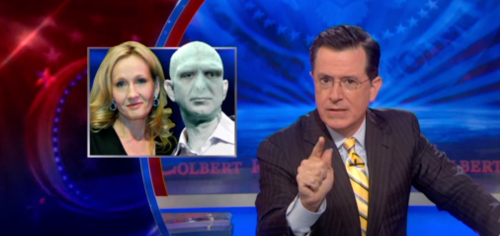
A few days after best-selling author Malcolm Gladwell came out against the online retailer for raising prices and delaying shipments of his books because of a dispute with publisher Hachette, Colbert has done the same. Colbert’s plaint, however, is funnier.

During a segment on Wednesday night’s Colbert Report, Colbert announced he was “mad prime” at Amazon for its latest actions. In particular, Colbert mocked Amazon’s suggestion that consumers in the market for his books should buy a used copy.

[Editor’s note: I think writer Sherman Alexie is correct. This is a battle between two big companies and the person(s) to support are the authors, who are getting smashed by both sides in this battle.]

Source: http://mashable.com/2014/06/05/stephen-colbert-amazon/#:eyJzIjoiZiIsImkiOiJfbDN3ZHQ3eDIza3NsOXdmZCJ9

Leave a comment

Filed under Amazon, book publishing, publishing