
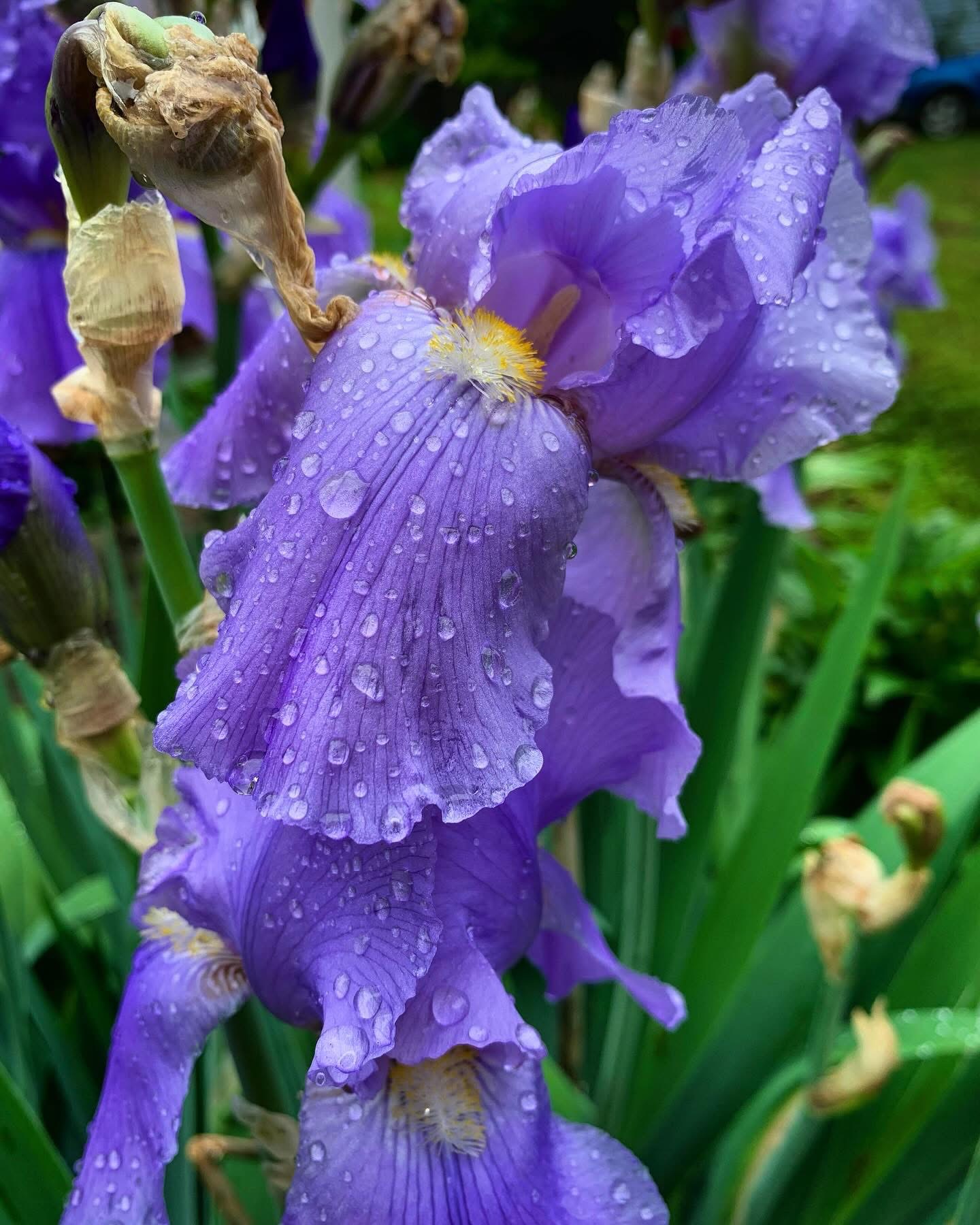
Skirt
Iris rise from dark soil, /
dress in a skirt of May rain, /
bloom and fall from light.
.
.
#skirt #iris #rain #May #light #bloom #soil #haiku #poem #poetry #haiga #photo #oldnorthknoxville #davidebooker #Sunday #050524 #2024
 How to write for a blog: authors need to learn to write Web content these days. 10 tips to help you attract Web readers and search engine spiders.
Source: How to Write for a Blog: 10 Tips for Writing Web Content that Gets Noticed
Good Web content attracts those search engine spiders.
by Anne R. Allen
These days, pretty much all writers need to learn to write Web content. Yes, even if you’re a Victorian romance author whose readers care more about reticules and spatterdashers than retweets and SEO. Even if you don’t have your own blog. Any website needs content. Plus you may want to plan a blog tour to promote your book launch, or guest on a blog for visibility. (Guest blogging is one of the best ways to market your book for free.)
Like it or not, all writers need to become “Web content providers” these days.
Yeah, I know. Sounds a lot less creative than “author” doesn’t it? And harder.
But it actually isn’t. Writing Web content is a little different from writing a traditional essay or magazine article, but it’s not hard. You just have to learn some basic guidelines.
Learning to Write Web Content Involves Unlearning
Especially what you were taught about paragraphing.
According to Mike Blankenship at Smart Blogger, the paragraph has gone through radical changes in the 21st century. He says the 100-200 word standard paragraph has disappeared. Now your average paragraph should be between two and four lines. You can go over and under — some paragraphs can be just one word long — but stay close to that average and you should be fine.
But don’t make them all the same length. Blankenship says, “Too many same-sized paragraphs in a row will bore your reader. It doesn’t matter if it’s too many small paragraphs or too many long paragraphs, the effect is similar.”
I had to unlearn a whole lot of what I was taught about writing prose back in the 20th century in order to be an effective Web content provider today. (Many thanks to my first online editor, Daryl Jung at the online zine Inkwell Newswatch.)
Back in the 20th century, good writers…
But the majority of people don’t read on the Internet; they skim. In fact, most people don’t even skim the whole article. Farhad Manjoo famously reported that only half the people who visit a website read past the first hundred words.
So how do you get them to come by…and stick around?
Forget all of the above and learn some new tricks:
1) Write Grabby Titles
This is probably the most important aspect of learning to blog.
Mystery author C. Hope Clark once said in her “Funds for Writers” newsletter: “You might be surprised at the key factor I use in deleting or holding to read: The quality of the subject line. Hey, when time is crazy limited…the words have to snag me as I rush by. That means first and foremost that the subject be crisp, sharp, attractive, intriguing, or whatever adjective you want to use that gives me whiplash. It has to shout, “HEY, READ ME OR YOU’LL REGRET IT.”
She’s right.
Headers are the most important element of your blog content, and it’s the one most novelists don’t get. We want our blogs to sound creative and literary like our books, not cheesy like a supermarket tabloid. But tabloid journalists are good at what they do. They have only a moment to grab a reader going through that checkout line, so they need an irresistible hook.
In our case, headers need to snag a reader in the endless stream of content Web browsers can choose from.
So how do we do that?
Here are 8 ways you can grab a Web reader’s attention with your story about, say, a writer who suspects her bathroom is haunted.
2) Promise a Speedy Read
Everybody’s in a hurry online.
Author Jillian Mullin recently wrote in the Web Writer Spotlight: “Generally, an average Web user only spends 10 to 30 seconds reading Internet content. People rarely read web pages word-per-word. Instead, they scan the page for related keywords, bullet points, subtitles, and quotes.”
That’s why one of the best ways to let people know you’ve got a quick, easy-scan piece is with a numbered “listicle” like “The 10 Best Ghostwritten Books” or “5 Signs Your Computer is Possessed.” Or, ahem, “10 tips for Writing Strong Web Content.”
The other thing is to learn to harness the power of white space. A page with lots of white space looks can be taken in at a glance..
I remember picking up a book my Yale-professor dad left in the living room when I was about 8 years old. It was thin and had lots of white space. An easy, quick read, I thought. So I sat down and read it before lunch. But the content was a bit disturbing. A mother did some really terrible things to the girl her husband was having an affair with. Then she killed her kids.
Yeah, it was the Robinson Jeffers translation of Euripides’ Medea. But hey, it was a quick read!
3) Pack Your Opener with Essential Information
Make sure your most important information is visible as soon as somebody opens your blog. People do a lot of reading on phones and small tablets these days, so those first words are all-important.
It’s also what Google shows in the search results. And those opening words will help the search engine spiders decide what searches will pick it up, so you need some keywords there, too. (Spiders, or “crawlers” are the programs that examine websites so they can index them for the search engine. Spiders are our friends and help make us visible on the Web.)
Since most people won’t read past the second paragraph, you don’t want to save your best stuff for the end. Half a century ago, journalists were taught to “humanize” stories by starting with a human interest line.
“Wendy Writer shouldn’t have a care in the world. She’s a pretty thirty-something freelance writer living in a gorgeous Victorian triplex in Old Town. She’s sitting on the front porch of the house she moved into last month with her cat Hortense. The three-story home was once owned by one Mildred Biggins, who died in 1924…”
The reporter could wait to get to the lead (then known as the “lede” to differentiate from the metal originally used to make type) in the third or fourth sentence. Not so anymore. You’ve got to give people the facts in the first 50-60 characters.
50-60 characters. That’s all Google shows in the search results, so make those characters work hard.
Just say it: “Wendy Writer’s house is haunted by the ghost of Mildred Biggins.”
4) Make Every Title Tweetable
Even if you’re not on Twitter, the reading public is, and you want your readers to share your piece and spread it around the Internet. Otherwise nobody reads it but your mom, your cat and maybe the poltergeist that might be lurking in the upstairs bathroom.
This means we have to avoid enigmatic, one-word headers that don’t give people any idea of your content. I recently saw a title that exemplified the kind of header that doesn’t work in the age of Twitter. The article was called “Ghosting.” It turned out to be about ghostwriting–a very timely subject at the moment.
But you wouldn’t know from the title. It might have been a piece on Tinder dates who evaporate, or ectoplasmic apparitions, or that short-lived TV show with Adam Scott and Craig Robinson. I didn’t have time to write a new header, so I didn’t retweet it.
You don’t want that to happen to your posts.
5) Use and Properly Format Subheaders
Sub-headers are essential for drawing traffic and keeping it. They have three jobs:
So if you’re writing about Mildred Biggins, you want to use sub-headers that contain keywords like ” ghost” , “haunted” , and “poltergeist” , rather than “Flappers in the Night” or ” Mildred or Hortense…who’s Flushing the Toilet at 3 AM?” .
IMPORTANT: Be sure to use the “header” and “subheader” mode in your blog program, and not the “normal” or “paragraph” setting.
For Blogger users, the sub-header menu is on the left-hand side of the toolbar, where you see the word “normal.” That window has a menu, where you can choose Heading, Subheading, or Minor Heading.
For WordPress users, it’s in the menu where you see “paragraph” as the default setting. You can choose “Headings” from one down to six.
When I started blogging, I didn’t have a clue about formatting, and didn’t know that spiders don’t recognize “normal” text as a sub-header even if it looks like one to human eyes. Finally somebody told me about the importance of using the appropriate formatting and our blog stats soared.
6) Write in a Light, Conversational Style
A blog is not the place to show off your encyclopedic vocabulary. If somebody has to click around to look up a word, they probably won’t come back.
It’s also not the place for jargon. Don’t write in geekspeak, legalese, or that “most scholars agree” phony-tony style you learned to use for college term papers.
Many tech people write in a language comprehensible only to them. It identifies them as “in the know.” But an “in crowd” blog isn’t going to get as many followers as one that’s friendly and welcoming to all.
Marketers and SEO specialists are some of the worst offenders. Several years ago, I remember being told I had to learn about something called Google Authorship. I read dozens of blogposts about it, but I couldn’t figure out if it was a software program, an app, a Google Plus circle, or the name of Larry Page’s secret Caribbean island. Nobody seemed able to define it. They only made fun of people who didn’t have it.
A few years later, I read that Google Authorship had died. I couldn’t help feeling it had something to do with the fact nobody outside of Google had any idea what it was.
You’re not going to reach the general public if you write in geek-speak and act smug.
7) Shorten your Sentences
My tech guru, Barb Drozdowich of Bakerview Consulting, has put little elves on this blog who rate my posts for “readability” before I post. The elves, aka algorithms, are courtesy of a WordPress plug-in called Yoast SEO. They give me a green light if I pass muster, an orange one if I’m getting too complex, and a red one if I’m moving into Ph.D. territory.
My most common offense? Long sentences. Ruth too. We’re old school. We know how to compose and punctuate complex sentences and we have fun writing them.
But it turns out Web readers don’t have so much fun reading them. And neither do the spiders. Once I started using Yoast, our traffic soared. As they say, “Yoast SEO does everything in its power to please both visitors and search engine spiders.”
It’s all about the spiders, people.
If you have trouble writing short sentences, Copyblogger has some helpful exercises to help you be creative with fewer words.
8) Format all Web Content so it’s Easy to Skim
Skimming is easier with lists, bullet points, and bolding. Italics can be useful too—anything to draw the eye along the text.
MS Word makes this a breeze. Unfortunately a lot of Word formatting doesn’t translate to blog programs, so you may have to resort to primitive means like numbering your own lists or using asterisks for bullet points.
A numbered list has a three-fold benefit:
9) Choose Informative Anchor Text for Hyperlinks
Hyperlinks are all-important in writing Web content.
What are hyperlinks? It’s okay to ask. I had no idea how to make a hyperlink for the first six months I blogged. You make a hyperlink when you turn an ugly URL like this: https://annerallen.com/2019/01/new-writing-scams-2019/ into a live bit of text that you can click on to take you to that address.
You make a hyperlink by selecting the text (called “anchor text”) that you want people to click on. Then you go to the icon that looks like two links of chain up there on the menu bar. Or in Blogger it is cleverly identified with the word “Link.”
Don’t make the link with the word “here” or “this link.” That’s because the words “here” and “this link” don’t mean anything to those Google spiders.
So select the whole phrase and make the hyperlink to that. So you’d select the words, “New Writing Scams” and put in the URL to that post. (Like the ugly one above.)
Spiders only notice links with identifying text. So either use the title of the piece as I did above, or say something about it, like “Author hounded relentlessly by scam marketers”
10) Keep Keywords and SEO in Mind, but Don’t Lard Your Post with Repetitions
I know SEO is one of those jargon expressions that make most writers’ eyes glaze over. A lot of people think it means repeating the same words over and over. But search engines actually favor using regular speech these days, so you don’t usually need to do anything strange to “optimize” for a search engine.
All you need to do is use simple keywords to help Google and other search engines find you. The best way to optimize for search engines is check after you write your post to see if you have keywords in the following:
And don’t worry a lot if you can’t cram them all in there. Treat that list as a helpful guideline, but don’t obsess or your prose will sound stilted and boring.
Using keywords simply means using the most basic words about your topic. So when you’re writing your copy or header, think of what words somebody might put into a search engine on the topic you’re writing about.
Say you’re writing about Wendy Writer’s cat, who has been flushing the toilet in the middle of the night, making her think the house is haunted by a long-dead tenant. Here are some possible headlines:
So put yourself in the shoes of a person who might be interested in a story about a toilet-flushing cat. Are they more likely to type “cat flush toilet” into Google, or “Hortense” ,”genius”, or “Mildred Baggins”?
Again it turns out that empathy, rather than a gimmick, is the most powerful “tip” of all.
***
What about you, scriveners? Do you format your blog posts for easy skimming? Do you know how to make friends with the spiders? Have you found using subheaders increases your blog traffic?
by Anne R. Allen (@annerallen) March 3, 2019
In case you’re wondering, and even if you aren’t, I would like to take a few moments and explain the new layout I am adopting for this blog. I have decided to make at least every work day specific to something. For example, Monday morning writing joke will be a joke focused on writing or about writing. It might also be a limerick (though nothing too naughty) or pun, which is something I have a weakness for.
Next: CarToonsday will be a cartoon, usually based in some way around writing, but not always.
Writing Tip Wednesday will have writing tips. It could also have recommendations of writing books to try, or information about writing conferences, or agents looking for new clients.
Haiku to you Thursday will be a haiku. At least for as long as I can write what I consider to be good quality ones. Sometimes I’m sure I’ll spit out a clunker, but sometimes you have to fail in order to succeed.
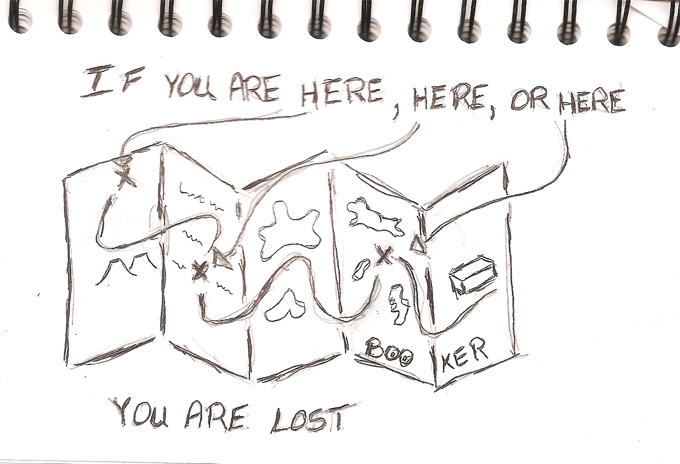
At times, the roadmap might be under construction.
Freeform Friday will be another poem, maybe not a haiku but something else, or writing such as a Blathering idiot installment, The Devil’s Dictionary, an essay. Maybe even something I haven’t tried before. Could even be another cartoon. (As if one a week is not enough.)
Story Saturday will be a part of a story. Something I am working on. Could also be a Found Story (photo with piece of writing about the photo). Could even be a whole story, if short enough. Or I may write something about my struggles to write stories, though I am sure that would get old and boring quickly.
Sunday? I may just take off. Or take off Saturday and make it Story Sunday. Or the whole weekend could be titled Workshop Weekend.
I have noticed on weekends there are usually fewer visitors to my blog. People are off doing other things, I assume. Plus a day off won’t hurt. I have a regular job, family obligations, and am working on a novel and short stories as well. On my days off, I aim for between 300 and 400 words of new writing on my stories or novel. So doing that and a blog entry can be tough. I might also skip a day here and there if I don’t have something that fits that day’s theme.
Certainly, comments and suggestions are welcome. And visits, too. The more the better. I aim to keep humor and wit of one stripe or another going on this blog. You may not be rolling in the floor laughing and sometimes you might even be rolling your eyes and groaning at the puns, but at least you’re not having to pay for the self-inflicted humor wound.
Last, but not least, thank you to all who have visited my blog and especially so to those who have linked up to receive notification when I post something new. I do appreciate it. Very much. Part of the reason for trying to more regularize the format is so that you know what’s coming.
Filed under blog, Workshop weekend, writing
Marriage of Socialism and Satan blamed for bizarre barrage of bad press over sandwich give away by Pennsylvania franchise.
Prayers called for by all right-minded Christians in the Chicken Sandwich Slinger’s hour of need. “Don’t get caught waffling,” one supporter intoned, “or you will fry in Hell.”
No official comment from the poultry wing of the political spectrum. Some say they have been bullied into submission and cower at the thought of speaking up for fear of being squawked. “We have decided to lay low on this one,” an inside source said, speaking anonymously on background. “This entire situation is all fowled up.”
“This is not egg-actly what we had hoped for,” C.T., founder and president of Chicken Sandwich Slinger, said when asked about it two weeks ago. “But we stand behind our independent franchise slinger’s actions in offering free sandwiches to legally married couples. Man and woman couples. We prayed about it and have decided to carry this idea nationwide and will be offering one free Chicken Slinger’s Sandwich to couples holding a valid marriage license.”
Unsubstantiated reports show an increase in online requests for ministers’ licenses, with the largest spikes appearing in the San Francisco, New York, and Atlanta areas. When asked about this, 84-year-old C.T. said it was “a feather in our cap,” if the increases were due to his promotional idea. “We’ll yet put the gay ol’ time back into marriage,” he said. “Even if we have to do it one Chicken Slinger’s Sandwich at a time.”
There was no immediate response from the Gay, Lesbian, Bisexual, Transgender Alliance.
More details as they become available.
Here are three writing places you can go to get some advice. I sure there are others, but these three stops could be helpful:
http://janeyolen.com/the-alphabetics-of-story/
From A to Z, literally in alphabetical order prolific author Jane Yolen discusses almost every aspect of story writing, from architecture to endings. None of the entries are long, so it is not as if you have to spend hours with your eyeballs glued to the screen. But hey, if you write, you’re probably already doing that anyway.
http://blogs.plos.org/neurotribes/2011/06/02/practical-tips-on-writing-a-book-from-22-brilliant-authors/
If you are more into writing non-fiction, then this list of practical tips from twenty-two authors could be of help for you. But there are nuggets of information for any writer, such as being willing to delete entire chapters and favorite passages. Not all the recommendations are so painful, but it takes more than fast fingers and a fluid imagination to make your writing work.
http://blog.nathanbransford.com/
A former agent turned author, Nathan Bransford covers a wide variety of topics dealing with writing, including poles where he asks his readers to offer their opinions. He has entries for subjects such as How to find an agent and How to write a synopsis or query letter, all under a heading called Publishing Essentials.
Filed under advice, blog, fiction, Jane Yolen, Nathan Brandsford, non-fiction, publishing, Steve Silberman, words, writer, writing, writing blog, writing tip


 Booker's Blog