
Alison Flood and Sian CainFri 10 Jan 2020 00.45 EST
Source: John le Carré wins $100,000 prize for ‘contribution to democracy’ | Books | The Guardian
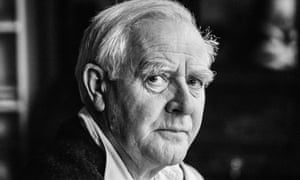
John le Carré has been named the latest recipient of the $100,000 (£76,000) Olof Palme prize, an award given for an “outstanding achievement” in the spirit of the assassinated Swedish prime minister.
Won in the past by names including whistleblower Daniel Ellsberg, who exposed the US government’s secret intelligence about the Vietnam war in 1971, the Olof Palme prize is intended to reward “an outstanding achievement in any of the areas of anti-racism, human rights, international understanding, peace and common security”.
Announcing Le Carré’s win early on Friday morning, the prize organisers praised the 88-year-old author, whose real name is David Cornwell, “for his engaging and humanistic opinion-making in literary form regarding the freedom of the individual and the fundamental issues of mankind.
“Attracting worldwide attention, he is constantly urging us to discuss the cynical power games of the major powers, the greed of global corporations, the irresponsible play of corrupt politicians with our health and welfare, the growing spread of international crime, the tension in the Middle East and the alarming rise of fascism and xenophobia in Europe and the US,” the organisers said, calling his career “an extraordinary contribution to the necessary fight for freedom, democracy and social justice”.
Le Carré said he would donate the winnings to the international humanitarian NGO Médecins Sans Frontières.
Le Carré, the acclaimed author of some of the last century’s most enduring works, from Tinker, Tailor, Soldier, Spy to The Spy Who Came in from the Cold, has been consistently outspoken about abuses of power in his fiction, his targets including governments, big pharma and arms dealing. Agent Running in the Field, his most recent book – which he has hinted will be his last – depicts collusion between Donald Trump’s US and the British security services with the aim of undermining the European Union.
The author has long steered clear of honours. In 2011, when he was nominated for the Man Booker International prize, he asked for his name to be withdrawn, saying that while he was “enormously flattered”, he did not compete for literary prizes.
Few authors have won the Olof Palme prize, named for the Social Democrat who led his country for 11 years and was mysteriously gunned down in a Stockholm street in 1986 after leaving the cinema. Playwright and political dissident Václav Havel won in 1989, soon before becoming president of Czechoslovakia, Danish novelist Carsten Jensen won in 2009 and the Italian journalist and author of Gomorrah Roberto Saviano won in 2011.
Le Carré will receive his award at a ceremony in Stockholm on 30 January.


 Booker's Blog
The Darwin Awards: The true blathering idiots
On days when you don’t feel as bright or with it as you normally do, consider these folks, nominees and winner of the Darwin Awards. The Darwin Awards is given annually to the person who did the gene pool the biggest service by killing himself in the most extraordinarily stupid way.
Some of these may make you both laugh and cry.
Semifinalist #1
A young Canadian man, searching for a way of getting drunk cheaply, because he had no money with which to buy alcohol, mixed gasoline with milk. Not surprisingly, this concoction made him ill, and he vomited into the fireplace in his house. This resulting explosion and fire burned his house down, killing both him and his sister.
[Editor’s comment: at the price of gas, wouldn’t cheap mouthwash have been a better choice?]
Semifinalist #2
Three Brazilian men were flying in a light aircraft at low altitude when another plane approached. It appears that they decided to moon the occupants of the other plane, but lost control of their own aircraft and crashed. They were all found dead in the wreckage with their pants around their ankles.
[Editor’s comment: This is not what is meant by the moon over San Paulo.]
Semifinalist #3
A 22-year-old Reston , VA , man was found dead after he tried to use octopus straps to bungee jump off a 70-foot rail road trestle. Fairfax County police said Eric Barcia, a fast-food worker, taped a bunch of these straps together, wrapped an end around one foot, anchored the other end to the trestle at Lake Accotink Park, jumped and hit the pavement. Warren Carmichael, a police spokesman, said investigators think Barcia was alone because his car was found nearby. “The length of the cord that he had assembled was greater than the distance between the trestle and the ground,” Carmichael said. Police say the apparent cause of death was “Major trauma.”
[Editor’s comment: clearly a case of gravity assisted suicide. If only the earth hadn’t gotten in the way.]
Semifinalist #4
A man in Alabama died from rattlesnake bites. It seems that he and a friend were playing a game of catch, using the rattlesnake as a ball. The friend – no doubt a future Darwin Awards candidate – was hospitalized.
[Editor’s comment: clearly the snake was being a spoiled sport.]
Semifinalist #5
Employees in a medium-sized warehouse in west Texas noticed the smell of a gas leak. Sensibly, management evacuated the building, extinguishing all potential sources of ignition; lights, power, etc.. After the building had been evacuated, two technicians from the gas company were dispatched. Upon entering the building, they found they had difficulty navigating in the dark. To their frustration, none of the lights worked. Witnesses later described the sight of one of the technicians reaching into his pocket and retrieving an object that resembled a cigarette lighter. Upon operation of the lighter-like object, the gas in the warehouse exploded, sending pieces of it up to three miles away. Nothing was found of the technicians, but the lighter was virtually untouched by the explosion. The technician suspected of causing the blast had never been thought of as ”bright” by his peers.
[Editor’s comment: Clearly an example of a career-limiting move.]
And Now, for the winner of this year’s Darwin Award –
(As always, awarded posthumously):
The Arizona Highway Patrol came upon a pile of smoldering metal embedded in the side of a cliff rising above the road at the apex of a curve. The wreckage resembled the site of an airplane crash, but it was a car. The type of car was unidentifiable at the scene. Police investigators finally pieced together the mystery. An amateur rocket scientist had somehow gotten hold of a JATO unit (Jet Assisted Take Off, actually a solid-fuel rocket) that is used to give heavy military transport planes an extra ‘push’ for taking off from short airfields. He had driven his Chevy Impala out into the desert and found a long, straight stretch of road. He attached the JATO unit to the car, jumped in, got up some speed and fired off the JATO!
The facts as best could be determined are that the operator of the 1967 Impala hit the JATO ignition at a distance of approximately 3.0 miles from the crash site. This was established by the scorched and melted asphalt at that location.
The JATO, if operating properly, would have reached maximum thrust within 5 seconds, causing the Chevy to reach speeds well in excess of 350 mph and continuing at full power for an additional 20 – 25 seconds. The driver, and soon-to-be pilot, would have experienced G-forces usually reserved for dog-fighting F-14 jocks under full afterburners, causing him to become irrelevant for the remainder of the event.
However, the automobile remained on the straight highway for about 2.5 miles (15-20 seconds) before the driver applied and completely melted the brakes, blowing the tires and leaving thick rubber marks on the road surface, then becoming airborne for an additional 1.4 miles and impacting the cliff face at a height of 125 feet, leaving a blackened crater 3 feet deep in the rock. Most of the driver’s remains were not recoverable.
Epilogue: It has been calculated that this “rocket scientist” attained a ground speed of approximately 420-mph, though much of his voyage was not actually on the ground.
[Editor’s comment: Apparently, some things still do take a rocket scientist.]
Share this:
4 Comments
Filed under absurdity, awards, blathering idiot, Commentary, Darwin, Darwin Awards, fun, humor, rocket scientist, true story
Tagged as absurdity, award, blathering idiot, commentary, Darwin, Darwin Awards, fun, humor, LinkedIn, rocket scientist, true story