Category Archives: author

After Twenty Years by O. Henry — LitReading – Classic Short Stories

Twenty years after heading west to find his fortunes a man returns to meet a long lost friend. 5 to 15 minutes

Source: After Twenty Years by O. Henry — LitReading – Classic Short Stories

THE COP MOVED ALONG THE STREET, LOOKING strong and important. This was the way he always moved. He was not thinking of how he looked. There were few people on the street to see him. It was only about ten at night, but it was cold. And there was a wind with a little rain in it.

He stopped at doors as he walked along, trying each door to be sure that it was closed for the night. Now and then he turned and looked up and down the street. He was a fine-looking cop, watchful, guarding the peace.

People in this part of the city went home early. Now and then you might see the lights of a shop or of a small restaurant. But most of the doors belonged to business places that had been closed hours ago.Then the cop suddenly slowed his walk. Near the door of a darkened shop a man was standing. As the cop walked toward him, the man spoke quickly.

“It’s all right, officer,” he said. “I’m waiting for a friend. Twenty years ago we agreed to meet here tonight. It sounds strange to you, doesn’t it? I’ll explain if you want to be sure that everything’s all right. About twenty years ago there was a restaurant where this shop stands. ‘Big Joe’ Brady’s restaurant.”

“It was here until five years ago,” said the cop.

The man near the door had a colorless square face with bright eyes, and a little white mark near his right eye. He had a large jewel in his necktie.

“Twenty years ago tonight,” said the man, “I had dinner here with Jimmy Wells. He was my best friend and the best fellow in the world. He and I grew up together here in New York, like two brothers. I was eighteen and Jimmy was twenty. The next morning I was to start for the West. I was going to find a job and make a great success. You couldn’t have pulled Jimmy out of New York. He thought it was the only place on earth.

“We agreed that night that we would meet here again in twenty years. We thought that in twenty years we would know what kind of men we were, and what future waited for us.”

“It sounds interesting,” said the cop. “A long time between meet- ings, it seems to me. Have you heard from your friend since you went West?”

“Yes, for a time we did write to each other,” said the man. “But after a year or two, we stopped. The West is big. I moved around every- where, and I moved quickly. But I know that Jimmy will meet me here if he can. He was as true as any man in the world. He’ll never forget. I came a thousand miles to stand here tonight. But I’ll be glad about that, if my old friend comes too.”

The waiting man took out a fine watch, covered with small jewels.

“Three minutes before ten,” he said. “It was ten that night when we said goodbye here at the restaurant door.”

“You were successful in the West, weren’t you?” asked the cop.

“I surely was! I hope Jimmy has done half as well. He was a slow mover. I’ve had to fight for my success. In New York a man doesn’t change much. In the West you learn how to fight for what you get.”

The cop took a step or two.

“I’ll go on my way,” he said. “I hope your friend comes all right. If he isn’t here at ten, are you going to leave?”

“I am not!” said the other. “I’ll wait half an hour, at least. If Jimmy is alive on earth, he’ll be here by that time. Good night, officer.”

“Good night,” said the cop, and walked away, trying doors as he went.

There was now a cold rain falling and the wind was stronger. The few people walking along that street were hurrying, trying to keep warm. And at the door of the shop stood the man who had come a thousand miles to meet a friend. Such a meeting could not be certain. But he waited.

About twenty minutes he waited, and then a tall man in a long coat came hurrying across the street. He went directly to the waiting man.

“Is that you, Bob?” he asked, doubtfully.

“Is that you, Jimmy Wells?” cried the man at the door.

The new man took the other man’s hands in his. “It’s Bob! It sure-

ly is. I was certain I would find you here if you were still alive. Twenty years is a long time. The old restaurant is gone, Bob. I wish it were here, so that we could have another dinner in it. Has the West been good to you?”

“It gave me everything I asked for. You’ve changed, Jimmy. I never thought you were so tall.”

“Oh, I grew a little after I was twenty.”

“Are you doing well in New York, Jimmy?”

“Well enough. I work for the city. Come on, Bob, We’ll go to a

place I know, and have a good long talk about old times.”

The two men started along the street, arm in arm. The man from the West was beginning to tell the story of his life. The other, with his coat up to his ears, listened with interest.

At the corner stood a shop bright with electric lights. When they

came near, each turned to look at the other’s face.

The man from the West stopped suddenly and pulled his arm away. “You’re not Jimmy Wells,” he said. “Twenty years is a long time,

but not long enough to change the shape of a man’s nose.”

“It sometimes changes a good man into a bad one,” said the tall man. “You’ve been under arrest for ten minutes, Bob. Chicago cops thought you might be coming to New York. They told us to watch for you. Are you coming with me quietly? That’s wise. But first here is something I was asked to give you. You may read it here at the window.

It’s from a cop named Wells.”

The man from the West opened the little piece of paper. His hand

began to shake a little as he read.

“Bob: I was at the place on time. I saw the face of the man want- ed by Chicago cops. I didn’t want to arrest you myself. So I went and got another cop and sent him to do the job.

JIMMY.”

Leave a comment

Filed under 2019, author, short story

Announcing The Charles Frazier Cold… | Hub City Writers Project

Charles Frazier, Hub City Press Team Up for Brand New Book Series

Source: Announcing The Charles Frazier Cold… | Hub City Writers Project

SPARTANBURG, S.C.—National Book Award Winner Charles Frazier and Hub City Press are teaming up on a new series of books spotlighting extraordinary writers from the American South. Beginning in spring 2019, the Cold Mountain Fund Series will publish literary fiction in hardback.

Frazier, best-selling author of “Cold Mountain,” “Thirteen Moons,” “Nightwoods,” and “Varina,” will provide financial support through the Frazier family’s Cold Mountain Fund at the Community Foundation of Western North Carolina. Frazier also will assist in book promotion and make occasional appearances with the Cold Mountain Fund Series authors.

“I have long considered Hub City Press to be one of the very finest independent publishers in the country and am excited to help foster their already excellent offerings of literary fiction,” Frazier said.

Hub City Press, now in its 24th year, is the South’s premier independent literary press. Funded by the National Endowment for the Arts, Hub City is focused on finding and publishing new and extraordinary voices from the South. Among its recent successes are an NPR Book of the Year, a Kirkus Book of the Year, a book longlisted for the Center for Fiction First Novel Prize, and coverage in The Los Angeles Times and The New York Times.

“I couldn’t be more thrilled at this new partnership,” said Meg Reid, director of Hub City Press. “Charles Frazier has long been one of the South’s greatest writers, as well as one of Hub City’s most ardent supporters. This series will be vital in helping us continue our mission to find and champion the finest fiction the South has to offer.”

The first three books in the series will be “The Magnetic Girl” by Jessica Handler of Atlanta, GA (April 2019), “Watershed” by Mark Barr of Little Rock, AR (October 2019), and “The Prettiest Star” by Carter Sickels of Lexington, KY (April 2020).

“Finding an audience has never been easy for writers of literary fiction,” Frazier said, “so in working with Hub City, my hope is to help amplify distinctive Southern voices and connect them with curious readers.”

Cold Mountain funds primarily will be targeted for more substantial book advances and for book marketing.

Hub City Press titles are distributed by Publishers Group West. Among its published authors are Leesa Cross-Smith, Ron Rash, Michel Stone, Julia Franks, Ashley Jones and others. Hub City annually sponsors the $10,000 C. Michael Curtis Short Story Book Prize (judged this year by Lauren Groff), the biennial New Southern Voices Poetry Prize and the biennial South Carolina Novel Prize.

Leave a comment

Filed under 2019, announcement, author

Tree of Smoke author Denis Johnson dies aged 67 | Books | The Guardian

Poet and novelist, who described his work as a ‘zoo of wild utterances’, was the winner of the National Book Award and twice shortlisted for the Pulitzer prize

Source: Tree of Smoke author Denis Johnson dies aged 67 | Books | The Guardian

by Danuta Kean

The acclaimed author and poet Denis Johnson has died aged 67. Best known for his classic short-story collection Jesus’ Son, Johnson won the National Book Award for his novel Tree of Smoke in 2007 and was twice shortlisted for the Pulitzer prize for fiction. His work has been compared to that of Raymond Carver and William Burroughs.

Alex Bowler, his UK publisher at Granta, called him a “singular writer and author of at least two immortal masterpieces”.

“His writing was so vital and distinct,” Bowler said. “It never patronised the reader and was work of such sympathy and energy. He was a genius.”

According to Bowler, Johnson brought “the unseen to life”, whether addicts, labourers or CIA operatives. “But he didn’t just make them visible, he made them incandescent and gave the authentic voice of their experience. They were works of huge empathy.”

Born in Munich in 1949, the son of a US state department official who liaised with the CIA, he spent his childhood in Tokyo, Manila and Washington DC among diplomats and the military. John Updike said his writing had “the gleaming economy and aggressive minimalism of early Hemingway”.

A student of Carver’s at the University of Iowa, Johnson was 19 when he published his first poetry collection, The Man Among the Seals. His first novel, Angels, was published to critical acclaim in 1983, but it was his 1992 short-story collection, Jesus’ Son, that saw him break through to a wider audience. Taking its title from the refrain in the Velvet Underground song Heroin, it features 11 stories about a group of addicts living in rural America. It is written in a style that seems chaotic, to reflect the mental state of the characters, and was adapted into a 1999 film starring Dennis Hopper and Billy Crudup.

In 2003, he told an interviewer: “The stories of the fallen world, they excite us. That’s the interesting stuff.” He later went on to describe his work as a “zoo of wild utterances”.

Tree of Smoke was set in the Vietnam war and revived the character Bill Houston, who first appeared in Angels. In the Guardian, Geoff Dyer described it as a “whopping mega-ton” of a novel. Calling Johnson “an artist of strange diligence”, Dyer wrote: “Central to Johnson’s dramatised worldview is the belief that it is the mangled and damaged, the downtrodden, who are best placed to achieve – ‘withstand’ is probably a better verb – enlightenment.”

He published, among other work, nine novels, five poetry collections, a novella, three plays and two screenplays. His last published book was the 2014 novel The Laughing Monsters. A convoluted, cosmopolitan tale of espionage set in Africa, it is narrated by a Swiss-educated, Dutch-based Danish-American sent by Nato to Sierra Leone to spy on Michael Adriko, an Israeli-trained Ugandan mercenary gone awol while serving with the US army in the Democratic Republic of Congo after spells in Afghanistan and the Middle East. Johnson spent a month in Uganda researching the novel. In an interview during his time in Africa, he joked: “I’m not trying to be Graham Greene. I think I actually am Graham Greene.”


Leave a comment

Filed under 2017, author, author obituary

Philip Pullman unveils epic fantasy trilogy The Book of Dust | Books | The Guardian

Author’s new novel series is set in London and Oxford and overlaps with hugely popular His Dark Materials

Source: Philip Pullman unveils epic fantasy trilogy The Book of Dust | Books | The Guardian

Philip Pullman has ended years of speculation by announcing that The Book of Dust, an epic fantasy trilogy that will stand alongside his bestselling series, His Dark Materials, will be published in October around the world.

The as-yet-untitled first volume of The Book of Dust, due out on 19 October, will be set in London and Oxford, with the action running parallel to the His Dark Materials trilogy. A global bestseller since the first volume, Northern Lights, was published in 1995, Pullman’s series has sold more than 17.5m copies and been translated into 40 languages.

Pullman’s brave and outspoken heroine, Lyra Belacqua, will return in the first two volumes. Featuring two periods of her life – as a baby and 10 years after His Dark Materials ended – the series will include other characters familiar to existing readers, as well as creations such as alethiometers (a clock-like truth-telling device), daemons (animals that are physical manifestations of the human spirit) and the Magisterium, the church-like totalitarian authority that rules Lyra’s world.

The Oxford-based former teacher said he had returned to the world of Lyra because he wanted to get to the bottom of “Dust”, the mysterious and troubling substance at the centre of the original books. “Little by little, through that story the idea of what Dust was became clearer and clearer, but I always wanted to return to it and discover more,” Pullman said.

In a description that will resonate with the current political climate, he added that “at the centre of The Book of Dust is the struggle between a despotic and totalitarian organisation, which wants to stifle speculation and inquiry, and those who believe thought and speech should be free”.

But David Fickling, whose firm, David Fickling Books, will publish The Book of Dust in the UK jointly with Penguin Random House children’s books, warned readers not to draw too many parallels between the new book and the current political situation in the UK or US. “I think it is a really important book for now, not in an intellectual way, but in a storytelling way,” Fickling said. He said the book would “resonate on a psychological level” and added: “Some of the best people for telling us the truth about our times are our great storytellers and Philip is one of them.”

Exact details of the plot are a closely guarded secret. However, Fickling hinted that readers would not have to wait 17 years – the gap between the last volume of His Dark Materials and the first of The Book of Dust – before the new series would conclude. The BBC reported on Wednesday that Pullman had completed the first and second volumes already, and was working on the third. Asked when the second volume would be published, Fickling replied, laughing: “You need to ask him, but readers should know they have a big treat ahead of them.”

The puzzle of how Lyra came to be living at Jordan College, Oxford, in her alternative universe, initiated the new trilogy. “In thinking about it, I discovered a long story that began when she was a baby and will end when she’s grown up,” Pullman said. Describing it as neither sequel nor prequel, but an “equel”, he added: “It doesn’t stand before or after His Dark Materials, but beside it. It’s a different story, but there are settings that readers of His Dark Materials will recognise and characters they’ve met before.”

Speaking to the Today programme on BBC Radio 4, Pullman said the first book of the trilogy opened roughly 10 years before the action of Northern Lights, and the series “continues roughly 10 years after His Dark Materials”.

“So we see Lyra both as a baby and we see her in the second book as an adult; she’s 20 years old,” Pullman added. “There she can fully take agency of the story, so to speak.”

Dust, as described in the original series, has been equated to dark matter. It is expected that Pullman will incorporate the latest findings about the substance, which scientists say exists because of evidence of its gravitational impact on the motion of visible matter.

Though Pullman’s publisher would not confirm how this research would feature in the book, Fickling admitted that it had some influence. “He has a capacious mind and is sent nearly every scientific book before publication,” he said. “If you visit his house, you will see all these books that are way above everyone else, he doesn’t miss much that is going on.”

The quest to understand, use and destroy Dust is central to His Dark Materials. But as well as being analogous to dark matter, Pullman has said that it is a metaphor for the original story, which he based upon Milton’s Paradise Lost. In His Dark Materials, the Magisterium regards it as evidence of original sin, which must be destroyed before children emerge from puberty into adulthood when their daemons, the animal familiars that represent their spirits, take their final form.

“Dust is an analogy of consciousness, and consciousness is this extraordinary property we have as human beings,” Pullman told the Today programme. “The story I’m telling in this book is more about in terms of William Blake’s vision, his idea of a fiercely reductive way of seeing things: it’s right or wrong; it’s black or white.

“He said that was far too limiting and we should bring out truer human vision when we see things, surround them all with a sort of penumbra of imagination and memories and hopes and expectations and fears and all these things.

“It’s an attack on the reductionism, the merciless reductionism, of doctrines with a single answer.”

Speaking to the Sydney Morning Herald in 2003, Pullman noted that the Harry Potter author, JK Rowling, had taken more flak for the magic in her books than he had for his overt criticism of organised religion. “I’ve been surprised by how little criticism I’ve got,” he told the newspaper. “Harry Potter’s been taking all the flak … Meanwhile, I’ve been flying under the radar, saying things that are far more subversive than anything poor old Harry has said. My books are about killing God.”

Leave a comment

Filed under 2017, author, new book

5 Reasons Why Your Kids Should Meet One of Their Favorite Authors | Brightly

Source: 5 Reasons Why Your Kids Should Meet One of Their Favorite Authors | Brightly

by Tom Burns

That’s an easy thing to say, isn’t it?

“Your kid should meet their favorite author!”

But it’s not always the easiest thing to do.

In fact, sometimes, it’s literally impossible to do — particularly if your child’s favorite author is E.B. White or A.A. Milne. And, if the author is still alive, sometimes geography and/or fame just makes the chances of a meet-and-greet impossible. (I recognize that the likelihood of my daughter getting to see J.K. Rowling in person is fairly low.)

That being said, there ARE so many opportunities for children to interact with authors they love. Book fairs, library events, bookstore readings — authors head out on the road to market their works more often than you might think. And, if you’re the parent of a book-loving kid, it becomes your job to become aware of those events, so your kid doesn’t find out that “OMG, my favorite author ever was at the library yesterday and we didn’t even know!”
Can it be a lot of work to find these author events? Yes. Is the experience of attending worth all that effort? YES. YES, YES, YES.

If you’re not sure that you want to brave the lines at your local bookstore to have your kid meet the creator of that new book or series they love, here are five reasons why meeting an author has the potential to be one of the coolest experiences your kid will ever have:

1. It humanizes their heroes.
Kids develop a really intimate relationship with authors they love. They see the name Rick Riordan or Amy Krouse Rosenthal, Brad Meltzer or Matt de la Peña on a book cover and, from that name alone, they know, “That book is for ME. That’s MY kind of book.” That’s a powerful connection that only gets deeper once your child has the opportunity to see the author in person.
Last summer, I was lucky enough to get to take my daughter to an event to meet Kate DiCamillo, an author she’d been calling her “favorite writer EVER” since she was six years old. I can’t describe to you what happened to my daughter’s face when Kate walked into the room. There was a flash of recognition, then disbelief, then one of the biggest smiles I’ve ever seen.
It was like watching someone meet an old pen-pal or long-distance acquaintance for the first time. It was magical.

2. There’s nothing like hearing an author read their own work.
Often, when you’re at an author event, you get the privilege of hearing an author read their work aloud. Maybe it’s a chapter from a new book, maybe it’s a short passage from an old favorite. Regardless, there is something wonderful about hearing a writer read their own writing to a large group of children.

It really is fantastic to hear the person who created a fictional world bring it to life with their own voice. They know how to hit all the jokes just right. They bring emotion and depth to pauses you never anticipated on your own. For a kid, it’s like watching an act of creation right in front of them. It’s unbelievable.

3. It lets your kids know “I could do that TOO!”
When your kid gets to see their favorite author in the flesh for the first time, it’s a strange moment. It’s almost like seeing a fictional character brought to life.

But that’s why this is a great experience for kids — because it lets them know that authors AREN’T fictional. They’re real. They’re just like you or me and, most importantly, just like THEM. When a child realizes that an author they adore is just a normal person, it reminds them that they’re capable of creating the exact same kinds of things. They can be a writer too, just like that oddly normal person signing books at the front of the line.

4. Autographs mean something.
They do.

Your child met the person who created that book they loved, and they have PROOF. The author might’ve even written your kid’s name in the inscription as well. It might just be a signature, but it means so much to the person who gets to carry that signed copy of the book around with them for the rest of their lives.

(And, if you meet an author who is also an illustrator, sometimes they draw sketches too! My daughter still can’t get over that Lane Smith actually sketched a picture of the title character of one of her favorite books, Grandpa Green, on the title page of her copy. She will keep that book FOREVER.)

5. It gives them a more personal connection to their favorite books.
As I mentioned, these chances to meet authors aren’t always possible. Sometimes, they only happen in big cities or, sometimes, your child’s favorite writers are already dead.

But, when the opportunity arises, if your child has the chance to meet the author of a book they love, that experience burns that book into your kid’s brain for the rest of their life. The book is elevated. It’s not just a better-than-average read. It becomes a book they now have history with. It’s a book that allowed them behind the scenes. A book that let them meet its author, ask a question, maybe get an autograph.

I’m not saying that meeting an author will always be a phantasmagorical experience. Maybe your kid will be shy. Or the author will be grumpy. Or the lines will just be way too long.

But, if you’re lucky, if your kid gets to meet a person who wrote a book they loved, that book will become a part of your child’s personal history in a way that most creative works never will.

So, if you have the opportunity to take your kid to an author signing, believe me, it’s worth it.

Leave a comment

Filed under 2017, author

BBC Radio 4 Extra – Ursula Le Guin – Earthsea

A tale of wizards, dragons and magic by Ursula Le Guin.

Source: BBC Radio 4 Extra – Ursula Le Guin – Earthsea

Leave a comment

Filed under 2017, author

Haruki Murakami to release new novel titled ‘Killing Commendatore’ – The Mainichi

Source: Haruki Murakami to release new novel titled ‘Killing Commendatore’ – The Mainichi

TOKYO (Kyodo) — Japanese novelist Haruki Murakami will release a new novel titled “Killing Commendatore” on Feb. 24, its publisher Shinchosha Publishing Co. said Tuesday, his first multivolume novel in seven years.

The novel, comprising two books, is priced at 1,944 yen ($16.77), tax included, said Shinchosha, via which Murakami, 67, released in 2009 and 2010 a long excerpt from “Book 1” through “Book 3” of his novel “1Q84.”

Murakami, one of Japan’s best-known contemporary novelists and often touted as a candidate for the Nobel Prize in literature, released the novel “Colorless Tsukuru Tazaki and His Years of Pilgrimage” in April 2013, and a collection of short stories entitled “Onna no Inai Otokotachi” (Men Without Women) in April 2014. The two books were published by Bungeishunju Ltd.

Shinchosha had announced in late November that Murakami will release a new novel in February. At that time the publisher did not disclose details including the title.

Leave a comment

Filed under 2017, author

Not Just a Southern Writer: Ron Rash

Ron Rash talks about his latest novel and his attachment to the natural world.

by Kelly Crisp

Source: http://www.publishersweekly.com/pw/by-topic/authors/profiles/article/71271-not-just-a-southern-writer-ron-rash.html

Ron Rash has become established as a representative of Southern Literature, although after more than two decades writing poetry, stories, and novels, he transcends the notion of a southern writer. Rash’s works have embraced a universal humanism and naturalism: his characters are both sustained by and compromised by the unpredictable natural world.

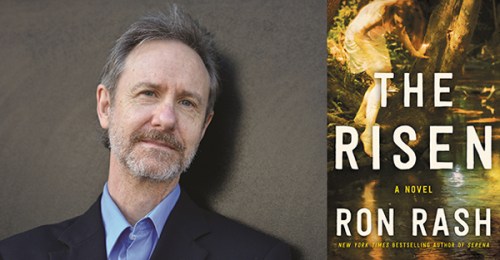
The Risen by Ron RashIn his latest novel, The Risen (Ecco, Sept.), the narrator, Eugene, while fishing with his brother during the summer of 1969, sees a naked teenaged girl with flowing red hair in the creek, the vision of her so fleeting that he wonders if he’s seen a mermaid. Visiting from Florida, Ligeia is no mermaid, but she is an exotic and free-spirited creature who introduces the boys to the excitement of the 60s, experiences they keep secret from their small town, and the watchful eyes of their controlling grandfather.

Ligeia vanishes, as does the close relationship between the brothers as they move into adulthood. When her body surfaces 46 years later, so do the memories of that summer.

The mystery is central to this plot, and like many of Rash’s novels, the story is driven by suspense. But just under the surface, there are difficult questions involving poverty, child neglect sanctioned by religion, and abuse authorized by a self-righteous class system. These are challenging themes, and yet, there is nothing forced in Rash. His prose is clean and without affectation.

Describing fishing: “When a rod tip trembled, one of us got out to reel in what tugged the line. Often it was a knottyhead or catfish, but if a trout we gilled it onto our metal stringer.” And when Eugene’s brother would lift the string of fish from the cooling waters: “Through a gap in the canopy, the declining sun brightened the stringer’s silver sheen, flared the red slashes on the trout’s flanks.”

During our conversation on the eve of Rash’s trip to France for an Eco-Literature convention, where the theme was “Enchantment,” he tells me that “One thing that’s important for me in my work is to remind people that there is a natural world. It’s very easy to think we are not connected to it anymore, but we are, whether we want to be or not.”

His easy reverence is in direct opposition to the rendering of the natural world in TV and film as a creepy, possibly demonic, adversary—or at the very least a place to be wary if you wander too far without an iPhone. “It’s amazing,” Rash says. “When anyone goes out in the woods in a movie, you know something horrible is going to happen.”

While there is danger to irresponsible humans, and the body count can be intense in some of Rash’s more tragic works, often the most profoundly felt loss is that of a formerly protected, or undisturbed natural resource.
Family folklore, passed down from his older relatives, gave Rash the idea that the world is fundamentally enigmatic. “I want the world to be mysterious, I don’t want to know everything,” he says. “One of my great delights is when an animal, that is allegedly extinct, fools people. Jaguars have recently come back into the United States; I love those moments when the natural world surprises us, and reminds us maybe we don’t know as much as we think we do.”

To hear him describe childhood summers on his grandmother’s farm near the Blue Ridge Parkway in N.C., it’s clear why he’s a celebrated voice among the eco-engaged. “I was like Huck Finn,” he says. “My grandmother would let me go, let me wander. It was a gift. I was not afraid. I just reveled in it. The connections I made with the natural world stayed with me.”

Rash is aware that writing about the south brings the possibility, as he has said, of being softly dismissed as “just” a southern writer. Southern writing, he says, “is like any writing. It’s either good or it isn’t. It either transcends the region, or it doesn’t. The best writers from the south transcend the south. Ultimately Faulkner’s goal is not to show how exotic the south is. He has deeper concerns, and certainly Flannery O’Connor did too.”

That doesn’t mean the south is not Rash’s territory. His collection of poems entitled Eureka Mill, based on the mill where his grandparents and parents worked, draws attention to the suffering and loss of humanity that rural southerners felt (and feel) when they leave the farm for the mill. Narratives of southern exploitation are seamlessly woven into the poems, as in “The Stretch-Out,” when a girl of seventeen is exhausted from a brutal day at the mill, and miscarries a child during the night. She explains, “I cried but cried quietly/ and let the bed sheets clot and stain, so that my man and me might save/ what strength a full night’s sleep might give/ I closed my eyes and slept again.”

Constructions like “my man and me,” exhibit Rash’s ear for speech patterns. His stories are known for capturing the voice of a region, but, rendering that voice universally, so that it rings true to any ear, takes a great deal of care and modulation. To Rash, Richard Price is one of the best at translating regional voices onto the page. “In many ways I feel a much deeper connection to him than other writers in the United States,” Rash says. “He’s trying to capture the patois of New York cops and young people in the city, and at the same time, he is working toward the universal. People wouldn’t think that, because of what I write, I would connect with Richard Price, but I feel a real kinship with him.”

As exhibited in Eureka Mill and other collections, his finely honed craftsmanship is most salient in his poetry, which has a casual, addictive appeal. Often compared to Seamus Heaney, the association is especially apt considering the Celtic musical, oral, and folkways ties running deeply through the Appalachians. Palimpsest and layered possession are intrinsic realities for rural North Carolinians. Plowing a field in “The Vanquished” from this year’s Poems: New and Selected turns up “pottery and arrowheads/ bone-shards that spilled across rows/ like kindling, a once-presence/ keen as the light of dead stars.”

By situating himself as the faithful observer of the natural world, Rash makes land, and landscape, available to readers. His dramatizations aren’t driven by sentimentality, but rather complex dilemmas usually centered on a question of land exploitation, or the exploitation of former land-workers, like those stuck in North Carolina’s Eureka Mill, fleeced of their land and sense of purpose. With his latest novel, Rash again creates an irresistible conceit that transcends the South. But, of course, the importance of the South is undeniable.

Source: http://www.publishersweekly.com/pw/by-topic/authors/profiles/article/71271-not-just-a-southern-writer-ron-rash.html

Leave a comment

Filed under 2016, author

PhD to Hollywood sleaze

PhD thriller writer who loves true crime and sleazy Hollywood books

by Amy Sutherland

Source: https://www.bostonglobe.com/arts/books/2016/08/18/phd-thriller-writer-who-loves-true-crime-and-sleazy-hollywood-books/gZH59ZltjppHaJohnXtUDL/story.html

Megan Abbott

Megan Abbott

Megan Abbott’s new thriller “You Will Know Me,” gives an alternate, and far darker, view of the world of gymnastics than what you could catch on TV during the Summer Olympics. This is Abbott’s eighth novel. She lives in New York City.

BOOKS: What are you reading currently?

ABBOTT: I just finished Jeffrey Toobin’s Patty Hearst book, “American Heiress,” which was really compelling. I had read her memoir years ago, which I loved. Joan Didion also has a famous essay on her, which I read in college, when I read everything Didion wrote.

BOOKS: Any other famous people you are drawn to in your reading?

ABBOTT: Anything with outlaws. There was a great biography of Bonnie and Clyde by Jeff Guinn, “Go Down Together.” He did one on Charles Manson recently, which was terrifying but really good. I also read a lot of entertainment biographies. I just read the third volume in Simon Callow’s biography of Orson Welles, which covered the ’50s and ’60s.

BOOKS: What other kinds of books do you read?

ABBOTT: I read a lot of crime fiction except when I’m in the latter stages of writing a book. Then I’ll read general fiction or literary fiction. I also read history, but it has to be character driven. I won’t read a Civil War book, but I maybe would read one about Ulysses S. Grant. I also like sleazy books about Hollywood. I love Kenneth Anger’s “Hollywood Babylon.” I don’t care whether it’s true or not.

BOOKS: What were you reading while you were writing your new book?

ABBOTT: I think I was reading Kate Atkinson’s “A God in Ruins.” She’s a big inspiration to me. I was also reading novels about prodigies and remember reading Lionel Shriver’s “We Need to Talk About Kevin.”

BOOKS: What is your favorite kind of true crime?

ABBOTT: In recent years there has been really great reported crime, such as “Lost Girls” by Robert Kolker. I read it twice, which I almost never do with true crime. “People Who Eat Darkness” by Richard Lloyd Parry is a very scary book. Those books also speak to larger issues in society. But I also like ripped-from-the-headlines true crime.

BOOKS: When did you start reading crime fiction?

ABBOTT: I wrote my dissertation on it. Before that I read some mysteries and James Ellroy. During graduate school I read the usual 20th-century authors, but when it came to my dissertation I wanted something that wasn’t a common subject. I started to read 1930s and 1940s crime fiction, Raymond Chandler and Dashiell Hammett. Now there’s no escaping.

BOOKS: Do you have pet peeves about crime writing?

‘Lately, I’ve been very intrigued by more gothic crime. We are having a resurgence of that.’

ABBOTT: I don’t like it when there are too many twists in the end. I also don’t generally like it when people from literary fiction write a crime novel and clearly have never read one. Martin Amis has a great one, “Night Train.” You could tell he loves the genre.

BOOKS: How would you characterize the crime fiction you like best?

ABBOTT: Lately, I’ve been very intrigued by more gothic crime. We are having a resurgence of that with Gillian Flynn’s “Gone Girl” and Paula Hawkins’s “The Girl on the Train,’’ these books about violence in the home, in the family. I also love procedurals because I can’t do them, like Ace Atkins’s books.

BOOKS: What film adaptations of crime novels do you think have worked?

ABBOTT: I really liked “Gone Girl.” A lot of the Patricia Highsmith adaptations have been excellent, and the Elmore Leonard ones are wonderful. A bad example, though I love the book and the director, would be Brian De Palma’s film of “The Black Dahlia,” which has the wrong mix of energy.

BOOKS: What was the hardest book for you in grad school?

ABBOTT: I didn’t enjoy reading “Middlemarch,” which everyone says is the greatest book. I didn’t finish it, which was shameful. I did read Eliot’s shorter one, “The Mill on the Floss,’’ which I liked. I also finished “Moby-Dick” but I had a crush on the professor. That definitely helped.

Leave a comment

Filed under 2016, author

Author turned bookseller

‘People are hungry for real bookstores’: Judy Blume on why US indie booksellers are thriving

At 78, the multimillion-selling author has begun a new career, opening her own bookshop – and joining a business sector that’s flourishing again in the US

By Alison Flood

Source: https://www.theguardian.com/books/2016/may/20/people-are-hungry-for-real-bookstores-judy-blume-on-why-us-indie-booksellers-are-thriving

She might be a beloved and bestselling author of classic children’s books from Forever to Blubber, but Judy Blume says she wakes up every day “and I look to the sky, and I say, ‘whoever’s up there, I thank you for not having to write today’.”

Blume doesn’t have to write because, at 78, she has embarked on a new career: she’s an independent bookseller. Together with her husband, George Cooper, she has opened a small, nonprofit bookshop in Key West, Florida, where she’s working almost every day. And she’s loving it. She had planned “to take a gap year” after she finished writing and promoting her last novel, In the Unlikely Event. “I was going to relax and read and have this whole time with no pressure. And then bingo – the chance comes along to open a bookshop, and there you go. I guess I like that in my life … To learn something new like this, at 78, makes it all the more exciting.”

Judy Blume (left), author turned bookseller.

Judy Blume (left), author turned bookseller.

Blume and Cooper had been urging Mitchell Kaplan, founder of independent book chain Books & Books, to open a bookshop in Key West for years. He told them that if they could find a space, he would partner with them. They found a corner store, part of a large deco building, and with help from Kaplan and his team, Books & Books @ the Studios of Key West opened in February.

“We’ve done better than anyone, including Mitch, thought we could do,” says Blume, down the line from Florida. “It has been a very satisfying experience … Writing In the Unlikely Event took five years – it was very long and difficult and complicated. This is just a great change for me, and I am enjoying it so much.”

Customers, she says, “sometimes” recognise her – an author who has sold more than 80m books around the world – “and they’re completely taken aback, especially if I’m sitting there dusting the shelves. I’m pretty good at recommendations – I’m good in the kids’ department for sure. I read all the picture books when they come in. And I can lead people to what they want, although I’ve not read as many of our books as some of our volunteers [the store has two paid employees, as well as Cooper, Blume and a series of volunteers]. I’m trying really hard to keep up. It’s like Christmas every day, working here.”

Business for independent bookstores in America in general, is “going well”, Blume believes. “I just think people are so hungry for a real bookstore again. So many people live in places where there isn’t one … It’s not just us doing well. A lot of independent booksellers are.”

The figures back her up. At BookExpo America last week, the American Booksellers Association announced that for the seventh year in a row, its bookstore membership has gone up, to 1,775 members operating in 2,311 locations, up from 1,401 members operating in 1,651 locations in 2009. The lion’s share of these are independents, says the ABA: in 2015, sales for independent booksellers were up just over 10%, and are remaining strong in 2016. In the UK by contrast, the Booksellers Association recorded 894 independent bookshops in 2015, a decrease of 3% from 2014. A decade ago, there were more than 1,500.

“Independent bookselling in the US is continuing not just to grow, but to thrive,” says ABA chief executive Oren Teicher, who attributes the growth to various factors: the localism movement, “which is exploding, and we are benefiting from that”; booksellers “getting smarter at using technology”; publishers’ increasing acknowledgment that “customers discover books in bricks and mortar locations [so] our colleagues in publishing have figured out that they need bricks and mortar stores as much as we need their books”; and the growing role of the bookseller as curator, in a world flooded with new titles.

The “resurgence of print” has also helped, says Teicher. A recent report in the UK revealed that in 2015, sales of printed books were up by 0.4% to £2.76bn, while ebook sales fell for the first time in the seven years the Publishers Association has tracked them, down 1.6% to £554m in 2015. In the US, the Association of American Publishers reported last month that while overall sales for consumer books were up 0.8% to $7.2bn (£4.9bn) in 2015, ebook sales declined, down 9.5% in adult books and 43.3% in children and young adult titles.

“Five years ago in the American book business, there was a widespread panic that somehow digital reading was going to replace physical books and they would be a relic of some other time and place. Fast forward to today, and I think digital reading has levelled off and calmed down slightly. It’s going to be a piece of our business, but print books aren’t going away. We’re living in a hybrid world,” says Teicher.

Added together, these ingredients make “the recipe for our success”, says Teicher. “But there is still a very modest margin in books, and people have to work really hard. We have significant challenges before us, clouds on the horizon that could interfere with our success.”

These range from pressure on wages and rents, he says, to the “1,000lb gorilla” – the continued growth of online shopping. “But independents are extraordinarily resilient,” he says. “If I had a penny for every time we’ve been counted out, I’d be a pretty rich guy today.”

Leave a comment

Filed under 2016, author, bookstore