
Literary detective Heather Wolfe reveals how her passion for manuscripts helped unravel mystery of who the bard really was
By Robert McCrum
Deep in the Folger Library, in Washington DC, Heather Wolfe says that studying Shakespeare makes an ideal preparation for the onset of Trump’s America. You can see her point: Shakespeare would have revelled in the mad excesses, the sinister vanities and the pervasive stench of cronyism and corruption surrounding the president-elect as America makes the painful transition from Barack Obama.
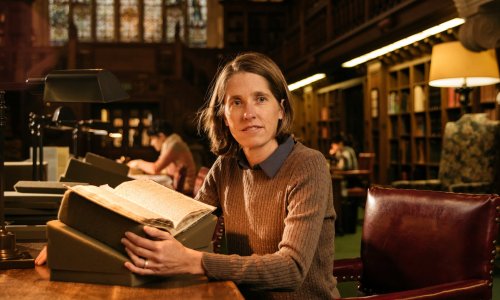
Dr Wolfe is a willowy, bright-eyed manuscript scholar, a paleographer specialising in Elizabethan England who in certain moods of candour might put you in mind of Portia or perhaps Cordelia. She’s also a Shakespeare detective who, last year, made the career-defining discovery that is going to transform our understanding of Shakespeare’s biography. In the simplest terms, Wolfe delivered the coup de grace to the wild-eyed army of conspiracy theorists, including Vanessa Redgrave and Derek Jacobi, who contest the authenticity, even the existence, of the playwright known to contemporaries as Master Will Shakespeare.
Wolfe is an accidental sleuth. Her scholar’s passion is as much for old manuscripts as for the obscurities surrounding our national poet. Project Dustbunny, for example, one of her initiatives at the Folger Shakespeare Library, has made some extraordinary discoveries based on microscopic fragments of hair and skin accumulated in the crevices and gutters of 17th-century books.
DNA forensics aside, Wolfe’s role as a curator at the Folger is to bring her expertise to bear on the tantalising mass of documents that survives from the late 16th century. And yet, despite a heap of legal, commercial and matrimonial evidence, Shakespeare the man continues to slip through scholars’ fingers. Four centuries after his death, apart from a handful of crabbed signatures, there is not one manuscript, letter or diary we can definitively attribute to the poet, sponsoring the pervasive air of mystery that surrounds his genius. Indeed, the most intimate surviving Shakespeare document remains that notorious will, in which he bequeathed his wife his “second best bed”.
Before Wolfe arrived on the scene, all that scholars could be certain about was that a man named Shaxpere, Shaxberd or Shakespear was born in Stratford in 1564, and that he was an actor whose name is printed in the collected edition of his work published in 1623. We also know that he married Anne Hathaway, and died in 1616, according to legend, on his birthday, St George’s Day. The so-called “Stratfordian” case for Shakespeare rested on these, and a few other facts, but basically, that was it.
Into this vacuum, a bizarre fraternity, including Mark Twain, Charlie Chaplin and Sigmund Freud, have projected a “Shakespeare” written by a more obviously accomplished writer: Edward de Vere (the 17th earl of Oxford), Sir Francis Bacon and the playwright Christopher Marlowe, to name the leading contenders in a field that includes Sir Walter Raleigh, and even Elizabeth, the Virgin Queen herself.
In the absence of reliable data, a mountain of speculation has morphed into the weirdest fantasy, notably the 2011 film, Anonymous. Wolfe has no time for this. Speaking exclusively for the first time to the Observer, she says: “Without the evidence for other contenders, it’s hard for me to engage with this line of inquiry.”
Wolfe’s appetite for manuscript corroboration has led her into many dusty corners of the Elizabethan archives. It was this research instinct that first led her to reopen the file on the coat of arms granted to Shakespeare’s father, the small-town glover, in 1596.
John Shakespeare, from Stratford-upon-Avon, was ambitious to rise in the world. He was certainly not the first Englishman keen to put his origins as a provincial tradesman behind him. Among his contemporaries in Stratford, he was a figure of fun for his social climbing. English class snobbery has a long pedigree. His son, who would continue the quest for official recognition after his father’s death, also attracted metropolitan disdain as “an upstart crow beautified with our feathers”. In 1601, after his father’s death, Shakespeare the upstart returned to the college of arms to renew the family application for a coat of arms. He had made a small fortune in the theatre, and was buying property in and around Stratford. Now he set out to consolidate his reputation as a “Gentleman”. Under the rules that governed life at the court of Elizabeth I, only the Queen’s heralds could grant this wish.
A much-reproduced sketch for a coat of arms crystallised Shakespeare’s hopes for legitimacy in the antique jargon of heraldry: “Gould, on a Bend Sables, a Speare of the first steeled argent. And for his Crest, a falcon, his winges displayed Argent, supporting a Speare Gould …” The needy applicant also attached a motto: Non Sanz Droit (“Not Without Right”). All this, and much more, is buried in the archives of the college of arms in London.
Wolfe’s fascination with Shakespeare’s quest for a family crest grew out of her immersion in the manners and customs of late Elizabethan England, in particular the College of Heralds. These court officials were required to administer the complex rituals governing the lives of the knights, barons and earls surrounding Queen Elizabeth.
An adjunct to the court, the College of Heralds was not exempt from its own secret feuds. In 1602, the internecine rivalry between Sir William Dethick, the Garter King of Arms, and another herald, Ralph Brooke, burst into the open when Brooke released a list of 23 “mean persons” whose applications for crests (he claimed) had been wrongfully preferred by Dethick. When “Shakespeare the Player” found himself on this list, his campaign for social advancement seemed in jeopardy. A bitter row broke out at court between two factions. Shakespeare himself became an object of ridicule. Another rival, Ben Jonson, in his satire Every Man out of his Humour, poked fun at him as a rustic buffoon who pays £30 for a ridiculous coat of arms with the humiliating motto “Not Without Mustard”.
It’s at this point in the story that Wolfe discovered “the smoking gun”. In the Brooke-Dethick feud, it becomes clear that “Shakespeare, Gent. from Stratford” and “Shakespeare the Player” are the same man. In other words, “the man from Stratford” is indeed the playwright. Crucially, in the long-running “authorship” debate, this has been a fiercely contested point. But Wolfe’s research nails any lingering ambiguity in which the Shakespeare deniers can take refuge.
Wolfe is circumspect about making extravagant claims. Speaking carefully, she says that her manuscript discoveries fill in gaps, illuminating Shakespeare’s character. “They point to someone actively involved in defining and defending his legacy in 1602, shortly after his father’s death.”
For Wolfe, it’s Shakespeare the man who breaks cover here. “He’s defending his legacy not only as a playwright but, most importantly to him, as a gentleman.” The derogatory references to arms belonging to “Shakespeare ye player”, she says, show that “he’s playing the same game as everyone else in the period, purchasing land in Stratford to support his case to ‘ancient’ gentility, rather than through his astonishing professional success”.
James Shapiro, bestselling author of 1599, who is persuaded by Wolfe’s discoveries, compares her to “a Sherlock Holmes of the archives”. Shapiro says that Wolfe “has had the intellectual independence to see what others have overlooked, the skills to make sense of what she has stumbled upon and the modesty not to trumpet the larger implications of those finds. But make no mistake: they are enormously consequential.”
For Shapiro, Wolfe’s work suggests future breakthroughs. “I doubt that these are the last archival treasures she will unearth. Her recent finds sharpen our sense of Shakespeare’s dogged pursuit of upward mobility. And it is one more nail in the coffin of those who can’t bring themselves to acknowledge that the glover’s son from Stratford was also the successful man of the theatre who left us so many extraordinary plays.”
Wolfe says she looks forward to “poking about” in the archives, and is convinced that Shakespeare’s identity no longer needs re-confirmation. “There is such a wealth of evidence out there that he’s the playwright.” She adds: “I’m sure there’s more untapped material waiting to be uncovered. Additional finds will certainly help us understand his life – as much as we can understand anyone’s life from 400 years ago.”


 Booker's Blog