Category Archives: author tribute

The Four Desires Driving All Human Behavior

Bertrand Russell’s magnificent Nobel prize acceptance speech.

Brain Pickings |

Maria Popova

https://getpocket.com/explore/item/the-four-desires-driving-all-human-behavior-bertrand-russell-s-magnificent-nobel-prize-acceptance?utm_source=pocket-newtab

Bertrand Russell (May 18, 1872–February 2, 1970) endures as one of humanity’s most lucid and luminous minds — an oracle of timeless wisdom on everything from what “the good life” really means to why “fruitful monotony” is essential for happiness to love, sex, and our moral superstitions. In 1950, he was awarded the Nobel Prize in Literature for “his varied and significant writings in which he champions humanitarian ideals and freedom of thought.” On December 11 of that year, 78-year-old Russell took the podium in Stockholm to receive the grand accolade.

Later included in Nobel Writers on Writing (public library) — which also gave us Pearl S. Buck, the youngest woman to receive the Nobel Prize in Literature, on art, writing, and the nature of creativity — his acceptance speech is one of the finest packets of human thought ever delivered from a stage.

Russell begins by considering the central motive driving human behavior:

All human activity is prompted by desire. There is a wholly fallacious theory advanced by some earnest moralists to the effect that it is possible to resist desire in the interests of duty and moral principle. I say this is fallacious, not because no man ever acts from a sense of duty, but because duty has no hold on him unless he desires to be dutiful. If you wish to know what men will do, you must know not only, or principally, their material circumstances, but rather the whole system of their desires with their relative strengths.

[…]

Man differs from other animals in one very important respect, and that is that he has some desires which are, so to speak, infinite, which can never be fully gratified, and which would keep him restless even in Paradise. The boa constrictor, when he has had an adequate meal, goes to sleep, and does not wake until he needs another meal. Human beings, for the most part, are not like this.

Russell points to four such infinite desires — acquisitiveness, rivalry, vanity, and love of power — and examines them in order:

Acquisitiveness — the wish to possess as much as possible of goods, or the title to goods — is a motive which, I suppose, has its origin in a combination of fear with the desire for necessaries. I once befriended two little girls from Estonia, who had narrowly escaped death from starvation in a famine. They lived in my family, and of course had plenty to eat. But they spent all their leisure visiting neighbouring farms and stealing potatoes, which they hoarded. Rockefeller, who in his infancy had experienced great poverty, spent his adult life in a similar manner.

[…]

However much you may acquire, you will always wish to acquire more; satiety is a dream which will always elude you.

In 1938, Henry Miller also articulated this fundamental driver in his brilliant meditation on how money became a human fixation. Decades later, modern psychologists would term this notion “the hedonic treadmill.” But for Russell, this elemental driver is eclipsed by an even stronger one — our propensity for rivalry:

The world would be a happier place than it is if acquisitiveness were always stronger than rivalry. But in fact, a great many men will cheerfully face impoverishment if they can thereby secure complete ruin for their rivals. Hence the present level of taxation.

Rivalry, he argues, is in turn upstaged by human narcissism. In a sentiment doubly poignant in the context of today’s social media, he observes:

Vanity is a motive of immense potency. Anyone who has much to do with children knows how they are constantly performing some antic, and saying “Look at me.” “Look at me” is one of the most fundamental desires of the human heart. It can take innumerable forms, from buffoonery to the pursuit of posthumous fame.

[…]

It is scarcely possible to exaggerate the influence of vanity throughout the range of human life, from the child of three to the potentate at whose frown the world trembles.

But the most potent of the four impulses, Russell argues, is the love of power:

Love of power is closely akin to vanity, but it is not by any means the same thing. What vanity needs for its satisfaction is glory, and it is easy to have glory without power… Many people prefer glory to power, but on the whole these people have less effect upon the course of events than those who prefer power to glory… Power, like vanity, is insatiable. Nothing short of omnipotence could satisfy it completely. And as it is especially the vice of energetic men, the causal efficacy of love of power is out of all proportion to its frequency. It is, indeed, by far the strongest motive in the lives of important men.

[…]

Love of power is greatly increased by the experience of power, and this applies to petty power as well as to that of potentates.

Anyone who has ever agonized in the hands of a petty bureaucrat — something Hannah Arendt unforgettably censured as a special kind of violence — can attest to the veracity of this sentiment. Russell adds:

In any autocratic regime, the holders of power become increasingly tyrannical with experience of the delights that power can afford. Since power over human beings is shown in making them do what they would rather not do, the man who is actuated by love of power is more apt to inflict pain than to permit pleasure.

But Russell, a thinker of exceptional sensitivity to nuance and to the dualities of which life is woven, cautions against dismissing the love of power as a wholesale negative driver — from the impulse to dominate the unknown, he points out, spring such desirables as the pursuit of knowledge and all scientific progress. He considers its fruitful manifestations:

It would be a complete mistake to decry love of power altogether as a motive. Whether you will be led by this motive to actions which are useful, or to actions which are pernicious, depends upon the social system, and upon your capacities. If your capacities are theoretical or technical, you will contribute to knowledge or technique, and, as a rule, your activity will be useful. If you are a politician you may be actuated by love of power, but as a rule this motive will join itself on to the desire to see some state of affairs realized which, for some reason, you prefer to the status quo.

Russell then turns to a set of secondary motives. Echoing his enduring ideas on the interplay of boredom and excitement in human life, he begins with the notion of love of excitement:

Human beings show their superiority to the brutes by their capacity for boredom, though I have sometimes thought, in examining the apes at the zoo, that they, perhaps, have the rudiments of this tiresome emotion. However that may be, experience shows that escape from boredom is one of the really powerful desires of almost all human beings.

He argues that this intoxicating love of excitement is only amplified by the sedentary nature of modern life, which has fractured the natural bond between body and mind. A century after Thoreau made his exquisite case against the sedentary lifestyle, Russell writes:

Our mental make-up is suited to a life of very severe physical labor. I used, when I was younger, to take my holidays walking. I would cover twenty-five miles a day, and when the evening came I had no need of anything to keep me from boredom, since the delight of sitting amply sufficed. But modern life cannot be conducted on these physically strenuous principles. A great deal of work is sedentary, and most manual work exercises only a few specialized muscles. When crowds assemble in Trafalgar Square to cheer to the echo an announcement that the government has decided to have them killed, they would not do so if they had all walked twenty-five miles that day. This cure for bellicosity is, however, impracticable, and if the human race is to survive — a thing which is, perhaps, undesirable — other means must be found for securing an innocent outlet for the unused physical energy that produces love of excitement… I have never heard of a war that proceeded from dance halls.

[…]

Civilized life has grown altogether too tame, and, if it is to be stable, it must provide harmless outlets for the impulses which our remote ancestors satisfied in hunting… I think every big town should contain artificial waterfalls that people could descend in very fragile canoes, and they should contain bathing pools full of mechanical sharks. Any person found advocating a preventive war should be condemned to two hours a day with these ingenious monsters. More seriously, pains should be taken to provide constructive outlets for the love of excitement. Nothing in the world is more exciting than a moment of sudden discovery or invention, and many more people are capable of experiencing such moments than is sometimes thought.

Complement Nobel Writers on Writing with more excellent Nobel Prize acceptance speeches — William Faulkner on the artist as a booster of the human heart, Ernest Hemingway on writing and solitude, Alice Munro on the secret to telling a great story, and Saul Bellow on how literature ennobles the human spirit — then revisit Russell on immortality and why science is the key to democracy.
Leave a comment

Filed under 2020, author tribute

The Unlikely Success of ‘One Hundred Years of Solitude’ – The Atlantic

When Gabriel García Márquez’s most famous novel was published 50 years ago, it faced a difficult publishing climate and baffled reviews.

Source: The Unlikely Success of ‘One Hundred Years of Solitude’ – The Atlantic

In 1967, Sudamericana Press published One Hundred Years of Solitude (Cien años de soledad), a novel written by a little known Colombian author named Gabriel García Márquez. Neither the writer nor the publisher expected much of the book. They knew, as the publishing giant Alfred A. Knopf once put it, that “many a novel is dead the day it is published.” Unexpectedly, One Hundred Years of Solitude went on to sell over 45 million copies, solidified its stature as a literary classic, and garnered García Márquez fame and acclaim as one of the greatest Spanish-language writers in history.

Fifty years after the book’s publication, it may be tempting to believe its success was as inevitable as the fate of the Buendía family at the story’s center. Over the course of a century, their town of Macondo was the scene of natural catastrophes, civil wars, and magical events; it was ultimately destroyed after the last Buendía was born with a pig’s tail, as prophesied by a manuscript that generations of Buendías tried to decipher. But in the 1960s, One Hundred Years of Solitude was not immediately recognized as the Bible of the style now known as magical realism, which presents fantastic events as mundane situations. Nor did critics agree that the story was really groundbreaking. To fully appreciate the novel’s longevity, artistry, and global resonance, it is essential to examine the unlikely confluence of factors that helped it overcome a difficult publishing climate and the author’s relative anonymity at the time.

* * *

In 1965, the Argentine Sudamericana Press was a leading publisher of contemporary Latin American literature. Its acquisitions editor, in search of new talent, cold-called García Márquez to publish some of his work. The writer replied with enthusiasm that he was working on One Hundred Years of Solitude, “a very long and very complex novel in which I have placed my best illusions.” Two and a half months before the novel’s release in 1967, García Márquez’s enthusiasm turned into fear. After mistaking an episode of nervous arrhythmia for a heart attack, he confessed in a letter to a friend, “I am very scared.” What troubled him was the fate of his novel; he knew it could die upon its release. His fear was based on a harsh reality of the publishing industry for rising authors: poor sales. García Márquez’s previous four books had sold fewer than 2,500 copies in total.

The best that could happen to One Hundred Years of Solitude was to follow a path similar to the books released in the 1960s as part of the literary movement known as la nueva novela latinoamericana. Success as a new Latin American novel would mean selling its modest first edition of 8,000 copies in a region with 250 million people. Good regional sales would attract a mainstream publisher in Spain that would then import and publish the novel. International recognition would follow with translations into English, French, German, and Italian. To hit the jackpot in 1967 was to also receive one of the coveted literary awards of the Spanish language: the Biblioteca Breve, Rómulo Gallegos, Casa de las Américas, and Formentor.

This was the path taken by new Latin American novels of the 1960s such as Explosion in a Cathedral by Alejo Carpentier, The Time of the Hero by Mario Vargas Llosa, Hopscotch by Julio Cortázar, and The Death of Artemio Cruz by Carlos Fuentes. One Hundred Years of Solitude, of course, eclipsed these works on multiple fronts. Published in 44 languages, it remains the most translated literary work in Spanish after Don Quixote, and a survey among international writers ranks it as the novel that has most shaped world literature over the past three decades.

And yet it would be wrong to credit One Hundred Years of Solitude with starting a literary revolution in Latin America and beyond. Sudamericana published it when the new Latin American novel, by then popularly called the boom latinoamericano, had reached its peak in worldwide sales and influence. From 1961 onward, like a revived Homer, the almost blind Argentine writer Jorge Luis Borges toured the planet as a literary celebrity. Following in his footsteps were rising stars like José Donoso, Cortázar, Vargas Llosa, and Fuentes. The international triumph of the Latin American Boom came when the Nobel Prize in Literature was awarded to Miguel Ángel Asturias in 1967. One Hundred Years of Solitude could not have been published in a better year for the new Latin American novel. Until then, García Márquez and his work were practically invisible.

* * *

In the decades before it reached its zenith, the new Latin American novel vied for attention alongside other literary trends in the region, Spain, and internationally. Its primary competition in Latin America was indigenismo, which wanted to give voice to indigenous peoples and was supported by many writers from the 1920s onward, including a young Asturias and José María Arguedas, who wrote in Spanish and Quechua, a native language of the Andes.

In Spain during the 1950s and 1960s, writers embraced social realism, a style characterized by terse stories of tragic characters at the mercy of dire social conditions. Camilo José Cela and Miguel Delibes were among its key proponents. Latin Americans wanting a literary career in Spain had to comply with this style, one example being a young Vargas Llosa living in Madrid, where he first wrote social-realist short stories.

Internationally, Latin American writers saw themselves competing with the French nouveau roman or “new novel.” Supporters, including Jean-Paul Sartre, praised it as the “anti-novel.” For them, the goal of literature was not narrative storytelling, but to serve as a laboratory for stylistic experiments. The most astonishing of such experiments was George Perec’s 1969 novel A Void, written without ever using the letter “e,” the most common in the French language.

In 1967, the book market was finally ready, it seemed, for One Hundred Years of Solitude. By then, mainstream Latin American writers had grown tired of indigenismo, a style used by “provincials of folk obedience,” as Cortázar scoffed. A young generation of authors in Spain belittled the stories in social-realist novels as predictable and technically unoriginal. And in France, emerging writers (such as Michel Tournier in his 1967 novel Vendredi) called for a return to narrative storytelling as the appeal of the noveau roman waned.

Between 1967 and 1969, reviewers argued that One Hundred Years of Solitude overcame the limitations of these styles. Contrary to the localism of indigenismo, reviewers saw One Hundred Years of Solitude as a cosmopolitan story, one that “could correct the path of the modern novel,” according to the Latin American literary critic Ángel Rama. Unlike the succinct language of social realism, the prose of García Márquez was an “atmospheric purifier,” full of poetic and flamboyant language, as the Spanish writer Luis Izquierdo argued. And contrary to the formal experiments of the nouveau roman, his novel returned to “the narrative of imagination,” as the Catalan poet Pere Gimferrer explained. Upon the book’s translation to major languages, international reviewers acknowledged this, too. The Italian writer Natalia Ginzburg forcefully called One Hundred Years of Solitude “an alive novel,” assuaging contemporary fears that the form was in crisis.

And yet these and other reviewers also remarked that One Hundred Years of Solitude was not a revolutionary work, but an anachronistic and traditionalist one, whose opening sentence resembled the “Once upon a time” formula of folk tales. And rather than a serious novel, it was a “comic masterpiece,” as an anonymous Times Literary Supplement reviewer wrote in 1967. Early views on this novel were indeed different from the ones that followed. In 1989, Yale literary scholar Harold Bloom solemnly called it “the new Don Quixote” and the writer Francine Prose confessed in 2013 that “One Hundred Years of Solitude convinced me to drop out of Harvard graduate school.”

Nowadays scholars, critics, and general readers mainly praise the novel as “the best expression of magical realism.” By 1995, magical realism was seen as making its way into the works of major English-language authors such John Updike and Salman Rushdie and moreover presented as “an inextricable, ineluctable element of human existence,” according to the New York Times literary critic Michiko Kakutani. But in 1967, the term magical realism was uncommon, even in scholarly circles. During One Hundred Years of Solitude’s first decade or so, to make sense of this “unclassifiable work,” as a reviewer put it, readers opted for labeling it as a mixture of “fantasy and reality,” “a realist novel full of imagination,” “a curious case of mythical realism,” “suprarrealism,”or, as a critic for Le Monde called it, “the marvelous symbolic.”

Now seen as a story that speaks to readers around the world, One Hundred Years of Solitude was originally received as a story about Latin America. The Harvard scholar Robert Kiely called it “a South American Genesis” in his review for the New York Times. Over the years, the novel grew to have “a texture of its own,” to use Updike’s words, and it became less a story about Latin America and more about mankind at large. William Kennedy wrote for the National Observer that it is “the first piece of literature since the Book of Genesis that should be required reading for the entire human race.” (Kennedy also interviewed García Márquez for a feature story, “The Yellow Trolley Car in Barcelona, and Other Visions,” published in The Atlantic in 1973.)

Perhaps even more surprisingly, respected writers and publishers were among the many and powerful detractors of this novel. Asturias declared that the text of One Hundred Years of Solitude plagiarized Balzac’s 1834 novel The Quest of the Absolute. The Mexican poet and Nobel recipient, Octavio Paz, called it “watery poetry.” The English writer Anthony Burgess claimed it could not be “compared with the genuinely literary explorations of Borges and [Vladimir] Nabokov.” Spain’s most influential literary publisher in the 1960s, Carlos Barral, not only refused to import the novel for publication, but he also later wrote “it was not the best novel of its time.” Indeed, entrenched criticism helps to make a literary work like One Hundred Years of Solitude more visible to new generations of readers and eventually contributes to its consecration.

With the help of its detractors, too, 50 years later the novel has fully entered popular culture. It continues to be read around the world, by celebrities such as Oprah Winfrey and Shakira, and by politicians such as Presidents Bill Clinton and Barack Obama, who called the book “one of my favorites from the time I was young.”

More recently, with the aid of ecologically minded readers and scholars, One Hundred Years of Solitude has unexpectedly gained renewed significance as awareness of climate change increases. After the explosion of the BP drilling rig Deepwater Horizon in 2010 in the Gulf of Mexico (one of the worst accidental environmental catastrophes in history), an environmental-policy advocate referred to the blowout as “tragic realism” and a U.S. journalist called it the “pig’s tail of the Petro-World.” What was the connection with One Hundred Years of Solitude? The explosion occurred at an oil and gas prospect named Macondo by a group of BP engineers two years earlier, so when Deepwater Horizon blew up, reality caught up with fiction. Some readers and scholars started to claim the spill revealed a prophecy similar to the one hidden in the Buendías manuscript:  a warning about the dangers of humans’ destruction of nature.

García Márquez lived to see the name of Macondo become part of a significant, if horrifying, part of earth’s geological history, but not to celebrate the 50th anniversary of his masterpiece: He passed away in 2014. But the anniversary of his best known novel will be celebrated globally. As part of the commemoration, the Harry Ransom Center in Austin, Texas, where García Márquez’s archives have been kept since 2015, has opened an online exhibit of unique materials. Among the contents will be the original typescript of the “very long and very complex novel” that did not die but attained immortality the day it was published.

We want to hear what you think about this article. Submit a letter to the editor or write to letters@theatlantic.com.

Alvaro Santana-Acuña is an assistant professor of sociology at Whitman College. He is the author of the forthcoming book Ascent to Glory: The Transformation of One Hundred Years of Solitude Into a Global Classic.

Leave a comment

Filed under 2020, author, author tribute

John le Carré wins $100,000 prize for ‘contribution to democracy’ | Books | The Guardian

Alison Flood and Sian CainFri 10 Jan 2020 00.45 EST

Source: John le Carré wins $100,000 prize for ‘contribution to democracy’ | Books | The Guardian

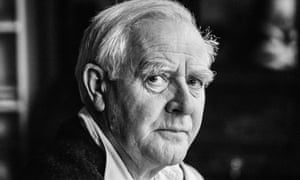
John le Carré has been named the latest recipient of the $100,000 (£76,000) Olof Palme prize, an award given for an “outstanding achievement” in the spirit of the assassinated Swedish prime minister.

Won in the past by names including whistleblower Daniel Ellsberg, who exposed the US government’s secret intelligence about the Vietnam war in 1971, the Olof Palme prize is intended to reward “an outstanding achievement in any of the areas of anti-racism, human rights, international understanding, peace and common security”.

Announcing Le Carré’s win early on Friday morning, the prize organisers praised the 88-year-old author, whose real name is David Cornwell, “for his engaging and humanistic opinion-making in literary form regarding the freedom of the individual and the fundamental issues of mankind.

“Attracting worldwide attention, he is constantly urging us to discuss the cynical power games of the major powers, the greed of global corporations, the irresponsible play of corrupt politicians with our health and welfare, the growing spread of international crime, the tension in the Middle East and the alarming rise of fascism and xenophobia in Europe and the US,” the organisers said, calling his career “an extraordinary contribution to the necessary fight for freedom, democracy and social justice”.

Le Carré said he would donate the winnings to the international humanitarian NGO Médecins Sans Frontières.

Le Carré, the acclaimed author of some of the last century’s most enduring works, from Tinker, Tailor, Soldier, Spy to The Spy Who Came in from the Cold, has been consistently outspoken about abuses of power in his fiction, his targets including governments, big pharma and arms dealing. Agent Running in the Field, his most recent book – which he has hinted will be his last – depicts collusion between Donald Trump’s US and the British security services with the aim of undermining the European Union.

The author has long steered clear of honours. In 2011, when he was nominated for the Man Booker International prize, he asked for his name to be withdrawn, saying that while he was “enormously flattered”, he did not compete for literary prizes.

Few authors have won the Olof Palme prize, named for the Social Democrat who led his country for 11 years and was mysteriously gunned down in a Stockholm street in 1986 after leaving the cinema. Playwright and political dissident Václav Havel won in 1989, soon before becoming president of Czechoslovakia, Danish novelist Carsten Jensen won in 2009 and the Italian journalist and author of Gomorrah Roberto Saviano won in 2011.

Le Carré will receive his award at a ceremony in Stockholm on 30 January.

Leave a comment

Filed under 2020, author, author tribute, awards

How to Celebrate Walt Whitman’s Two-Hundredth Birthday – New Yorker

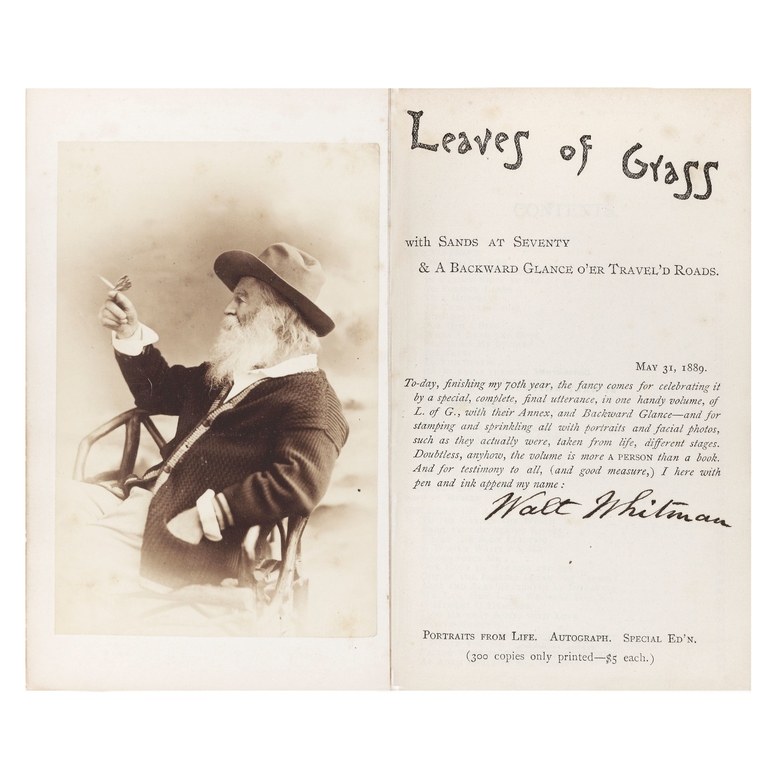
Walt Whitman, Leaves of Grass
Signed copy of “Leaves of Grass” by Walt Whitman, 1889. Known as “the birthday edition”

Loaf at your ease, luxuriating in the poet’s unhurried, insinuated cadences.

Source: How to Celebrate Walt Whitman’s Two-Hundredth Birthday | The New Yorker

This year we celebrate the two-hundredth birthday of Walt Whitman; and by “we” I mean all of us who take conscious pleasure in speaking American English. Whitman invented a poetry specific to this language and open to the kinds of experience, peculiar to democracy in a polyethnic society on a vast continent, that might otherwise be mute. Public events commemorating the bicentennial include three summer shows in New York—at the Morgan Library, the New York Public Library, and the Grolier Club—that touch on the story of his life. There are books, manuscripts, prints, photographs, audio and video elements, and relics—at the Public Library, a lock of his hair, and, at the Grolier, snips that may be from his beard. The shows are excellent of their kind: informational and evocative, about remembering. But I don’t much care for them. They have unavoidably cultish auras, akin to celebrity worship; not that Whitman would have minded, he having been a shame-free self-promoter who ghosted rave reviews of “Leaves of Grass” and played to his sappy popular image as “the Good Gray Poet” (less good if brunet, less gray if bad?). Such exhibits are to poetry as museum wall texts are to art works—supposedly enhancing but often displacing aesthetic adventure.

I recommend observing the occasion at home, or on vacation. Sit down with a loved one and read aloud two poems: the miraculous “The Sleepers” (1855), in which Whitman eavesdrops on the slumber of multitudes, alive and dead, and interweaves dreams of his own—at one point joining a merry company of spirits, of whom he says, “I reckon I am their boss, and they make me a pet besides”—and “When Lilacs Last in the Dooryard Bloom’d” (1865), his epic elegy for Abraham Lincoln, in which the President isn’t named, even as his loss interpenetrates nature, symbolized by the unearthly song of “the gray-brown bird,” a hermit thrush. (I’ve gone online to hear its call: a melancholy arpeggio, repeated at different pitches.) In either case, see how far you get before you’re in tears, then pull yourself together and continue to the end. Reading Whitman silently enriches, but hearing your own or a partner’s voice luxuriate in the verse’s unhurried, insinuating cadences, drawn along on waves of alternately rough and delicate feeling, can quite overwhelm. That’s because your voice, if you are fluent in American, is anticipated, pre-wired into the declarative but intimate, easy-flowing lines. It’s as if you were a phonograph needle dropped into a vinyl groove.

Whitman was born the second of nine children on a farm in West Hills, on Long Island, where his father struggled in various lines of work. When Whitman was three, the family moved to Brooklyn, and, in 1830, he left school, at age eleven, to help support the household. He took jobs as a printer, meanwhile roaming the city and, an insatiable reader, haunting libraries. After the printing district burned down, in 1835, he returned to Long Island, working unhappily as a schoolteacher and pursuing a knockabout career in journalism. By 1846, he was the editor of the prestigious Brooklyn Daily Eagle, from which he was fired, two years later, for his radical free-soil and anti-slavery politics. Among subsequent ventures, he founded a weekly newspaper; another fire destroyed the office after its initial issue.

In 1855, Whitman self-published the first of an eventual nine editions of “Leaves of Grass.” He advertised it by printing, without permission, a private letter of praise that he had received from Ralph Waldo Emerson, whose essay “The Poet,” from 1844, reads in parts like a directive—“America is a poem in our eyes; its ample geography dazzles the imagination, and it will not wait long for metres”—that young Walt more than carried out. The book gradually gained wide notice, while often coming under attack for alleged obscenity. Whitman’s homosexuality became unmistakable in his impassioned “Calamus” poems of “adhesiveness,” named for a plant with phallus-shaped “pink-tinged roots,” but, even before then, his sensuality, regarding women as well as men, was earthy enough to rattle the genteel. He expressed fervent Union patriotism at the start of the Civil War and, in 1862, travelled south of Washington, D.C., to find his brother George, who had been wounded in the Battle of Fredericksburg. For the next three years, he served indefatigably as a volunteer nurse and comforter of wounded, sick, and, too often, dying soldiers in Washington hospitals. “The real war will never get in the books,” he wrote, but certain of its awful aspects are etched in his own writing.

Those harrowing years amplified Whitman’s already Romantic conceptions of death. If Keats was “half in love with easeful death,” Whitman was head over heels for it, as a subject fit for his titanic drive to coax positive value from absolutely anything. (“What indeed is beautiful, except Death and Love,” he wrote. Note that death has pride of place.) Meanwhile, he piloted his soul in genial company with all other souls, afoot like him on ideal democracy’s Open Road, exulting in human variety. If he failed any definitive American experience, it was aloneness. That lack was made good by his younger contemporary Emily Dickinson: the soul in whispered communication with itself. Both poets dealt with the historical novelty of a nation of splintered individuals who must speak—not only for themselves but to be reassured of having selves at all. There have been no fundamental advances in the spiritual character—such as it is, touch and go—of our common tongue since Whitman and Dickinson. It’s a matter of the oneness of what they say with how they sound saying it. Admittedly, Whitman can be gassy and Dickinson obscure, but they mined truth, and mining entails quantities of slag. They derived messages from and for the mess of us.

Whitman’s flaws were at once eccentric and typical of his day. He was a sucker for modish philosophies and supposed sciences, from positivism to phrenology. In “Salut au Monde!” (called “Poem of Salutation” on its first publication, in 1856), he exalted the “divine-souled African, large, fine-headed, nobly-formed, superbly destined, on equal terms with me!” But he was less universalist in his journalism and made pointedly racist remarks in later years, calling blacks “baboons” and “wild brutes”—a serious matter in any era but especially today, at a moment of newly concerted will to face down the pestilential afterlife of slavery. Whitman had imbibed a version of social Darwinism that predicted the decline of nonwhite peoples, Asians sometimes excepted. It’s not for me to say that this, much less his slurs, should be forgiven. Even so, in liberalism he was miles ahead of his most penetrating modern critic, D. H. Lawrence, whose apposite essay in his alternately profound and infuriating “Studies in Classic American Literature” leaps to my mind whenever I think of Whitman.

Lawrence is sardonic about Whitman’s hyperbolism. Quoting the line “I am he that aches with amorous love,” Lawrence comments, “Better a bellyache.” He taxes Whitman with a disintegration of personhood, “leaking out in a sort of dribble, oozing into the universe.” But then he writes, “Whitman, the great poet, has meant so much to me”—as “a strange, modern, American Moses” and “a great changer of the blood in the veins of men.” Lawrence quails at democracy, from which he wants to rescue Whitman. “The only riches, the great souls,” he concludes, with bullying confidence in having one himself. But for Whitman the soul is fungible, shared by all. It’s a terrific contrast: Lawrence bitterly struggling to be free of Old World constrictions, Whitman born free to “loaf at my ease, observing a spear of summer grass.” Lawrence craved the American’s freedom without surrendering his own alpha-male prerogative, recoiling from a charity of spirit that was a common sense of citizenship to Whitman. Having no use for prerogatives, Whitman took in all the world that was and returned himself to it, giving himself continuously away. ♦

Leave a comment

Filed under 2019, author tribute

Gene Wolfe, Acclaimed Science Fiction Writer, Dies at 87 – The New York Times

Gene Wolfe, a prolific science fiction and fantasy writer whose best works, full of inventive language, mysteries and subtly conveyed themes, are considered to be among the genre’s finest, died on Sunday in Peoria, Ill. He was 87.

His daughter Therese Goulding said the cause was heart disease.

Mr. Wolfe broke through in 1972 with “The Fifth Head of Cerberus,” a novella (which he soon expanded to three novellas) whose narrator, an inhabitant of the twin planetary system of St. Croix and St. Anne, tells the story of how he came to kill his father.

His most acclaimed work was the four-novel series “The Book of the New Sun,” published from 1980 to 1983.

“The publication of his brilliant ‘Fifth Head of Cerberus’ in 1972 earned him a place among the small band of accomplished stylists in science fiction, along with Samuel R. Delany, Thomas M. Disch, Joanna Russ and one or two others,” Gerald Jonas wrote in The New York Times when the final book of the series, “The Citadel of the Autarch,” appeared. “The completed ‘Book of the New Sun’ establishes his pre-eminence, pure and simple.”

Mr. Wolfe also wrote numerous short stories and published several collections. The most recent of his 30 or so novels were “The Land Across” (2013), an earthbound story about a travel writer who explores an obscure East European country, and “A Borrowed Man” (2015), a futuristic noir.

Mr. Wolfe was much admired by his fellow writers.

“He’s the finest living male American writer of SF and fantasy — possibly the finest living American writer,” Neil Gaiman wrote in 2011 in The Guardian. “Most people haven’t heard of him. And that doesn’t bother Gene in the slightest. He just gets on with writing the next book.”

Gene Rodman Wolfe was born on May 5, 1931, in Brooklyn. His father, Emerson Leroy Wolfe, was a salesman; after the family moved to Houston in about 1937, he and Mr. Wolfe’s mother, Mary Olivia (Ayers) Wolfe, also ran a diner. In the days before readily available air-conditioning, the Texas heat made an impression on young Gene.

The publication of Mr. Wolfe’s “The Fifth Head of Cerberus” in 1972, one critic wrote, “earned him a place among the small band of accomplished stylists in science fiction.”

The publication of Mr. Wolfe’s “The Fifth Head of Cerberus” in 1972, one critic wrote, “earned him a place among the small band of accomplished stylists in science fiction.”

“I stood and read in front of an electric fan,” Mr. Wolfe told the MIT Technology Review in 2014. “That’s what we kids did in that hot weather.”

After graduating from Lamar High School in Houston, he enrolled at Texas A&M, where he wrote his first short stories while studying engineering. But his grades were poor and he dropped out; he then was drafted into the Army, serving during the Korean War as a combat engineer. He returned from Korea “a mess,” as he put it.

“I’d hit the floor at the slightest noise,” he later recalled. His marriage to Rosemary Dietsch in 1956 helped him find stability, he said.

After graduating from the University of Houston on the G.I. Bill he became an engineer at Procter & Gamble, where his accomplishments included developing the machine used to cook the dough for Pringles potato chips. (“I developed it,” he clarified in an interview in the 2007 book “Shadows of the New Sun: Wolfe on Writing, Writers on Wolfe,” in response to the perception that he had come up with the concept. “I did not invent it. That was done by a German gentleman.”) He started looking for a side income, and resumed what he had done at Texas A&M.

“If you have a wife and four children, as I do,” he told The Washington Post in 1983, “you tend to be scraping around for ways to make a bit of additional income.”

In 1965 he finally sold a story, “The Dead Man,” to “one of those skin magazines, a poor man’s Playboy,” as he put it. His fortunes began to improve when the science fiction writer and magazine editor Damon Knight began buying his work.

His first novel, “Operation Ares,” appeared in 1970. “The Fifth Head of Cerberus” appeared two years later and was nominated for both a Nebula and a Hugo, the top awards in the genre. (He lost out on the Nebula to Arthur C. Clarke and on the Hugo to Ursula K. Le Guin.)

Despite the acclaim and more novels — “Peace” in 1975, “The Devil in a Forest” in 1976 and “The Shadow of the Torturer” (the first of the “New Sun” series) in 1980 — writing remained a sideline. From 1972 to 1984 Mr. Wolfe was an editor for Plant Engineering, a trade journal.

“We had a staff of 24, and all of us had several jobs,” he said. “It seemed to me that I had more than most. I was the robot editor; I was the screws editor, the glue editor, the welding editor. I was in charge of power transmission belts, and gears, and bearings, and shafts, and all sorts of stuff like that.”

“The Citadel of the Autarch” was the fourth and final book of the series “The Book of the New Sun,” Mr. Wolfe’s most acclaimed work, published from 1980 to 1983.

“The Citadel of the Autarch” was the fourth and final book of the series “The Book of the New Sun,” Mr. Wolfe’s most acclaimed work, published from 1980 to 1983.

With the success of the “New Sun” series, he became a full-time writer. The series, set in the distant future, involves the journeys of Severian, an apprentice torturer who as the saga begins violates code by showing mercy to a prisoner. He then proceeds to wander the land, encountering giants, cults and more.

“A wise reader will keep a dictionary nearby, but it won’t always prove useful,” The New Yorker said of the series in a 2015 article about Mr. Wolfe. “Though Wolfe relies merely on the strangeness of English — rather than creating a new language, like Elven or Klingon — he nonetheless dredges up some truly obscure words: cataphract, fuligin, metamynodon, cacogens.”

Mr. Wolfe liked to employ the unreliable-narrator technique, keeping readers guessing about what was true and what wasn’t. His stories could be bleak, but they also had dashes of comedy.

“I have been told often enough that I have a sense of humor that makes strong men faint and women reach for weapons,” he said in the introduction to “Castle of Days,” a 1995 story collection.

He returned to the “New Sun” universe with two later series, but he also kept exploring. “The Wizard Knight,” a two-book series published in 2004, had a medieval-inspired setting. “The Land Across,” his recent book about a travel writer, explored a fictional land that, as Alan Cheuse put it in a review for NPR, “appears to have more affinity with Kafka country than any other.”

Mr. Wolfe won numerous awards, including two Nebulas, and in 2013 he was named a Science Fiction and Fantasy Writers of America grand master, one of the field’s most prestigious titles.

His wife died in 2013, and a son, Roy, died in 2017. In addition to Ms. Goulding, he is survived by another daughter, Madeleine Fellers; a son, Matthew; and three granddaughters.

In a 1988 interview with the literary critic Larry McCaffery, Mr. Wolfe talked about the genesis of his often intricate stories, how ideas would knock around inside his head and eventually gel into something.

“There’s a wonderful ‘Peanuts’ cartoon that pretty much describes what I’m talking about,” he said. “Snoopy is on the top of his doghouse and he writes something like: ‘A frigate appeared on the edge of the horizon. The king’s extravagances were bankrupting the people. A shot rang out. The dulcet voice of a guitar sounded at the window.’ Then he turns and looks at the reader and says, ‘In the last chapter I’m going to pull all this together!’ ”

Leave a comment

Filed under 2019, author tribute

Harlan Ellison, Intensely Prolific Science Fiction Writer, Dies at 84 – The New York Times

By Richard Sandomir

Harlan Ellison, Intensely Prolific Science Fiction Writer, Dies at 84

9-12 minutes

By Richard Sandomir

Harlan Ellison, a furiously prolific and cantankerous writer whose science fiction and fantasy stories reflected a personality so intense that they often read as if he were punching his manual typewriter keys with his fists, died on Wednesday at his home in Los Angeles. He was 84.

His wife, Susan Ellison, confirmed his death but said she did not know the cause. He had had a stroke and heart surgery in recent years.

Mr. Ellison looked at storytelling as a “holy chore,” which he pursued zealously for more than 60 years. His output includes more than 1,700 short stories and articles, at least 100 books and dozens of screenplays and television scripts. And although he was ranked with eminent science fiction writers like Ray Bradbury and Isaac Asimov, he insisted that he wrote speculative fiction, or simply fiction.

“Call me a science fiction writer,” Mr. Ellison said on the Sci-Fi Channel (now SyFy) in the 1990s. “I’ll come to your house and I’ll nail your pet’s head to a coffee table. I’ll hit you so hard your ancestors will die.”

Mr. Ellison’s best-known work includes “A Boy and His Dog” (1969), a novella set in a postapocalyptic wasteland of the United States, which was made into a 1975 movie; “I Have No Mouth and I Must Scream” (1967), a short story about a computer that tortures the last five humans on earth; “The City on the Edge of Forever,” a beloved back-in-time episode of the “Star Trek” television series in 1967; and “ ‘Repent, Harlequin!’ Said the Ticktockman” (1965), about a futuristic society in which time is regimented by a fearsome figure called the Ticktockman.

“But no one called him that to his mask,” Mr. Ellison wrote. “You don’t call a man a hated name, not when that man, behind his mask, is capable of revoking the minutes, the hours, the days and nights, the years of his life. He was called the Master Timekeeper to his mask.”

Mr. Ellison was a fast-talking, pipe-smoking polymath who once delighted talk-show hosts like Merv Griffin and Tom Snyder with his views on atheism, elitism, violence and Scientology.

He could be wild, angry and litigious. He said that he lost his job with the Walt Disney Company — on the first day — when he stood up in its commissary (with company executives watching) and described how he wanted to make an animated pornographic film starring Mickey and Minnie Mouse.

He is said to have sent a dead gopher to a publisher and attacked an ABC executive, breaking his pelvis.

He frequently criticized studios and television producers when he believed they had copied his stories. His many lawsuits included one against the makers of the movie “The Terminator,” which accused them of plagiarizing “Soldier,” a script he wrote in 1964 for the TV series “The Outer Limits.”

And he remained upset for years that Gene Roddenberry, the creator of “Star Trek,” and others had made rewrites to his script for “The City on the Edge of Forever.” Decades later, he sued CBS Paramount TV for merchandising royalties that he felt he was owed from the episode.

Ms. Ellison said that her husband eventually put his “Star Trek” imbroglio behind him. But he would never watch the classic episode.

“Let’s not go that far,” she said in a telephone interview.

Harlan Jay Ellison was born on May 27, 1934, in Cleveland. His father, Louis, was a dentist and jeweler, and his mother, Serita (Rosenthal) Ellison, worked in a thrift store. Growing up, partly in Painesville, Ohio, about 30 miles northeast of Cleveland, he was bullied in school, largely for being Jewish. The experience made him feel like an outsider and fueled his anger.

“I survived their tender mercies with nothing more debilitating to show for it than a lifelong, blood-drenched obsession for revenge,” he wrote in “Harlan Ellison’s Watching,” a collection of film reviews first published in 1989.

That anger imbued his writing, said James Gunn, the founding director of the Gunn Center for the Study of Science Fiction at the University of Kansas in Lawrence.

“Some writers were able to detach themselves and write objectively,” Mr. Gunn said in a telephone interview, “but you could always sense that Harlan was in there yelling. You could hear Bradbury in his stories, but he was not violent at all; he had a melancholy attitude.”

After his father died, Harlan moved back to Cleveland with his mother and his sister, Beverly, in 1949 and started the Cleveland Science Fiction Club, became a frequent moviegoer and worked as a runner for local mobsters, he told The Plain Dealer of Cleveland.

He left home several times, traveling around the country and variously working on a tuna boat, as a truckdriver and as a short-order cook, among other jobs.

Mr. Ellison attended Ohio State University but left after two years. At one point he punched an English professor who had told him that he did not see any writing talent in him. Thereafter, Mr. Ellison sent copies of his published stories to the professor.

In the mid-1950s he began publishing a torrent of work — in publications like Galaxy and Fantastic Science Fiction — that would continue for years. He wrote stories, novels and novellas. He edited anthologies like “Dangerous Visions” (1967) and a sequel. And he wrote episodes of television series like “Route 66,” “The Man From U.N.C.L.E.,” “The Alfred Hitchcock Hour,” the 1980s revival of “The Twilight Zone” and, improbably, “The Flying Nun” (an episode in which Sally Field’s character, Sister Bertrille, and two other nuns land on a remote island).

In 1965, he found he had become a character in Gay Talese’s celebrated New Journalism article “Frank Sinatra Has a Cold, published in Esquire magazine. By Mr. Talese’s account, Sinatra, annoyed at the boots that Mr. Ellison was wearing in the pool room of a private club in Beverly Hills, asked him what he did for a living.

“I’m a plumber,” Mr. Ellison answered.

When someone interjected that Mr. Ellison had written the screenplay of “The Oscar,” a forthcoming film, Sinatra replied: “Oh, yeah? Well, I’ve seen it, and it’s a piece of crap.”

Mr. Ellison then said, “That’s strange, because they haven’t even released it.” (It was released in 1966.)

He left after few more testy exchanges with Sinatra. (Sinatra, coincidentally, had a cameo role in “The Oscar.”)

By the time he encountered Sinatra, Mr. Ellison was already reviewing movies and writing essays about buddy films and other genres.

Most of the movies he reviewed were mainstream productions like “Rosemary’s Baby” (which he loved) and “Star Trek: The Motion Picture” (which he called “stultifyingly predictable”).

In a review of “Harlan Ellison’s Watching” in The New York Times in 1989, Robert Moss wrote that “one is never tempted to stop reading” despite Mr. Ellison’s occasional windiness. His criticism, Mr. Moss added, “has some of the spellbinding quality of a great nonstop talker with a cultural warehouse for a mind.”

In recent years, Mr. Ellison wrote a graphic novel, “7 Against Chaos” (2013),” with the artist Paul Chadwick for DC Comics. About 30 of his stories were reissued digitally. He published “None of the Above,” an unproduced screenplay based on “Bug Jack Barron,” a story by Norman Spinrad, a science fiction writer who had been his friend since the 1950s.

Mr. Ellison was also the star of “Dreams With Sharp Teeth” (2008), a documentary feature about his life directed by Erik Nelson. In the film, which showcases Mr. Ellison’s fierce, volcanic and argumentative personality, he is described as a “hurricane,” “an alternately impish and furious 11-year-old boy” and, by his friend Robin Williams, “a skin graft on a leper.”

In describing her husband’s friendship with Mr. Williams, Ms. Ellison said, “Talent will find talent.”

His marriage to Susan Toth, his only immediate survivor, was his fifth; his four previous marriages ended in divorce.

Isaac Asimov once called Mr. Ellison “one of the best writers in the world.” But he lamented that Mr. Ellison had too often been sidetracked by his furies.

“It is simply terrible that that he should be constantly embroiled in matters which really have nothing to do with his writing and which slow him down tragically,” Mr. Asimov wrote in 1994 in his autobiography, “I, Asimov.”

He added: “He claims he is five feet four inches tall, but it doesn’t really matter. In talent, energy and courage, he is eight feet tall.”

Leave a comment

Filed under 2018, author obituary, author tribute

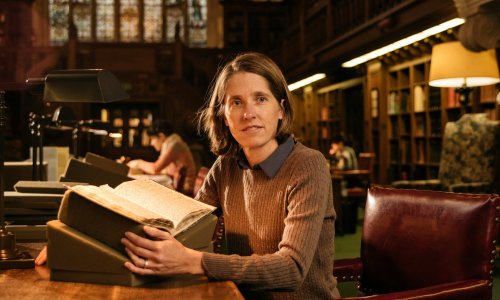
How ‘Sherlock of the library’ cracked the case of Shakespeare’s identity | Culture | The Guardian

Literary detective Heather Wolfe reveals how her passion for manuscripts helped unravel mystery of who the bard really was

heather-wolfe

By Robert McCrum

https://www.theguardian.com/culture/2017/jan/08/sherlock-holmes-of-the-library-cracks-shakespeare-identity?CMP=share_btn_link

Deep in the Folger Library, in Washington DC, Heather Wolfe says that studying Shakespeare makes an ideal preparation for the onset of Trump’s America. You can see her point: Shakespeare would have revelled in the mad excesses, the sinister vanities and the pervasive stench of cronyism and corruption surrounding the president-elect as America makes the painful transition from Barack Obama.

Dr Wolfe is a willowy, bright-eyed manuscript scholar, a paleographer specialising in Elizabethan England who in certain moods of candour might put you in mind of Portia or perhaps Cordelia. She’s also a Shakespeare detective who, last year, made the career-defining discovery that is going to transform our understanding of Shakespeare’s biography. In the simplest terms, Wolfe delivered the coup de grace to the wild-eyed army of conspiracy theorists, including Vanessa Redgrave and Derek Jacobi, who contest the authenticity, even the existence, of the playwright known to contemporaries as Master Will Shakespeare.

Wolfe is an accidental sleuth. Her scholar’s passion is as much for old manuscripts as for the obscurities surrounding our national poet. Project Dustbunny, for example, one of her initiatives at the Folger Shakespeare Library, has made some extraordinary discoveries based on microscopic fragments of hair and skin accumulated in the crevices and gutters of 17th-century books.

DNA forensics aside, Wolfe’s role as a curator at the Folger is to bring her expertise to bear on the tantalising mass of documents that survives from the late 16th century. And yet, despite a heap of legal, commercial and matrimonial evidence, Shakespeare the man continues to slip through scholars’ fingers. Four centuries after his death, apart from a handful of crabbed signatures, there is not one manuscript, letter or diary we can definitively attribute to the poet, sponsoring the pervasive air of mystery that surrounds his genius. Indeed, the most intimate surviving Shakespeare document remains that notorious will, in which he bequeathed his wife his “second best bed”.

Before Wolfe arrived on the scene, all that scholars could be certain about was that a man named Shaxpere, Shaxberd or Shakespear was born in Stratford in 1564, and that he was an actor whose name is printed in the collected edition of his work published in 1623. We also know that he married Anne Hathaway, and died in 1616, according to legend, on his birthday, St George’s Day. The so-called “Stratfordian” case for Shakespeare rested on these, and a few other facts, but basically, that was it.

Into this vacuum, a bizarre fraternity, including Mark Twain, Charlie Chaplin and Sigmund Freud, have projected a “Shakespeare” written by a more obviously accomplished writer: Edward de Vere (the 17th earl of Oxford), Sir Francis Bacon and the playwright Christopher Marlowe, to name the leading contenders in a field that includes Sir Walter Raleigh, and even Elizabeth, the Virgin Queen herself.

In the absence of reliable data, a mountain of speculation has morphed into the weirdest fantasy, notably the 2011 film, Anonymous. Wolfe has no time for this. Speaking exclusively for the first time to the Observer, she says: “Without the evidence for other contenders, it’s hard for me to engage with this line of inquiry.”

Wolfe’s appetite for manuscript corroboration has led her into many dusty corners of the Elizabethan archives. It was this research instinct that first led her to reopen the file on the coat of arms granted to Shakespeare’s father, the small-town glover, in 1596.

John Shakespeare, from Stratford-upon-Avon, was ambitious to rise in the world. He was certainly not the first Englishman keen to put his origins as a provincial tradesman behind him. Among his contemporaries in Stratford, he was a figure of fun for his social climbing. English class snobbery has a long pedigree. His son, who would continue the quest for official recognition after his father’s death, also attracted metropolitan disdain as “an upstart crow beautified with our feathers”. In 1601, after his father’s death, Shakespeare the upstart returned to the college of arms to renew the family application for a coat of arms. He had made a small fortune in the theatre, and was buying property in and around Stratford. Now he set out to consolidate his reputation as a “Gentleman”. Under the rules that governed life at the court of Elizabeth I, only the Queen’s heralds could grant this wish.

A much-reproduced sketch for a coat of arms crystallised Shakespeare’s hopes for legitimacy in the antique jargon of heraldry: “Gould, on a Bend Sables, a Speare of the first steeled argent. And for his Crest, a falcon, his winges displayed Argent, supporting a Speare Gould …” The needy applicant also attached a motto: Non Sanz Droit (“Not Without Right”). All this, and much more, is buried in the archives of the college of arms in London.

Wolfe’s fascination with Shakespeare’s quest for a family crest grew out of her immersion in the manners and customs of late Elizabethan England, in particular the College of Heralds. These court officials were required to administer the complex rituals governing the lives of the knights, barons and earls surrounding Queen Elizabeth.

An adjunct to the court, the College of Heralds was not exempt from its own secret feuds. In 1602, the internecine rivalry between Sir William Dethick, the Garter King of Arms, and another herald, Ralph Brooke, burst into the open when Brooke released a list of 23 “mean persons” whose applications for crests (he claimed) had been wrongfully preferred by Dethick. When “Shakespeare the Player” found himself on this list, his campaign for social advancement seemed in jeopardy. A bitter row broke out at court between two factions. Shakespeare himself became an object of ridicule. Another rival, Ben Jonson, in his satire Every Man out of his Humour, poked fun at him as a rustic buffoon who pays £30 for a ridiculous coat of arms with the humiliating motto “Not Without Mustard”.

It’s at this point in the story that Wolfe discovered “the smoking gun”. In the Brooke-Dethick feud, it becomes clear that “Shakespeare, Gent. from Stratford” and “Shakespeare the Player” are the same man. In other words, “the man from Stratford” is indeed the playwright. Crucially, in the long-running “authorship” debate, this has been a fiercely contested point. But Wolfe’s research nails any lingering ambiguity in which the Shakespeare deniers can take refuge.

Wolfe is circumspect about making extravagant claims. Speaking carefully, she says that her manuscript discoveries fill in gaps, illuminating Shakespeare’s character. “They point to someone actively involved in defining and defending his legacy in 1602, shortly after his father’s death.”

For Wolfe, it’s Shakespeare the man who breaks cover here. “He’s defending his legacy not only as a playwright but, most importantly to him, as a gentleman.” The derogatory references to arms belonging to “Shakespeare ye player”, she says, show that “he’s playing the same game as everyone else in the period, purchasing land in Stratford to support his case to ‘ancient’ gentility, rather than through his astonishing professional success”.

James Shapiro, bestselling author of 1599, who is persuaded by Wolfe’s discoveries, compares her to “a Sherlock Holmes of the archives”. Shapiro says that Wolfe “has had the intellectual independence to see what others have overlooked, the skills to make sense of what she has stumbled upon and the modesty not to trumpet the larger implications of those finds. But make no mistake: they are enormously consequential.”

For Shapiro, Wolfe’s work suggests future breakthroughs. “I doubt that these are the last archival treasures she will unearth. Her recent finds sharpen our sense of Shakespeare’s dogged pursuit of upward mobility. And it is one more nail in the coffin of those who can’t bring themselves to acknowledge that the glover’s son from Stratford was also the successful man of the theatre who left us so many extraordinary plays.”

Wolfe says she looks forward to “poking about” in the archives, and is convinced that Shakespeare’s identity no longer needs re-confirmation. “There is such a wealth of evidence out there that he’s the playwright.” She adds: “I’m sure there’s more untapped material waiting to be uncovered. Additional finds will certainly help us understand his life – as much as we can understand anyone’s life from 400 years ago.”

Leave a comment

Filed under 2017, author tribute, author write up

Dashiell Hammett: a hero for our time – San Francisco Chronicle

Source: Dashiell Hammett: a hero for our time – San Francisco Chronicle

Every Christmas season, my family indulges in the same movie-watching rituals as we trim the tree and string necklaces of twinkling lights around the living room. These movies serve as a comforting backdrop to our yuletide routines. Some of our favorite seasonal films are relative obscurities like “The Family Man” (2000), starring Nicolas Cage, Téa Leoni and Don Cheadle. But we also search out classics, including movies that seemingly have nothing to do with the holiday season. Inevitably, we end up watching at least one of the old “Thin Man” features, that durable Dashiell Hammett detective series starring the most adorable and effervescent married couple in cinematic history, Nick and Nora Charles (William Powell and Myrna Loy).
Why does “The Thin Man” series beckon us this time of year? Maybe it’s the lovely, icy clatter of a holiday martini shaker, that merry clinking sound Nora used to call Nick home to their New York hotel suite when he was relaxing far away in Central Park with their toddler. “Nicky,” the bibulous detective tells Junior, “something tells me that something important is happening somewhere and I think we should be there.”

Or maybe it’s the witty banter and teasing sexuality between Nick and Nora that every sophisticated relationship should aspire to. Nick (trying to divert his wife from an uncomfortably racy subject): “Did I ever tell you that you’re the most fascinating woman on this side of the Rockies?” Nora (signaling she’s no prude): “Wait till you see me on the other side.”
Or it could be the San Francisco aura that drifts through the “Thin Man” films, especially my favorite, “After the Thin Man” (1936), which is set in the city and features locations like the Coit Tower lawn, doubling as the grounds of the Charleses’ Telegraph Hill mansion. Foggy nights in San Francisco are still suffused with a Hammett-like mystery. And there is no better place to conjure the spirit of the founder of the hard-boiled mystery genre than John’s Grill on Ellis Street, where Hammett hero Sam Spade grabbed a quick meal of chops, baked potato and sliced tomato in “The Maltese Falcon.” Hammett himself pounded out his pulp masterpieces on his Underwood typewriter in his apartment nearby, at 891 Post St., after his TB-wracked lungs made it impossible for him to continue his career as a Pinkerton Agency gumshoe.

There is no better way to celebrate the holidays in San Francisco than taking a break from the tyranny of shopping at the legendary downtown grill, presided over by John Konstin, the city’s most charming Greek (besides Art Agnos). A recent lunch hour there was populated by the usual mix of jailhouse lawyers, newshounds, colorful barflies, and SFPD detectives with legendary names – including Lt. Dave Falzon and retired homicide inspector John Cleary Jr. In other words, old San Francisco at its best.

And there is no better lunch companion for such an occasion than fedora-wearing, dapper Eddie Muller — the “Czar of Noir” whose classic cinema festival at the Castro Theatre each January brings together a wildly diverse pageant of filmgoers, from schlumpy and frighteningly obsessive cineastes to elegantly dressed lounge-room lizards and femme fatales who have stepped right out of their own torrid dream. Muller is also a growing presence on the Turner Classic Movies channel, as the film noir host for the brilliantly curated network.

Muller has a familial affinity for the world of Hammett. His late father was the boxing reporter for the San Francisco Examiner for a half-century, a respected fixture in a demimonde filled with the palookas, promoters, and gangsters — the same types Nick and Nora liked to pal around with. And we both share an affection for the prototypical, if opposite, Hammett screen heroines, Loy and Mary Astor.

Astor was the sad-eyed, seductive screen siren who costarred with Bogart in “The Maltese Falcon” (and with my father, Lyle, in such lesser 1930s offerings as “Return of the Terror,” “Red Hot Tires” and “Trapped by Television,” a B-movie thriller that foresaw the scary aspects of the coming medium). Astor was a sexually liberated woman of her day; her erotic self-confidence surges through her performance as the masterfully manipulative Brigid O’Shaughnessy in the Hammett classic.

In 1936, Astor found herself on the pyre in the hottest Hollywood sex scandal of its day, when her estranged husband exposed her “Purple Diary” to the press — a lusty account of her sexual exploits, including the grades she assigned to her lovers’ performances. Playwright George S. Kaufman scored the highest, with Astor extolling his prowess. “Fits me perfectly,” she wrote. “Many exquisite moments … twenty — count them, diary, twenty … I don’t see how he does it … he’s perfect.”

Astor — whose Purple Diary is the subject of two recent books, including a sensually illustrated chronicle by the artist Edward Sorel — got Muller and me talking about Hammett and his view of women. “In some ways, the male-female dynamic is the most interesting thing about Hammett’s work,” said Muller, between sips from his Manhattan. “There’s an emotional complexity and tension that separates it from other detective fiction.” In his own life, Hammett cut himself off from his father and brother at a young age, but remained close to his mother and sister. His own formidable drinking and sparring partner, the writer Lillian Hellman, was the inspiration for Nora Charles.

“He was a tall, slim, well-dressed ladies’ man, who carried with him a sense of damage that women found attractive,” continued Muller. “His drinking, his illness. He made binge drinking heroic because he was so frail. Women would marvel at him — it’s 4 a.m. and he’s still going.”

Hammett had another kind of fortitude as well. A lifelong man of the Left, he was dragged before a federal tribunal during the Cold War and asked to reveal the names of those who had contributed to a bail fund he had overseen for jailed Communist Party leaders. He refused. Ratting on friends was not the kind of thing that the creator of Sam Spade would do. He was sentenced to six months in federal prison for contempt of court, and when he was released in December 1951, his health was more ruined than ever. In 1953, he was summoned again by the witch-hunters, this time by Sen. Joe McCarthy and his sidekick, the reptilian Roy Cohn — one of Donald Trump’s mentors. Again Hammett refused to cooperate. He was blacklisted by Hollywood and went broke. But he was unbroken.

As Trump adviser Newt Gingrich floats the idea of reviving the notorious House Un-American Activities Committee, it’s a good time for us to recall Hammett’s heroism. “People should read his testimony and look at the pictures of him as he underwent the inquisition; it’s so inspiring,” said Muller. “He was just so cool and unshakable. His attitude was like, ‘Do your worst, you can’t even make me angry.’ He was one of his own heroes come to life.”

San Francisco Chronicle columnist David Talbot appears Sundays, Tuesdays and Thursdays. Email: dtalbot@sfchronicle.com

Leave a comment

Filed under 2016, author tribute

Meet the 92-Year-Old Who Helped Recognize Edgar Allan Poe

Patricia Bartevian owns Bartevian’s on Boylston Street, around the corner from the newly installed Edgar Allan Poe statue.

Source: Meet the 92-Year-Old Who Helped Recognize Edgar Allan Poe

Patricia Bartevian sits at the counter of Bartevian’s on the first floor of 160 Boylston Street.

Glancing around the store, you almost miss her. She’s surrounded by the items she consigns—paintings, clothing, stacks of VHS tapes, jewelry, furniture, and porcelain dolls, to name a few. Her seat, in the corner of the store next to its window, has a perfect view of the sprawling display of Edgar Allan Poe souvenirs by the door. Poe is a poet who owes a thank you to the shop owner.

Bartevian, or Pat, as she’s known, has spent most of her life in this store.

“We’re a nonprofit family trust,” she explains to me. “We’ve been here over 105 years. My father started the business back in 1910 and we take things on consignment to help people.”

The 92-year-old clarifies: She was away from the store for part of her life.

“During the ’40s, my sister Priscilla and I went to Hollywood. We were in the movies for ten years,” she says. “The Hickory Sisters. We’re on Google and Yelp.”

Flipping through a large, black, three-ring binder filled with photos, Bartevian speaks affectionately of Old Hollywood.

Eventually, the sisters returned to Boston to help with the business as their father approached age 100. Bartevian has been at the store since, where she tries to make it feel “like a living room.” Her sister Priscilla painted cherubs on the store’s ceiling.

When they weren’t tending to customers or their upstairs tenants in the building, Pat and her sister realized there was nothing commemorating an author who’d once lived around the corner at 62 Carver Street. Born there on January 19, 1809, Edgar Allan Poe was never particularly fond of Boston, but was a Bostonian, nonetheless.

“We thought, ‘Well, there isn’t anything about Poe in town. We should have something,’” says Bartevian.

Poe’s home was torn down in 1959, so the Bartevians started by aiding in the installment of a plaque on a nearby building in 1989.

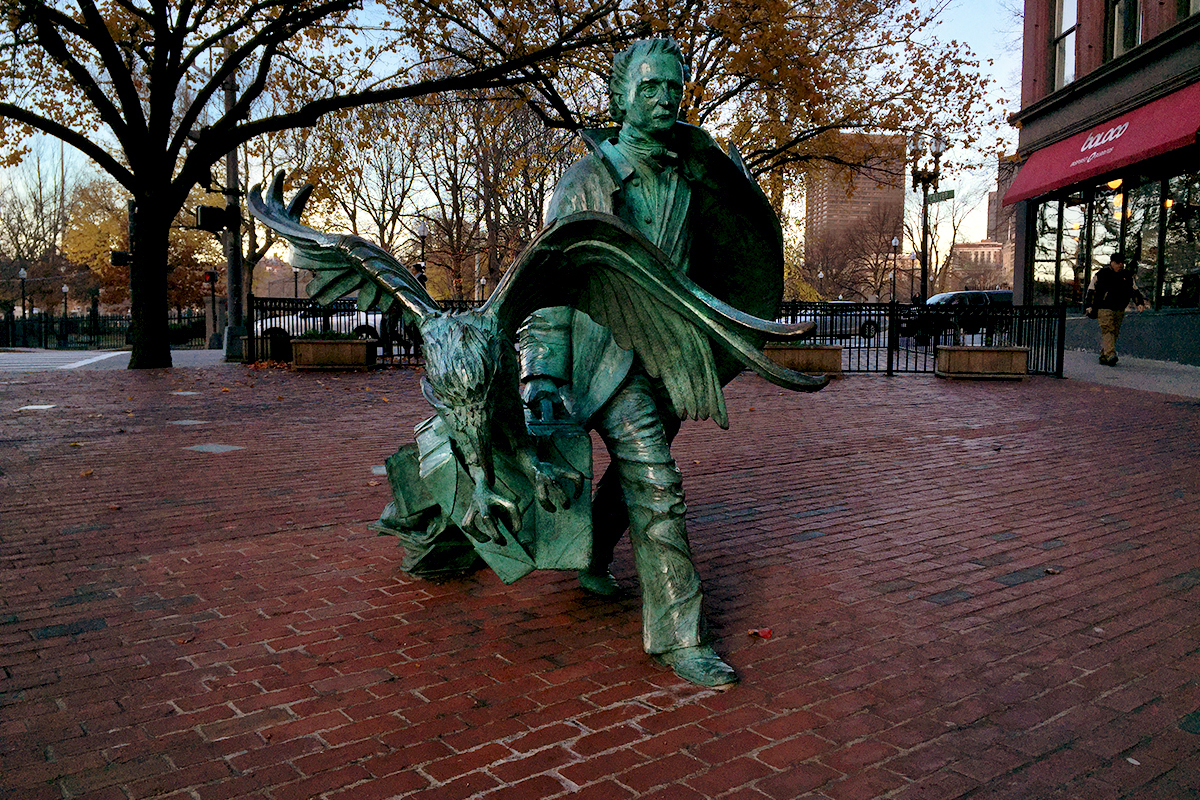
Though Priscilla passed away after a battle with cancer ten years ago, Pat continued to recognize Poe. In 2009, she helped in requesting that the city name the area Edgar Allan Poe Square. But most notably and most recently, she played an important role in the commissioning of the Edgar Allan Poe statue in October 2014.

The Edgar Allan Poe Foundation of Boston was formed in 2010 solely to fund the statue, and Bartevian promptly joined as its treasurer. She aided its president, John LaFleur, and chair, Paul Lewis, in fundraising efforts. As they applied for grants, Pat sold Poe baubles in her store. Poe playing cards, Poe buttons, Poe t-shirts, Poe bandages, Poe action figures, Poe bobbleheads, Poe mugs, Poe books, and even stuffed ravens sit on a few shelves.

Proceeds from the Poe gifts now go toward upkeep and maintenance of the statue.

“Without Bartevians’ physical promotion, it would have been a different project,” says LaFleur.

Bartevian put up posters and flyers for events, and gave the Poe Foundation a home in an office on the second floor of 160 Boylston.

“With everybody who came into her store, she was the person shilling for it day-to-day,” he says. “Without her, it would have been like a lot of things these days—they just unwind.”

Bartevian sees the fruits of her labor each time she heads into work: the life-size bronze statue done by Stefanie Rocknak.

“Between the suitcase with all the stories falling out and him walking to his room, it’s a very clever statue,” says Bartevian. “[Rocknak] is extremely talented.”

And as Bartevian appreciates Rocknak, the artist behind the Poe statue nods to Bartevian.

“She’s always been terrific,” says Rocknak. “She had people come into her shop to check out the marquettes (small versions of the statue), and she’s selling postcards now. I usually stop in whenever I get the chance.”

Bartevian has made a commitment in writing for her store and building to be a perpetual nonprofit location. And while there is some flexibility, the building will always have a Poe theme to support the Poe legacy efforts as well as Edgar Allan Poe Square.

“It’ll be a perpetual ‘leave the light on for Poe,’” says LaFleur. “He’ll always have a place on the first floor of Bartevian’s.”

Leave a comment

Filed under 2016, author tribute

‘It’s All One Case’ is a revealing look at detective master Ross Macdonald – The Washington Post

The sprawling book includes previously unpublished interviews and hundreds of photos.

Source: ‘It’s All One Case’ is a revealing look at detective master Ross Macdonald – The Washington Post

“It’s All One Case” is a book that any devotee of American detective fiction would kill for. For fans of Ross Macdonald, the finest American detective novelist of the 1950s and ’60s, it’s an absolute essential.

First off, this huge album contains the transcript of 47 hours of talk between Kenneth Millar — Macdonald’s real name — and Rolling Stone reporter Paul Nelson. The conversations, which took place in 1976, were intended for an article that never got written. Soon after the interviews were over, Millar began to exhibit symptoms of Alzheimer’s disease and would never write another book. He died in 1983. Nelson’s life would gradually just fall apart. He died in 2006.

Largely because of Kevin Avery’s devotion and hard work this major work of mystery scholarship has finally appeared in print.

Yet there’s still another reason to covet this book — its pictures, hundreds of them. Virtually every page shows off Jeff Wong’s awe-inspiring collection of material relating to Millar.

Here one can see every Ross Macdonald novel in every hardcover and paperback edition and seemingly all the periodicals — from Ellery Queen’s Mystery Magazine to Cosmopolitan and Gallery — in which Millar published a story or article; reproductions of the writer’s handwritten letters, spiral notebooks and typed manuscripts; pages from Knopf galleys; and even VHS tapes and DVDs of the movies and TV series based on private eye Lew Archer.

In addition, “It’s All One Case” includes dozens of photographs of Millar, as a boy in Canada, at his longtime home in Santa Barbara, and with his wife, the comparably gifted mystery writer Margaret Millar (whose works Soho Press has recently reissued in several omnibus volumes).

Nearly all Lew Archer’s cases — “The Zebra-Striped Hearse ,” “The Chill ” and a half dozen others — deal, more or less, with the sins of an earlier generation wreaking havoc in the present. In the interviews here, Millar admits that he consciously worked and reworked variations on this theme because of its personal relevance: His father walked out on his mother when he wasn’t quite 4, and little Ken grew up being shunted among various relatives, so much so that he had lived in 50 different houses or apartments by the time he was 16.

At an early age, Millar decided to become a writer. He tells Nelson that important influences included Poe and Twain but that F. Scott Fitzgerald’s “The Great Gatsby” was, for him, “the central novel of the century.” He reveres Dashiell Hammett’s “The Maltese Falcon” and deeply admires the early work of James M. Cain: “Nothing has ever been done in its field better than ‘Double Indemnity.’ ” Among favorite contemporary writers, Millar names Nabokov, “who doesn’t really make mistakes.” He regards Dostoevsky “as probably the greatest of all fiction writers.”

To write his detective novels, Millar says he spends months scribbling plot details in notebooks and that he deliberately uses symbolic imagery as a structural element. His books are, consequently, both complicated and precisely engineered: “I don’t aim at simplicity.” He also stresses that it’s “the stories of the other people” — Archer’s clients rather than the detective himself — “that really interest me more. Archer is just a means of getting to them and showing them as they are.” Indeed, some of his books, he would argue, “are tragedy or at least aim at it.”

Nonetheless, Millar explains, “I don’t start out with a character. I start out with an idea, which is generally a moral situation. . . . The characters are just notations which together form the book. They do represent energies of course, various kinds of imaginative energy going in different directions, and all that has to be orchestrated and unified. That’s what really is so difficult: to get it all in a proper balance so that each of these energies represented by the twenty or so characters in a book gets its proper place, its proper presentation, and its final place in the structure.” He emphasizes that structure is “the one thing I can do better than my competition, so I spend a lot of time on it.”

Clearly Millar, who earned a Ph.D in English from the University of Michigan, isn’t your average pulp mystery hack. Instead his books honor the hard-boiled tradition, even as they complicate and slightly soften it. These days, however, I suspect that Millar’s novels —despite being reprinted in the Library of America — have fallen into literary limbo, remembered but not much read. Yet his mysteries still pack a wallop, as I discovered when, after many years, I again picked up my copy of “The Galton Case.” From the start, Archer’s voice exhibits the laconic factuality and low-keyed wit we associate with Hammett and Raymond Chandler:

“The law offices of Wellesley and Sable were over a savings bank on the main street of Santa Teresa. Their private elevator lifted you from a bare little lobby into an atmosphere of elegant simplicity. It created the impression that after years of struggle you were rising effortlessly to your natural level, one of the chosen.”

As Millar talks about his life and work in “It’s All One Case,” he does repeat some of the same points again and again. Nonetheless, he absolutely refuses to discuss his daughter Linda, who accidentally killed a young boy when driving drunk at the age of 16 and later died at 31. While Millar admits that his fiction is replete with troubled adolescents, he contends that any personal or autobiographical material has been sublimated, shaped and refracted. He is an artist, after all, and that’s what artists do.

Michael Dirda reviews books on Thursdays in Style.

Leave a comment

Filed under 2016, author tribute