Category Archives: author profile

Archaeology Is Revealing New Clues About Shakespeare’s Life (And Death)

New technology is helping archaeologists uncover details of the playwright’s home, workplaces and his final resting place.

The Conversation

  • William Mitchell

https://getpocket.com/explore/item/william-shakespeare-archaeology-is-revealing-new-clues-about-the-bard-s-life-and-death?utm_source=pocket-newtab

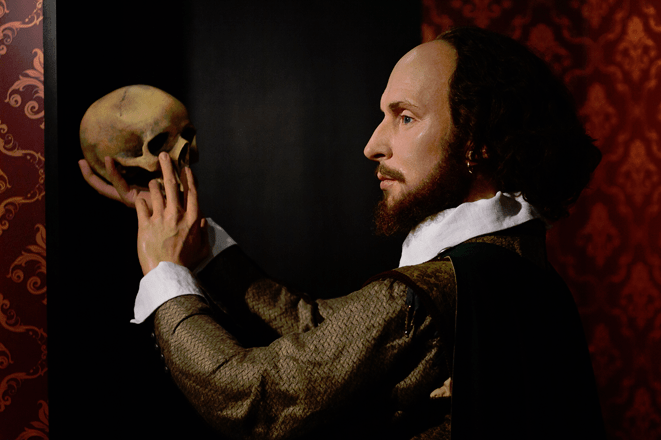
Waxwork of Shakespeare by Madame Tussauds in Berlin. Photo from Anton Ivanov via Shutterstock.

William Shakespeare is widely regarded as one of the greatest authors of all time and one of the most important and influential people who has ever lived. His written works (plays, sonnets and poems) have been translated into more than 100 languages and these are performed around the world.

There is also an enduring desire to learn more about the man himself. Countless books and articles have been written about Shakespeare’s life. These have been based primarily on the scholarly analysis of his works and the official record associated with him and his family. Shakespeare’s popularity and legacy endures, despite uncertainties in his life story and debate surrounding his authorship and identity.

The life and times of William Shakespeare and his family have also recently been informed by cutting-edge archaeological methods and interdisciplinary technologies at both New Place (his long-since demolished family home) and his burial place at Holy Trinity Church, Stratford-upon-Avon. The evidence gathered from these investigations by the Centre of Archaeology at Staffordshire University provides new insights into his interests, attitudes and motivations – and those of his family – and shows how archaeology can provide further tangible evidence. These complement traditional Shakespearean research methods that have been limited to sparse documentary evidence and the study of his works.

Archaeology has the ability to provide a direct connection to an individual through the places and objects associated with them. Past excavations of the Shakespearean-era theatres in London have provided evidence of the places he worked and spent much of his time.

Attributing objects to Shakespeare is difficult, we have his written work of course, his portrait(s) and memorial bust – but all of his known possessions, like those mentioned in his will, no longer exist. A single gold signet ring, inscribed with the initials W S, is thought by some to be the most significant object owned and used by the poet, despite its questionable provenance.

Shakespeare’s House

Shakespeare’s greatest and most expensive possession was his house, New Place. Evidence, obtained through recent archaeological investigations of its foundations, give us quantifiable insights into Shakespeare’s thought processes, personal life and business success.

The building itself was lost in the 18th century, but the site and its remains were preserved beneath a garden. Erected in the centre of Stratford-upon-Avon more than a century prior to Shakespeare’s purchase in 1597, from its inception, it was architecturally striking. One of the largest domestic residences in Stratford, it was the only courtyard-style, open-hall house within the town.

This type of house typified the merchant and elite classes and in purchasing and renovating it to his own vision, Shakespeare inherited the traditions of his ancestors while embracing the latest fashions. The building materials used, its primary structure and later redevelopment can all be used as evidence of the deliberate and carefully considered choices made by him and his family.

Shakespeare focused on the outward appearance of the house, installing a long gallery and other fashionable architectural embellishments as was expected of a well-to-do, aspiring gentleman of the time. Many other medieval features were retained and the hall was likely retained as the showpiece of his home, a place to announce his prosperity, and his rise in status.

It provided a place for him and his immediate and extended family to live, work and entertain. But it was also a place which held local significance and symbolic associations. Intriguingly, its appearance also resembled the courtyard inn theatres of London and elsewhere with which Shakespeare was so familiar, presenting the opportunity to host private performances.

In Search of the Bard

Extensive evidence of the personal possessions, diet and the leisure activities of Shakespeare, his family and the inhabitants of New Place were recovered during the archaeological investigations, revolutionising what we understand about his day-to-day life.

An online exhibition, due to be made available in early May 2020, presents 3D-scanned artefacts recovered at the site of New Place. These objects, some of which may have belonged to Shakespeare, have been chosen to characterise the chronological development and activities undertaken at the site.

Open access to these virtual objects will enable the dissemination of these important results and the potential for others to continue the research.

Here Lies …

Archaeological evidence recovered from non-invasive investigations at Shakespeare’s burial place has also been used to provide further evidence of his personal and family belief. Multi-frequency Ground Penetrating Radar (GPR) was used to investigate the Shakespeare family graves below the chancel of Holy Trinity Church.

A number of legends surrounded Shakespeare’s burial place. Among these were doubts over the presence of a grave, its contents, tales of grave robbing and suggestions of a large family crypt. The work confirmed that individual shallow graves exist beneath the tombstones and that the various members of Shakespeare’s family were not buried in coffins, but in simple shrouds. Analysis concluded that Shakespeare’s grave had been disturbed in the past and that it was likely that his skull had been removed, confirming recorded stories.

These family graves occupy a significant (and expensive) location in Holy Trinity Church. Despite this, the simple nature of Shakespeare’s grave, with no elite trappings or finery and no large family crypt, coupled with his belief that he should not be disturbed, confirm a simple regional practice based on pious religious observance and an affinity with his hometown.

There is still so much we don’t know about Shakespeare’s life, so it’s a safe bet that researchers will continue to investigate what evidence there is. Archaeological techniques can provide quantifiable information that isn’t available through traditional Shakespearean research. But just like other disciplines, interpretation – based on the evidence – will be key to unlocking the mysteries surrounding the life (and death) of the English language’s greatest writer.

William Mitchell is a Lecturer in Archaeology at Staffordshire University.

Leave a comment

Filed under 2020, author, author profile

Known Alias: How Stephen King Was Outed as Richard Bachman

Steve Brown was working his shift at Olsson’s Bookstore in Washington, D.C. in the spring of 1985 when he heard his name come over the store intercom. There was a call waiting for him.

When Brown picked up the telephone, he heard a voice ask, “Steve Brown? This is Steve King. Okay, you know I’m Bachman, I know I’m Bachman, what are we going to do about it? Let’s talk.”

King was referring to Richard Bachman, the alias he had adopted eight years earlier and carried through four books (Rage, The Long Walk, Roadwork, and The Running Man). The titles had floated in and out of the market in relative obscurity, drawing only passing suspicion that their true author was one of the most well-known and successful writers of the 20th century. New American Library (NAL), Bachman’s publisher, refuted any suggestion that the author was fictional.

But Brown—a bookstore clerk, writer, and fanzine publisher—had read enough King novels to recognize that Bachman’s latest book, Thinner, was unequivocally a King work. After some additional investigation, Brown wrote a letter to King’s agent sharing his discovery and asked how they’d like to proceed. It marked the beginning of the end for Bachman, who would soon perish, King wrote, owing to “cancer of the pseudonym.”

***

By 1977, King had completed his transformation from nearly-destitute English teacher to cultural phenomenon. His first three books—Carrie, Salem’s Lot, and The Shining—were bestsellers, with The Stand nearing completion. Feature film and paperback rights for his work added to his newfound wealth.

King’s professional problem, if he could be said to have one, was that he secreted words like most people produce sweat. His novels were swelling in size—The Stand’s first publication saw it cut from 1152 to 752 pages—and he was eager to publish more than the industry standard of one book a year.

Editors balked: Multiple releases would glut the market, they insisted, undercutting the King brand and cannibalizing his sales.

Tired of arguing his point, King decided to submit one of his earlier manuscripts to his paperback publisher, New American Library, with the caveat that it would be distributed under a pen name. NAL editor Elaine Koster agreed to an impressive veil of secrecy, including keeping most NAL employees and even their CEO in the dark about their newly-signed author.

Beyond circumventing the antiquated thinking about being too prolific, King had an alternative motivation for pursuing a pseudonym. He had long wondered if his work could be successful outside of the notoriety he had developed over the years. Getting It On, a long-finished book about a student who takes his high school class hostage, would receive little publicity and would essentially be left to flourish or perish on its own merits. “I wanted it to go out there and either find an audience or just disappear quietly,” King told The Washington Post in 1985.

The first stumbling block was King’s preferred alias: Guy Pillsbury. Pillsbury was the name of King’s maternal grandfather, but when Getting It On began to circulate around the NAL offices, some people became aware of the connection to King. He pulled the manuscript, retitled it Rage, and had better luck flying under the radar.

When it was time for the book to go to press, King received a call asking about a pen name. According to King, a Bachman Turner Overdrive record was playing and a Richard Stark novel was on his desk. Stark was the pen name for writer Donald E. Westlake—hence “Richard Bachman.”

The publication of Rage in 1977 was followed by The Long Walk in 1979, Roadwork in 1981, and The Running Man in 1982. Sales were modest at best, and reader reaction was tepid: King recalled getting 50 or 60 fan letters a week for himself and perhaps two a month for Bachman. Still, he seemed to relish having an alter ego and delighted in inventing a morbid biography for him. In his mind, Bachman was a chicken farmer in New Hampshire who wrote novels at night, happily married but facially deformed owing to a past illness—hence, poor Bachman would be unavailable for interviews.

King’s cover endured for a surprisingly long period. But the 1985 release of Thinner would usher in fresh suspicion about Bachman. Unlike the other four novels, Thinner was contemporary King, a hardcover written with the knowledge it was a “Bachman book” and perhaps more self-conscious about its attempt at misdirection. And unlike early-period Bachman, which often featured nihilistic but grounded scenarios—a walking marathon that ends in death, or a game show where prisoners can earn their freedom—Thinner took on more of a horror trope, with a robust lawyer cursed to lose weight by a vengeful gypsy until he’s practically nothing but skin and bone.

When Stephen Brown obtained an advance copy at Olsson’s, he had an innate belief he was reading a King novel. To confirm his suspicions, he visited the Library of Congress to examine the copyrights for each Bachman title. All but one were registered to Kirby McCauley, King’s agent. The remaining title, Rage, was registered to King himself. It was the smoking gun.

Brown wrote McCauley with the evidence and requested his advice on what to do with the information he had gathered. He didn’t plan on “outing” King, but, by this time, the King-as-Bachman theory had been gathering steam, with both King and NAL getting more inquiries from journalists. That’s when King decided to phone Brown directly and offer him an exclusive interview revealing himself as Bachman.

***

With King’s permission, NAL began circulating Thinner with a credit that read, “Stephen King writing as Richard Bachman.” The following year, they reissued the previous Bachman titles in a volume titled The Bachman Books, with sales more in line with what publishers would expect from a King title. Film producers who had optioned The Running Man were ecstatic, since they had gotten a bargain Bachman price on the rights for a King product.

The only person unhappy with the reveal was the author himself. Bachman, King felt, was on the cusp of developing his own following and his own identity, and he had fully intended to continue publishing under the pen name. (King had planned on making Misery a Bachman tome.) But Thinner had been too much of a King book, and there is evidence King himself may been giving himself too much rope with which to hang his alias. One of the characters in Thinner muses that “You were starting to sound like a Stephen King novel for a while there.”

In his introduction to The Bachman Books, King hinted that more “undiscovered” Bachman manuscripts may be lurking. In 1996, he published The Regulators as a “posthumous” Bachman novel, and did the same with Blaze, a 2007 paperback that was originally written in the 1970s. King’s 1991 novel, The Dark Half, was dedicated to his pen name. It was about an author with a pseudonym who takes on a life of his own.

Ultimately, Bachman may have outlived his usefulness. In the 1980s, publishers seemed to relax on their shop-worn edicts over publication frequency, and King once published four titles (all under his own name) in a calendar year.

Whether Bachman could have one day rivaled King in popularity will have to remain a mystery. During his short time in publishing, he would sometimes get favorable notices that hinted at a bright future. “This is what Stephen King would write like if Stephen King could really write,” remarked one reviewer.

Jake Rossen is a writer, editor, and curator of fine comic strip art. (Except Garfield.) His byline can be found within the pages of The New York Times, ESPN.com, Wired.com and a slew of health and fitness-related publications.

Source: Known Alias: How Stephen King Was Outed as Richard Bachman

Leave a comment

Filed under 2019, author profile

“Humans never learn”: the philosopher John Gray on New Atheism, the God Debate and why history repeats itself | The Sunday Times Magazine | The Sunday Times

Source: “Humans never learn”: the philosopher John Gray on New Atheism, the God Debate and why history repeats itself | The Sunday Times Magazine | The Sunday Times

Gray’s latest book, Seven Types of Atheism, targets the New Atheists

by Bryan Appleyard

Once upon a time an American writer called Sam Harris wrote a book called The End of Faith, about how silly it was to believe in God. The book sold many copies, so some other people — Richard Dawkins, Christopher Hitchens, Daniel Dennett, AC Grayling — wrote the same book. This made them all quite a bit richer and turned them into a movement called either Militant Atheism or the New Atheism. They were all fairly clever, but none of them was even half as clever as another philosopher called John Gray. (I would say he’s the greatest, but he’s a mate so you might think I’m biased.)

Gray became “bored and frustrated” with what came to be known as the God Debate, so he decided to put them in their place.

“They’ve not read very much of anything at all,” he explains, “and they don’t know anything very much.”

The New Atheists wanted to get rid of God because they thought he was the real problem. When communism collapsed in the late 1980s, people believed the West had won and soon everybody would be nice liberal democrats. It didn’t happen. Then along came 9/11, which was caused by God or, at least, bad religion. And it was this, the New Atheists concluded, that was stopping people becoming just like them.

So the New Atheists set up a new, godless religion of science. Science was the one human activity that shows constant progress, so letting science set the rules seemed the way to ensure constant progress in all things. This is, Gray believes, a fairy tale. In his view, there is no evidence whatsoever that human progress is inevitable and enduring. And there is plenty of evidence that it isn’t. The 20th century was a slaughterhouse from the trenches of the First World War to the Holocaust in the Second. The 21st is now heading that way with gas attacks on children in Syria, the genocide of the Rohingya in Burma and, most chilling of all, the recreation of the Cold War with the use of nuclear weapons now being discussed as an imminent reality. All civilisations, all human aspirations, eventually fail. The best we can do is sustain the good times. Humans can hope, but optimism — the belief in a fundamental change in our condition — is futile.

Gray’s new book, Seven Types of Atheism, is not just a demolition of the anti-God squad, it is also an assault on their strange religion. But who is John Gray?

Born in South Shields in 1948, Gray now lives in Bath with his Japanese wife, Mieko. They have been married for 30 years and have no children. They do, however, have a cat, Julian, a 21-year-old birman that is the hero of Gray’s next book, Feline Philosophy: Cats and the Meaning of Life. “Cats,” he says, “enjoy their lives without needing to turn them into stories.”

When he was growing up, cats “were a normal aspect of working-class life, everybody had cats”. He still has remnants of a Tyneside accent that becomes more pronounced when he tells funny stories, which he does a lot. From his upbringing and his parents — Nick, a joiner and, during the war, a docker, and Joan — he learnt most of the basics of his later thinking. He was born three years after the Second World War, in which our species decided to kill 85m of its members. There were too many such “hemoclysms” — bloodbaths — in the 20th century and I believe Gray is the only philosopher to have recognised their true import. “Secular meliorism — which is the religion of pretty much everybody who thinks they have no religion — says that what has been achieved in history in the way of improvements cannot be lost.” Gray, on the other hand, states that “they were repeatedly lost in the 20th century when whole peoples, whole forms of life were destroyed, so whatever improvements there were within them were gone. And that is normal.”

History, for Gray, is cyclical. There is no upward trend, we are stuck on the treadmill of our own inadequacies. The best that politicians can do is find “partial remedies to recurring human evils” and thereby sustain periods of improvement for a little longer. “I was a beneficiary of the Second World War. If it hadn’t happened, there would have been no welfare state and no opening up of opportunities and I probably wouldn’t have achieved anything. Of course, that improvement was itself a side effect of a catastrophic event … I do believe it was a just and necessary war, but with catastrophic suffering.”

Gray is hyperaware of fragility in all that we do, from the comical, small, daily failures to the life-changing disasters. His manner is, as a result, faintly nervous, but he survives all of this because of the stoicism he learnt from his parents. “I benefited from the inculcation of stoicism from my mother and the whole culture,” he says. “That’s disparaged now.” Stoics, however, can follow their best impulses and assert themselves against fate. Gray did this through books. He started going to the local library, and reading was a way out of Tyneside. Crucially, however, it was not a rejection of his terraced house community. “Doors were left open all the time. That I know because I lived that way. It’s not a romantic, nostalgic backward glance, it’s all true. But this is another lesson about how you can’t have the good without the bad. The downside was that those communities could be very repressive. If you were the son of a miner you were expected to go down the mines; if you were a woman, it was very patriarchal … So if you wanted to live in some other way, you had to leave.”

He went, via books and grammar school, to Oxford and a succession of academic posts in Britain and America. Latterly, he became professor of politics at Oxford and then professor of European thought at LSE. He retired in 2007.

Politically he had been on the left, then the right in the 1980s, then the left. In the 1980s and 1990s his books surveyed vast landscapes of political thought. His friend and Oxford mentor Isaiah Berlin’s analysis of the contradictions of liberalism was a vital inspiration. Gray’s book False Dawn: The Delusions of Global Capitalism, in 1998, was an assault on the right-wing ideology of neoliberalism and has achieved lasting authority because it foresaw the terms of the 2007 financial crash; this led to a new edition in 2009. His next book, Straw Dogs: Thoughts on Humans and Other Animals, however, began a new phase. “Straw Dogs marked a shift in subject matter, writing style and audience for my work. Rather than a treatise in academic political philosophy or a polemic like False Dawn, it was a text I hoped anyone interested in fundamental questions about what it means to be human could find stimulating. It was also a book I enjoyed writing.”

Straw Dogs trashed most modern pieties. For example: “As commonly practised, philosophy is the attempt to find good reasons for conventional beliefs.”

His books that followed — notably, The Immortalization Commission, The Silence of Animals and The Soul of the Marionette — seemed to dissolve all genres, even though they were trashed by many critics. They were philosophy, history, art and literature, economics and politics, all held together with funny stories. For instance, in Gray’s latest book we have the ludicrous atheist French philosopher Auguste Comte, who had clothes made with the buttons down the back so that you needed somebody else to help you dress — it was supposed to promote fraternal co-operation to compensate for the loss of God.

The main problem people seem to have with Gray’s late works is what they mistakenly see as their bleakness. They don’t know what to think or where to go when they put the books down, probably because they have lived their lives under the comfort blanket of the progressive, scientistic superstition. This is a misreading. It is true that, like Darwin, Gray sees humans as just one more species, a passing phenomenon — “The Earth will forget mankind. The play of life will go on.” It is also true that, as he keeps saying, he does not believe in anything. This led to the likes of Professor Terry Eagleton calling him a nihilist. Gray brushes this aside. “Nihilism in common parlance is anything that disrupts the pieties of the time. In 1890 if you said gay sex was OK you’d be a nihilist — ‘You mean buggery is OK! Only a moral nihilist, someone who believed there was no moral order in the cosmos, would say this!’ Well, the Greeks didn’t seem to mind.

“The local piety now is the belief in progress, the human spirit, uplift. In my view this is always dancing on the edge of depression. They need to stand up stiffly for fear of falling flat on their face.”

His latest, Seven Types of Atheism, is a provocation. Even the title itself is designed to rile the New Atheists as they seem to think theirs is the only type of atheism: a disbelief in God and a belief in science as the only road to salvation. This is a fairy tale that has so often had an unhappy ending — communism, Nazism — that it is hard to believe it is still being told. But it survives because of another incurable human attribute: forgetfulness. It is this that made the absurd “God Debate” possible. This debate, Gray says, is “ignorant and parochial and uninformed”. He’s tired of poking holes in Dawkins’s deficient learning and self-serving logic, but he still likes to stick the odd knife into Sam Harris, the American leader of the movement, accusing him of “a willed ignorance of the history of ideas”.

“The whole God Debate was a recycled and cheapened version of debates that went on in the 19th century, with not much that is genuinely new … There is nothing that wasn’t in Victorian atheism, which was often better expressed and certainly with more knowledge of Christianity and biblical texts.”

For Gray, to say you are an atheist is not to say that there is no God, but rather to say you don’t need a God. (In these terms, he is an atheist himself.) Historically, atheism has taken many forms — secular humanist, scientific, apocalyptic, God-hating and so on. The particular contemporary form, with its emphasis on a story of redemption through science, is, Gray claims, quite clearly religious — a version of the monotheistic belief in a linear history terminating with salvation. Also, the religion attacked by the New Atheists is only a small local sect.

“They talk as if all religion is a series of iterations of 20th-century American, Protestant, fundamentalist Christianity. Christianity is incomparably, almost inexhaustibly richer than that. They’re not really talking about religion or even atheism. They’re just prosecuting a local culture war. Why should anyone be interested in that?” Their parochialism, he says, makes them too hung up on belief, which they do not distinguish from faith. His wife, Mieko, for example, introduced him to Zen Buddhism, which requires no belief whatsoever and, like many other faiths, does not need a God. Now, for Gray, “the heart of religion is living in a particular way, it is a form of life”.

And as for science and technology — well, yes, they are the only human artefacts that do, in fact, progress. But that does not and cannot lead to ethical or political progress. Anaesthetic dentistry and, possibly, contraception are the only developments he acknowledges that did not come with a cost. And he goes back to South Shields when he talks about the well-meaning progressives who knocked down the terraced houses to build tower blocks. People were better housed, but communities were destroyed — “Everything comes with a shadow.”

Or, to put it another way, the best of us cohabits with the worst of us. “Human nature is shown by the high degree of constancy in human needs, desires, passions and reactions. It is why human history and events are so repetitive.”

If we weren’t mixed, fallen, incurable, we wouldn’t be human.

Seven Types of Atheism is published on Thursday (Allen Lane £18)

Leave a comment

Filed under 2018, author profile

Ted Chiang’s Soulful Science Fiction – The New Yorker

With just fourteen short stories and a novella, the author behind the recent film “Arrival” has gained a rapturous following within the genre and beyond.

Source: Ted Chiang’s Soulful Science Fiction – The New Yorker

by Joshua Rothman

In the early nineteen-nineties, a few occurrences sparked something in Ted Chiang’s mind. He attended a one-man show in Seattle, where he lives, about a woman’s death from cancer. A little later, a friend had a baby and told Chiang about recognizing her son from his movements in the womb. Chiang thought back to certain physical principles he had learned about in high school, in Port Jefferson, New York, having to do with the nature of time. The idea for a story emerged, about accepting the arrival of the inevitable. A linguist, Chiang thought, might learn such acceptance by deciphering the language of an alien race with a different conception of time. For five years, when he wasn’t working as a technical writer in the software industry, Chiang read books about linguistics. In 1998, he published “Story of Your Life,” in a science-fiction anthology series called Starlight. It was around sixty pages long and won three major science-fiction prizes: the Nebula, the Theodore Sturgeon, and the Seiun, which is bestowed by the Federation of Science Fiction Fan Groups of Japan. Last year, “Arrival” was released, an adaptation of “Story of Your Life,” in which Amy Adams plays a linguist who learns, decades in advance, that her daughter will die, as a young woman, of a terminal illness, but goes ahead with the pregnancy anyway.

Chiang is now forty-nine, with streaks of gray in his ponytail. He started writing science fiction in high school. Since then, he has published fourteen short stories and a novella. By this means, he has become one of the most influential science-fiction writers of his generation. He has won twenty-seven major sci-fi awards; he might have won a twenty-eighth if, a few years ago, he hadn’t declined a nomination because he felt that the nominated story, “Liking What You See: A Documentary,” was unfinished. (It imagines using neuroscience to eliminate “lookism,” or the preference for beautiful faces.) Many of Chiang’s stories take place in the past, not the future. His first published story, “Tower of Babylon,” which appeared in 1990 and won a Nebula Award, follows Hillalum, a Babylonian stonecutter tasked with climbing to the top of the world and carving a doorway into its granite ceiling. It has the structure of a parable and an uncanny and uncompromising material concreteness. At the top of the tower, Hillalum finds that the roof of the world is cold and smooth to the touch. The stonecutters are eager to find out what lies on the other side of the sky, but they are also afraid, and, in a prayer service, Chiang writes, “they gave thanks that they were permitted to see so much, and begged forgiveness for their desire to see more.” Chiang goes to great lengths to show how ancient stonecutting techniques might actually be used to breach the floor of Heaven. He writes the science fiction that would have existed in an earlier era, had science existed then.

Chiang’s stories conjure a celestial feeling of atemporality. “Hell Is the Absence of God” is set in a version of the present in which Old Testament religion is tangible, rather than imaginary: Hell is visible through cracks in the ground, angels appear amid lightning storms, and the souls of the good are plainly visible as they ascend to Heaven. Neil, the protagonist, had a wife who was killed during an angelic visitation—a curtain of flame surrounding the angel Nathanael shattered a café window, showering her with glass. (Other, luckier bystanders were cured of cancer or inspired by God’s love.) Attending a support group for people who have lost loved ones in similar circumstances, he finds that, although they are all angry at God, some still yearn to love him so that they can join their dead spouses and children in Heaven. To write this retelling of the Book of Job, in which one might predict an angel’s movements using a kind of meteorology, Chiang immersed himself in the literature of angels and the problem of innocent suffering; he read C. S. Lewis and the evangelical author Joni Eareckson Tada. Since the story was published, in 2001, readers have argued about the meaning of Chiang’s vision of a world without faith, in which the certain and proven existence of God is troubling, rather than reassuring.

Earlier this winter, I began talking with Chiang about his work, first through Skype, then over the phone and via e-mail. He still works as a technical writer—he creates reference materials for programmers—and lives in Bellevue, near Seattle. “I’m curious about what you might call discredited world views,” he told me, during a phone conversation. “It can be tempting to dismiss people from the past—to say, ‘Weren’t they foolish for thinking things worked that way?’ But they weren’t dummies. They came up with theories as to how the universe worked based on the observations available to them at the time. They thought about the implications of things in the ways that we do now. Sometimes I think, What if further observation had confirmed their initial theories instead of disproving them? What if the universe had really worked that way?”

Chiang has been described as a writer of “humanist” sci-fi; many readers feel that his stories are unusually moving and wonder, given their matter-of-fact tone, where their emotional power comes from. His story “The Great Silence” was included in last year’s edition of “The Best American Short Stories,” and Junot Díaz, who edited that volume, has said that Chiang’s “Stories of Your Life and Others” is “as perfect a collection of stories as I’ve ever read.” Chiang himself seems to find this kind of praise bewildering. When, after about a month of long-distance conversation—he is a slow, careful speaker, and so I had asked to interview him again and again—we met for lunch at a ramen restaurant in Bellevue, I asked Chiang why he thought his stories were beloved. He threw up his hands and laughed with genuine incredulity. He had “no idea” how to account for his own success, he said. He seems almost to regard his stories as research projects pursued for their own sake. When I asked him to speculate—surely all writers have some sense of why they are valued?—he blushed and declined.

Chiang was born on Long Island in 1967. He went to Brown and majored in computer science. In 1989, he attended the Clarion Workshop, a kind of Bread Loaf for sci-fi and fantasy writers. Around that time, he moved to Seattle, where he met Marcia Glover, his long-term partner, during a stint at Microsoft (“I was documenting class libraries or A.P.I.s,” he said); she’s an interface designer turned photographer. He admires the writing of Annie Dillard and enjoyed “The Last Samurai,” by Helen DeWitt.

Beyond this narrow Wikipedian territory, Chiang is reluctant to venture. Although he is amiable and warm, he is also reticent and does not riff. Over several conversations, I learned, in addition, that he owns four cats, goes to the gym three times a week, and regards a small cylindrical seal made of hematite sometime around 1200 B.C. as one of his most treasured possessions—it was a gift from his sister, a reference to “Tower of Babylon.” He told me that, when he was a child, his family celebrated Christmas but wasn’t religious. When I asked Chiang if he had hobbies, he said no, and then, after a long pause, admitted that he plays video games. He refused to say what he eats for breakfast. Eventually, I sent him an e-mail with twenty-four questions that, I hoped, might elicit more personal details:

Do you have a favorite novel?
There isn’t one that I would want to single out as a favorite. I’m wary of the idea of a favorite anything.

You’ve spent many years living near the water. Do you like the sea?
Not particularly. I don’t actually spend much time on the coast; it’s just chance that I happened to move here.

What was the last work of art that made you cry?
Don’t know.

Do you consider yourself a sensitive person?
Yes.

What Chiang really wanted to talk about was science fiction. We spoke about free will (“I believe that the universe is deterministic, but that the most meaningful definition of free will is compatible with determinism”), the literary tradition of naturalism (“a fundamentally science-fictional approach of trying to work out the logical consequences of an idea”), time travel (he thinks of “A Christmas Carol” as the first time-travel story), and the metaphorical and political incoherence of Neill Blomkamp’s aliens-under-apartheid movie “District 9” (he believes that “Alien Nation,” in which the aliens are framed as immigrants, is more rigorously thought through). Chiang reframes questions before answering them, making fine philosophical distinctions. He talks more about concepts than he does about people. “I do want there to be a depth of human feeling in my work, but that’s not my primary goal as a writer,” he said, over lunch. “My primary goal has to do with engaging in philosophical questions and thought experiments, trying to work out the consequences of certain ideas.”

Chiang’s novella, “The Lifecycle of Software Objects,” grew, he said, out of his intellectual skepticism about how artificial intelligence is imagined in science fiction. Often, such computers are super-competent servants born in a lab and preprogrammed by engineers. “But what makes any human being a good, reliable worker?” he asked me. “A hundred thousand hours of good parenting, of unpaid emotional labor. That’s the kind of investment on which the business world places no value; it’s an investment made by people who do it out of love.” “Lifecycle” tells of Ana and Derek, two friends who, almost by accident, become the loving and protective parents of artificially intelligent computer programs. Ana and Derek spend decades raising their virtual children, and, by means of a “slow, difficult, and very fraught process”—playing, teaching, chiding, comforting—succeed in creating artificial beings with fully realized selves. Having done so, they are loath to sell their children, or copies of them, to the Silicon Valley startups that are eager to monetize them. They face, instead, the unexpected challenges of virtual parenthood: What do you do when the operating system on which your child runs becomes obsolete? How can you understand the needs and wants of a child so different from yourself?

In an e-mail, I asked Chiang to tell me about his own parents. (He has no children.) Did they inspire the ones in his novella? “I’m not going to try to describe their personalities,” he wrote, “but here are some basic facts”:

Both of my parents were born in mainland China. Their families fled to Taiwan during the Communist Revolution. They went to college in Taiwan and came to the U.S. for their graduate studies; they met here. They’re divorced. My father still works as a professor in the engineering department at SUNY Stony Brook. My mother is retired, but used to be a librarian. I didn’t have them in mind when writing “Lifecycle.”

Perhaps there’s something contrarian in Chiang’s refusal to acknowledge, or even describe, the role that his life plays in the construction of his fiction. Alternatively, he may be being accurate. Contemplating his e-mail, I found myself thinking, in a Chiangian way, about the nature of ethics. According to one theory, a system of ethics flows from the bottom up, emerging from the network of agreements we make in everyday life. According to another, it flows from the top down, and consists of absolute moral truths that are discoverable through rigorous analysis. The feelings in Chiang’s stories are discovered from the top down. “The Lifecycle of Software Objects” isn’t a story about Chiang’s parents disguised as a thought experiment. It’s a thought experiment so thorough that it tells us something about the feeling of parenthood. That kind of thoroughness is unusual. It is, in itself, a labor of love.

“I don’t get that many ideas for stories,” Chiang said, around a decade ago, in an interview with the sci-fi magazine Interzone. “If I had more ideas, I would write them, but unfortunately they only come at long intervals. I’m probably best described as an occasional writer.” That is still more or less true. Chiang continues to make ends meet through technical writing; it’s unclear whether the success of “Arrival” could change that, or even whether he would desire such a change. A script based on another of his stories, “Understand,” is also in development. “I don’t want to try to force myself to write novels in order to make a living,” Chiang wrote, in an e-mail. “I’m perfectly happy writing short stories at my own pace.”

In the course of our conversations, he and I discussed various theories about his writing—about what, in general, his project might be. At lunch, he proffered one theory—that his stories were an attempt to resist “the identification of materialism with nihilism.” Over the phone, I suggested another, perhaps related theory—that Chiang’s stories are about the costs and uses of knowledge. I pointed out that some of his stories are about the pain of knowing too much, while others are about the long path to knowing, which permits of no shortcuts. In “Story of Your Life,” Chiang’s linguist, Louise, finds that knowing your life story in advance doesn’t make you want to change it; if anything, it makes you more determined to live it out in full. Knowledge alone is flat and lifeless; it becomes meaningful through the accumulation of experience over time.

Chiang, in his precise and affable way, questioned my idea that his stories were “about” knowledge. “Is that really a useful way to characterize my stories, as opposed to other people’s stories?” he asked. He laughed—and then suggested a different subject that, he’d noticed, was a “recurring concern” in his work. “There’s a book by Umberto Eco called ‘The Search for the Perfect Language,’ ” he said. “It’s a history of the idea that there could be a language which is perfectly unambiguous and can perfectly describe everything. At one point, it was believed that this was the language spoken by angels in Heaven, or the language spoken by Adam in Eden. Later on, there were attempts by philosophers to create a perfect language.” There’s no such thing, Chiang said, but the idea appealed to him in an abstract way. In “Understand,” he pointed out, the protagonist learns to reprogram his own mind. He knits together the vocabularies of science and art, memory and prediction, literature and math, physics and emotion. “He’s searching for the perfect language, a cognitive language in which he can think,” Chiang said. “A language that will let him think the kinds of thoughts he wants.”

Leave a comment

Filed under 2017, author profile