Category Archives: author interview

The Origins of Gabriel Garcia Marquez’s Magic Realism – The Atlantic

“Surrealism runs through the streets,” the Colombian author, who died today at age 87, told The Atlantic in 1973. “Surrealism comes from the reality of Latin America.”

Source: The Origins of Gabriel Garcia Marquez’s Magic Realism – The Atlantic

It’s often said that the works of Colombian novelist and short-story writer Gabriel Garcia Marquez are quintessential examples of “magic realism”: fiction that integrates elements of fantasy into otherwise realistic settings. In his 1967 novel One Hundred Years of Solitude, which ambles through a century in the lives of one family in the enchanted Latin American hamlet of Macondo, magic carpets fly, ghosts haunt villagers, and trickles of blood from a killing climb stairs and turn corners to find the victim’s mother in her kitchen.

When Garcia Marquez, who died today at age 87, spoke to William Kennedy in an extensive interview published in the January 1973 issue of The Atlantic, he explained why he and other Latin American authors chose to weave fantastical details into their stories:

In Leaf Storm, the old doctor sits down to a pretentious, bourgeois dinner and startles everybody by saying to a servant: “Look, miss, just start boiling a little grass and bring that to me as if it were soup.” “What kind of grass, doctor?” the servant asks. “Ordinary grass, ma’am,” the doctor says. “The kind that donkeys eat.”

Surreal? Not to García. “A man said that in my house,” he said.

He believes that Faulkner differs from him on this matter in that Faulkner’s outlandishness is disguised as reality.

“Faulkner was surprised at certain things that happened in life,” García said, ‘but he writes of them not as surprises but as things that happen every day.”

García feels less surprised. “In Mexico,” he says, “surrealism runs through the streets. Surrealism comes from the reality of Latin America.”

About two weeks before he talked, a newsman had called to ask García for his reaction to an occurrence in a rural Colombian town. About ten in the morning at a small school, two men pulled up in a truck and said, “We came for the furniture.” Nobody knew anything about them, but the schoolmaster nodded, the furniture was loaded onto the truck and driven off, and only much later was it understood that the truckmen were thieves.

“Normal,” says García.

“One day in Barcelona,” he continued, “my wife and I were asleep and the doorbell rings. I open the door and a man says to me, ‘I came to fix the ironing cord.’ My wife, from the bed, says, ‘We don’t have anything wrong with the iron here.’ The man asks, ‘Is this apartment two?’ ‘No,’ I say, ‘upstairs.’ Later, my wife went to the iron and plugged it in and it burned up. This was a reversal. The man came before we knew it had to be fixed. This type of thing happens all the time. My wife has already forgotten it.”

García likes the principles of surrealism but not the surrealists themselves. Given a choice, he prefers the painters to the poets, but he does not think of himself as being like any of them. And it is true that his work is based more in the anecdote than in the symbolic or random flow of events so important to the surrealists; true also that his aim is to be accessible, not obscure. And yet, a surreal quality, a rendering of the improbable and impossible as real, pervades his work.

In 1982, Garcia Marquez won the Nobel Prize for Literature, and three years later, he published the widely acclaimed novel Love in the Time of Cholera.

Read Kennedy’s full interview with Gabriel Garcia Marquez here.

Leave a comment

Filed under 2020, author interview

Ian McEwan ‘dubious’ about schools studying his books, after he helped son with essay and got a C+

Ian McEwan, the award-winning author, has admitted feeling “a little dubious” about people being compelled to study his books, after helping his son with an essay about his own novel and receiving a C.

Source: Ian McEwan ‘dubious’ about schools studying his books, after he helped son with essay and got a C+

by Hannah Furness, Arts Correspondent, 8 May 2018

McEwan, author of works including Atonement, Amsterdam, and On Chesil Beach, said he remained unconvinced about the purpose of asking students to analyse his work.

“I always feel a little dubious about people being made to read my books,’ he told Event magazine, saying his son Greg was required to write an A-Level essay on Enduring Love several years ago.

“Compelled to read his dad’s book – imagine. Poor guy,” McEwan added.

“I confess I did give him a tutorial and told him what he should consider. I didn’t read his essay but it turned out his teacher disagreed fundamentally with what he said.

“I think he ended up with a C+.”

Asked for his thoughts on the literary landscape of 2018, McEwan suggested he was sceptical.

“Literary fiction is in a curious nosedive saleswise, down about 35 per cent over the past five years,” he said.

“Everyone’s got a theory: TV box sets, some sort of fatigue, who knows. Maybe it’s not just good enough.

“When people ask me who are the amazing writers under 30, I’m not in a position to judge. I start a lot of modern novels and don’t find myself compelled to continue.”

McEwan’s latest work has seen him adapt his novel, On Chesil Beach, for the screen after other books were turned into films by outside scriptwriters.

“I’ve learnt from experience that if you want to have influence, you have to get your hands dirty,” he said, admitting: “I tinker – I can’t stop.

“There’s one scene in the movie I know that if it had occurred to me when I was writing the novel, I’d have put it in.

“What’s also not in the book is the ending, because cinematically it’s irresistible.”


Leave a comment

Filed under 2018, author interview

Margaret Atwood on What It’s Like To Watch Her Own Dystopia Come True

It seems like everyone I know is reading—or re-reading—The Handmaid’s Tale nowadays. With good reason, of course—the land of Gilead has never felt closer (plus, there’s going to be a bi…

Source: Margaret Atwood on What It’s Like To Watch Her Own Dystopia Come True

by Emily Temple

It seems like everyone I know is reading—or re-reading—The Handmaid’s Tale nowadays. With good reason, of course—the land of Gilead has never felt closer (plus, there’s going to be a big Hulu adaptation, so, you know). To be quite fair, same goes for her eco-speculative trilogy, which begins with Oryx & Crake. For International Women’s Day, author, environmentalist, and (apparently) Canada’s premier seer Margaret Atwood gave an AMA at Reddit, in which she answered questions about feminism, guilty pleasures, and what our political priorities should be in this time of crisis. See some of the highlights from her answers below, and catch the whole thing on Reddit.

On the evolution of her feminism and her advice for women now:

I am so shrieking old that my formative years (the 40s and 50s) took place before 2nd wave late-60’s feminist/women’s movement. But since I grew up largely in the backwoods and had strong female relatives and parents who read a lot and never told me I couldn’t do such and such because of being a girl, I avoided the agit-prop of the 50s that said women should be in bungalows with washing machines to make room for men coming back from the war. So I was always just very puzzled by some of the stuff said and done by/around women. I was probably a danger to myself and others! (joke) My interest was in women of all kinds—and they are of all kinds. They are interesting in and of themselves, and they do not always behave well. But then I learned more about things like laws and other parts of the world, and history… try Marilyn French’s From Eve to Dawn, pretty massive. We are now in what is being called the 3rd wave—seeing a lot of pushback against women, and also a lot of women pushing back in their turn.

I’d say in general: be informed, be aware. The priorities in the US are roughly trying to prevent the roll-back that is taking place especially in the area of women’s health. Who knew that this would ever have to be defended? Childbirth care, pre-natal care, early childhood care—many people will not even be able to afford any of it. Dead bodies on the floor will result. It is frightful. Then there is the whole issue of sexual violence being used as control—it is such an old motif. For a theory of why now, see Eve’s Seed. It’s an unsettled time. If I were a younger woman I’d be taking a self-defense course. I did once take Judo, in the days of the Boston Strangler, but it was very lady-like then and I don’t think it would have availed. There’s something called Wen-Do. It’s good, I am told.

On her inspiration for The Handmaid’s Tale:
Ooo, three main things: 1) What some people said they would do re: women if they had the power (they have it now and they are); 2) 17th C Puritan New England, plus history through the ages—nothing in the book that didn’t happen, somewhere and 3) the dystopian spec fics of my youth, such as 1984, Ray Bradbury’s Fahrenheit 451, etc. I wanted to see if I could write one of those, too.

On the books she returns to again and again:
This is going to sound corny but Shakespeare is my return read. He knew so much about human nature (+ and minus) and also was an amazing experimenter with language. But there are many other favourites. Wuthering Heights recently. In moments of crisis I go back to (don’t laugh) Lord of the Rings, b/c despite the EVIL EYE OF MORDOR it comes out all right in the end. Whew.

On her guilty pleasures:
Haha there are so many of them! Just saw Miss Congeniality again on a plane—very funny! Also The Producers and Young Frankenstein. Also Singing in the Rain when depressed. In the World O Vampires, I am a Christopher Lee fan; but also Let The Right One In, Swedish version. Night of the Living Dead, first one… a classy low budget horror film I could go on…

On getting questions about being a female writer and/or a Canadian writer:
I have got asked about both a great deal over time. But nobody ever asks me what it’s like to be a canoe-paddling writer, or a writer who gardens, or even a knitting writer. Neglected fields! (I’m going to wish I hadn’t said that.)

On where she gets her ideas:
Ideas… never a shortage! I think my brain just works that way. Not all of my ideas have been amazing. Some have not, NOT worked out! As they say (I think it was Beckett): try, fail. Try again, fail better. Or something like that. We have all had projects that have ended up as smashed eggs on the floor.

On advice for struggling writers:
Check out Chuck Wendig’s blogsite/website. He has SO MANY tips and encouragements! He saves me a lot of time b/c I would say much the same things myself. He’s a freelancer, like me. If you have a day job (as I did for I dunno 16 years or something) the advice just has to cover a more challenging time period (i.e. 12 midnite). No one said this would be easy!

On whether she’d rather fight one horse-sized duck or a hundred duck-sized horses:
Are the ducks dead ducks, or are they alive? Are they Zombie Ducks? Is the horse a Pale Horse? Maybe not enough information here. I think I’d pick the hundred duck-sized horses. Easy to stampede, no? (“Scram, ducks!” Opens and closes an umbrella very fast. That’s worked for me in the past, against those weeny ducks.)

On what kids should be reading:
I think kids find books that call out to them if given half a chance. What IS vital is to have a school library + access to a librarian (marks go up by 20% on average) and a home with books in it, even public library books if possible. I don’t like to tell people what they Have to read because it is a very individual thing. I would have to have a [conversation] with a person. Then I might begin to be able to make a [recommendation].

On how it feels to know that America is on its way to becoming Gilead:
I cannot tell you how strange this feels. I wrote the book hoping to fend it off, and I believe it will be fended off: America is very diverse, a lot of people have been jolted out of political slumber and are paying attention, and the Constitution still stands. The upcoming Hulu TV series of which I’ve seen 3 episodes is even more up-to-date and chilling than the book, so let’s see how that may impact. Support your leaders who are standing against unconstitutional laws; keep informed, as best as possible. Everything is “as best as possible” right now.

Leave a comment

Filed under 2017, author interview

The Past, Present And Future Of Sci Fi With N.K. Jemisin | WBEZ

Hugo Award-winning author N.K. Jemisin tells us how she builds fantastical worlds and why science fiction is evolving for the better.

Source: The Past, Present And Future Of Sci Fi With N.K. Jemisin | WBEZ

N.K. Jemisin is the author of a number of books, including The Broken Earth trilogy, the first of which won the Hugo Award for best novel in 2016. She spoke with Nerdette’s Greta Johnsen about being the first black person to win a Hugo, how she comes up with her book ideas, and why diversity is essential to the future of science fiction. Here are some highlights from their conversation.

Greta Johnsen: You say you write speculative fiction, not science fiction. For people who don’t know the difference, can you explain what that means?

N.K. Jemisin: Well, there’s a lot of different definitions of speculative fiction. I used it as a catchall for science fiction, fantasy, horror, interstitial and the occasional comic book. A lot of people use “speculative fiction” to specifically delineate that branch of the literary field that’s willing to toss in some unreal or secondary worldish elements in order to test characters in interesting ways. It’s not science fiction; it’s literative stuff that goes “what if?” It speculates.

Johnsen: So what you’re saying is, it’s not necessarily aliens, but things that could potentially, theoretically happen in a world like ours.

Jemisin: In my case, it simply means that I’m not just a fantasy writer. With other people, it can mean different things, too. It’s a term that everyone adapts in their own particular way.

Johnsen: Recently, friends have asked me for recommendations of things to read or watch. They’re like, “I’ll check out anything, except sci fi.” And that drives me crazy. Because to me, that’s like saying, “Oh, I like anything except imagination.” Can you help me make the sell to the haters? Because that’s ridiculous.

Jemisin: It is ridiculous. It’s because science fiction is terrible at marketing, I think. Science fiction has, for years, allowed a fairly vocal subset of its readership to declare that the only true science fiction is stuff that was written 50 or 60 years ago, that the pulps of the ’40s is what the genre is all about. The plain fact of the matter is that it’s an art form like any other. It has evolved. It has grown. It has expanded in ways that I think it hasn’t done the best job of revealing to the mainstream.

So I would test anybody who says they don’t read science fiction or fantasy. I’d say, “OK, what was the last science fiction or fantasy that you read? Where is this coming from? Did you just watch an episode of old school Star Trek and call it a day, or are you doing this with some real information here?”

And then, there’s multiple places that I would direct them. I would take them to the Nebula list and have them look at a few years’ worth of Nebula nominees and novels. I would show them some current science fiction on television, quite a bit of which is getting critical acclaim. I’m very excited that Stranger Things season two is coming. I just watched the first season of Westworld. I had some questions and thoughts, but it’s an example of something that you can shoot to people to say, “Hey, we’ve moved on a little from Star Trek.”

And even in something like Stranger Things, which is recursively looking at the science fiction of the ’80s, you will see some fascinating ways in which it’s playing with the idea of what science fiction has evolved from and is becoming. In the ’80s, you didn’t usually see a girl as the focus of a story about boys. If you did, she was a prize to be won. She wasn’t the protagonist and the person doing the most awesome things in it.

Johnsen: What makes sci fi so remarkable — and what I love about your books as well — is there’s the actual consumption of the thing, which is satisfying in and of itself, but then the conversation that arises around that, and the interaction with people who are also engaging with the same material, is just … it’s just so much more rewarding than, “Wasn’t that book fun?”

Jemisin: I mean, I’m not doing anything that science fiction and fantasy haven’t done in their own ways for decades. It’s simply that because I’m coming from a different perspective and different things interest me, I’m engaging with politics that are not easily camouflaged by the mainstream.

When you’ve got a slew of stories that are set in a version of medieval England that’s curiously devoid of people of color, and poor people, and queer people, and women, you’ve got this strange secondary world where it’s a bunch of white guys running around poking things at each other and having empowerment fantasies, that’s political. That’s communicating a political message. That’s just communicating a political message that’s fairly commonly seen in our society, and which we don’t necessarily think is weird.

There’s nothing wrong with it — the catch is that some of the rest of us like to get out there and have our empowerment fantasies too. We want to poke stuff with sticks. This is really the thing. When you change something as simple as who it is who pokes a stick at things, people get their backs up. I don’t know why, but they do.

Johnsen: I love that that in and of itself is subversive.

Jemisin: It shouldn’t be. And should our society ever become a place where everybody gets to poke a stick at stuff, then it’ll stop being so subversive. If enough people, and enough of a breadth of people, get to explore the speculative what-ifs, then the stuff that I do will stop being novel. At least in the sense of identity.

I sure hope the stories stand the test of time, but I guess we’ll see.

Leave a comment

Filed under 2017, author interview

Heart of Darkness?

Darkness on the Edge of Town
Joe R. Lansdale is the toast of Italy, a hot property in Hollywood, and an inspiration to a generation of horror and thriller writers everywhere. And he owes it all to Nacogdoches.
by Eric Benson

Source: http://www.texasmonthly.com/the-culture/darkness-on-the-edge-of-town/

JoeRLansdale

Joe R. Lansdale

Joe R. Lansdale—author of more than 45 novels and 400 short stories, essays, comic books, and screenplays, ranging in genre from historical fiction to grind-house pulp—is a hell of a nice guy, maybe the nicest in East Texas. An avuncular 64-year-old with piercing blue eyes, a Matterhorn nose, and a slightly crooked grin, Lansdale is a big-hearted pillar of the Nacogdoches community, a still-smitten husband to his wife of four decades, and a proud-as-pie dad of two children. Lansdale rescues stray dogs. He has been known to house kids in need. He runs a local martial arts school at a loss. He offers advice to aspiring writers—on his Facebook page, in emails, in person. When he walks into any of his familiar haunts—the Starbucks on North Street, the Japanese restaurant Nijiya, the General Mercantile and Oldtime String Shop—he addresses employees by name, inquires about their lives, and leaves pretty much everyone smiling.

Tim Bryant, a Nacogdoches crime writer who studied screenwriting under Lansdale, swears that his former professor is the “friendliest, most down-to-earth” man that he’s ever known. This comes as a surprise to some, Bryant attests. “A lot of people think he must be the craziest, darkest, most twisted person.”

That’s because Lansdale is not only the nicest guy in East Texas, he’s also the man who wrote this: “Ellen stooped and grabbed the dead child by the ankle and struck Moon Face with it as if it were a club. Once in the face, once in the midsection. The rotting child burst into a spray of desiccated flesh and innards.” And this: “As they roared along, parts of the dog, like crumbs from a flaky loaf of bread, came off. A tooth here. Some hair there. A string of guts. A dew claw. And some unidentifiable pink stuff. The metal-studded collar and chain threw up sparks now and then like fiery crickets. Finally they hit seventy-five and the dog was swinging wider and wider on the chain.” And, just last year, this: “In the next instant Uncle Bob was dangling by a rope from a tree and had been set on fire by lighting his pants leg with a kitchen match. That was done after a nice churchgoing lady had opened his fly, sawed off his manhood with a pocketknife, and tossed it to a dog.”

When I first met Lansdale, I had a hard time fathoming where he found such darkness. It was a mid-November afternoon, and Lansdale was sitting with his family at their favorite Starbucks. They were a picture of suburban bliss: sipping lattes, making plans for dinner, and reminding one another not to forget the “puppaccino” for Lansdale’s one-year-old pit bull, Nicholas. (“He knows when we’ve been to Starbucks and expects it!” Lansdale laughed.) His daughter, Kasey, a 29-year-old country singer, was on her way to teach a yoga class, but she would soon be moving to Los Angeles. You could tell. She was wearing full makeup, movie-star shades, platform heels, and a pink T-shirt emblazoned with the words “La Di Da.” (A bracelet with tiny skulls on it was the only accessory that betrayed the macabre sensibility she had inherited from her dad.) Her brother, Keith, a 33-year-old 911 dispatcher and screenwriter with a laid-back surfer vibe, simply looked exhausted. He’d woken up from a nap after his graveyard shift and had stumbled into Starbucks to power up before another night fielding emergency calls. Their mother, Karen—the poised, flaxen-haired matriarch, who manages the business end of Lansdale’s creative pursuits—sat smiling at her husband and children. She injected the occasional quip as they bantered back and forth about film festivals in Italy, blues festivals in Norway, Kasey’s impending move, and the family’s decades-long collaborations.

“We did our first story together when they were kids,” Lansdale said happily. “Keith was twelve and Kasey was eight. It was for Random House, Great Writers & Kids Write Spooky Stories. Kasey wrote this hanging scene and it was really good, but they said we had to take it out. It was too intense for other eight-year-olds.”

I’d come to Nacogdoches to spend a few days with Lansdale, because after decades as an object of fan-boy adulation, he looked to be on the brink of the kind of above-the-title celebrity that rarely accrues to a writer, much less one who has spent his life behind the Pine Curtain. Starting in the late eighties, Lansdale made his reputation by leaping across genres (western, horror, crime, sci-fi), bounding through tones (from campy to bleak to tender and back again), and skewering bigots, Bible-thumpers, and plain old hypocrites along the way. That fearlessness had done more than earn Lansdale fans; as Steven L. Davis, the curator of the Southwestern Writers Collection at Texas State University, once wrote, it had established him as “the unabashed conscience of East Texas.” But even as he’s won an ardent following with works like Bubba Ho-Tep (in which JFK and Elvis, both still very much alive, battle a reanimated mummy in their nursing home), the Southern-fried noir Cold in July, and, especially, his sublime Hap and Leonard series, Lansdale’s stories and novels have remained niche products, his readers members of a devoted and select cadre.

Lately, though, Lansdale’s writing has attracted a broader audience. His recent novels Edge of Dark Water, The Thicket, and Paradise Sky—all published by Little, Brown’s Mulholland Books imprint—have balanced his penchant for absurdity and visceral horror with a style that’s a little more accessible, albeit still happily in-your-face. After decades of false starts, Cold in July was finally made into a movie, and Hollywood is pursuing other adaptations, with Bill Paxton planning to direct a screen version of Lansdale’s coming-of-age fable The Bottoms and Peter Dinklage’s production company developing a project based on The Thicket. And Hap and Leonard, Lansdale’s crime-fighting odd couple (Hap: white, liberal, straight; Leonard: black, Republican, gay), will soon swagger into the big time. Over the next two months, Lansdale will release a complete collection of Hap and Leonard short stories as well as the ninth Hap and Leonard novel, Honky Tonk Samurai. But the really big occasion arrives on March 2, when Sundance TV will air the first episode of its Hap and Leonard series, starring the classically trained English actor James Purefoy as Hap and Michael Kenneth Williams, best known for his work as Omar Little on HBO’s The Wire, as Leonard. (Christina Hendricks of Mad Men plays Hap’s bad-news ex-wife.)

– See more at: http://www.texasmonthly.com/the-culture/darkness-on-the-edge-of-town/#sthash.a2ejTQTO.poRQSpF0.dpuf

Leave a comment

Filed under 2016, author interview, authors, Uncategorized

 Samuel R. Delany Speaks

 The award-winning novelist discusses the intersection of race, sexual identity, and science fiction.

by Cecilia D’Anastasio

Source: http://www.thenation.com/article/samuel-r-delany-speaks/

When he was 11, Samuel R. Delany stayed overnight at a Harlem hospital for observation. It was 1953, and nearly a decade before Delany would publish his first science-fiction novel. He had already realized he was gay. With trepidation, he asked the doctor, a white man, how many gays existed in America. The doctor laughed. “[He] told me it was an extremely rare disease,” Delany says. “No more than one out of 5,000 men carried it.” Rest assured, the doctor added, no medical records existed confirming the existence of black homosexuals. “Simply because I was black,” Delany says, “I didn’t need to worry!”

Samuel R. Delany

Samuel R. Delany

In his 2007 novel Dark Reflections, Delany’s experience at the hospital resurfaces. The protagonist, a gay black poet named Arnold, is having his tonsils removed when the doctor notes the improbability of his identity. Such recollections, particular to Delany’s upbringing and voice, surface throughout the body of his work and have taken his science fiction to heights unexplored by authors ignorant of marginality. In July, on the occasion of the publication of A, B, C: Three Short Novels (Vintage; paper $16.95), The Nation spoke with Delany, a four-time Nebula awardee, about intersectionality, growing up black in New York City, and placing his legacy as a gay sci-fi writer of color in perspective. — Cecilia D’Anastasio

CD: You have said, “For better or for worse, I am often spoken of as the first African-American science-fiction writer.” What did you mean by that?

SD: What did I mean by “for better or for worse?” It’s a placeholder. It holds a place for ghosts—the ghosts around any such discussion as this, ghosts sometimes useful to evoke in discussions of any practice of narrative writing, science fiction or other.

In my 1998 essay “Racism and Science Fiction” that you quote, I mention some of those ghosts in the paragraphs following my sentence: M.P. Shiel, Martin Delany (no relation), Sutton E. Griggs, Edward A. Johnson, W.E.B. Du Bois (certainly the best known), and George Schuyler—black Americans (or, in Shiel’s case, Caribbean), who wrote books or stories that we can read as science fiction. Full disclosure: Before I started writing science fiction, I’d looked through a copy of Shiel’s The Purple Cloud but had not known he was black by the current laws that made me so.

Today, I want to amend the sentence, in that I am the first broadly known African-American science-fiction writer to come up through the commercial genre that coalesced before and after the term “science fiction” began to appear more and more frequently in Hugo Gernsback’s magazine Amazing Stories between 1929 and 1932. Octavia E. Butler was the second. She was briefly my student in the summer of 1970 and my friend until her death in Washington State in 2006. We read together at the Schomburg library in New York City or shared panels at the Franklin Institute in Philadelphia, at a book fair in Florida, twice in Atlanta; and once we presented together for the Smithsonian on a rainy DC night.

 But another set of ghosts are needed to make our own discussion here make sense—ghosts who come from the genre (and I used the word advisedly) we call “the literary.” For an idea of how much literature has changed since I first entered the field as a writer in 1962, or perhaps when, in 1966, I attended my first science-fiction convention in Cleveland, consider first what the academy that gives us our sense of what literature is teaches today—and then consider how that differed from what it taught in 1967. In that year, there were no virtually black studies classes (much less programs or departments); there were no women’s studies classes or programs, and no gay studies or queer studies classes or programs.

 CD: It may be fair to say, then, that few writers were using the genre of what Darko Suvin has called “cognitive estrangement” to address personal experiences of marginalization before you.

SD: Here’s one I’ve written about in a narrative contained in my book of stories Atlantis: Three Tales—the second story in the book. Though the story does not narrate the first time; nor does it tell the last.

The first person to call me a nigger was not some hostile white man or woman. (Though, before I’d gone to my first science-fiction convention, some had.) Like many, many, many blacks all through this country, certainly in those years, and even today, it was my dad—whenever he got really frustrated with me. He was a black man—and a black from the American South, born before World War I. We were not poor. But we were nobody’s rich, either. And when my dad got really riled, I was a “stubborn, thickheaded nigger.” I didn’t think much of it. It was one of the most common words on the streets on which I lived, and I knew perfectly well I wasn’t supposed to say it at all. So I didn’t. But it prepared me for the first time a white person did—which we’ll talk about later.

To say that literature—one of the several cultural products that supported this system—was a very different thing (as science fiction, hemmed around by it, was a different thing) is another way of saying the world itself was simply different. To me, it seems neither fair nor accurate [to say that no one was using science fiction to address personal experiences of anti-black racism before me]. The problem here is that I’m not sure how the personal experiences of marginalization and the personal experiences of blackness have to be related. Do both the experiences and the blackness have to be mine to be personal? Could they be observed by someone else? If they were, would they be less personal? Is personal there the same as subjective, and in what way? Or are they not?

Around us, here, I see all those literary ghosts, who I picture as pressing closer to see the outcome as to how we will handle those questions, the ghost of Dickens’s Oliver Twist, David Copperfield; Balzac’s Cousin Bette, le père Goriot; Becky Sharp, Jane Eyre, Heathcliff, Hawkeye, Chingachgook, Ishmael, Queequeg, Jean Valjean, and Raskolnikov, Huck Finn, Jim, the nameless hero of Hamsun’s Hunger, Steinbeck’s Tom Joad, and Fitzgerald’s James Gatz. These ghosts are pushed forward by the black characters behind them. In their own tales, all these ghosts, black and white, are marginalized characters, some clearly so, some only suggestively, in the societies their writers portray, for better or worse (still a placeholder for more emendations, more ghosts that can’t demand them but can explain why they are needed); poor boys who grow up to be poor men or got their money dishonorably or died; socially impoverished poor relations trapped in families who resented having them at all. All of them required their writers to create fictive strategies to present that marginalization.

 The ghosts above have alerted their readers to the fundamental ways in which poverty, economics, the social blindness, and hypocrisy of others as well as small-mindedness and the way small-town propriety chastens and destroys.

CD: What other writers were doing this kind of work in ways that resonated with you?

SD: The first white writer who wrote a black character I personally found believable—and I read lots and lots, both inside and outside science fiction—was Thomas M. Disch, in his 1968 New Wave novel Camp Concentration, first serialized in the British science-fiction magazine New Worlds, whose first installment appeared in its first tabloid-style issue. The presentation of Mordecai is one reason I think it’s such an important book in science fiction’s history. Yes, that book passed my own Turing test in a way that, for me, Faulkner’s black characters did not—as, indeed, many of his white characters failed to do for me as well, though I always found his language exacting, when it wasn’t exhausting. Tom told me later that he’d modeled Mordecai on a black classmate of his in the Midwest. But, boy, did I recognize him from my memories of myself and my black friends on the Harlem streets.

Till that point, all of the white attempts to do this, in my experience, had failed. But that’s narration. That’s science fiction. That’s literature—or perhaps that’s a place where, sometimes, instead of trying to strangle one another, the three become congruent. But it also suggests that the way to succeed is a matter of a writer’s being observant, intelligent, and creative, with a sense that the more cliché the characters are, the more likely (but not certainly) they are to be unbelievable, while at the same time they can’t be so idiosyncratic as to be irrelevant, and that is more important than the race of the writer.

The novel [Camp Concentration] takes place only an indeterminate 10 or 15 years after it was written—in short, it has undergone the transition all science fiction is doomed to follow, from historical speculation to historical fantasy. The United States is fighting a war—which may be an extension of the war in Vietnam or another, in Malaysia. It’s purposely unclear. Our protagonist is a conscientious objector and a poet—and the book is his journal. In 1967, when I first read Camp Concentration in its New Worlds serialization, after it had failed to find a US publisher, I can think of two things that were then inconceivable: The first is that 50 years later, we would have a black president. But by 2005, it was very thinkable. Morgan Freeman had played the current president of the United States in Deep Impact, with at least two other black actors representing the POTUS on various running series—so that, if anything, when Obama got in in ’08, today hindsight makes it look more inevitable than surprising.

And in the early ’70s [in “Angouleme,” from 334, published in 1972], Disch was the first science-fiction writer to conceive of gay marriage as lying in a foreseeable future. I wasn’t. I’d already worked through all my interest in marrying anyone and was pretty sure it was not an institution for me. I still am.

CD: Could you tell me about another experience of yours, growing up in mid-century Harlem, that found its way into your fiction?
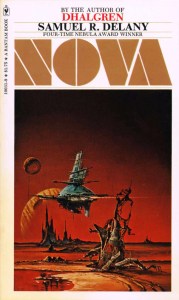
novaSD: All the experiences that were used in my own stories and books were black experiences—why? Because they were mine. In my books, sometimes the central characters were white—as in Trouble on Triton. Sometimes, as in The Fall of the Towers, Babel-17 (where the main character is Asian), or The Einstein Intersection, Dhalgren (where the main character has a white father and a Native American mother), or the Return to Nevèrÿon series, many or sometimes all were non-Caucasian.

 Here is something that I think as an almost purely black experience (it is only that racial experiences are never pure that keeps such purity a metaphor), one that I’ve told many of my black friends, fewer of my white friends, and written about fairly indirectly in my Return to Nevèrÿon fantasy sequence.

All my life, one of the things people—white people in particular—had been telling me was that I looked white. I didn’t particularly believe them—though sometimes I wondered. My parents had told me that I was black and I should be proud of it, as both of them were, but one day in late September or among the first days of Indian summer (I was still in elementary school, so I was probably 10 or 11), I was sitting on a bench in Central Park, with my school notebook open, doing my math homework, when, with unkempt blond hair and steel-blue eyes, a kid about 20—today, from the state of his jeans and sneakers and T-shirt you would know immediately he was homeless, and, though “homeless” was not part of our vocabulary then, I realized it—walked up in front of me, his grin showing not very good teeth. “Hey,” he said with the thickest Southern accent I’d heard in a while, “you a nigga ain’ ya, there, huh?” I looked up, surprised. “Yeah, you a nigga. I can tell. Tha’s cause I’m from Alabama. See I can always tell. You ain’ gonna get nothin’ by me. I can see it, right in yo’ face there. The mouth, the nose. All that—naw, I can see it. You ain’t gonna fool somebody like me, get away with nothin’.” Then, still grinning, he turned and walked off, through the sunny park.

And that was the first time I was called a nigger by a white guy—a homeless Alabama drifter coming up to an urban black kid on a bench doing his math homework.

Frankly, I got less upset over that one than I did over my father’s. Because at least it taught me something. I mean, he was right. There’s nothing unpleasant for a black person to be recognized, especially when, I assume, they feel they are telling you something that for some reason they think you want to hear.

And sometimes it happened with black folk. Yet more stories. At this point, I don’t remember whether it was the fifth or sixth time [that happened], but after one of the men or women left, frowning after them, I said to myself: You thickheaded nigger, you better stop believing all these white assholes who keep telling you how white you are, because obviously there are a whole lot of white people in this city—in the country (by then, it had happened a couple of times outside New York)—who have nothing else to do but go around on the lookout for any black person they think might be racially passing, and remind them that they can’t. But this is one very small way in which a race gets constituted socially.

Rest of the article: http://www.thenation.com/article/samuel-r-delany-speaks/

1 Comment

Filed under 2015, author interview, authors

Stephen Baxter interview: why science fiction is like therapy

The bestselling SF writer talks about the rush to finish the Long Earth series, being the order to Terry Pratchett’s chaos and how maths helps him write

by Alison Flood

Source: http://www.theguardian.com/books/2015/jul/25/stephen-baxter-interview-why-science-fiction-is-like-therapy

In the summer of 2013, Stephen Baxter and Terry Pratchett published The Long War, the second volume of their Long Earth science-fiction series, about parallel worlds that can be “stepped” into. By the end of that year, the two authors – both prolific by any standards – had completed drafts of the remaining three novels in the series. It was an astonishing rate of work, but there was a deadline that needed to be met: Pratchett had announced his diagnosis with a rare form of early onset Alzheimer’s in 2007. By the summer of 2014, he would pull out of a Discworld convention, citing “The Embuggerance”, which was “finally catching up with me”. He died in March this year.

Stephen Baxter

Stephen Baxter

“I think Terry was aware he was running out of time, and he wanted to do other things as well,” Baxter says. “So we rushed through it a little bit. Terry’s basic vision was the first step, but he also wanted to have a huge cosmic climax at the end, which would be book five … We had no idea how to get there but we knew where we were going.”

The Long Utopia, the fourth in the series, sees settlers on an Earth more than “a million steps” west of ours stumble across a disturbing, insectile form of alien life. Like its predecessors, the novel is compelling not only for its central storyline of exploration and danger and humans doing foolishly human things – and in this case a particularly cataclysmic finale – but also for its slow, unhurried laying out of the minute differences between these empty-of-humanity Earths.

The concept of a chain of parallel worlds, each a little different from its neighbour, was one Pratchett originally had, and set aside, in the 1980s. He told Baxter, a long-time friend and one of the UK’s most respected science-fiction authors, about it over dinner one night, and they decided to collaborate.

“It was a great idea but Terry’s strength did not lie in landscapes and things,” Baxter says. “He’d get a story by having a basic idea, get two people in a room talking and see where it went from there.”

This is not how Baxter works. His fiction, whether about the colonising mission sent to a planet orbiting a nearby red dwarf star, in Proxima, or the exploration of different evolutions of humanity in the Destiny’s Children series, is meticulously planned and pinned down, rooted in the scientific background from which he comes. He has a degree in maths from Cambridge and a PhD in aeronautical engineering; he is a fellow of the British Interplanetary Society and applied for a guest spot on the Mir space station in 1989, making it through a number of stages on his quest to be a cosmonaut but eventually missing out because of his lack of foreign languages.

Whether Baxter decides to submerge the world (Flood), or make humanity live in the centre of a neutron star (Flux), or keep the sea off Doggerland in an alternative prehistory (Stone Spring), there’s always a hook into something real. “I try to get it right. If you can get the maths right, I figure you’re most of the way there,” he says.

Baxter is fiercely intelligent, in a generous way, sharing his enthusiasms and knowledge on everything from recently discovered exoplanets to the Mars project (he’s not hopeful, because he doesn’t think enough has been done on long-term life support systems). At the British Interplanetary Society, he’s been part of study projects on everything from designing star ships to extraterrestrial liberty, an issue explored in Ark, his follow-up to Flood, in which the scraps of humanity flee their devastated planet in “generation ships” for an uncertain future outside the solar system.

“It’s all very well to plan a five-generation mission to Alpha Centauri, but if you’re one of the middle generations, you live out your life with very little room for manoeuvre,” he says. “So what right do you have to submit your children and grandchildren to a life of slavery like that? You get some interesting ethical issues – do you have rights over people who don’t yet exist, do they have rights?”

Rest of the article: http://www.theguardian.com/books/2015/jul/25/stephen-baxter-interview-why-science-fiction-is-like-therapy

Leave a comment

Filed under 2015, author interview

Author interview: Jonathan Lethem

Jonathan Lethem: “My intent to skewer is practically nonexistent”

He talks to Salon about his new book “Lucky Alan,” comics, fans and adoring his characters—even the difficult ones

Source: http://www.salon.com/2015/03/28/jonathan_lethem_my_intent_to_skewer_is_practically_nonexistent/

by MATT BELL

I started reading Jonathan Lethem with “Amnesia Moon,” maybe five or six years after it first came out. A teacher had suggested the book, after seeing me struggle with the more realist selections of the typical undergrad creative writing syllabus of the early 2000s, and almost immediately I was hooked, on both that book and Lethem’s writing in general. “Amnesia Moon” is an intoxicating but very strange novel — perhaps Lethem’s strangest, at least for me — and so I was surprised, in 2003, to find myself reading “The Fortress of Solitude,” with its much more grounded period setting beginning in 1970s Brooklyn.

I would soon immerse myself in the rest of Lethem’s books, and this range became one of the most exciting aspects of reading his novels and stories and essays: His interests are broad, his obsessions deep and his influences both announced and fully explored, engaged, built upon. If Lethem has topics or time periods or genres he returns to frequently, it feels to me less like a tic or a limitation and more like an indication that something is not yet finished, that his unshed obsessions return often to further provoke his imagination into new stories.

Jonathan Lethem’s “Lucky Alan” is his first short story collection since 2004’s “Men and Cartoons,” collecting the stories written in the decade that followed. In the years between, he’s published three novels, including 2013’s “Dissident Gardens,” and a slew of other projects in other genres, including penning a reboot of the comic book “Omega the Unknown”; collecting two books of essays, including “The Ecstasy of Influence,” titled after his provocative Harper’s essay of the same name; editing a volume of selections of Philip K. Dick’s journals; and another nonfiction book on The Talking Heads album “Fear of Music” for the popular 33 1/3 series. Our conversation with Lethem discusses how stories in “Lucky Alan” were written, as well as what changed (and what stayed the same) throughout this busy and productive decade.

Once I was a few stories into “Lucky Alan,” I started thinking about the book’s ordering, wondering if you’d consciously decided to start with two of the more realist stories — the title story and “The King of Sentences” — before moving on to stranger fare, like “Traveler Home,” where the protagonist is given a baby by a pack of wolves, or “Procedure in Plain Air,” with its surreal “installation” involving a man left in a hole outside a coffee shop, “an inverted phone booth of dirt and rubble.” But then a friend mentioned seeing you read “Procedure in Plain Air” at Skylight Books in Los Angeles a few weeks ago, where he reported that you’d said the stories appear here in the order they were written.

That answers one question but begs another: How do you chart the progress of your interests in the short story over that time? Does “Pending Vegan,” the last story, complete some line of artistic thought that began with the first, “Lucky Alan,” or is the book simply a method of collecting all the short work of a certain period in one place?

Q.: I’ve got at least 12 answers to this question, depending on whether I grab it by trunk or tail or some other appendage. Somewhere I once read a pragmatic assertion that the way to order a story collection is to put the best story first and the second-best last and the rest anywhere you like. I do think “Lucky Alan” and “Pending Vegan” are the two most satisfying and complete stories I’ve written, or at least that were uncollected. When I threw them into those positions, just to see what that looked like, I noticed immediately that one was the earliest piece in the book, and the other the most recent. Putting them in chronological sequence made for a quick solution to what probably wasn’t an important question in the first place: Does anybody typically read a story collection from beginning to end? (Of course many would say I could quit that rhetorical question sooner: Does anybody typically read a story collection?)

A.: Of course, I may have forgotten or been mistaken or be lying about the order of writing of some of the stories between those two. I jiggered the sequence at some point to make for what I thought would be a better alternation of the “more realist” with the “stranger fare” — though we might differ on what’s strange. In the experience of their maker, “The King of Sentences,” for instance, is stranger than “Procedure in Plain Air.” The first is an unrepeatable language pratfall, the second a pretty methodological fiction, putting two incommensurate things together and playing out the result. That one feels traditional to me. But that’s just the experience of the maker.

More at: http://www.salon.com/2015/03/28/jonathan_lethem_my_intent_to_skewer_is_practically_nonexistent/

Leave a comment

Filed under 2015, author interview

An Interview With Margaret Atwood

The acclaimed author on hope, science, and writing about the future.

By Ed Finn

Source: http://www.slate.com/articles/technology/future_tense/2015/02/margaret_atwood_interview_the_author_speaks_on_hope_science_and_the_future.single.html

Margaret Atwood

Margaret Atwood

Climate fiction, or “cli fi,” can be a dreary genre. Storytellers like to make a grim business of climate change, populating their narratives with a humorless onslaught of death, destruction, drowned monuments, and starving children. Margaret Atwood is the conspicuous exception, somehow managing to tackle the subject, including these familiar elements, with deadpan wit and an irreverent playfulness, making it both more interesting and believable. The flood is coming, her MaddAddam trilogy promises, but there is hope.

Atwood’s intensely literary, human focus on environmental issues and the future of the planet is shaping a more optimistic vision of cli fi, one that sidesteps the blame games and the “will-they, won’t-they” battles over carbon emissions. Her response is clear and compelling: The planet is changing. We need creativity, ambition, and some powerful new stories to understand how we can change with it.

My colleagues and I invited Atwood to Arizona State University in November to help launch a new project about these challenges, the Imagination and Climate Futures Initiative. (Disclosure: ASU is a partner with Slate and New America in Future Tense.) Our conversation was inspired by the idea that an effective response to what Atwood calls the “everything change” will take more than better batteries and lightbulbs (though we’ll need them too). To answer the challenge, we need to think much bigger about what it means to be human in the era when we dominate every corner of this world.

Last fall, you became the first author to submit work to the Future Library project—and no one will be able to read that story until 2114.

The Future Library project is something thought up by a conceptual artist called Katie Paterson. She was approached by the Oslo Library in Norway, which is building a new facility, and it wanted a special thing. What she came up with was Future Library. A forest has been planted in Norway that will grow for 100 years. Each one of those 100 years, one author will be invited to contribute something to the future library in a sealed box. It can be one word. It can be a poem. It can be a story. It can be a novel. It can be nonfiction. There are two stipulations: No. 1, no images. No. 2, you cannot tell anybody what is inside the box.

These boxes will accumulate in a special room—the Future Library room—and people will be able to go into that room and see the titles and the authors and imagine what’s in the boxes. Meanwhile the forest is growing, and at the 100-year moment, the boxes will all be opened and enough trees will be cut from this forest to make the paper to print the Future Library books. The first person to put a box in there—their book will be a hundred years old. The last person to put it in—it will be 1 year old. You will get a continuum through 100 years of what writers have seen fit to communicate to the future.

The selecting committee will renew itself as it will have to do, and the people who will be on that final committee have not been born yet nor have their parents been born. The final authors have not been born yet nor have their parents been born, so it’s completely an unknown. It’s the kind of project you are going to either say yes to immediately because it grabs your imagination, or you’re going to say no to it immediately because you’ll not be able to see the point of writing something that will not be published in your lifetime.

Rest of the interview: http://www.slate.com/articles/technology/future_tense/2015/02/margaret_atwood_interview_the_author_speaks_on_hope_science_and_the_future.single.html

Leave a comment

Filed under 2015, author interview

Author regrets writing story

“Brokeback Mountain” author Annie Proulx says she regrets writing the story

by Daisy Wyatt

Source: http://www.independent.co.uk/arts-entertainment/books/news/brokeback-mountain-author-annie-proulx-says-she-regrets-writing-the-story-9949636.html

Annie Proulx has said she regrets writing “Brokeback Mountain” due to the number of men who have written to her complaining about the story’s ending.

The US author said she wishes she had not written the short story after the “hassle and problems and irritation” she received after the film came out in 2005.

“So many people have completely misunderstood the story. I think it’s important to leave spaces in a story for readers to fill in from their own experience, but unfortunately the audience that ‘Brokeback’ reached most strongly have powerful fantasy lives,” Proulx said in an interview with the Paris Review.

“And one of the reasons we keep the gates locked here is that a lot of men have decided that the story should have had a happy ending. They can’t bear the way it ends – they just can’t stand it.

“So they rewrite the story, including all kinds of boyfriends and new lovers and so forth after Jack is killed. And it just drives me wild.”

The author said the majority of letters she received complaining about the film’s ending began “I’m not gay, but…” and added that she was frustrated the men did not seem to understand that the story was not about the lead characters Jack and Ennis.

“It’s about homophobia; it’s about a social situation; it’s about a place and a particular mindset and morality. They just don’t get it,” she said.

Rest of the article at: http://www.independent.co.uk/arts-entertainment/books/news/brokeback-mountain-author-annie-proulx-says-she-regrets-writing-the-story-9949636.html

Leave a comment

Filed under author commentary, author interview