Category Archives: article by author

Writing tip Wednesday: “Cat got your keyboard?”

by DAVID E. BOOKER

To be or not be stuck...

To be or not to be stuck…

Stuck? Writing stuck? No, not writer’s block, just not quite sure what to do next or even how to start that article, story, or novel? Here are three suggestions that might help. There are plenty of others, so if these don’t help, don’t hesitate to look for something that will. You only fail at writing when you don’t try.

1) Write a letter
Put what you want to say in letter form. The writer Tom Wolfe once was stuck on an article he was doing on stock car racing. He had spent time researching and talking with drivers, mechanics, and any number of people. He had the information, but he couldn’t quite figure out how to write. His deadline was fast approaching, but he couldn’t get traction. Finally, he called the editor at the magazine where the article was to appear and explained he couldn’t write the article. He would type up his notes and send them in and the editor could find somebody else to write the piece. So, he wrote up the information in a letter form and sent it in. When the editor received it, he immediately saw that it was an almost complete article just the way it was. The editor and Tom Wolfe made a few edits and adjustments to the piece and it was published pretty much as Tom Wolfe had written – that is, like a letter.

2) Keep several things going
The late Isaac Asimov, author of over 500 books (fiction and non-fiction), used to keep two or three writing projects going at the same time. That way, if he got stuck on one, he would turn to work on another. Once when asked what would he do if he was told he had only six months to live, he replied, “Type faster.” Keeping two or three things going at once can help prevent you from getting stuck on any one piece of work.

3) Free writing
Free writing is writing what comes to mind without regard to how it fits into what you “need” to be writing or even what may be the next sentence. Sometimes to get going in the “write” direction, you need a little gibberish to get you going. Maybe even write a silly poem, like
Roses are red
violets are blue
I suck at writing poetry
how about you?

Do free writing for about fifteen minutes and see if gets you going.

These are not the only ways to get your writing unstuck, but whatever you use, I hope you realize from these examples that even published and prolific authors can get stuck, too.

Leave a comment

Filed under article by author, Writing Tip Wednesday

Writing Week in Review

Writing Week in Review

or

Ten minutes You’ll never get back in this lifetime

by DAVID E. BOOKER
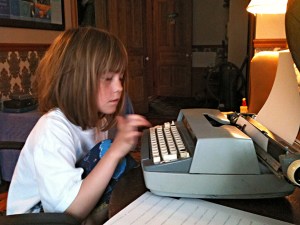
Practice, practice, practice.

Practice, practice, practice.

Summary: Up and down week for my computer, my Internet connect, and for my writing.

Details: I don’t know if my computer is on its last virtual legs or headed for silicon senility, but it has taken to spontaneously rebooting, and even telling me after it has done so that it has “Recovered from a System Error” or something like that. There is no set time of the day for this to take place. It has happened while I am sitting at the computer and while I am away.

My Internet connection has also been up and down. That was also without a set time of the day, though it tended to happen more after 9 PM. It had been going on for several weeks, building from a spotty event to a continual-though-hard-to-predict-when event. I finally reached the point of exasperation, having done all the things I could do, such as reboot the modem (several times), check the inside connections (again several times), and run the diagnostics provided with the modem, which only tended to confirm that my Internet was down. (Dah, don’t you think I already figured that much out?)

First, an inside guy appeared and checked out everything. It was one of those appointment windows – you know the type – where you get a window of opportunity, as I like to call it. The technician was scheduled to be there “between 4 and 8 PM.” Fortunately, he arrived a little after 4 PM and even called my wife, who was at home, at 4 to say he would be at our house in ten minutes, and he was. He was polite and checked things out and said everything on the inside was fine, that an outside technicians would have to be scheduled to come out. He couldn’t say exactly when that would happen. I guess technicians don’t have a secret handshake – virtual or otherwise – that gets them any more inside information that the rest of us get.

Well, the outside guy arrived the next morning. He called to say he was outside, but nobody was at home at the time he called. The inside technician seemed to think the outside guy might have to replace the line running from the pole to the house, and so would need access to the house. Not likely to happen when nobody’s here. I have heard of one person in my neighborhood who leaves her house doors unlocked when she leaves, but she ain’t me. I lock, lock, and lock again.

Anyway, whatever he did, short of replacing the line, appears to be working. For the past few days the Internet connect has not dropped out at unexpected times for explained reasons. So, I give high marks for the workmanship, the promptness of service (even if one part of it came without a confirmation of the schedule), and for the courtesy of the technicians, including the person at the call center, for whom I’m sure English was not his native language. Or maybe it was my tired ears that couldn’t quite understand him and had to ask, on several occasions, for something to be repeated.

As for my writing, it has been a bit skewed this week. Normally, I get up at 3 AM to write for about 30 minutes or so before going to work. I have a modest goal of 300 words a day on the two novels I am working on. However, due to a change in my work schedule, I am not getting up at 3 AM to get to work. Because of that my modest goal has fallen behind this week. I have tried writing in the late afternoon or early evening when I get home, but there are always chores and family obligations and evening meetings that get in the way. I am trying to adjust. Maybe I can catch up some this weekend.

It is often frustrating how little things and acts of life can get in the way of writing. Of course, I can do a good job of getting in my own way, but that is a topic for another time.

[Author’s note: this is the first time I have done this and it may not be a regular thing. My intention is not to bore and certainly not to call attention to myself as someone special. If anything, it shows how ordinary a person a writer is, except for the desire to accomplish something that looks so easy, but is far from it.]

Leave a comment

Filed under article by author, Photo by author, Writing Week in Review

Writing tip Wednesday: “Pre-writing”

Pre-writing might help you write faster and clearer.

Pre-writing might help you write faster and clearer.

Do you pre-write?

Pre-writing? Is that like rinsing your dishes before putting them in the dishwasher to make sure they get clean? you ask.

Sort of. The goal is at least equivalent. You pre-write with the idea in mind that it will help guide you to a better conclusion to that day’s writing.

It doesn’t take long. The amount of time pre-writing could depend on the number words or amount of time you are going to spend writing, but should probably be no more than ten minutes.

When you pre-write, you decide what scene it is you are working on and what should happen or that you want to happen in that scene.

For example, say Nick is in a hurry to get to the local BBQ restaurant to meet Kelly for their first date. You decide: Nick is nervous. He hasn’t had a date in almost a year and he always wanted to date Kelly. He is so nervous he mistakes his cologne for his shampoo and accidentally dumps most of his cologne on his head and now has to scramble to clean himself up and NOT reek of his favorite cologne, the one guaranteed to drive women mad. Kelly will certainly be mad if he arrives late.

Now, with that brief sketch of the scene, you write it out in more detail, but you know what he has done and what he is trying to do and what has happened to prevent him from accomplishing his goal of meeting Kelly on time, or even arriving a little ahead of time.

Give it a try and see if it works for you. See if it helps you write more in the same amount of time or write clearer. Some authors, such as Rachel Aaron in her e-book 2,000 to 10,000, How to write faster, write better, and write more of what you love.

I wonder how long it took her to write that title.

Leave a comment

Filed under article by author, Writing Tip Wednesday

Writing tip Wednesday: three keys to dialogue

by David E. Booker

1) It’s not conversation. In his book, On Writing: Advice to Those Who Write to Publish (Or Would Like to), George V. Higgins, known for his dialogue, advises developing an ear for dialogue, but that dialogue in stories is not simply conversation lifted from daily life and dropped into a story.

Normal speech is full of too many “uhs, ahs, and other sounds that are verbal place holders and don’t really have any place in fictional dialogue. Also, normal speech is full of “small talk.” Things like, “Hi, how are you? How’s the husband and kids? It sure looks like the team will have a good season this year.” All things meant to keep the lines of communication open, psychologists might say, but are of little use in furthering your story. In short, good dialogue moves the story forward. Asking about the family or saying the team will have a good year only keeps the story in place.

A corollary to this is the “As you know, Fred” dialogue, which is dialogue between two people who know the information being conveyed, but they are conveying it, anyway, for the sake of the reader, who doesn’t know. Science fiction can many times be guilty of this when two scientists of the same discipline, say particle physics, “converse” with each other about what a particle is.

2) It’s often what you don’t say. Subtext is the hidden force of any scene of a story or movie. As the noted script writer and teacher, Robert McKee says, “If a scene is about what a scene is about, then the scene is dead.”

Good dialogue

Often, good dialogue is about what isn’t being said.

For example, if two people are engaged in changing a tire and all they talk about is tire changing, then the scene is dead. However, if during that scene, one member is gruff to the other one and eventually says the flat was his fault for not checking the tires to begin with, then you have an emotional charge running through the scene and dialogue is then used to convey that emotional charge, the subtext is the tug of war of one person trying to blame another and how the person being blamed reacts or handles the accusation.

3) It’s okay to only use “said” and “asked.” Many writers learning their craft try to spice up a scene by having their characters express their dialogue with: he espoused, she guffawed, he trumpeted, she queried, etc. This will only slow down a scene. It should be: he said, or he asked, if it is a question. One exception might be: she yelled. But other than these, if the scene does not convey the right intensity with which your characters should be speaking, then there is something amiss in the scene, and it won’t be fixed by exchanging “she said” for “she espoused.”

In fact there are some writers, such as the late Robert B. Parker, who use only “he said” or “she said,” even where there was a question. He figured the use of the question mark at the end of the spoken sentence was clue enough.

And please note, by saying “he” or “she,” I am not saying never use the speaker’s name. particularly when somebody is speaking for the first time in a scene, it is often recommended that the text read, “Bob said” or “Alice asked.”

There are certainly other suggestions for creating good dialogue, but mastering these three will put you on your way to having dialogue that moves the story forward and adds a good boast to your writing.

2 Comments

Filed under article by author, dialogue, writing tip, Writing Tip Wednesday