Category Archives: advice

Emotional Intelligence: The Social Skills You Weren’t Taught in School

https://getpocket.com/explore/item/emotional-intelligence-the-social-skills-you-weren-t-taught-in-school?utm_source=pocket-newtab

You’re taught about history, science, and math when you’re growing up. Most of us, however, aren’t taught how to identify or deal with our own emotions, or the emotions of others. These skills can be valuable, but you’ll never get them in a classroom.

Emotional intelligence is a shorthand that psychological researchers use to describe how well individuals can manage their own emotions and react to the emotions of others. People who exhibit emotional intelligence have the less obvious skills necessary to get ahead in life, such as managing conflict resolution, reading and responding to the needs of others, and keeping their own emotions from overflowing and disrupting their lives. In this guide, we’ll look at what emotional intelligence is, and how to develop your own.

What Is Emotional Intelligence?

Measuring emotional intelligence is relatively new in the field of psychology, only first being explored in the mid-80s. Several models are currently being developed, but for our purposes, we’ll examine what’s known as the “mixed model,” developed by psychologist Daniel Goleman. The mixed model has five key areas:

  • Self-awareness: Self-awareness involves knowing your own feelings. This includes having an accurate assessment of what you’re capable of, when you need help, and what your emotional triggers are.
  • Self-management: This involves being able to keep your emotions in check when they become disruptive. Self-management involves being able to control outbursts, calmly discussing disagreements, and avoiding activities that undermine you like extended self-pity or panic.
  • Motivation: Everyone is motivated to action by rewards like money or status. Goleman’s model, however, refers to motivation for the sake of personal joy, curiosity, or the satisfaction of being productive.
  • Empathy: While the three previous categories refer to a person’s internal emotions, this one deals with the emotions of others. Empathy is the skill and practice of reading the emotions of others and responding appropriately.
  • Social skills: This category involves the application of empathy as well as negotiating the needs of others with your own. This can include finding common ground with others, managing others in a work environment, and being persuasive.

You can read a bit more about these different categories here. The order of these emotional competencies isn’t all that relevant, as we all learn many of these skills simultaneously as we grow. It’s also important to note that, for our purposes, we’ll only be using this as a guide. Emotional intelligence isn’t an area that most people receive formal training in. We’ll let psychologists argue over the jargon and models, but for now let’s explore what each of these mean and how to improve them in your own life.

Self-Awareness

Before you can do anything else here, you have to know what your emotions are. Improving your self-awareness is the first step to identifying any problem area you’re facing. Here are some ways to improve your self-awareness:

  • Keep a journal: Career skill blog recommends starting by keeping a journal of your emotions . At the end of every day, write down what happened to you, how you felt, and how you dealt with it. Periodically, look back over your journal and take note of any trends, or any time you overreacted to something.
  • Ask for input from others: As we’ve talked about before when dealing with your self-perception, input from others can be invaluable . Try to ask multiple people who know you well where your strengths and weaknesses lie. Write down what they say, compare what they say to each other and, again, look for patterns. Most importantly, don’t argue with them. They don’t have to be correct. You’re just trying to gauge your perception from another’s point of view.
  • Slow down (or meditate): Emotions have a habit of getting the most out of control when we don’t have time to slow down or process them . The next time you have an emotional reaction to something, try to pause before you react (something the internet makes easier than ever, if you’re communicating online). You can also try meditating to slow your brain down and give your emotional state room to breathe.

If you’ve never practiced intentional self-awareness, these tips should give you a practical head start. One strategy I personally use is to go on long walks or have conversations with myself discussing what’s bothering me. Often, I’ll find that the things I say to the imaginary other end of the conversation can give me some insight into what’s really bugging me. The important aspect is to look inwards, rather than focusing solely on external factors.

Self-Management

Once you know how your emotions work, you can start figuring out how to handle them. Proper self-management means controlling your outbursts, distinguishing between external triggers and internal over-reactions, and doing what’s best for your needs.

One key way to manage your emotions is to change your sensory input. You’ve probably heard the old advice to count to ten and breathe when you’re angry. Speaking as someone who’s had plenty of overwhelming issues with depression and anger, this advice is usually crap (though if it works for you, more power to you). However, giving your physical body a jolt can break the cycle. If you’re feeling lethargic, do some exercise. If you’re stuck in an emotional loop, give yourself a “snap out of it” slap. Anything that can give a slight shock to your system or break the existing routine can help.

Lifehacker alum Adam Dachis also recommends funneling emotional energy into something productive. It’s alright to let overwhelming emotions stew inside you for a moment, if it’s not an appropriate time to let them out. However, when you do, rather than vent it on something futile, turn it into motivation instead:

I recently started playing tennis for fun, knowing that I’d never become exceptional because I began too late in life. I’ve become better and have a very minor talent for the game, so when I play poorly I now know and I get down on myself. When up against an opponent with far more skill I find it hard to do much else than get angry. Rather than let that anger out, I take note of it and use it to fuel my desire to practice more. Whether in sports, work, or everyday life, we can get complacent with our skill and forget that we always have some room for improvement. When you start to get mad, get better instead.

You can’t always control what makes you feel a certain way, but you can always control how you react. If you have some impulse control problems, find ways to get help when you’re feeling calm. Not all emotions can be vented away. My struggle with depression taught me that some emotions persist long after the overflow. However, there’s always a moment when those feelings feel a little less intense. Use those moments to seek help.

Motivation

We talk about motivation a lot . When we’re talking about motivation as it relates to emotional intelligence, however, we don’t just mean getting up the energy to go to work. We’re talking about your inner drive to accomplish something. That drive isn’t just some feel-goody nonsense, either. As Psychology today explains, there’s a section of your prefrontal cortex that lights up at the mere thought of achieving a meaningful goal.

Whether your goal is building a career, raising a family, or creating some kind of art, everyone has something they want to do with their life.When your motivation is working for you, it connects with reality in tangible ways. Want to start a family? Motivated people will start dating. Want to improve your career? Motivated people will educate themselves, apply for new jobs, or angle for a promotion.

Daniel Goleman suggests that in order to start making use of that motivation, you first need to identify your own values. Many of us are so busy that we don’t take the time to examine what our values really are. Or worse, we’ll do work that directly contradicts what we value for so long that we lose that motivation entirely.

Unfortunately, we can’t give you the answer for what it is you want in life, but there are lots of strategies you can try . Use your journal to find times when you’ve felt fulfilled. Create a list of things you value. Most of all, accept the uncertainty in life and just build something. Fitness instructor Michael Mantell, Ph.D suggests that using lesser successes you know you can accomplish. Remember, everyone who’s accomplished something you want to achieve did it slowly, over time.

Empathy

Your emotions are only one half of all your relationships. It’s the half you focus on the most, sure, but that’s only because you hang out with yourself every day. All the other people that matter to you have their own set of feelings, desires, triggers, and fears. Empathy is your most important skill for navigating your relationships . Empathy is a life-long skill, but here are some tips you can use to practice empathy:

  • Shut up and listen: We’re gonna start with the hardest one here, because it’s the most important. You can’t experience everyone else’s lives to fully understand them, but you can listen. Listening involves letting someone else talk and then not countering what they say. It means putting aside your preconceptions or skepticism for a bit and allowing the person you’re talking to a chance to explain how they feel. Empathy is hard, but virtually every relationship you have can be improved at least marginally by waiting at least an extra ten seconds before you retake the conversation.
  • Take up a contrary position to your own: One of the quickest ways to solidify an opinion in your mind is to argue in favor of it. To counter this, take up a contrary position. If you think your boss is being unreasonable, try defending their actions in your head. Would you find their actions reasonable if you were in their shoes? Even asking the questions of yourself can be enough to start empathizing with another’s point of view (though, of course, getting real answers from others can always help).
  • Don’t just know, try to understand: Understanding is key to having empathy. As we’ve discussed before, understanding is the difference between knowing something and truly empathizing with it. If you catch yourself saying, “I know, but,” a lot, take that as an indicator that you should pause a bit more. When someone tells you about an experience that’s not your own, take some time to mull over how your life might be different if you experienced that on a daily basis. Read about it until it clicks. It’s okay if you don’t spend all your time devoted to someone else’s life, but putting in just some time—even if it’s idle thought time while you work—can be beneficial.

By definition , empathy means getting in the emotional dirt with someone else. Allowing their experiences to resonate with your own and responding appropriately. It’s okay to offer advice or optimism, but empathy also requires that you wait for the right space to do that. If someone’s on the verge of tears, or sharing some deep pain, don’t make light of it and don’t try to minimize the hurt. Be mindful of how they must feel and allow them space to feel it.

Social Skills

Summing up all social skills in one section of an article would do about as much justice to the topic as if we snuck in a brief explainer on astrophysics. However, the tools you develop in the other four areas will help you resolve a lot of social problems that many adults still wrestle with. As Goleman explains, your social skills affect everything from your work performance to your romantic life:

Social competence takes many forms – it’s more than just being chatty. These abilities range from being able to tune into another person’s feelings and understand how they think about things, to being a great collaborator and team player, to expertise at negotiation. All these skills are learned in life. We can improve on any of them we care about, but it takes time, effort, and perseverance. It helps to have a model, someone who embodies the skill we want to improve. But we also need to practice whenever a naturally occurring opportunity arises – and it may be listening to a teenager, not just a moment at work.

You can start with the most common form of social problems: resolving a disagreement. This is where you get to put all your skills to the test in a real-world environment. We’ve gone into this subject in-depth here , but we can summarize the basic steps:

  • Identify and deal with your emotions: Whenever you have an argument with someone else, things can get heated. If someone involved is emotionally worked up, deal with that problem first. Take time apart to vent, blow off steam on your own, then return to the problem. In a work environment, this may just mean complaining to a friend before you email your boss back. In a romantic relationship, remind your partner that you care about them before criticizing.
  • Address legitimate problems once you’re both calm: Once you’re in your right headspace, identify what the conflict is. Before you jump to solutions, make sure you and the other person agree on what the problems really are . Propose solutions that are mutually beneficial and be sympathetic to any concessions the other person may be unwilling to make (but be sure to stand firm on your own).
  • End on a cooperative note: Whether in business or pleasure, relationships work best when everyone involved knows that they’re on the same page. Even if you can’t end on a positive note, make sure that the last intention you communicate is a cooperative one. Let your boss/coworker/significant other know that you want to work towards the same goal, even if you have different views.

Not every type of interaction with another person will be a conflict, of course. Some social skills just involve meeting new people , socializing with people of different mindsets , or just playing games . However, resolving conflict can be one of the best ways to learn how to apply your emotional skills. Disputes are best resolved when you know what you want, can communicate it clearly, understand what someone else wants, and come to favorable terms for everyone. If you’ve been paying attention, you’ll notice that this involves every other area of the emotional intelligence model.
Leave a comment

Filed under 2020, advice

The 27 Best Books on Writing

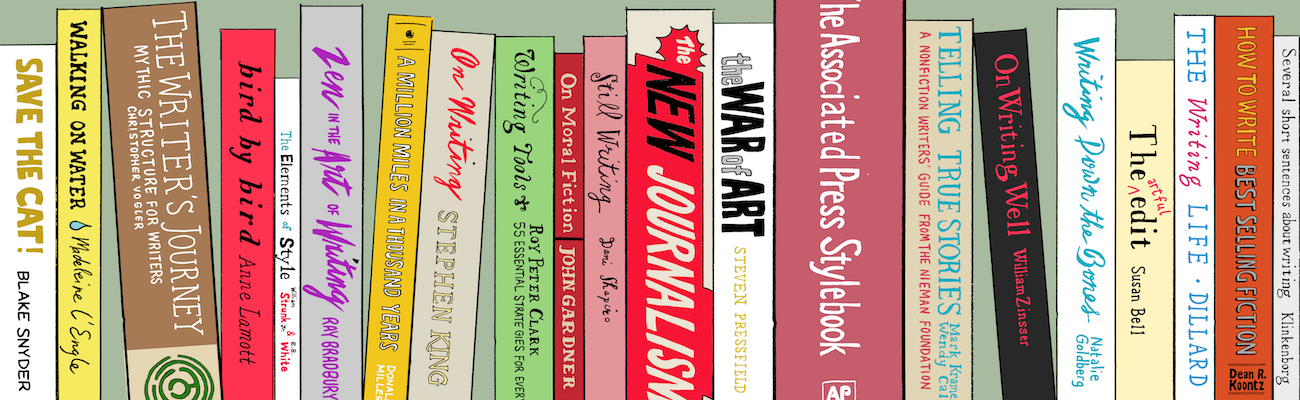
Writing is hard, and defining yourself as a writer can be even harder. Here’s our exhaustive list of the best books on writing when the blank page beckons.

Source: The 27 Best Books on Writing

Writing is, as a general rule, hard. Defining yourself as a writer can be even harder. Sure, there are other difficult practices like law and medicine out there, but a person becomes a lawyer or a doctor when he or she passes a series of exams and graduates from a certain school. Writing doesn’t always work that way. There aren’t tests to study for and facts to memorize. Where are we supposed to learn how to write?

From grammar rules to publishing advice to personal narratives, these books on writing reveal in intimate detail the ins and outs of what it means to call yourself a writer. Sometimes harsh, sometimes funny, but always honest, they can be thought of as a kind of syllabus for writing. Whether you’re an aspiring artist working on your first drafts or a seasoned veteran in the publishing world, these are some of the best books on writing with insight and wisdom that can support you at all stages of your writing process.

Books listed include:

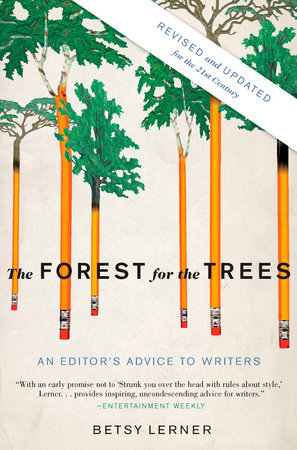
The Forest for the Trees (Revised and Updated)
An Editor’s Advice to Writers

by Betsy Lerner

For both established and prospective authors alike, the publishing house can seem like a jungle. Luckily, Betsy Lerner is here to lead a safari, citing her vast collection of experiences as an editor as her field guide. The Forest for the Trees motivates writers by helping them get over their fear of the unknown. It’s less about taming the wilderness and more about facing the demons of self-doubt and sloth that live in every person’s own mind.

***

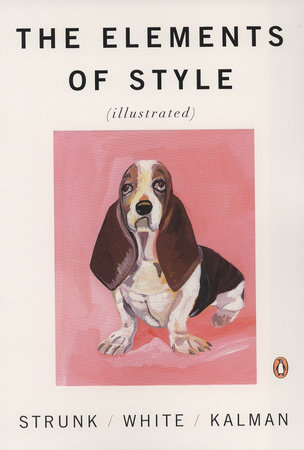
The Elements of Style Illustrated

by Strunk, White, Kalman

William Strunk and E.B. White’s The Elements of Style is so widely known that we’re sure you already have a copy, but of course we had to mention it. The only style guide to ever appear on a bestseller list, this book should be your go-to if your writing is in need of an infusion of clarity. Plus, this particular edition is illustrated by Maira Kalman, adding a visual element of style to the classic.

***

Story Engineering

by Larry Brooks

Larry Books turns a technical eye to the writing process in Story Engineering. If you don’t properly plan out your story prior to setting pen to paper, he argues, your storytelling won’t be as effective as you’d like it to be. To remedy this, he takes readers through six core elements of storytelling: concept, character, theme, story structure, scene construction, and voice.

***

Naked, Drunk, and Writing
Shed Your Inhibitions and Craft a Compelling Memoir or Personal Essay

by Adair Lara

Adair Lara’s Naked, Drunk, and Writing is a must-read for any memoirist or personal essayist. With experience as a teacher, editor, and, of course, writer, Lara’s know-how will help readers through problems like how to face your family after they’ve read your work and how to find an agent who will fight for you. The perfect mix of tough love, comic relief, and passion, Lara’s book is invaluable for anyone who needs a little help telling their story.

***

How to Write a Damn Good Novel

by James N. Frey

James N. Frey’s overarching guide will be of use to both the novice and the seasoned, published writer. He provides advice for how to overcome writer’s block and fear of the blank page, how to turn a critical eye to your own writing, and more. Frey’s book is one to keep within arm’s reach while writing, to grab during those moments when you need to take a step back from your work and get back to basics.

***

On Moral Fiction

by John Gardner

Morality and art have a complicated relationship, but John Gardner faces it fearlessly in this book-length essay. By Gardner’s way of thinking, all real art is moral, but morality doesn’t necessarily have to do with codes of conduct and submission to a Higher Power; it is the ability of art to point to some human value. The harsh lines he draws to distinguish “art” from “not art,” may frustrate some, but even in that case, this book’s ideas stick in the reader’s head.

***

On Writing

by Stephen King

If you’ve ever read a book by renowned American horror novelist Stephen King, you’ve probably wondered just how he comes up with his ideas. For the answer, look no further than On Writing, King’s memoir where he describes his writing process, including anecdotes about how he started some of his most iconic stories. In addition to recounting his personal experiences, he dedicates a whole chapter to grammar and offers his advice on form. It’s a great read for anyone in need of inspiration, and how better to make you pay attention than Mr. King?

***

The Writer’s Journey

by Christopher Vogler

Movie lovers will appreciate this book from Christopher Vogler. He exemplifies his writing tips with movies, a practice that makes this instructional especially helpful for screenwriters. Having received praise from writers and directors such as Darren Aronofsky (Black Swan) and Bruce Joel Rubin (Ghost), The Writer’s Journey can boast its status as an essential to anyone looking to write the next Oscar nominated film. It’s also an excellent field guide for a novelist stuck in a plot maze and desperate to get out.

***

A Poetry Handbook

by Mary Oliver

Imagine if you could get help with the very basics of writing poetry from a Pulitzer Prize-winning poet? Fact is, you can via Mary Oliver’s book A Poetry Handbook. The handbook is written in a way that makes it a perfect resource for both teens and adults as they start on their poetry journey – and is a useful refresher for veteran poets as well.

***

For the full list, with brief descriptions and links to buy them, go to http://www.signature-reads.com/2016/10/the-27-best-books-on-writing/?ref=PRH6E5971A08F&aid=randohouseinc31159-20&linkid=PRH6E5971A08F

Leave a comment

Filed under 2016, advice

Robert De Niro’s advice can be of use to us all

Esteemed actor Robert De Niro’s commencement speech to the 2015 graduates of NYU’s Tisch School of Arts is colorful, humorous, and honest. Reject will come often, he said. His answer: Next. Next project. Next part. Next try.

It will not be easy, he said, but succumbing to your destiny often isn’t, especially in the arts.

Don’t worry, it’s only about 16 minutes long. He headed the advice of a couple of Tish students he consulted beforehand who told him to keep it short.

Leave a comment

Filed under 2015, advice

Saturday update: “‘Breakneck speed'”

[Editor’s note: below is a follow up article to the one posted in this blog on Thursday: https://talltalestogo.wordpress.com/2014/12/04/haiku-to-you-thursday-brain-drain/.]

UT: Missing brains were destroyed

By Benjamin Wermund | December 3, 2014

Source: http://www.chron.com/local/education/campus-chronicles/article/UT-scrambling-to-find-missing-brains-5932435.php

The bizarre mystery of the University of Texas at Austin’s missing brains came to a swift end Wednesday, as officials revealed that the preserved organs had been destroyed more than a decade ago. But some questions remain.

One hundred brains, kept in formaldehyde-filled jars, were reported missing this week from the state’s premier research university. About 200 brains dating from the 1950s, which originally belonged to patients at the Austin State Hospital, were given to UT for research in the 1980s.

About half of them briefly went unaccounted for and officials spent Tuesday and Wednesday scrambling to find them. A preliminary university investigation found that UT environmental health and safety officials disposed of multiple brain specimens in 2002 in accordance with protocols concerning biological waste.

But questions remain — including why the brains were destroyed — and the university said it would appoint an investigative committee to get answers.

“As researchers and teachers, we understand the potential scientific value of all of our holdings and take our roles as stewards of them very seriously,” UT officials said in a statement. “The university will also investigate how the decision was made to dispose of some of these specimens and how all brain specimens have been handled since the university received its collection from the Austin State Hospital in the 1980s.”

The brains were in poor condition when the university received them in the 1980s and were not suitable for research or teaching, the university said in a statement. Workers disposed of between 40 and 60 jars, some of which contained multiple human brains, the statement said.

Despite reports that the missing brains included that of Charles Whitman, the sniper who went on a shooting spree from the UT Tower in 1966, UT officials said they had no evidence that Whitman’s brain had been destroyed with the others. Other reports Wednesday that the brains had been given to UT campuses in San Antonio also appeared to be false, UT said. The university will continue to investigate both claims, however.

“We’re moving at breakneck [Editor’s note: An interesting word choice considering speed to figure this all out,” UT spokesman Gary Susswein said Wednesday. “We obviously take this very seriously.”

Author Alex Hannaford discovered the brains had gone missing while reporting for his book, “Malformed: Forgotten Brains of the Texas State Mental Hospital.” Hannaford detailed the mystery in an article for the Atlantic, published Tuesday.

Timothy Schallert, a neuroscientist at UT and curator of the university’s collection of preserved brains, told Hannaford that by the mid-1990s, about 200 of the organs, sealed in jars, were taking up much-needed space at UT’s Animal Resources Center. Jerry Fineg, the center’s then-director, asked Schallert if he would move half of the jars elsewhere.

Eventually, Schallert discovered about half of the brains had gone missing. “I never found out exactly what happened—whether they were just given away, sold or whatever—but they just disappeared,” he told Hannaford.

Hannaford said Wednesday that UT still has a lot of questions to answer. He questioned whether 100 brains could possibly fit into the 40 to 60 jars UT says it destroyed.

“It leaves the question, are there some that are unaccounted for?” he said, adding that it was “pretty obvious that Whitman’s brain was part of the collection.”

Coleman de Chenar, a pathologist at the Austin State Hospital in the 1960s, conducted the autopsy on Whitman, who had left a note for police, urging physicians to examine his brain for signs of mental illness. Whitman’s brain reportedly ended up in the collection of specimens then housed at the hospital that was later given to UT, Hannaford said.

“As far as I’m concerned, it leaves some sort of open ended questions,” Hannaford said.

1 Comment

Filed under advice

I’m a writer and I don’t get no respect

[Editor’s note: I believe it was the late Rodney Dangerfield who had a comedy routine based on “I don’t get no respect.” The lack of respect could come from anybody, anywhere, including his wife. Below is a playwright Rodney could empathize with. He writes to Dear Abby, and she responds. I have known one or two other writers in the same situation. Maybe you, do, too.]

Rodney Dangerfield

Sometimes respect is hard to come by for a writer, or a comic. Just ask Rodney Dangerfield.

DEAR ABBY: I am an amateur playwright. Our local theater sponsors an annual playwriting contest. The prize isn’t monetary, but something far more important to an author – full scale production of the play.

I have won this prize four times – more than any other writer in the history of the contest. But is my family impressed? Not at all! My wife told me she thinks I write everything the same way and have simply repeated myself four times.

I am up in years. It’s unlikely I will ever again win this prize. So how do I respond to such indifference? What do you do when you feel you have accomplished something important and the response is, “so what else is new?”

–Looking for Validation in Florida

DEAR LOOKING FOR VALIDATION: My hat’s off to you. That you have won this prize more than any other writer in the history of the contest is a notable achievement. Attend the production, take your well-earned bow in the spotlight, and accept that the less you look to your wife for validation, the happier your life will be.

Leave a comment

Filed under advice, Dear Abby, humor, respect, Rodney Dangerfield, writer, writing

Best writing advice you’ve received?

Below is some writing advice gathered by Chip MacGregor of MacGregor Literary. The listing below is from his blog. Website for the agency is http://macgregorliterary.com/.

http://chipmacgregor.typepad.com/main/2011/12/whats-the-best-writing-advice-you-ever-got-.html

December 30, 2011

What’s the best writing advice you ever got?

I’ve had several people write to share the best writing advice they’ve ever received.

Vince Zandri, who has done numerous novels and sold more than a quarter million books, wrote to me and said, “The best writing advice I ever got came from Ernest Hemingway in the form of his memoir, A Moveable Feast. If writers are worried about one thing, it’s the ability to keep a story moving from day to day. To avoid the ‘block,’ as some people call it. Papa wrote slowly and methodically in the early morning hours, and trained himself to stop at a point where he knew what was going to happen next. That way he could be sure of getting started the next day — and it left him the afternoons to play, exercise, fish, drink, or do whatever he wanted.”

Successful nonfiction writer Mel Lawrenz wrote to say, “The best advice? Take the long view. See the long process of publishing as an advantage — the stages of writing, editing, rewriting, and revising make for a more refined end product. Don’t miss the opportunity to rethink what you originally wrote.”

Harlequin author Dana Mentink sent this: “The best writing advice I got as a pre-pubbed author was that I should act like a professional. My mentor encouraged me to treat my writing like a business, not a hobby. Put in the hours, describe yourself to others as a writer, and really put yourself into the mindset of a professional. She explained to me that there’s a big difference between ‘I want to write a book’ and ‘I want to be an author.’ The latter requires professional dedication.”

Children’s author Kayleen Reusser noted, “Believe in yourself, even if no one else does. At my beginning I was the only one who believed I could write and get published. Even my mother told me I could not write — no money, no time, three small children to care for. But I swore I would die trying. (Thank goodness it has not come to that.)”

And novelist Dianne Price wrote to say, “Know your characters. LIve with them. Talk to them. Listen to their words and the cadence of their speech. Make them your constant companions. Argue with them. Commiserate with them. Ask them questions. You must know them to make them believable.”

What about you? What’s the best writing advice you’ve ever heard?

4 Comments

Filed under advice, agents, writing, writing tip

“Wings” to heaven.

DEAR ABBY: I am a middle-aged woman who is Baptist by faith. I believe that when I die I will go to heaven, My problem is, if going to heavean means being reunited with my parents and other family members, then I don’t want to go! The idea of spending eternity with them is more than I can stand, but I don’t want to go to hell, either. Any thoughts? –Eternally Confused in Mississippi

DEAR ETERNALLY CONFUSED: Yes. When you reach the pearly gates, talk this over with St. Peter. Perhaps he would be willing to place you in a different wing than the one your parents and other family members are staying in. And in the meantime, discuss this with your minister.

&&&

Sometimes, you just can’t make things up. The entry above appeared in the Dear Abby column of my local paper in November of this year. In one sense, it needs no commentary, though it does remind me of the quote from mark Twain: “Heaven for climate and hell for society.” This also seems like a question the writer should have been asking of her minister before asking Dear Abby or even instead of Dear Abby, whose response is interesting and yet odd in its own way. “Wings” to heaven?  Is this an attempt at a pun?

Leave a comment

Filed under advice, Dear Abby, heaven, humor, Mark Twain, puns

Starting with the obvious

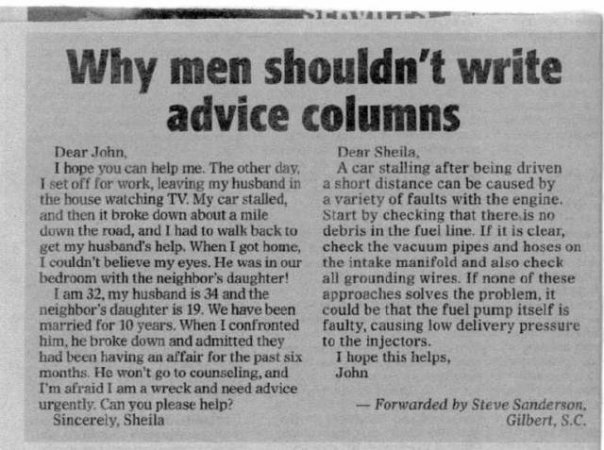
Why men shouldn't write advice columns

Some things need no commentary, but I have one below anyway.

Editor’s comment: Some say this is an example of why men should not write advice columns. I say it’s an example of missing the obvious. First, the advice guy should have told the writer to check to make sure there was enough gas in the car’s tank. An empty gas tank and a car will stall easily. Geez, some people never want to start with obvious.

Leave a comment

Filed under absurdity, advice, advice column, age, car, fun, humor, men, obvious, wit, words, writing

Building a better story: Tension

In the last installment, I said there was a difference between conflict and tension. Conflict, as Bob McKey pointed out, is the gap between expectation and result. The gap can be small, such as being overcharged a dime or great, such as losing a loved one when you thought he would survive.

The best way to explain tension is to refer to a small book on writing by the writer and editor Algis Budrys, Lithuanian for “Gordon John Sentry, more or less.” His book, Writing to The Point: A complete guide to selling fiction is only 64 pages long, and may be hard to get. But this Strunk and White-sized guide to writing is worth your time (and it even covers manuscript formatting).

For Gordon John Sentry, more or less, a story consists of seven parts: 1) a character 2) in a context with a 3) problem, who 4) makes an intelligent attempt to solve the problem and 5) fails, tries a second time and fails, tries a third time and finally 6) succeeds or completely fails, and whose actions are then 7) validated by another character in the story.

Sounds simple, doesn’t it? That is the allure of telling a good story. But the execution is often more difficult, for writer as well as story character. Step 4 – 6 above is where in a story you find tension. The key is that the character makes an intelligent attempt and fails. With increased knowledge, he or she tries again, and fails. The increased knowledge increases the stakes in the attempt and thus increases the tension. After all, it should succeed, right? Then there is a third and final attempt. This is, in essence, all or nothing, so the tension should be at its highest here.

Grimm reaper and man

Tension, while often confused with conflict, is not the same thing.

Tension, then, is something that builds over the life of the story, fueled by and feeding into the conflict. A well known love story may provide the clearest example. Romeo and Juliet loved each other. Their families, however, were adversaries. Romeo and Juliet attempted to find a way to manifest their love in the midst of this conflict, each time failing until each makes one last effort that leads to both their deaths. In this example, the tension builds in opposition to the conflict, which is fairly clever if you think about, and because of that opposition, the conflict works to heighten the tension.

Leave a comment

Filed under advice, Algis Budrys, building a better story, tension, words, writer, writing, writing tip

Writing Tip: Conflict

In the last installment of this feature, I put forth a little paradigm about writing that started off with “Drama is conflict….” But what is conflict? Is it open hostilities between two armies? It can be. It is the harsh words a husband has for a wife? It can be that, too. It is dealing with opposing desires or wants, such as deciding between love and honor? Yes, it can be that as well.

But all three examples listed above and in a host of others there is a common thread, something unspoken, and as important as words are, it is often the unspoken or unwritten element that defines a scene in a story and sometimes the story itself.

As I said in the previous article, I learned the paradigm that begins “Drama is conflict …” in 1993. Some twelve years later, and even though I wasn’t looking, I learned from author, screen writer, and teacher Steven Womack a definition of conflict that adds depth and, dare I say, meaning to the word conflict and the entire paradigm. He credits learning it from Bob McKey, a script doctor. McKey has made a living and a small fortune fixing other people’s scripts though he often doesn’t get screen credit for it. All scripts need conflict; conflict drives the story forward. How will the protagonist react? What will she do? But conflict is not car chases, gun battles, or galaxies spiraling out of control. Conflict, McKey said, is the gap between expectation and result. That’s it.

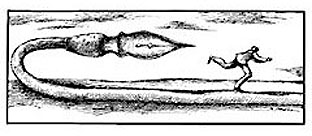
Pen chasing man

Conflict can be a small thing, or a large one, real or imagined.

Conflict can be as small as being overcharged a dime and how your protagonist reacts or as great as losing a battle when the protagonist fought hard to win. In both examples, there is a gap between expectations and results. How your protagonist deals with that gap and what steps he takes to close it are what drives a story forward, whether the story is a script, a short story, or a novel. The obstacles in the way preventing the protagonist from easily closing that gap are what are called tension, but that is a discussion for another time.

Leave a comment

Filed under advice, Bob McKey, building a better story, novel, Steven Womack, tension, words, writer, writing, writing tip