

Category Archives: 2019

Photo finish Friday: “Creek Crew”

Join the Creek Crew /
Saturday Nine to Noon. /
T-shirt for you?
Haiku to you Thursday (and photo): “The Road Less Taken”
The road less taken /
Rattles like a bare spring tree /
Only lonelier.

Why have we forgotten Jack the Ripper’s victims? – books podcast | Books | The Guardian
 Historians Hallie Rubenhold and Lindsey Fitzharris discuss their books The Five and The Butchering Art
Source: Why have we forgotten Jack the Ripper’s victims? – books podcast | Books | The Guardian
For hundreds of years, people have been fascinated by true crime and death, but the blurred line between real stories and entertainment can uncomfortably inflect our knowledge of the truth – and our empathy for people in the past.
Two historians are doing their bit to make us reappraise what we know about such histories. Hallie Rubenhold is the author of The Five, tracing the lives of the five women killed by Jack the Ripper. And Lindsey Fitzharris’s The Butchering Art is a history of Victorian medicine and the life of pioneering surgeon Joseph Lister, which includes details of riveting medical cases and shows the reality behind the gory details.
Reading list
The Five by Hallie Rubenhold (Hodder)
The Butchering Art by Lindsey Fitzharris (Penguin)
Photo finish Friday: “Interpretation”

Filed under 2019, Photo Finish Friday
Haiku to you Thursday (and photo): “Read, Donnie, Read”
Savor every word. /
Turn the pages respectfully. /
Arm the mind and heart.

Filed under 2019, Haiku to You Thursday, poetry by author
Writing tip Wednesday: “Work Alone: Ernest Hemingway’s 1954 Nobel Acceptance Speech”
“Writing, at its best, is a lonely life.”
By Maria Popova
https://www.brainpickings.org/2013/03/21/ernest-hemingway-1954-nobel-speech/
“One can never be alone enough to write,” Susan Sontag observed. Solitude, in fact, seems central to many great writers’ daily routines — so much so, it appears, that part of the writer’s curse might be the ineffable struggle to submit to the spell of solitude and escape the grip of loneliness at the same time.
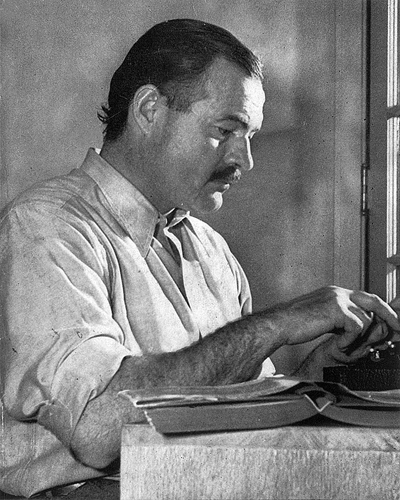
In October of 1954, Ernest Hemingway was awarded the Nobel Prize in Literature. But he didn’t exactly live every writer’s dream: First, he told the press that Carl Sandburg, Isak Dinesen and Bernard Berenson were far more worthy of the honor, but he could use the prize money; then, depressed and recovering from two consecutive plane crashes that had nearly killed him, he decided against traveling to Sweden altogether. Choosing not to attend the Nobel Banquet at the City Hall in Stockholm on December 10, 1954, Hemingway asked John C. Cabot, the United States Ambassador to Sweden at the time, to read his Nobel acceptance speech, found in the 1972 biography Hemingway: The Writer as Artist (public library). At a later date, Hemingway recorded the speech in his own voice. Hear an excerpt, then read the transcript of the complete speech below:
Having no facility for speech-making and no command of oratory nor any domination of rhetoric, I wish to thank the administrators of the generosity of Alfred Nobel for this Prize.
No writer who knows the great writers who did not receive the Prize can accept it other than with humility. There is no need to list these writers. Everyone here may make his own list according to his knowledge and his conscience.
It would be impossible for me to ask the Ambassador of my country to read a speech in which a writer said all of the things which are in his heart. Things may not be immediately discernible in what a man writes, and in this sometimes he is fortunate; but eventually they are quite clear and by these and the degree of alchemy that he possesses he will endure or be forgotten.
Writing, at its best, is a lonely life. Organizations for writers palliate the writer’s loneliness but I doubt if they improve his writing. He grows in public stature as he sheds his loneliness and often his work deteriorates. For he does his work alone and if he is a good enough writer he must face eternity, or the lack of it, each day.
For a true writer each book should be a new beginning where he tries again for something that is beyond attainment. He should always try for something that has never been done or that others have tried and failed. Then sometimes, with great luck, he will succeed.
How simple the writing of literature would be if it were only necessary to write in another way what has been well written. It is because we have had such great writers in the past that a writer is driven far out past where he can go, out to where no one can help him.
I have spoken too long for a writer. A writer should write what he has to say and not speak it. Again I thank you.
Filed under 2019, writing tip, Writing Tip Wednesday

Monday morning writing joke: “Forward leaning”

Filed under 2019, Monday morning writing joke


