Category Archives: 2017

Philip Pullman unveils epic fantasy trilogy The Book of Dust | Books | The Guardian

Author’s new novel series is set in London and Oxford and overlaps with hugely popular His Dark Materials

Source: Philip Pullman unveils epic fantasy trilogy The Book of Dust | Books | The Guardian

Philip Pullman has ended years of speculation by announcing that The Book of Dust, an epic fantasy trilogy that will stand alongside his bestselling series, His Dark Materials, will be published in October around the world.

The as-yet-untitled first volume of The Book of Dust, due out on 19 October, will be set in London and Oxford, with the action running parallel to the His Dark Materials trilogy. A global bestseller since the first volume, Northern Lights, was published in 1995, Pullman’s series has sold more than 17.5m copies and been translated into 40 languages.

Pullman’s brave and outspoken heroine, Lyra Belacqua, will return in the first two volumes. Featuring two periods of her life – as a baby and 10 years after His Dark Materials ended – the series will include other characters familiar to existing readers, as well as creations such as alethiometers (a clock-like truth-telling device), daemons (animals that are physical manifestations of the human spirit) and the Magisterium, the church-like totalitarian authority that rules Lyra’s world.

The Oxford-based former teacher said he had returned to the world of Lyra because he wanted to get to the bottom of “Dust”, the mysterious and troubling substance at the centre of the original books. “Little by little, through that story the idea of what Dust was became clearer and clearer, but I always wanted to return to it and discover more,” Pullman said.

In a description that will resonate with the current political climate, he added that “at the centre of The Book of Dust is the struggle between a despotic and totalitarian organisation, which wants to stifle speculation and inquiry, and those who believe thought and speech should be free”.

But David Fickling, whose firm, David Fickling Books, will publish The Book of Dust in the UK jointly with Penguin Random House children’s books, warned readers not to draw too many parallels between the new book and the current political situation in the UK or US. “I think it is a really important book for now, not in an intellectual way, but in a storytelling way,” Fickling said. He said the book would “resonate on a psychological level” and added: “Some of the best people for telling us the truth about our times are our great storytellers and Philip is one of them.”

Exact details of the plot are a closely guarded secret. However, Fickling hinted that readers would not have to wait 17 years – the gap between the last volume of His Dark Materials and the first of The Book of Dust – before the new series would conclude. The BBC reported on Wednesday that Pullman had completed the first and second volumes already, and was working on the third. Asked when the second volume would be published, Fickling replied, laughing: “You need to ask him, but readers should know they have a big treat ahead of them.”

The puzzle of how Lyra came to be living at Jordan College, Oxford, in her alternative universe, initiated the new trilogy. “In thinking about it, I discovered a long story that began when she was a baby and will end when she’s grown up,” Pullman said. Describing it as neither sequel nor prequel, but an “equel”, he added: “It doesn’t stand before or after His Dark Materials, but beside it. It’s a different story, but there are settings that readers of His Dark Materials will recognise and characters they’ve met before.”

Speaking to the Today programme on BBC Radio 4, Pullman said the first book of the trilogy opened roughly 10 years before the action of Northern Lights, and the series “continues roughly 10 years after His Dark Materials”.

“So we see Lyra both as a baby and we see her in the second book as an adult; she’s 20 years old,” Pullman added. “There she can fully take agency of the story, so to speak.”

Dust, as described in the original series, has been equated to dark matter. It is expected that Pullman will incorporate the latest findings about the substance, which scientists say exists because of evidence of its gravitational impact on the motion of visible matter.

Though Pullman’s publisher would not confirm how this research would feature in the book, Fickling admitted that it had some influence. “He has a capacious mind and is sent nearly every scientific book before publication,” he said. “If you visit his house, you will see all these books that are way above everyone else, he doesn’t miss much that is going on.”

The quest to understand, use and destroy Dust is central to His Dark Materials. But as well as being analogous to dark matter, Pullman has said that it is a metaphor for the original story, which he based upon Milton’s Paradise Lost. In His Dark Materials, the Magisterium regards it as evidence of original sin, which must be destroyed before children emerge from puberty into adulthood when their daemons, the animal familiars that represent their spirits, take their final form.

“Dust is an analogy of consciousness, and consciousness is this extraordinary property we have as human beings,” Pullman told the Today programme. “The story I’m telling in this book is more about in terms of William Blake’s vision, his idea of a fiercely reductive way of seeing things: it’s right or wrong; it’s black or white.

“He said that was far too limiting and we should bring out truer human vision when we see things, surround them all with a sort of penumbra of imagination and memories and hopes and expectations and fears and all these things.

“It’s an attack on the reductionism, the merciless reductionism, of doctrines with a single answer.”

Speaking to the Sydney Morning Herald in 2003, Pullman noted that the Harry Potter author, JK Rowling, had taken more flak for the magic in her books than he had for his overt criticism of organised religion. “I’ve been surprised by how little criticism I’ve got,” he told the newspaper. “Harry Potter’s been taking all the flak … Meanwhile, I’ve been flying under the radar, saying things that are far more subversive than anything poor old Harry has said. My books are about killing God.”
Leave a comment

Filed under 2017, author, new book

Photo finish Friday: “Dusk”

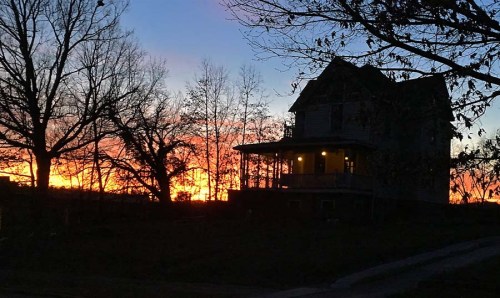
She stumbled upon the house from her dreams on the dusk of day of her lover’s funeral.

Photo and first line. Now, what’s the rest of the story?

Leave a comment

Filed under 2017, photo by David E. Booker, Photo Finish Friday

Haiku to you Thursday: “Highs and lows”

Highs and lows will come. /

Always here and just passing. /

Murmuring promises.

Leave a comment

Filed under 2017, Haiku to You Thursday, poetry by author

Top 7 Ways Authors Are Using Instagram – The Book Designer

Follow Other Authors Especially if you are a new author, following more experienced authors certainly can’t hurt. Even the most experienced author is not exempt from gaining insight from other authors. Networking with other authors as a new or previously unpublished author can be eye-opening and present you with opportunities you may not have otherwise come across.Instagram is one of the best social apps you can use as an author, because not only does it give us a rest from all those words, but it can be used in so many ways—personally or professionally. You just have start thinking less in words and more in pictures.

Source: Top 7 Ways Authors Are Using Instagram – The Book Designer

By Adrienne Erin (@adrienneerin)

I don’t know about you, but I’ve often wondered if the very popular but visually-oriented social media sites like Instagram are a good place to market books (over 300 million visitors a month, more than 70% of them from outside the U.S.). After all, books are words, not pictures (usually). Adrienne Erin knows that authors can get a lot of attention they might not otherwise get for their books with some savvy tactics in hand. Here’s her report.

Words are for us as writers what computers are to office workers. They are the lifeline to pretty much every facet of our work. Not only do we use them to communicate our art form, but we obsess, play, hate, love and need them in order to do what we do. Sometimes we need a rest from all the word playing—and hating.

Where can we find that rest without cutting ourselves off even further from social exchange, but also without having to use even more words? It can be done—with Instagram. Not only can you use Instagram, but as an author, you should be using Instagram. For more than one or two reasons.

Why You Should Use Instagram as an Author

There are a lot of authors who use Instagram in ways that may be entertaining. It’s entertaining in the same way the crazy lady in the grocery store is who pulls out every gallon of milk from the dairy cooler in order to get the one that has the furthest date of expiration. Yeah, it’s weird and maybe a little funny, but mostly kind of pathetic.

There are plenty of famous authors who evoke that kind of reaction on Instagram. Don’t be one of those authors. Instead, consider some of the following rational ways to use Instagram to help further your author name and influence.

  1. To Follow Bloggers Who Review Books
    This reason really shouldn’t have to be explained. I mean, duh – if you follow enough book-bloggers, you increase the chance that one or more of them will review your book, which is read by said blogger’s audience. Whether that audience is 100 or 100,000 – isn’t it worth it to reach that amount of potential buyers of your book for free?
  2. For Self-Promotion and Marketing
    Instagram can be used for promoting your name or your newest book. You can host a contest with a free copy of your book as the prize. You can ask for photo submissions that revolve around the theme of your book or you can just use photos to connect to your fans and readers. As BuzzFeed’s article on book covers altered to include James Franco shows us, humor can be a great marketing strategy.
  3. Inspire Yourself and Your Fans
    Visual imagery can be the source of inspiration on a daily basis. All you need to do is catalogue it and you have your own visual diary for defeating the worst case of writer’s block. Not only can these photos inspire you, but they may equally inspire your readers and fans, who will in turn, recommend their network to follow you as well. Many writers use inspirational tweets and Facebook posts to reach their readers. Your followers will respond well to inspirational messages that reaffirm their beliefs.
  4. Collaborate with Your Fans
    This could be a marketing project or it could be research for a new novel. Projects can range from social research to just-for-fun, to things like #100HappyDays, which seems to be a combination of both. 100HappyDays is inspirational, fun, challenging and engaging. Hosting a project like this could provide you with tons of material for your next book, or it could simply attract a ton of followers — aka, readers.
  5. Cover Art Photos = Free Book Promotion
    What better place to advertise your stunning new book cover than Instagram? Book covers are certainly one of the most powerful tools you have in your arsenal for attracting a new reader. I don’t know about you, but if I come across an author I’ve never heard of, but they write in a genre I like to read and they have a fantastically interesting book cover – I am much more likely to purchase that book. By the way, this is also another reason to never cut any corners on your cover art.
  6. Give Fans/Readers an Inside Look at Your Life
    You don’t have to reveal all the skeletons in your closet, but a few pictures of your most recent vacation, your adorable pets, a weekend trip to the harbor and a ride on a boat will get you noticed — people love this kind of stuff. The more you draw in your readers and fans by showing that you’re just like them, the more they will be inclined to follow you and interact with your more professional work.
  7. Follow Other Authors
    Especially if you are a new author, following more experienced authors certainly can’t hurt. Even the most experienced author is not exempt from gaining insight from other authors. Networking with other authors as a new or previously unpublished author can be eye-opening and present you with opportunities you may not have otherwise come across.


Instagram is one of the best social apps you can use as an author, because not only does it give us a rest from all those words, but it can be used in so many ways—personally or professionally. You just have start thinking less in words and more in pictures.

Leave a comment

Filed under 2017, Writing Tip Wednesday, writing tips

Monday morning writing joke: “Tough it out”

Q. Why are Saturday and Sunday the toughest days?

A. Because the others are weakdays.

Enjoy your weak. Yeah, I know, a week joke.

Leave a comment

Filed under 2017, Monday morning writing joke

New words to live by: “Scraggle”

Time, once again, for New words to live by. This is a word or phrase not currently in use in the U.S. English lexicon, but might need to be considered. Other words, such as obsurd, crumpify, subsus, flib, congressed, and others, can be found by clicking on the tags below. Today’s New Word is created by taking an adjective and creating a noun form of the word. Without further waiting, scraggle.

OLD WORD
Scraggly, adj. 1. Irregular, uneven, jagged. 2. Unkempt, ragged.

NEW WORD
Scraggle, n. 1. Something or someone ragged or unkempt, often in a small patch. 2. Something or someone jagged, irregular, or uneven.

Somewhere between the stickers and thorns, vines and broken branches, scraggles of grass and clay soil in front of me was the voice.

Leave a comment

Filed under 2017, new word, New words to live by

Who doesn’t read books in America? | Pew Research Center

About a quarter of American adults (26%) say they haven’t read a book in whole or in part in the past year. Who, exactly, are these non-book readers?

Source: Who doesn’t read books in America? | Pew Research Center

by Andrew Perrin

About a quarter of American adults (26%) say they haven’t read a book in whole or in part in the past year, whether in print, electronic or audio form. So who, exactly, are these non-book readers?

Several demographic traits correlate with non-book reading, Pew Research Center surveys have found. For instance, adults with a high school degree or less are about three times as likely as college graduates (40% vs. 13%) to report not reading books in any format in the past year. A 2015 Pew Research Center survey shows that these less-educated adults are also the least likely to own smartphones or tablets, two devices that have seen a substantial increase in usage for reading e-books since 2011. (College-educated adults are more likely to own these devices and use them to read e-books.)

Adults with an annual household income of less than $30,000 are about twice as likely as the most affluent adults to be non-book readers (33% vs. 17%). Hispanic adults are also about twice as likely as whites (40% vs. 23%) to report not having read a book in the past 12 months.

Older Americans are a bit more likely than their younger counterparts not to have read a book. Some 29% of adults ages 50 and older have not read a book in the past year, compared with 23% of adults under 50. In addition, men are less likely than women to have read a book, as are adults in rural areas compared with those in urban areas.

The share of Americans who report not reading any books in the past 12 months is largely unchanged since 2012, but is slightly higher than in 2011, when the Center first began conducting surveys of book-reading habits. That year, 19% of adults reported not reading any books.

Given the share that hasn’t read a book in the past year, it’s not surprising that 19% of U.S. adults also say they have not visited a library or a bookmobile in the past year. The same demographic traits that characterize non-book readers also often apply to those who have never been to a library. For example, men, Hispanics, older adults, those living in households earning less than $30,000 and those who have no more than a high school diploma or did not graduate from high school are the most likely to report they have never been to a public library.


Leave a comment

Filed under 2017, reading

Photo finish Friday: “Morning”

Spring morning after a day of rain.

Leave a comment

Filed under 2017, photo by David E. Booker, Photo Finish Friday

Haiku to you Thursday: “Blinking idiot”

use blinking blinkers /

you fool in front of me, or /

Spring will end too soon.

Leave a comment

Filed under 2017, Haiku to You Thursday, poetry by author

Writing tip Wednesday: “10 Things I Learned About Writing and Publishing From Managing a Porn Store” | LitReactor

Source: 10 Things I Learned About Writing and Publishing From Managing a Porn Store | LitReactor

By Christoph Paul

I used to manage a porn store in northeast D.C. I worked there for two years and it was the best writer job I ever had. There were whole blocks of time where I could read and write while I sat behind the counter. It was a blessing to get paid to practice my craft. All the hours added up and I became a better writer, but managing the porn store also taught me certain skills that I use on a daily basis in my writing and publishing career.

Covers and Titles

The first thing I learned was that we had to buy and sell lots of rentals on our new releases to stay afloat. If I picked a lot of bad movies for the new release wall that didn’t get bought or rented within the first month, my boss would be pissed. The customers also got pissed, and then I would have to deal with a lot of bullshit instead of focusing on writing or reading. The only real work I had besides putting movies back on their shelves was picking the weekly new releases. With the goal of having my boss stay off my back, I made sure to kill it each week with my new release section. I learned what sold and what type of titled stood out. I use that same skill when writing or publishing a new book. Whether it be porn or fiction, the cover and title has to show the readers and viewers that they will enjoy the product. The cover must at least peak curiosity and satisfy something a reader or porn watcher is wanting. Bad covers, whether on a porno or on a novel, are easy to spot and will always stay on the shelf.

Dialogue

My shift was eight hours a day, five days a week. Though I would have loved to spend every hour reading and writing, I had to interact with the customers. There were a lot of regulars who wanted to talk about politics, sports, their personal lives, their kinks, and their jobs. They would not hold back, and almost treated me like a priest. I heard some hardcore confessions. When I am figuring out how a certain character would sound, I have a ton of examples from the porn store. I can use their quirks and speech patterns to inject more realism and humor into my dialogue. Whether it be someone in the closet renting gay porn or a person explaining why they don’t want to have sex with their significant other anymore, I heard people speaking their truths. This gave me an ear for both inner and outer dialogue. There are things that a character reveals in more subtle and nuanced ways, through their rhythms, vocabulary, and even through the things they pointedly leave out.

Writing Through Chaos and Distractions

You can write anywhere. That is what I learned those years behind the porn store counter. I’d have homeless people come in, zoning law inspectors, gang bang recruiters (seriously), cops coming in to shoot the shit, the boss stopping by to complain, and customers looking for very specific fetishes. I learned to stop and deal with who or whatever I had to attend to, and then get back to writing. While there, I finished the second draft of a literary novel, some short stories, and read a ton. I learned there is no perfect place to read and write, and that even through the most awkward disruptions you can still find time to be creative.

Con Selling

If you can sell a $29.95 DVD with ‘anal’, ‘cuckold’, and/or ‘big cocks’ in the title, you can sell a book you have edited or written to a stranger. I picked up some practical sales skills at the porn store. My constant goal was to keep enough money coming in so my boss never suspected I was writing on the job. Though selling shitty porno movies and fake penis growth pills felt disenchanting at times, it taught me how to interact with strangers. When I started doing book festivals and conferences three years ago, they were a joy, because I actually believed in my books and understood how to communicate each book’s value. While penis enlargement pills are bullshit, I actually believe in what I sell. That combination of enthusiasm and sales skills has helped me finish in the black for almost every con/festival I have attended.

Character Studies

It wasn’t just dialogue I learned from the porn patrons. It was crafting real characters with real quirks and commonalities. Listening and talking to the porn store patrons was as good as reading any craft book on creating realized and memorable characters. After working the store for a year, I could usually tell a lot about a person within the first minute of talking to them. I noticed the physical: body language, the sound of their voice, build, did they look me in the eyes or not; sociological: how well read or educated they were, where they worked, what kind of money they made, religion, nationality; and emotional: were they stable, lonely and needing to connect, fake happy, assertive or aggressive, timid. All of these characteristics combined into making them who they were. I could use this skill to build real characters in my fiction. I could take physical, sociological, and emotional attributes and combine them into a unique human being. I would sometimes compare them to real individuals I met at the porn store to see if they felt ‘real.’

Genre Expectations and Surpassing Them

Different fetishes and types of porn are really just different genres. The videos that end up getting rented and bought the most not only meet ‘genre expectation,’’ they also add something special. While I don’t want to get super graphic here, it usually involves something memorable in the video—a scene, a style, and many times, a certain actress. I learned from the popular porno videos that when writing in a certain genre you have to make those genre fans happy, but also give them something unique. It can be your style of language, it can be taking a new approach on a familiar trope, and most importantly giving the reader an outstanding character. When you meet the expectations of genre and create something memorable in your story, your books will sell as good as porn.

Talking Books

On very slow days I would sit behind the register and read. A lot of customers didn’t want to interact and I would just look up, put in my bookmark, and get them their movie. This was pretty standard, but sometimes the porn patrons would be curious about what I was reading. Many of these guys were proud non-readers. I took this as a challenge to infuse the porn store with at least a little literary curiosity. To do this I had to tell them why the book was enjoyable and get them interested enough to want to hear more. I was very proud when I was able to get 4 men excited about the story of one of my favorite novels, Anna Karenina. Experiences like that have made it a lot easier for me to write the back copy of my own as well as other writers’ books.

Vibrator Editor 

Until I got the hang of it, selling and recommending vibrators was a challenge. Though white male privilege exists, it doesn’t come in handy when talking to a woman about what vibrator she should buy. At first it was very awkward and I didn’t sell many vibrators, but I learned that I had to help the female customer feel comfortable. I also needed to be knowledgeable and a little humorous, as well as respectful. When I took this approach I easily sold vibrators and learned better communication skills. These skills help me so much when editing other people’s work. Communication and making artists feel comfortable is important. Sex toys, someone’s story, they both involve vulnerability, but if you communicate the right way, a writer will be able to access the right technique and tool for the job.

Storytelling

When it was cold, the porn sales always rose. Wintertime was the most popular time in the store. Not just for rentals and purchases, but for guys just wanting to hang out. The porn store would feel a lot like a barbershop. There were guys who proudly didn’t read and didn’t even like watching movies or TV. They only liked sports, but some of these guys would come up with the funniest stories I have ever heard. There were always men wanting to talk, but if you couldn’t tell a good story or keep people’s interest, they wouldn’t give you a chance to be heard. I saw that being a great storyteller had nothing to do with being a great writer. Storytelling was a separate skill, and there were some guys who might not have ever picked up a book but could tell a great story. I started listening to these guys and dissecting their stories. I realized they were using many of the techniques I read about in the craft books about great storytelling.

Snobbery

I started the porn store job a good 7 years ago. At the time, I was a big literary snob. I believed that only the serious literary novel is what people should read, and even though I was selling porno, I thought erotica and romance writers were total hacks. After two years of working there my mind really opened, and I saw that whether it be porn, erotica, or romance, they were art forms and audiences enjoyed the fantasy and desire that they provided. I lost my snobbery, seeing that any kind of storytelling takes skill. A few years later I would take what I learned at the porn store and write erotica under a pen name. The erotica I have created is still the most successful work I have published. If I hadn’t worked at the porn store, I would be just another bitter failed literary novelist complaining about Chuck Tingle.

Leave a comment

Filed under 2017, Writing Tip Wednesday