Category Archives: 2016

The aroma of books

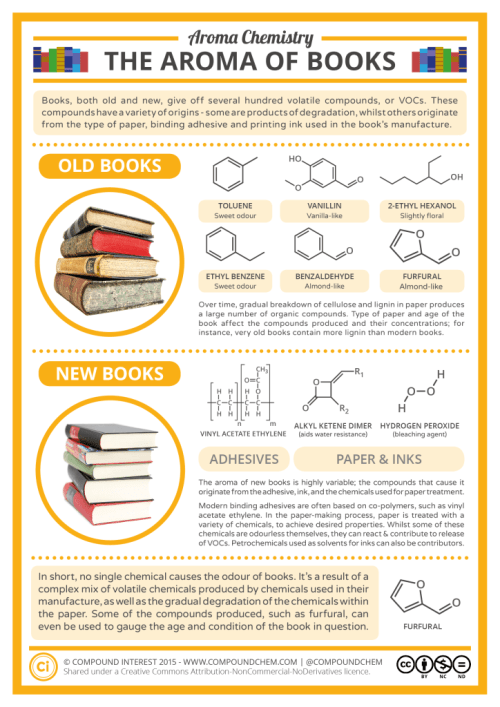
What Causes the Smell of New & Old Books?

Source: http://www.compoundchem.com/2014/06/01/newoldbooksmell/

The smell of books.

The smell of books.

Everyone’s familiar with the smell of old books, the weirdly intoxicating scent that haunts libraries and second-hand book stores. Similarly, who doesn’t enjoy riffling through the pages of a newly purchased book and breathing in the crisp aroma of new paper and freshly printed ink? As with all aromas, the origins can be traced back to a number of chemical constituents, so we can examine the processes and compounds that can contribute to both.

As far as the smell of new books goes, it’s actually quite difficult to pinpoint specific compounds, for a number of reasons. Firstly, there seems to be a scarcity of scientific research that’s been carried out on the subject – to be fair, it’s understandable why it might not exactly be high up on the priority list. Secondly, the variation in the chemicals used to manufacture books also means that it’s an aroma that will vary from book to book. Add to this the fact that there are literally hundreds of compounds involved, and it becomes clearer why it evades attribution to a small selection of chemicals.

It’s likely that the bulk of ‘new book smell’ can be put down to three main sources: the paper itself (and the chemicals used in its manufacture), the inks used to print the book, and the adhesives used in the book-binding process.

The manufacture of paper requires the use of chemicals at several stages. Large amounts of paper are made from wood pulp (though it can also be made from cotton and textiles) – chemicals such as sodium hydroxide, often referred to in this context as ‘caustic soda’, can be added to increase pH and cause fibres in the pulp to swell. The fibres are then bleached with a number of other chemicals, including hydrogen peroxide; then, they are mixed with large amounts of water. This water will contain additives to modify the properties of the the paper – for example, AKD (alkyl ketene dimer) is commonly used as a ‘sizing agent’ to improve the water-resistance of the paper.

Many other chemicals are also used – this is just a very rough overview. The upshot of this is that some of these chemicals can contribute, through their reactions or otherwise, to the release of volatile organic compounds (VOCs) into the air, the odours of which we can detect. The same is true of chemicals used in the inks, and the adhesives used in the books. A number of different adhesives are used for book-binding, many of which are based on organic ‘co-polymers’ – large numbers of smaller molecules chemically chained together.

As stated, differences in paper, adhesives, and inks used will influence the ‘new book smell’, so not all new books will smell the same – perhaps the reason why no research has yet attempted to definitively define the aroma.

An aroma that has had much more research carried out around it, however, is that of old books. There’s a reason for this, as it’s been investigated as a potential method for assessing the condition of old books, by monitoring the concentrations of different organic compounds that they give off. As a result, we can be a little more certain on some of the many compounds that contribute to the smell.

Generally, it is the chemical breakdown of compounds within paper that leads to the production of ‘old book smell’. Paper contains, amongst other chemicals, cellulose, and smaller amounts of lignin – much less in more modern books than in books from more than one hundred years ago. Both of these originate from the trees the paper is made from; finer papers will contain much less lignin than, for example, newsprint. In trees, lignin helps bind cellulose fibres together, keeping the wood stiff; it’s also responsible for old paper’s yellowing with age, as oxidation reactions cause it to break down into acids, which then help break down cellulose.

‘Old book smell’ is derived from this chemical degradation. Modern, high quality papers will undergo chemical processing to remove lignin, but breakdown of cellulose in the paper can still occur (albeit at a much slower rate) due to the presence of acids in the surroundings. These reactions, referred to generally as ‘acid hydrolysis’, produce a wide range of volatile organic compounds, many of which are likely to contribute to the smell of old books. A selected number of compounds have had their contributions pinpointed: benzaldehyde adds an almond-like scent; vanillin adds a vanilla-like scent; ethyl benzene and toluene impart sweet odours; and 2-ethyl hexanol has a ‘slightly floral’ contribution. Other aldehydes and alcohols produced by these reactions have low odour thresholds and also contribute.

Other compounds given off have been marked as useful for determining…

Details at: http://www.compoundchem.com/2014/06/01/newoldbooksmell/

1 Comment

Filed under 2016, books

Hard or Soft? How do you like your S.F.?

How Do You Like Your Science Fiction? Ten Authors Weigh In On ‘Hard’ vs. ‘Soft’ SF

by Fran Wilde

Source: http://www.tor.com/2016/01/21/how-do-you-like-your-science-fiction-ten-authors-weigh-in-on-hard-vs-soft-sf/

With The Martian a big-screen success and Star Wars: The Force Awakens blowing box office doors off their hinges, articles like this one from NPR have begun appearing all over, encouraging SF authors and readers to “Get Real.” Meanwhile, debates about whether one movie or another is scientific enough are cropping up in various corners of the internet. (This, in my view, feels like an odd ranking system—if one movie has a sarlacc pit as an ancestor, and another might be seen as channeling Ghost [1990, the one with Demi Moore] as a way to explain cross-universe communication via physics… it’s pretty cool, yes? It’s fun to let imaginations wander about? Yes. I’ll be seeing you in the comments, yes. Onwards.)

2001: A Space Odyssey, an example of "hard" science fiction.

2001: A Space Odyssey, an example of “hard” science fiction.

So is a deeper, harder line being drawn in the sand about “hard” science fiction than usual? Or are we discovering that perhaps there’s a whole lot more sand available with regards to how imaginative and future-looking fiction can develop, and even entertaining the possibility that these developments could become blueprints for future-fact?

I asked ten science fiction authors about their definitions of “hard” and “soft” science fiction, and how they see science fiction (hard, soft, and otherwise) in today’s terms. They returned with ten fascinating—and not surprisingly, entirely different—answers.

Have a read and then maybe jump in the comments to discuss!

Nancy Kress

Nancy Kress’s latest work is The Best of Nancy Kress (Subterranean Press, 2015).

“Hard SF” and “soft SF” are really both misnomers (although useful in their way). Hard SF has several varieties, starting with really hard, which does not deviate in any way from known scientific principles in inventing the future; this is also called by some “mundane SF.” However, even the hardest SF involves some speculation or else it would not be science fiction.

High-viscosity SF takes some guesses about where current science might go IF certain discoveries are made (such as, for instance, identifying exactly which genes control things like intelligence, plus the ability to manipulate them). Or, alternately, it starts with one implausibility but develops everything else realistically from there (as in Andy Weir’s The Martian, with its huge-velocity windstorm on Mars). From there you go along a continuum toward things that, with our current level of knowledge, do not seem possible, such as faster-than-light travel. At some point along that continuum, high-viscosity SF becomes science fantasy, and then fantasy, when magic is involved. But the critical point is that it IS a continuum, and where a given innovation belongs on it is always a matter of dispute. This is good, because otherwise half the panels at SF cons would have nothing to argue about.

I would define “soft SF” as stories in which SF tropes are used as metaphors rather than literals. For example, aliens that don’t differ from us much in what they can breathe, drink, eat, or how their tech functions. They have no delineated alien planet in the story, because they are meant to represent “the other,” not a specific scientifically plausible creature from an exosolar environment. This seems to me a perfectly valid form of science fiction (see my story “People Like Us”), but it is definitely not “hard SF,” no matter how much fanciful handwaving the author does. Nor are clones who are telepathic or evil just because they’re clones (it’s delayed twinning, is all) or nanotech that can create magical effects (as in the dreadful movie Transcendence).

Tade Thompson

Tade Thompson’s Sci-fi novel Rosewater, from Apex Books, will be released in September 2016.

First, a working definition of SF: fiction that has, at its core, at least one science and/or extrapolation of same to what could be possible.

Second, a (messy) working definition of a science: a field of knowledge that has at its core the scientific method, meaning systematic analyses of observed phenomena including objective observations, hypothesis/null hypothesis, statistical analysis, experimentation, peer review with duplication of findings. I am aware that this definition is a mess.

Defining ‘Hard’ SF is a bit difficult. If we use the Millerian definition (scientific or technical accuracy and detail), it won’t hold water. The reason is not all sciences are equal in SF. In my experience, fictional works that focus on physics, astronomy, mathematics, engineering and (to a lesser extent) chemistry tend to be filed as ‘Hard,’ especially if there is an exploratory or militaristic aspect. The further the extrapolation of the science from what is known, the more likely the story will be classed as ‘soft.’ On the other hand, those that Jeff VanderMeer jokingly refers to as ‘squishy’ sciences like botany, mycology, zoology, etc. tend to be classed as soft SF along with the social sciences like anthropology, psychology, etc. Medicine can fall either way, depending on the actual narrative.

That the definitions are problematic becomes obvious immediately. I find the terms intellectually uninteresting because they assume that social sciences use less rigor, which I know to be untrue. My background is in medicine and anthropology, and I have seen both sides.

There may be other elements to the definitions. There may be a pejorative flavor to being designated ‘soft’. There may be some gender bias, although I have seen this in discussions, and not in print. Take a lot of the work of Ursula Le Guin. Many would not class her SF as ‘Hard’ despite her clear understanding of anthropology and psychology. The exploration of cultures should not take a back seat to the exploration of the solar system. Take Frankenstein, which is often regarded as the first science fiction novel. Few would regard it as Hard SF, yet it used contemporary scientific beliefs. At the time the novel was set, galvanism was a big thing. Reanimation was not thought to be impossible. The Royal Humane Society in England started with reanimation of the dead at its core, and its motto is a small spark may perhaps lie hid.

At the root of the Hard-Soft divide is a kind of “I scienced more than you” attitude, which is unnecessary. There are fans of all flavours of SF and the last thing we need is to focus on divisions that were introduced in the late 1950s.

Elizabeth Bear

Elizabeth Bear’s most recent novel is Karen Memory (Tor 2015). You can find her on Twitter.

I feel like the purported hard/soft SF divide is one of those false dichotomies that humans love so much—like white/black, male/female, and so forth. The thing is, it’s really arbitrary. I write everything from fairy tales to fairly crunchy sciency SF, and I think the habit of shoving all of this stuff into increasingly tiny boxes that really amount to marketing categories is kind of a waste of time. There’s no intrinsic moral element that makes a rigorously extrapolated near-future cascading disaster story (like The Martian) “better” than an equally critically hailed and popular sociological extrapolation. Is anybody going to argue, for example, that 1984 or The Handmaid’s Tale aren’t worthy books because they are about societies in crisis rather than technology?

I love hard—or rigorously extrapolated physical—science fiction, for what it’s worth. My list of favorite books includes Peter Watts, Tricia Sullivan, and Robert L. Forward. But it’s not new, and it’s not dying out. It’s always been a percentage of the field (though Analog still has the biggest readership of any English-language SF magazine, I believe) and it’s still a vibrant presence in our midst, given writers like Kim Stanley Robinson and James L. Cambias, for example. It’s hard to write, and hard to write well, mind, and Andy Weir kind of knocked it out of the park.

My own pocket definition of SF is that it’s the literature of testing concepts to destruction: space travel, societies, ideologies. At its best, that’s what science fiction does that most other literary forms do not. (Most of them—the ones with a literary bent, at least–are about testing people (in the form of people-shaped objects called “characters”) to destruction. Science fiction does it on a scale up to and including entire galaxies, which is kind of cool. Drawing little boxes around one bit of it and saying, “This is the real thing here,” is both basically pointless and basically a kind of classism. It’s the Apollonian/Dionysian divide again, just like the obsession of certain aspects of SF with separating the mind from the meat.

(Spoiler: you can’t: you are your mind, and your mind is a bunch of physical and chemical and electrical processes in some meat. You might be able to SIMULATE some of those processes elsewhere, but it seems to me entirely unlikely that anybody will ever “upload a person,” excepting the unlikely proposition that we somehow find an actual soul somewhere and figure out how to stick it in a soul bottle for later use.)

Anyway, I kind of think it’s a boring and contrived argument, is what I’m saying here.

Max Gladstone

Max Gladstone’s latest novel is Last First Snow (Tor, 2015). Find him on Twitter.

Hard SF is, in theory, SF where the math works. Of course, our knowledge of the universe is limited, so hard SF ends up being “SF where the math works, according to our current understanding of math,” or even “according to the author’s understanding of math,” and often ends up feeling weirdly dated over time. In very early SF you see a lot of “sub-ether” devices, from back when we still thought there might be a luminiferous ether; more recent SF that depends on a “Big Crunch” singularity collapse end of the universe seems very unlikely these days, since observations suggest the universe’s expansion is accelerating. Often you find stories in which the orbital dynamics are exactly right, but everyone’s using computers the size of a house, because of course 33rd century computers will still be made with vacuum tubes, or stories that have decent rocketry but a lousy understanding of genetics, or stories that get both rocketry and genetics right, but don’t have a clue how human societies or beings function.

I don’t think there’s a dichotomy, really. “Hardness” is a graph where the X axis starts at zero, and that’s, say, Star Wars—SF that doesn’t even mention math or orbital dynamics, but is still recognizably SF—and proceeds to, say, Apollo 13, which is so hard it’s not even fiction. On the y axis you have “quality.” You can place every SF text somewhere within that space, but no curve exists. Neal Stephenson’s Cryptonomicon is SF so hard that it borders on a technothriller, but that hardness doesn’t determine its quality when set against, say, The Left Hand of Darkness (where the plot hinges on FTL comms), or Childhood’s End (force fields, psychic storm omega point gestalts, etc.).

But if we really want something to pose against “hard,” how about “sharp SF”? Sharp SF acknowledges that our understanding of the universe is a moving target, and believes the point of SF is to show how human beings, relationships, and societies transform or endure under different conditions. Sharp SF takes math, physics, sociology, economics, political science, anthropology, psychology, etc. into account when posing its hypothetical worlds—but cares more about the human consequences of those hypotheticals than it cares about the hypothetical’s underlying architecture. I’d include 1984, The Handmaid’s Tale, Parable of the Sower, Nova, Dune, and Lord of Light as canonical examples of good sharp SF.

Aliette de Bodard

Aliette de Bodard’s latest novel, The House of Shattered Wings, was published by Roc (US)/Gollancz (RoW) in August 2015.

I think they’re labels, and as labels they’re useful because they tell you what kind of story you’re going to get, and what it’s going to focus on (in the case of hard SF, hard sciences such as maths, physics, computer science, and an emphasis on the nitty-gritty of science and engineering as core to the plot. Soft SF is going to focus more on sociology, societies and the interaction between characters). The issue with labels is twofold: first, they can be used dismissively, i.e., “it’s not real SF if it’s not hard SF,” or “hard SF is the best kind of SF and everything else is of little worth,” which is unfortunately something I see happening all too often. And it’s doubly problematic, because this dismissal is disproportionately used to single out women/POCs/marginalised people as not writing “proper SF.” (I should add that I’ve got nothing whatsoever against hard SF and will quite happily enjoy an Alastair Reynolds or a Hannu Rajaniemi when I’m in the mood for it).

The second issue is that like any labels, they can be restrictive: they can create an impression in the author’s mind that “real SF” should have such and such; and particularly the emphasis on the nitty-gritty of science makes a lot of people feel like they shouldn’t be writing hard SF, that you should have several PhDs and degrees and everyday practice of physics, etc., to even consider writing something. It’s not that it doesn’t help (as someone with a degree in science, I can certainly attest that it helps make things go down more smoothly with only minimal amounts of research), but I worry that it raises a barrier to entry that doesn’t really have a reason to be there. My personal testimony is that I held off from writing SF because I didn’t think I had the chops for it (and that’s in spite of the actual maths/computer science degree…); and also that it took me a long time to write what I actually wanted to write because I was afraid that taking bits and pieces from every subgenre I liked was somehow an unspeakable crime…

Walter Jon Williams

Walter Jon Williams’ novella “Impersonations” will appear from Tor.com Publishing in September 2016.

I’d define Hard SF as a subdivision of Geek Fiction. I’m currently at work on a General Theory of Geek Fiction, and while my ideas are still in flux, I can define Geek Fiction as that fiction in which the greatest emphasis is given to process. The story becomes not one of plot or character or setting—although ideally those are present as well—but a story in which the action is broken down into a series of technical problems to be solved.

Thus The Martian is a book about all the technical problems that need to be surmounted in order to survive on Mars. C.S. Forester’s Hornblower books are about the technical issues involved in commanding square-rigged sailing ships in wartime. Police procedurals are about the process of police procedure. These sorts of books can be about other things as well, but if the emphasis isn’t on process, it’s not Geek Fiction.

As for Soft SF, it’s better to define it by what it is instead of by what it isn’t. After all, Soft SF includes space opera, science fantasy, dystopia, near-future works, alternative history, time travel stories, satirical and comic SF, and great big unclassifiable tours-de-force like Dhalgren. Just call the thing what it is.

Ellen Klages

Ellen Klages (and her co-author Andy Duncan) won the 2014 World Fantasy Award for the novella, “Wakulla Springs,” originally published at Tor.com.

Attempting to differentiate hard and soft science fiction implies that “science” has gradations on some sort of undefined, Mohs-like scale. Talc science vs. diamond science. But that seems to me a misunderstanding of what science is. Science is not an established body of knowledge as much as it is an attempt to explain things that we don’t yet know, and to organize what we do know in a systematic way. It is the manual that the world ought to have come with, but was somehow left out of the box.

Things We Don’t Know is a rather large category to begin with, and is also quite fluid, because everything we do know is continually shifting and changing—our understanding of reality is a work in progress. When most people say “this is hard science fiction” they mean the plot depends on demonstrable, provable, known facts about the physical world. Hard, like concrete, not fluid and mutable like water.

I sometimes think they also mean it in the same sense as when Mac users were looked down on by PC users 30 years ago: if you didn’t know how to program your computer, you didn’t really know how to use one. If it’s not hard (as in difficult to do or to understand), it has less value.

Historically, hard science fiction has been more about how inanimate objects work than how human beings live. More about plot than about character. Go figure. Humans—or at the very least, biological beings—are part of any world, and there’s so, so much we don’t know about them. So studying what makes humans tick—the sciences of sociology, economics, linguistics, psychology, etc.—must surely be as much part of that missing world manual as physics and chemistry. A person is more complex than any machine I can think of, and when we start aggregating into groups and societies and nations, that complexity grows exponentially.

I prefer my science fiction to be well-rounded, exploring and explaining the people as well as the furniture and the landscape.

Maurice Broaddus

Maurice Broaddus’ latest story, “Super Duper Fly” appeared in Apex Magazine.

The thing is, my background is as a hard science guy. I have a B.S. in biology and I can still remember the grumbling during our graduation when those who received degrees in psychology were introduced as fellow graduates of the School of Science. Ironically, even after a 20-year career in environmental toxicology, the science of my SF writing tends to lean to the “soft” side of things.

There is an imagined line in the sand that doesn’t need to be there. In fact, hard and soft SF go hand-in-hand. Much of the SF I’m drawn to turns on the soft science of sociology. The impact of technology in a culture’s development, how people organize, and how people interact with the technology and each other because of it. (Think of how prescient 1984 seems now.) And for all of the hard science of The Martian, it would all be science porn if we also didn’t have the soft science of psychology in play also. A story is ultimately driven by the psychology of its characters.

Linda Nagata

Linda Nagata’s novel The Red: First Light was a Publishers Weekly best book of 2015.

My definition of hard SF is pretty simple and inclusive. It’s science fiction that extrapolates future technologies while trying to adhere to rules of known or plausible science. “Plausible,” of course, being a squishy term and subject to opinion. For me, the science and technology, while interesting in itself, is the background. The story comes from the way that technology affects the lives of the characters.

I don’t use the term “soft science fiction.” It’s one of those words whose meaning is hard to pin down, and likely to change with circumstances. Instead I think about science fiction as a continuum between hard science fiction and space fantasy, with no clear dividing line—although when you’ve wandered well into one or the other, you know it. And besides, just because we’ve split out the hard stuff, that doesn’t mean that everything that’s left can be dumped into the same “not hard” category. So there is science fiction, and within it there is hard science fiction, planetary stories, retro science fiction, space opera, military science fiction, and a lot more—but I don’t have an all-encompassing term for the non-hard stuff.

Michael Swanwick

Michael Swanwick’s latest novel is Chasing the Phoenix (Tor, 2015). He’s won many awards.

I go with what Algis Budrys said, that hard science fiction is not a subgenre but a flavor, and that that flavor is toughness. It doesn’t matter how good your science is, if you don’t understand this you’ll never get street cred for your hard SF story. You not only have to have a problem, but your main character must strive to solve it in the right way—with determination, a touch of stoicism, and the consciousness that the universe is not on his or her side. You can throw in a little speech about the universe wanting to kill your protagonist, if you like, but only Larry Niven has been able to pull that off and make the reader like it.

Source: http://www.tor.com/2016/01/21/how-do-you-like-your-science-fiction-ten-authors-weigh-in-on-hard-vs-soft-sf/

Leave a comment

Filed under 2016, authors, science fiction

Photo finish Friday: “Collapse”

Snow place to go but down.

Snow place to go but down.

Leave a comment

Filed under 2016, photo by David E. Booker, Photo Finish Friday

Haiku to you Thursday: “White anticipation”

Snow exciting. /

Anticipation as white /

as the first small flakes.

1 Comment

Filed under 2016, Haiku to You Thursday, poetry by author

Writing tip Wednesday: “Flexibility”

7 Steps to Creating a Flexible Outline for Any Story

by K.M. Weiland

Source: http://www.writersdigest.com/online-editor/7-steps-to-creating-a-flexible-outline-for-any-story?utm_source=newsletter&utm_campaign=wds-bak-nl-160112&utm_content=812469_WDE160112&utm_medium=email

Mention the word outline in a room full of writers, and you’re sure to ignite a firestorm of passionate debate. Writers either love outlines, or they hate them. We either find them liberating, or we can’t stand how confining they are.

K.M. Weiland

K.M. Weiland

My experience has been that more often than not, those who swear they dislike outlines are thinking of them in the wrong ways. Outlines are not meant to trap you into preset ideas or sap your creativity before you start the first draft. Outlines are also definitely not meant to be lifeless Roman-numeral lists.

To imbue your writing with the full power of outlining, you need to approach the process from a mindset of flexibility and discovery. When you do this, you’ll end up with a road map to storytelling success. Road maps are there to show you the fastest and surest way to reach your destination, but they certainly don’t prevent you from finding exciting off-road adventures and scenic drives along the way.

At their best, outlines can help you flesh out your most promising story ideas, avoid dead-end plot twists and pursue proper structure. And the greatest part? They save you time and prevent frustration. Sketching out your plot and characters in your first draft can take months of trial and error. Figuring out those same elements in an outline requires a fraction of the time—and then allows you to let loose and have fun in your first draft.

Let’s take a look at how to get the most out of the outlining process, beginning with the shaping of your premise and working all the way through to a complete list of scenes. (Note: Although this outlining method is one I use myself and highly recommend, keep in mind that there is no right or wrong way to outline a story. The only requirement is that you find the groove that works for you. If you start outlining and begin to feel the technique isn’t working for you, rather than denouncing outlines entirely, consider how you might adjust the process to better suit your personality and creative style.)

1. Craft your premise.

Your premise is the basic idea for your story. But it’s not enough to just have an idea. “Guy saves girl in an intergalactic setting” is a premise, but it’s also far too vague to offer much solid story guidance.

This is why your outline needs to begin with a tightly crafted premise sentence that can answer the following questions:

  • Who is the protagonist?
  • What is the situation? What is the hero’s personal condition at the beginning? How will that condition be changed, for better or worse, by the hero himself or by the antagonistic force?
  • What is the protagonist’s objective? At the beginning, what does the hero want? What moral (or immoral) choices will she have to make in her attempt to gain that objective?
  • Who is the opponent? Who or what stands in the way of the hero achieving his objective?
  • What will be the disaster? What misfortune will befall the hero as the result of her attempts to achieve her objective?
  • What’s the conflict? What conflict will result from the hero’s reaction to the disaster? And what is the logical flow of cause and effect that will allow this conflict to continue throughout the story?

Once you’ve answered these questions, combine them into one or two sentences:

Restless farm boy (situation) Luke Skywalker (protagonist) wants nothing more than to leave home and become a starfighter pilot, so he can live up to his mysterious father (objective). But when his aunt and uncle are murdered (disaster) after purchasing renegade droids, Luke must free the droids’ beautiful owner and discover a way to stop (conflict) the evil Empire (opponent) and its apocalyptic Death Star.

2. Roughly sketch scene ideas.

Armed with a solid premise, you can now begin sketching your ideas for this story. Write a list of everything you already know about your story. You’ll probably come to this step with a handful of scenes already in mind. Even if you have no idea how these scenes will play out in the story, go ahead and add them to the list. At this point, your primary goal is to remember and record every idea you’ve had in relation to this story.

Once you’ve finished, take a moment to review your list. Whenever you encounter an idea that raises questions, highlight it. If you don’t know why your character is fighting a duel in one scene, highlight it. If you don’t know how two scenes will connect, highlight them. If you can’t picture the setting for one of the scenes, highlight that, too. By pausing to identify possible plot holes now, you’ll be able to save yourself a ton of rewriting later on.

Your next step is to address each of the highlighted portions, one by one. Write out your ideas and let your thoughts flow without censoring yourself. Because this is the most unstructured step of your outline, this will be your best opportunity to unleash your creativity and plumb the depths of your story’s potential. Ask yourself questions on the page. Talk to yourself without worrying about punctuation or spelling.

Every time you think you’ve come up with a good idea, take a moment to ask yourself, “Will the reader expect this?” If the answer is yes, write a list of alternatives your readers won’t expect.

3. Interview your characters.

In order to craft a cast of characters that can help your plot reach its utmost potential, you’ll need to discover crucial details about them, not necessarily at the beginning of their lives but at the beginning of the story.

To do this for your protagonist, work backward from the moment in which he will become engaged in your plot (the “disaster” in your premise sentence). What events in your protagonist’s life have led him to this moment? Did something in his past cause the disaster? What events have shaped him to make him respond to the disaster in the way he does? What unresolved issues from his past can further complicate the plot’s spiral of events?

Once you have a basic idea of how your character will be invested in the main story, you can start unearthing the nitty-gritty details of his life with a character interview. You may choose to follow a preset list of questions (you can find a list of more than 100 such questions in my book Outlining Your Novel: Map Your Way to Success), or you may have better luck with a “freehand interview” in which you ask your protagonist a series of questions and allow him to answer in his own words.

4. Explore your settings.

Whether your setting is your childhood neighborhood or the seventh moon of Barsoom, you’ll want to enter your first draft with a firm idea of where your prominent scenes will be taking place.

Don’t choose a setting just because it sounds cool or because you’re familiar with it. Look for settings that will be inherent to your plot. Can you change your story’s primary locale without any significant alterations to the plot? If so, dig a little deeper to find a setting better suited to your plot, theme and characters.

Based on the scenes you’re already aware of, list the settings you think you’ll need. Can you reduce this list by combining or eliminating settings? Nothing wrong with a sprawling story locale, but extraneous settings should be eliminated just as assiduously as unnecessary characters.

5. Write your complete outline.

You’re finally ready to outline your story in full. This is where you will begin plotting in earnest. In Step 2, you solidified the big picture of your story by identifying the scenes you were already aware of and figuring out how they might fit together. Now, you will work through your story linearly, scene by scene, numbering each one as you go. Unlike the “sketches” in Step 2, in which your primary focus was on brainstorming and exploring possibilities, you will now be concentrating on molding your existing ideas into a solid structure.

How comprehensive you want to be is up to you. You may choose to write a single sentence for each scene (“Dana meets Joe at the café to discuss their impending nuptials”), or you may choose to flesh out more details (“Joe is sitting by himself in a booth when Dana arrives; Dana orders coffee and a muffin; they fight about the invitation list”). Either way, focus on identifying and strengthening the key components of each scene’s structure. Who will be your narrating character? What is his goal? What obstacle will arise to obstruct that goal and create conflict? What will be the outcome, and how will your character react to the resulting dilemma? What decision will he reach that will fuel the next scene’s goal?

Work to create a linear, well-structured plot with no gaps in the story (see the checklist on the opposite page). If you can get this foundation right in your outline, you’ll later be free to apply all your focus and imagination to the first draft and bring your story to life.

As you mentally work through each scene, watch for possible lapses of logic or blank areas in how one event builds to another. Take the time to think through these potential problems so they won’t trip you up later. If you get stuck, try jumping ahead to the next scene you know, and then working backward. For instance, if you know where you want your characters to end up, but not how they’ll get there, start at the ending point and then see if you can figure out what has to happen in the preceding events to make it plausible.

6. Condense your outline.

Once you’ve finished your extended outline, you may want to condense the most pertinent points into an abbreviated version. Doing so allows you to weed out extraneous thoughts and summarize the entire outline into a scannable list for easier reference. Because your full outline may contain a fair amount of rambling and thinking out loud on the page, you’re likely to end up with a lot of notes to review (I often have nearly three notebooks of material). Rather than having to wade through the bulk of your notes every time you sit down to work on your first draft, you can save yourself time in the long run by doing a little organizing now.

You may choose to create your abbreviated outline in a Word document, write out your scenes on index cards, or use a software program such as the free Scrivener alternative yWriter.

7. Put your outline into action.

By now, you’ll be feeling prepared and eager to get going on your first draft. Each time you sit down to work on your manuscript, begin by reviewing your outline. Read the notes for your current scene and the scene to follow. Before you start writing, work through any remaining potential problems in your head or on paper. If the time comes (and it will come) when you’re struck with a better idea than what you had planned in your outline, don’t hesitate to go off-road. These ventures into unknown territory can result in some of the most surprising and intriguing parts of your story.

An outline will offer you invaluable structure and guidance as you write your first draft, but never be afraid to explore new ideas as they occur. Remember, your outline is a map showing you the route to your destination, but that doesn’t mean it is the only route.

***

K.M. Weiland is the IPPY and NIEA Award-winning and internationally published author of the Amazon bestsellers Outlining Your Novel and Structuring Your Novel, as well as Jane Eyre: The Writer’s Digest Annotated Classic, the western A Man Called Outlaw, the medieval epic Behold the Dawn, the portal fantasy Dreamlander, and the historical/dieselpunk adventure Storming. When she’s not making things up, she’s busy mentoring other authors on her award-winning blog Helping Writers Become Authors. She makes her home in western Nebraska.

Leave a comment

Filed under 2016, writing tip, Writing Tip Wednesday

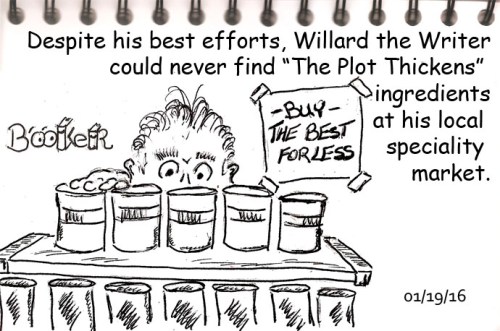
cARtOONSdAY: “wRITING sPICE”

He did find some interesting okra.

He did find some interesting okra.

Leave a comment

Filed under 2016, cartoon by author, CarToonsday

Monday morning writing joke: “Smile”

There once was a writer in town /

Who frowned when the critic came around. /

Still, he tried one day /

To smile anyway: /

The day he saw the critic gagged and bound.

Leave a comment

Filed under 2016, Monday morning writing joke, poetry by author

One book at a time

Japanese bookshop stocks only one book at a time

by Alison Flood

Owner of Morioka Shoten in Tokyo says the strategy adds up to a dedicated exhibition for each volume it sells

Source: http://www.theguardian.com/books/2015/dec/23/japanese-bookshop-stocks-only-one-book-at-a-time

Japanese bookshop

With hundreds of thousands of books published every year, the choice of what to stock can prove bewildering for booksellers. The owner of one small bookshop in Tokyo has taken an unusual approach to the problem: Morioka Shoten, located in the luxury shopping district of Ginza, offers just one title to its customers.

Owned by experienced bookseller Yoshiyuki Morioka, the store opened in May, stocking multiple copies of just one title, which changes weekly. Books to have featured in the shop include Finnish author Tove Jansson’s novel The True Deceiver, in which a young woman fakes a burglary of an elderly artist’s house to persuade her she cannot live alone, and Hans Christian Andersen’s Fairy Tales.

“Before opening this bookstore in Ginza, I had been running another one in Kayabacho for 10 years. There, I had around 200 books as stock, and used to organise several book launches per year. During such events, a lot of people visited the store for the sake of a single book. As I experienced this for some time, I started to believe that perhaps with only one book, a bookstore could be managed,” said Morioka.

“This bookstore that sells only one book could also be described as ‘a bookstore that organises an exhibition derived from a single book’. For instance, when selling a book on flowers, in the store could be exhibited a flower that actually appears in the book. Also, I ask the authors and editors to be at the bookstore for as much time as possible. This is an attempt to make the two-dimensional book into three-dimensional ambience and experience. I believe that the customers, or readers, should feel as though they are entering ‘inside a book’.”

Other titles to have featured in Morioka Shoten include Tsukiyo To Megane (Moon Night and Glasses) by Mimei Ogawa, Karachi No Moto (Source of Form) by Akito Akagi, Koichi Uchida and Takejiro Hasegawa, and Karl Blossfeldt: Working Collages, a collection of the artist’s photographs of plants. The first title to be sold next year will be Maseru Tatsuki’s photo anthology Fish-Man.

“The concept of this bookstore seems to have gained the sympathy of a lot of people, and I receive a number of guests from all over the globe,” said Morioka, who has sold 2,100 books so far.

The bookseller added that while “the current book market seems to be taking second billing to ebooks and other media such as social networking services”, he believes that “a book is a physical object with special attraction that has been, is and will always be the same, and that many will continue to utilise physical books, especially as a communication tool”.

Leave a comment

Filed under 2016, bookshop, bookstore

Photo Finish Friday: “Air Apparent”

A piece of the sky.

A piece of the sky.

The blue fedora

Try as he might;
try as he will
it became apparent
there was nothing for him still.
He worked to the bone
and then he worked beyond.
When one day somebody asked
he was already gone.
Air apparent to a world
that had passed him by.
With his blue fedora
he took off for the sky.
Maybe some day he’ll make it
up there to one of the stars.
Some say that’s far enough;
others say it’s much too far.
Maybe some day you’ll see him
chasing dreams or chasing a cat
the air apparent man
and his blue fedora hat.

–David E. Booker

The blue fedora man and the world he left behind.

The blue fedora man and the world he left behind.

In honor of National Hat Day.

1 Comment

Filed under 2016, photo by David E. Booker, Photo Finish Friday, poetry by author

Haiku to you Thursday: “Light”

We leave the light on— /

not to provide you guidance /

but to give us hope.

1 Comment

Filed under 2016, Haiku to You Thursday, poetry by author