Category Archives: 2016

Writing tip Wednesday: “Hands-on Research”

7 Tips for Using Hands-On Research to Enrich Your Writing

by Delilah S. Dawson

Delilah S. Dawson

Delilah S. Dawson

They say, “Write what you know,” which is why my next book is about killing monsters in 1800s Texas. Not that I’ve ever killed anything bigger than a wolf spider, but I know what it’s like to spend a long, painful day in the saddle. When you’re writing about a new world, your readers will have an easier time making the jump from reality to fantasy if you can use telling details to win their trust. And that means that you should travel to new places and seek experiences and local culture that will enrich your writing. The key? Using all your senses.

Source: http://www.writersdigest.com/editor-blogs/guide-to-literary-agents/7-tips-for-using-hands-on-research-to-enrich-your-writing?utm_source=newsletter&utm_campaign=wd-bak-nl-161119&utm_content=813973_WDE160119&utm_medium=email

1. See the place.

Traveling allows you to soak up the visual backdrop of a new place. If you grew up in the country, it’ll be hard to write a big city since you’ve never looked up at a looming skyscraper. Visiting the place you’re writing about will inform you of what the people wear, what they hang on the walls, what sidewalk vendors sell, what colors the mountains are in the distance. I’m from Georgia, and I’ll never forget what it felt like to see the Alps for the first time, to climb the stairs of the Duomo in Milan, or to take a ferry to Santorini. Mountains are so much bigger than I’d imagined, and the Mediterranean is such a specific crystal blue. The mental photographs you’ll take while traveling will make your descriptions richer and more specific.

2. Taste the food.

Even if you’re not writing Game of Thrones-style banquet orgies, place-specific food still plays a big part in any story. If you’ve never tried to make coffee by a campfire or roast meat on a stick, you’re going to have trouble describing the process your character goes through and how satisfying their end result is. I’ll never forget what a wakeup call it was the first time I had breakfast in France— baguette with Nutella and hot chocolate. Or that summer in Greece, when we had fresh cherries over ice. Or a bag of hot chestnuts in Florence in January. Wherever you go, find out what the locals eat and try it with an open mind.

3. Feel the experience.

Thanks to TripAdvisor and Yelp, it’s easy to find place-specific activities that can inform your writing. Go ziplining over the jungle, go for a ride with a cop, watch an autopsy, try spinning wool or dipping candles. Take a horseback riding lesson or a short trip in a hot air balloon. Save up to go on a safari or just ride the camel at the zoo for six dollars. For almost any activity you’re going to use in your book, there’s a way to experience it yourself for under a hundred dollars.

That goes for clothes, too. Personally, I feel like you shouldn’t write about corsets until you’ve spent a day wearing one. Try dancing in a ball gown or tying a cravat. Go to the RenFaire and try chainmail. Clothes affect how you move, what you do with your time, where you sit, and how you feel overall. Visit the dealer room of any Comic Con to try costume pieces that translate to your work.

4. Feel the discomfort.

I once threw a Romance novel across the room because the pampered main character lost her virginity in a filthy, abandoned hovel on a bed of loose straw. Have you felt real straw? So not sexy.

Discomfort is part of life—now, in the far less hygienic past, and even in space in the future. If your character spends all day sweating in a saddle in too-small boots, they’re going to have a hard time walking, much less killing vampires. If your character gets in a fight, they’re going to have bruises. And shouldn’t James Bond have jet lag basically all the time? Capturing an experience means paying homage to the good and the bad with careful attention to the realistic consequences of their physical experience.

5. Listen to crowds, listen to the silence.

It makes a big difference if you’re awakened by barking dogs, a crowing rooster, Big Ben, songbirds, or a blaring alarm. The sounds of a city are entirely different from the sounds of a mountain cabin. Even the birds sing differently in different places. Is your character in a city that never sleeps or on a spaceship so quiet that she’s going mad? Adding place-specific sounds to your story help us feel what your character is feeling and give us a flavor for the culture and setting.

6. Smell the air.

Whether you’re describing the hot garbage smell of New York in August or the clean pine smell of the mountains in autumn, your descriptions of scent will add one more facet to your character’s experience. It’s hard to describe the scent of a desert or ocean if you’ve never been there. The smell of horses is entirely different from the scent of cows, pigs, camels, or elephants. Rain smells different when it hits hot concrete at night as compared to an aluminum roof on a cool morning. If you have a difficult time describing scents, I would recommend taking a wine tasting class, which really helps tease apart different notes in a way that translates to the world of smell.

7. Learn the lingo.

Without googling, can you name the device used to move yarn through the warp and weft of a loom? Can you identify the parts of a saddle? Do you know the parts of a gun? Using the right words—not necessarily the proper words—helps convince your readers that you’re enough of an expert to write about a topic. And the best way to learn the right lingo is to experience it for yourself and ask the true expert tons of questions. Wikipedia is great but not always accurate, and absorbing word choice from other books won’t always guide you in the right direction. There’s simply no better source than firsthand knowledge.

And the other good news? If you have income from your writing, trips and adventures used as research are considered tax deductible. Win-win!

***
Delilah S. Dawson, author of WAKE OF VULTURES (Oct. 2015, Orbit), written as Lila Bowen. Delilah is the author of the Blud series, SERVANTS OF THE STORM, HIT, and STAR WARS: THE PERFECT WEAPON. She teaches writing classes at LitReactor and has received the Steampunk Book of the Year and May Seal of Excellence for 2013 for WICKED AS SHE WANTS. Find her online at www.whimsydark.com

***
Source: http://www.writersdigest.com/editor-blogs/guide-to-literary-agents/7-tips-for-using-hands-on-research-to-enrich-your-writing?utm_source=newsletter&utm_campaign=wd-bak-nl-161119&utm_content=813973_WDE160119&utm_medium=email

Leave a comment

Filed under 2016, writing tip, Writing Tip Wednesday

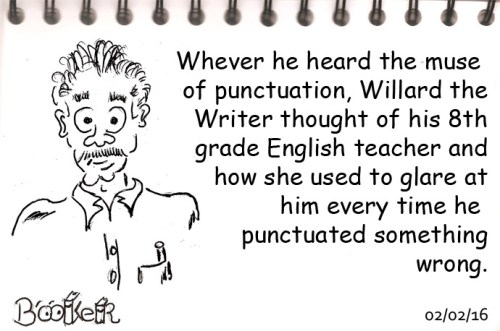
cARtOONSdAY: “pUNCT-U-ALL”

Sometimes the muse was not a-musing.

Sometimes the muse was not a-musing.

1 Comment

Filed under 2016, cartoon by author, CarToonsday

Monday morning writing joke: “Writing a wrong”

The mother-in-law drops by for a visit with her daughter, but finds her son-in-law, Robert, in a blind rage and slamming stuff into his suitcase.

“What happened, Robert?” she asks.

“What happened? I’ll tell you what happened! I sent an e-mail to my wife telling her I was coming home early from my writing conference. I get home … and guess what I found? Your daughter, my wife, Jean, naked with Jack Murphy in our bed! This is unforgivable, the end of our marriage. I’m done. I’m leaving forever!”

“Ah now, calm down, calm down, Robert,” says his mother-in-law. “There is something very odd going on here. Jean would never do such a thing. There must be a simple explanation. I’ll go speak to her immediately and find out what happened.”

Moments later, the mother-in-law comes back with a big smile.  “Robert, I told you there was a simple explanation. She said she never got your e-mail!”

1 Comment

Filed under 2016, Monday morning writing joke

“Holly’s Corner,” part 10

[Writer’s note: What began as a writing prompt — photo and first paragraph — has become at least the start of a story. I will endeavor to add short sections to it, at lest as long as there is some interest. It might be a little rough in parts, but that’s because it is coming “hot off the press,” which could be part of the fun of it. In the meantime, you are free to jump off from any part of this story thus far and write your own version. Click Holly’s Corner below to get Parts 1 – 9.]

by David E. Booker

“Tea anyone?” Father Brown wriggled himself around me and walked into the room carrying a wicker service tray that was sagging slightly toward the center from the weight of the teapot.

I pointed toward the low coffee table and said, “Now.”

He gave me a look like I was demanding tea immediately.

“In a minute,” he said.

It was a cool, rainy day down at Holly's Corner.

It was a cool, rainy day down at Holly’s Corner.

I helped him put it on the coffee table. Maybe Father believed he could beat gravity, but I had other faith. Once the tray was on the coffee table, he shooed me away.

“Take care of your client.”

I could not want to tell him she was not my client. She would have heard and he seemed almost too please that there was one.

I walked over to my desk and took a seat behind it, letting Father Brown serve the tea and make a few pleasant bits of small talk as he did so. When he was done, I asked him to leave.

He frowned.

“Investigator / client privilege,” I said.

“But I found her first,” he said.

“Hey,” she said. “Nobody found me. I found you.”

“And so you did,” I said. “I don’t believe I caught your name.”

“Probably ’cause I ain’t thrown it at you.”

I had a feeling that she was teetering on the edge of sobriety and that whatever repercussions from her dip into alcohol would be manifesting themselves soon. I preferred they didn’t manifest themselves in my office.

“My name’s Rachel. Rachel Ray. Friends call me Ray Ray. I hate Ray Ray. They think they’re being sweet or cute or something or other, but mostly they’re being fuckin’ annoying.”

She took another breath and was about to go on, when I said, “Mrs. Ray.”

“Miss Ray or Ms Ray. I am not now nor have I ever been married.”

“You say it like you’re swearing an oath.”

She smirked at me and then reached for her rolling pin. I decided not to duck.

“I want to hire you.”

“I don’t do recipes.”

“That’s what you think this is about.”

“And you carry around a rolling pin because it is the latest in fashion accessories?”

She lowered the pin. “I don’t believe in guns.”

“The same can’t be said for threats.”

“Do you always speak your mind?”

(To be continued.)

Leave a comment

Filed under 2016, photo by David E. Booker, Story by author

Heart of Darkness?

Darkness on the Edge of Town
Joe R. Lansdale is the toast of Italy, a hot property in Hollywood, and an inspiration to a generation of horror and thriller writers everywhere. And he owes it all to Nacogdoches.
by Eric Benson

Source: http://www.texasmonthly.com/the-culture/darkness-on-the-edge-of-town/

JoeRLansdale

Joe R. Lansdale

Joe R. Lansdale—author of more than 45 novels and 400 short stories, essays, comic books, and screenplays, ranging in genre from historical fiction to grind-house pulp—is a hell of a nice guy, maybe the nicest in East Texas. An avuncular 64-year-old with piercing blue eyes, a Matterhorn nose, and a slightly crooked grin, Lansdale is a big-hearted pillar of the Nacogdoches community, a still-smitten husband to his wife of four decades, and a proud-as-pie dad of two children. Lansdale rescues stray dogs. He has been known to house kids in need. He runs a local martial arts school at a loss. He offers advice to aspiring writers—on his Facebook page, in emails, in person. When he walks into any of his familiar haunts—the Starbucks on North Street, the Japanese restaurant Nijiya, the General Mercantile and Oldtime String Shop—he addresses employees by name, inquires about their lives, and leaves pretty much everyone smiling.

Tim Bryant, a Nacogdoches crime writer who studied screenwriting under Lansdale, swears that his former professor is the “friendliest, most down-to-earth” man that he’s ever known. This comes as a surprise to some, Bryant attests. “A lot of people think he must be the craziest, darkest, most twisted person.”

That’s because Lansdale is not only the nicest guy in East Texas, he’s also the man who wrote this: “Ellen stooped and grabbed the dead child by the ankle and struck Moon Face with it as if it were a club. Once in the face, once in the midsection. The rotting child burst into a spray of desiccated flesh and innards.” And this: “As they roared along, parts of the dog, like crumbs from a flaky loaf of bread, came off. A tooth here. Some hair there. A string of guts. A dew claw. And some unidentifiable pink stuff. The metal-studded collar and chain threw up sparks now and then like fiery crickets. Finally they hit seventy-five and the dog was swinging wider and wider on the chain.” And, just last year, this: “In the next instant Uncle Bob was dangling by a rope from a tree and had been set on fire by lighting his pants leg with a kitchen match. That was done after a nice churchgoing lady had opened his fly, sawed off his manhood with a pocketknife, and tossed it to a dog.”

When I first met Lansdale, I had a hard time fathoming where he found such darkness. It was a mid-November afternoon, and Lansdale was sitting with his family at their favorite Starbucks. They were a picture of suburban bliss: sipping lattes, making plans for dinner, and reminding one another not to forget the “puppaccino” for Lansdale’s one-year-old pit bull, Nicholas. (“He knows when we’ve been to Starbucks and expects it!” Lansdale laughed.) His daughter, Kasey, a 29-year-old country singer, was on her way to teach a yoga class, but she would soon be moving to Los Angeles. You could tell. She was wearing full makeup, movie-star shades, platform heels, and a pink T-shirt emblazoned with the words “La Di Da.” (A bracelet with tiny skulls on it was the only accessory that betrayed the macabre sensibility she had inherited from her dad.) Her brother, Keith, a 33-year-old 911 dispatcher and screenwriter with a laid-back surfer vibe, simply looked exhausted. He’d woken up from a nap after his graveyard shift and had stumbled into Starbucks to power up before another night fielding emergency calls. Their mother, Karen—the poised, flaxen-haired matriarch, who manages the business end of Lansdale’s creative pursuits—sat smiling at her husband and children. She injected the occasional quip as they bantered back and forth about film festivals in Italy, blues festivals in Norway, Kasey’s impending move, and the family’s decades-long collaborations.

“We did our first story together when they were kids,” Lansdale said happily. “Keith was twelve and Kasey was eight. It was for Random House, Great Writers & Kids Write Spooky Stories. Kasey wrote this hanging scene and it was really good, but they said we had to take it out. It was too intense for other eight-year-olds.”

I’d come to Nacogdoches to spend a few days with Lansdale, because after decades as an object of fan-boy adulation, he looked to be on the brink of the kind of above-the-title celebrity that rarely accrues to a writer, much less one who has spent his life behind the Pine Curtain. Starting in the late eighties, Lansdale made his reputation by leaping across genres (western, horror, crime, sci-fi), bounding through tones (from campy to bleak to tender and back again), and skewering bigots, Bible-thumpers, and plain old hypocrites along the way. That fearlessness had done more than earn Lansdale fans; as Steven L. Davis, the curator of the Southwestern Writers Collection at Texas State University, once wrote, it had established him as “the unabashed conscience of East Texas.” But even as he’s won an ardent following with works like Bubba Ho-Tep (in which JFK and Elvis, both still very much alive, battle a reanimated mummy in their nursing home), the Southern-fried noir Cold in July, and, especially, his sublime Hap and Leonard series, Lansdale’s stories and novels have remained niche products, his readers members of a devoted and select cadre.

Lately, though, Lansdale’s writing has attracted a broader audience. His recent novels Edge of Dark Water, The Thicket, and Paradise Sky—all published by Little, Brown’s Mulholland Books imprint—have balanced his penchant for absurdity and visceral horror with a style that’s a little more accessible, albeit still happily in-your-face. After decades of false starts, Cold in July was finally made into a movie, and Hollywood is pursuing other adaptations, with Bill Paxton planning to direct a screen version of Lansdale’s coming-of-age fable The Bottoms and Peter Dinklage’s production company developing a project based on The Thicket. And Hap and Leonard, Lansdale’s crime-fighting odd couple (Hap: white, liberal, straight; Leonard: black, Republican, gay), will soon swagger into the big time. Over the next two months, Lansdale will release a complete collection of Hap and Leonard short stories as well as the ninth Hap and Leonard novel, Honky Tonk Samurai. But the really big occasion arrives on March 2, when Sundance TV will air the first episode of its Hap and Leonard series, starring the classically trained English actor James Purefoy as Hap and Michael Kenneth Williams, best known for his work as Omar Little on HBO’s The Wire, as Leonard. (Christina Hendricks of Mad Men plays Hap’s bad-news ex-wife.)

– See more at: http://www.texasmonthly.com/the-culture/darkness-on-the-edge-of-town/#sthash.a2ejTQTO.poRQSpF0.dpuf

Leave a comment

Filed under 2016, author interview, authors, Uncategorized

Photo finish Friday: “Shades”

The bridge, the river, the sky.

The bridge, the river, the sky.

Bridge, river, and sky: /

gray to blue to promises /

of new adventure.

1 Comment

Filed under 2016, long sentence, Photo Finish Friday

Haiku to you Thursday: “Entwined”

Eyes entwined and deep, /

your face bears stoic witness /

to a mother’s heart.

Leave a comment

Filed under 2016, Haiku to You Thursday, poetry by author

Writing tip Wednesday: “Breaking ‘rules'”

10 Writing “Rules” We Wish More Science Fiction and Fantasy Authors Would Break

by Charlie Jane Anders

Source: http://io9.gizmodo.com/5879434/10-writing-rules-we-wish-more-science-fiction-and-fantasy-authors-would-break

Science fiction and fantasy are genres where almost anything can happen — as long as the author can make it seem plausible, and as long as it’s part of a good story. But that doesn’t mean there are no rules. If anything, the fact that these genres are so wide open mean that there are tons of rules out there, some unspoken and some written in black and white.

And sometimes, breaking the rules is the only way to tell a really fascinating story. Here are 10 rules of SF and fantasy that more authors should consider breaking from time to time.

Note: We’re not saying you must break any of the rules below. You can craft a brilliant work of fiction while still following all of the rules below. And most of these rules exist for a reason — because if you break them without knowing what you’re doing, you can screw up horrendously. Some of the rules below represent things that may have been done to death in the past, so it’s best to make sure you have a fresh spin. But at the same time, too many rules can be a creativity-killer, and sometimes it’s good to bust out some illegal moves.

Getting to the heart of the matter.

Getting to the heart of the matter.

Third-person omniscient used to be the default mode for a lot of novelists — a lot of the classics of literary fiction as well as science fiction are written in third person omniscient. This means, in a nutshell, that the narrator can see what’s going through any character’s head, and can flit around as the story requires. But in recent years, fiction writers have opted for first person or limited third — in which only one person at a time gets to be a viewpoint character. The thing is, though, when you have tight third person with multiple viewpoint characters, it often feels like an omniscient narrator who’s choosing to play games.

1) No third-person omniscient

An actual third-person omniscient can be fantastic — you need look no further than Douglas Adams’ Hitchhiker’s Guide to the Galaxy, which freely lets you know what Arthur Dent, Ford Prefect and assorted other characters are thinking at any given moment. Or countless classic SF writers, for that matter. But I also want to put in a plea: anyone who’s serious about writing genre fiction should read Henry Fielding, who makes third-person omniscient into an art form. In novels like Joseph Andrews and Tom Jones, Fielding draws these brilliant tableaux where he pauses to show what everyone’s thinking, and how much at cross-purposes everyone is. It helps him be a keen observer of people, and also creates these beautifully funny set pieces.

2) No prologues

This is one I’ve been hearing for years — some agents and editors say they stop reading immediately if they see that a book has a prologue. But prologues have their uses, especially if you want to set a mood or establish some crucial backstory before you start introducing your main characters. Like most of the other things on this list, prologues can be done well, or they can be done horrendously. Luckily, we don’t have to reach far to think of an example of prologues done well — George R.R. Martin starts every one of the Song of Ice and Fire books with one, and it’s clear why these prologues are there. They help set up the conflicts of each book, via the experiences of a throw-away character. (Literally, in fact.)

3) Avoid infodumps

Like its cousin, “show don’t tell,” this injunction can be a great idea but can also get you into trouble. Sometimes an infodump can be a horrendous load of backstory or technical schematics, rammed down your poor reader’s throat. But at other times, authors can go to huge, insane lengths to avoid having to come out and explain something. Like having contrived conversations, or weird “teachable moments” to convey a basic bit of worldbuilding to the reader, with the effect that the story grinds to a halt. We posted a collection of 20 well-done infodumps a while back, just to prove it can be done well. Perdido Street Station art by Les Daniels.

And you may have noticed that whenever literary writers tackle science fiction or fantasy, they include tons of infodumps? Maybe this is one of those instances where they’re not as familiar with the genre conventions, and thus fall into habits that many “real” SF and fantasy authors would avoid — but in this instance, they may just be right. Sometimes you just have to explain something, as painlessly as you can.

4) Fantasy novels have to be series instead of standalones

We love a good epic trilogy (or decalogy) as much as the next fantasy addict. But sometimes a nice done-in-one story is also exceedingly welcome. And this is one area where science fiction seems to have a slight advantage over fantasy — both genres have tons of sprawling series, but science fiction at least sometimes spawns one-off novels. And there’s something to be said for getting a satisfying story in one volume, without a cliffhanger or any loose ends afterwards. And sometimes, characters can actually be developed more fully if the author doesn’t have to hold anything back for future books. A character who gets a full arc in one book can be a richer character.

5) No portal fantasy

The “portal fantasy” is a mainstay in both science fiction and fantasy, even though it’s mostly used in the latter. (You could argue that Hitchhiker’s Guide is a “portal fantasy.”) In this type of book, someone from our world discovers a pathway to another world, where he or she is our relatable everyhuman explorer, and we discover this new world through his or her eyes. It’s a tried and true notion, and Lev Grossman gets a lot of mileage out of it in The Magicians — both Brakebills and Fillory, in different ways, are strange worlds that Quentin visits from the “real” world, and there’s a lot of portaling. But we’ve heard many people say that “portal fantasy” is over, and so is the neophyte who learns about the magical world over the course of a book. Now, everybody wants stories where the main character is already steeped in the magical (or science-fictional) world as the story begins.

But as we argued a while back, there’s still a lot of awesomeness lurking in the concept of an ordinary person traveling to a strange world. There are so many ways to tell that story, and so many metaphors buried in the notion of someone being thrust into a weird new world. Isn’t that what we all do when we start exploring genre fiction? I think to some extent, this is something that die-hard genre fans have seen too much of, but these sorts of stories could still have a lot of appeal to mainstream and newbie readers.

6) No FTL

Yes, our current understanding of physics tends to frown upon faster-than-light space travel — no matter what a few weird neutrinos may or may not have done. And there’s definitely a place for totally rigid, scientifically plausible fiction in which the very real difficulties of exploring our own solar system are explored. But then again, there’s something undeniably awesome about being able to jump to hyperspace, or warp speed, or whatever. And maybe a little bit less realism is needed sometimes, to amp up the excitement of space travel. Most of us grew up on big, bold space operas in which interstellar travel was unrealistically, thrillingly fast — and that’s still the portrayal of space that resonates with many people. Plus, FTL makes all sorts of other stuff possible, including space warfare and lots more first contact.

Additional rules are:

7) Women can’t write “hard” science fiction.

8) Magic has to be just a minor part of a fantasy world

9) No present tense

10) No “unsympathetic” characters

Details at: http://io9.gizmodo.com/5879434/10-writing-rules-we-wish-more-science-fiction-and-fantasy-authors-would-break

***

Charlie Jane Anders is the author of All The Birds in the Sky, coming in January from Tor Books.

Leave a comment

Filed under 2016, writing tip, Writing Tip Wednesday

cARtOONSdAY: “fULL rETREAT”

humor writers retreat

Leave a comment

January 26, 2016 · 8:23 pm

Monday morning writing joke: “Adding up — the puns”

Just when you thought it was safe to square your Pi.

Just when you thought it was safe to square your Pi.

Leave a comment

Filed under 2016, Monday morning writing joke