Category Archives: 2016

Isaac Asimov: How to Never Run Out of Ideas Again – Personal Growth – Medium

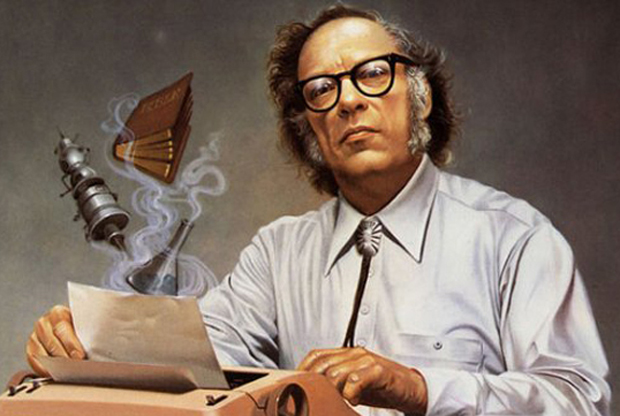
If there’s one word to describe Isaac Asimov, it’s “prolific”.

Source: Isaac Asimov: How to Never Run Out of Ideas Again – Personal Growth – Medium

by Charles Chu

If there’s one word to describe Isaac Asimov, it’s “prolific.”
To match the number of novels, letters, essays and other scribblings Asimov produced in his lifetime, you would have to write a full-length novel every two weeks for 25 years.

Why was Asimov able to have so many good ideas when the rest of us seem to only have 1 or 2 in a lifetime? To find out, I looked into Asimov’s autobiography, It’s Been a Good Life.

Asimov wasn’t born writing 8 hours a day 7 days a week. He tore up pages, he got frustrated and he failed over and over and over again. In his autobiography, Asimov shares the tactics and strategies he developed to never run out of ideas again.

Let’s steal everything we can.
________________________________________
1. Never Stop Learning
Asimov wasn’t just a science fiction writer. He had a PhD in chemistry from Columbia. He wrote on physics. He wrote on ancient history. Hell, he even wrote a book on the Bible.

Why was he able to write so widely in an age of myopic specialization?
Unlike modern day “professionals”, Asimov’s learning didn’t end with a degree—

“I couldn’t possibly write the variety of books I manage to do out of the knowledge I had gained in school alone. I had to keep a program of self-education in process. My library of reference books grew and I found I had to sweat over them in my constant fear that I might misunderstand a point that to someone knowledgeable in the subject would be a ludicrously simple one.”

To have good ideas, we need to consume good ideas too. The diploma isn’t the end. If anything, it’s the beginning.

Growing up, Asimov read everything —
“All this incredibly miscellaneous reading, the result of lack of guidance, left its indelible mark. My interest was aroused in twenty different directions and all those interests remained. I have written books on mythology, on the Bible, on Shakespeare, on history, on science, and so on.”
Read widely. Follow your curiosity. Never stop investing in yourself.
________________________________________
2. Don’t Fight the Stuck
It’s refreshing to know that, like myself, Asimov often got stuck —
Frequently, when I am at work on a science-fiction novel, I find myself heartily sick of it and unable to write another word.

Getting stuck is normal. It’s what happens next, our reaction, that separates the professional from the amateur.

Asimov didn’t let getting stuck stop him. Over the years, he developed a strategy…

I don’t stare at blank sheets of paper. I don’t spend days and nights cudgeling a head that is empty of ideas. Instead, I simply leave the novel and go on to any of the dozen other projects that are on tap. I write an editorial, or an essay, or a short story, or work on one of my nonfiction books. By the time I’ve grown tired of these things, my mind has been able to do its proper work and fill up again. I return to my novel and find myself able to write easily once more.

When writing this article, I got so frustrated that I dropped it and worked on other projects for 2 weeks. Now that I’ve created space, everything feels much, much easier.

The brain works in mysterious ways. By stepping aside, finding other projects and actively ignoring something, our subconscious creates space for ideas to grow.
________________________________________
3. Beware the Resistance
All creatives — be they entrepreneurs, writers or artists — know the fear of giving shape to ideas. Once we bring something into the world, it’s forever naked to rejection and criticism by millions of angry eyes.

Sometimes, after publishing an article, I am so afraid that I will actively avoid all comments and email correspondence…

This fear is the creative’s greatest enemy. In the The War of Art, Steven Pressfield gives the fear a name.

He calls it Resistance.

Asimov knows the Resistance too —
The ordinary writer is bound to be assailed by insecurities as he writes. Is the sentence he has just created a sensible one? Is it expressed as well as it might be? Would it sound better if it were written differently? The ordinary writer is therefore always revising, always chopping and changing, always trying on different ways of expressing himself, and, for all I know, never being entirely satisfied.

Self-doubt is the mind-killer.

I am a relentless editor. I’ve probably tweaked and re-tweaked this article a dozen times. It still looks like shit. But I must stop now, or I’ll never publish at all.

The fear of rejection makes us into “perfectionists”. But that perfectionism is just a shell. We draw into it when times are hard. It gives us safety… The safety of a lie.

The truth is, all of us have ideas. Little seeds of creativity waft in through the windowsills of the mind. The difference between Asimov and the rest of us is that we reject our ideas before giving them a chance.

After all, never having ideas means never having to fail.
________________________________________
4. Lower Your Standards
Asimov was fully against the pursuit of perfectionism. Trying to get everything right the first time, he says, is a big mistake.

Instead, get the basics down first —
Think of yourself as an artist making a sketch to get the composition clear in his mind, the blocks of color, the balance, and the rest. With that done, you can worry about the fine points.

Don’t try to paint the Mona Lisa on round one. Lower your standards. Make a test product, a temporary sketch or a rough draft.

At the same time, Asimov stresses self-assurance —
[A writer] can’t sit around doubting the quality of his writing. Rather, he has to love his own writing. I do.

Believe in your creations. This doesn’t mean you have to make the best in the world on every try. True confidence is about pushing boundaries, failing miserably, and having the strength to stand back up again.

We fail. We struggle. And that is why we succeed.
________________________________________
5. Make MORE Stuff
Interestingly, Asimov also recommends making MORE things as a cure for perfectionism —

By the time a particular book is published, the [writer] hasn’t much time to worry about how it will be received or how it will sell. By then he has already sold several others and is working on still others and it is these that concern him. This intensifies the peace and calm of his life.

If you have a new product coming out every few weeks, you simply don’t have time to dwell on failure.

This is why I try to write multiple articles a week instead of focusing on one “perfect” piece. It hurts less when something flops. Diversity is insurance of the mind.
________________________________________
6. The Secret Sauce
A struggling writer friend of Asimov’s once asked him, “Where do you get your ideas?”

Asimov replied, “By thinking and thinking and thinking till I’m ready to kill myself. […] Did you ever think it was easy to get a good idea?”
Many of his nights were spent alone with his mind —

I couldn’t sleep last night so I lay awake thinking of an article to write and I’d think and think and cry at the sad parts. I had a wonderful night.
Nobody ever said having ideas was going to be easy.
If it were, it wouldn’t be worth doing.
________________________________________

Leave a comment

Filed under 2016, Writing Tip Wednesday, writing tips

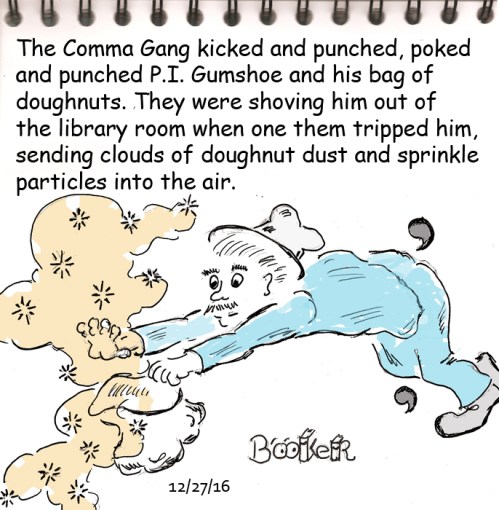
cARtOONSdAY: “cASE lOGIC 21: dUST uP”

"Oh NO!" the head comma said, realizing this was a turning point.

“Oh NO!” the head comma said, realizing this was a turning point.

Leave a comment

Filed under 2016, cartoon by author, CarToonsday

Sadly, ‘Puppy’ Isn’t Merriam-Webster’s Word Of The Year | The Huffington Post

Source: Sadly, ‘Puppy’ Isn’t Merriam-Webster’s Word Of The Year | The Huffington Post

“Surreal” is Merriam-Webster’s (yes, the dictionary) word of the year.

“Surreal” won out over “puppy,” “flummadiddle,” and “fascism,” which were all trending earlier this month.

The announcement comes after Oxford Dictionaries’ choice of “post-truth” and Dictionary.com’s choice of “xenophobia” for their respective Word of the Year picks.

Merriam-Webster defines surreal as “marked by the intense irrational reality of a dream,” with its synonyms being unbelievable and fantastic.

dictionary publisher established their choice due to the high volume of lookups “surreal” received in 2016.

The word spiked after the Brussels terror attacks in March, the coup attempt in Turkey, the terrorist attack in Nice, and the U.S. election in November, according to the site.

Merriam-Webster editor at large Peter Sokolowski noted in a press release how unusual it was that the word had been so frequently searched.

“Historically, surreal has been one of the words most searched after tragedy, most notably in the days following 9/11, but it was associated with a wide variety of stories this year,” he said.

“Surreal” was an even more surprising winner for Word of the Year when you consider that both “puppy,” “flummadiddle,” and “fascism” were all trending this month. “Fascism” was leading the pack for a while, but in an effort to, you know, not have “fascism” be the Word of the Year, the folks at Merriam-Webster sent out a call to arms to ask people to search literally anything else.

But don’t worry: this election was not rigged. Merriam-Webster assured us all weeks ago that they’d select a winner appropriately.

“Our Word of the Year cannot be rigged. We encourage people to look up new words at all times, particularly if those words are strange 19th-century Americanisms or words for adorable doll-like creatures, but our Word of the Year is based on year-over-year increase in lookups,” they said on their site. “We look for a word which got a high number of lookups and increased dramatically in popularity when compared to previous years.”

Leave a comment

Filed under 2016, words

Dashiell Hammett: a hero for our time – San Francisco Chronicle

Source: Dashiell Hammett: a hero for our time – San Francisco Chronicle

Every Christmas season, my family indulges in the same movie-watching rituals as we trim the tree and string necklaces of twinkling lights around the living room. These movies serve as a comforting backdrop to our yuletide routines. Some of our favorite seasonal films are relative obscurities like “The Family Man” (2000), starring Nicolas Cage, Téa Leoni and Don Cheadle. But we also search out classics, including movies that seemingly have nothing to do with the holiday season. Inevitably, we end up watching at least one of the old “Thin Man” features, that durable Dashiell Hammett detective series starring the most adorable and effervescent married couple in cinematic history, Nick and Nora Charles (William Powell and Myrna Loy).
Why does “The Thin Man” series beckon us this time of year? Maybe it’s the lovely, icy clatter of a holiday martini shaker, that merry clinking sound Nora used to call Nick home to their New York hotel suite when he was relaxing far away in Central Park with their toddler. “Nicky,” the bibulous detective tells Junior, “something tells me that something important is happening somewhere and I think we should be there.”

Or maybe it’s the witty banter and teasing sexuality between Nick and Nora that every sophisticated relationship should aspire to. Nick (trying to divert his wife from an uncomfortably racy subject): “Did I ever tell you that you’re the most fascinating woman on this side of the Rockies?” Nora (signaling she’s no prude): “Wait till you see me on the other side.”
Or it could be the San Francisco aura that drifts through the “Thin Man” films, especially my favorite, “After the Thin Man” (1936), which is set in the city and features locations like the Coit Tower lawn, doubling as the grounds of the Charleses’ Telegraph Hill mansion. Foggy nights in San Francisco are still suffused with a Hammett-like mystery. And there is no better place to conjure the spirit of the founder of the hard-boiled mystery genre than John’s Grill on Ellis Street, where Hammett hero Sam Spade grabbed a quick meal of chops, baked potato and sliced tomato in “The Maltese Falcon.” Hammett himself pounded out his pulp masterpieces on his Underwood typewriter in his apartment nearby, at 891 Post St., after his TB-wracked lungs made it impossible for him to continue his career as a Pinkerton Agency gumshoe.

There is no better way to celebrate the holidays in San Francisco than taking a break from the tyranny of shopping at the legendary downtown grill, presided over by John Konstin, the city’s most charming Greek (besides Art Agnos). A recent lunch hour there was populated by the usual mix of jailhouse lawyers, newshounds, colorful barflies, and SFPD detectives with legendary names – including Lt. Dave Falzon and retired homicide inspector John Cleary Jr. In other words, old San Francisco at its best.

And there is no better lunch companion for such an occasion than fedora-wearing, dapper Eddie Muller — the “Czar of Noir” whose classic cinema festival at the Castro Theatre each January brings together a wildly diverse pageant of filmgoers, from schlumpy and frighteningly obsessive cineastes to elegantly dressed lounge-room lizards and femme fatales who have stepped right out of their own torrid dream. Muller is also a growing presence on the Turner Classic Movies channel, as the film noir host for the brilliantly curated network.

Muller has a familial affinity for the world of Hammett. His late father was the boxing reporter for the San Francisco Examiner for a half-century, a respected fixture in a demimonde filled with the palookas, promoters, and gangsters — the same types Nick and Nora liked to pal around with. And we both share an affection for the prototypical, if opposite, Hammett screen heroines, Loy and Mary Astor.

Astor was the sad-eyed, seductive screen siren who costarred with Bogart in “The Maltese Falcon” (and with my father, Lyle, in such lesser 1930s offerings as “Return of the Terror,” “Red Hot Tires” and “Trapped by Television,” a B-movie thriller that foresaw the scary aspects of the coming medium). Astor was a sexually liberated woman of her day; her erotic self-confidence surges through her performance as the masterfully manipulative Brigid O’Shaughnessy in the Hammett classic.

In 1936, Astor found herself on the pyre in the hottest Hollywood sex scandal of its day, when her estranged husband exposed her “Purple Diary” to the press — a lusty account of her sexual exploits, including the grades she assigned to her lovers’ performances. Playwright George S. Kaufman scored the highest, with Astor extolling his prowess. “Fits me perfectly,” she wrote. “Many exquisite moments … twenty — count them, diary, twenty … I don’t see how he does it … he’s perfect.”

Astor — whose Purple Diary is the subject of two recent books, including a sensually illustrated chronicle by the artist Edward Sorel — got Muller and me talking about Hammett and his view of women. “In some ways, the male-female dynamic is the most interesting thing about Hammett’s work,” said Muller, between sips from his Manhattan. “There’s an emotional complexity and tension that separates it from other detective fiction.” In his own life, Hammett cut himself off from his father and brother at a young age, but remained close to his mother and sister. His own formidable drinking and sparring partner, the writer Lillian Hellman, was the inspiration for Nora Charles.

“He was a tall, slim, well-dressed ladies’ man, who carried with him a sense of damage that women found attractive,” continued Muller. “His drinking, his illness. He made binge drinking heroic because he was so frail. Women would marvel at him — it’s 4 a.m. and he’s still going.”

Hammett had another kind of fortitude as well. A lifelong man of the Left, he was dragged before a federal tribunal during the Cold War and asked to reveal the names of those who had contributed to a bail fund he had overseen for jailed Communist Party leaders. He refused. Ratting on friends was not the kind of thing that the creator of Sam Spade would do. He was sentenced to six months in federal prison for contempt of court, and when he was released in December 1951, his health was more ruined than ever. In 1953, he was summoned again by the witch-hunters, this time by Sen. Joe McCarthy and his sidekick, the reptilian Roy Cohn — one of Donald Trump’s mentors. Again Hammett refused to cooperate. He was blacklisted by Hollywood and went broke. But he was unbroken.

As Trump adviser Newt Gingrich floats the idea of reviving the notorious House Un-American Activities Committee, it’s a good time for us to recall Hammett’s heroism. “People should read his testimony and look at the pictures of him as he underwent the inquisition; it’s so inspiring,” said Muller. “He was just so cool and unshakable. His attitude was like, ‘Do your worst, you can’t even make me angry.’ He was one of his own heroes come to life.”

San Francisco Chronicle columnist David Talbot appears Sundays, Tuesdays and Thursdays. Email: dtalbot@sfchronicle.com

Leave a comment

Filed under 2016, author tribute

Most annoying word?

Poughkeepsie, NY, A poll by Marist College found that the most annoying word or phrase used in casual conversation in America is “whatever.” The poll indicates the word irritates 38 percent of Americans.

The pollsters offered up five options for most annoying word of phrase: “whatever,” “no offense, but,” “you know, right,” I can’t even,” and “huge.”

In second place? “No offense, but” with 20 percent. Third place went to two phrases that tied: “you know, right,” and “I can’t even.” In each case, 14 percent of Americans found the phrase irksome. In last place, with 8 percent, was the word “huge.”

Last year “whatever” took first place with 43 percent. Also, age maters. Americans under 30 years old found “I can’t even” to be the most annoying word or phrase for whatever reason.

Leave a comment

Filed under 2016, words

Photo finish Friday: “It’s Christmas when…”

You know it’s Christmas when…

  1. You find a half-empty cup of eggnog in your refrigerator and you mix it with milk and chocolate syrup for your breakfast drink.
  2. You get to eat slightly lumpy chipped beef on toasted bagel, because, well, you’re home for the holidays and you just do.
  3. Your artificial Christmas tree sheds needles like real one.
  4. You set up your outdoor inflatable Christmas decorations and two of them die. One right out of storage from last Christmas, and the other shortly after it has been set up and inflated for this year.
  5. In order to entice your significant other into at least being more tolerant of your outdoor inflatables, you replace one of the ones that dies with something she likes but you have no fondness for – an inflatable pink flamingo. Even though it’s carrying a gift and wearing a red stocking cap, it still is not a favorite.
  6. Nothing says Christmas quite like an inflatable pink flamingo in a red cap.

    Nothing says Christmas quite like an inflatable pink flamingo in a red cap.

  7. Two Christmas packages arrive and they rattle – but they shouldn’t.
  8. You find a Christmas card from several years back from a friend and mentor whom you had lost touch with and learned recently died earlier this year.
  9. You pay a repair to fix a major appliance, and the problem he finds is an easy fix you should have seen if you had been a little more on the ball.
  10. You receive a present you wanted, but it turns out not to be all that interesting, but you also receive a present that you didn’t want and it turns out to be the most interesting thing you received. In kids, this is known as “The-cardboard-box-is-more-fun-to-play-with-than-the-toy-inside phenomenon.” It happens with adults, too. We just don’t generally call it that, or own up to it.
  11. To boldly go where no Christmas tree has gone … recently. For the first time in five years you get to put up your Star Trek Christmas tree. And because you have so many, you decide to limit the decorations to those from The Original Series, because it is the original and you are that old.
  12. "Beam me somewhere Mr. Scott. Any ol' place in Earth or space. You pick the century and I'll pick the spot."

    “Beam me somewhere Mr. Scott. Any ol’ place in Earth or space. You pick the century and I’ll pick the spot.”

  13. A young lady shows up at your doorstep, gently tapping on your door, a bag of homemade Michelle Obama’s shortbread cookies in her hand. She gives them to you and says, “Merry Christmas.” Then she scurries away.
  14. You’re driving around with you kids looking at Christmas lights and see Santa crossing the street and walking into a dive bar on the edge of your neighborhood. Not sure how to explain that one.
  15. Merry Christmas and Happy New Year. Happy Holidays, whichever ones you celebrate. Including Festivus for the Rest of Us

    Merry Christmas and Happy New Year. Happy Holidays, whichever ones you celebrate. Including Festivus for the Rest of Us,

Leave a comment

Filed under 2016, photo by David E. Booker, Photo Finish Friday

Haiku to you Thursday: “Santa say”

For footfalls in the snow, /

you wait like a five-year-old. /

What would Santa say? /

Leave a comment

Filed under 2016, Haiku to You Thursday, poetry by author

cARtOONSdAY: “nICHE mARKETS”

Specialty writing.

Specialty writing.

Leave a comment

Filed under 2016, CarToonsday

Monday (morning) writing joke: “Dueling puns, part 6”

Two writers who didn’t like each other met in a bar, as such writers often do. Each claimed it was his favorite bar and each claimed he had found it first. After several months of glowering at each other and bad mouthing each other, they agree to settle the matter with a duel of puns.

Since the tall writer won the fifth round, the short writer was allowed to go first for round six. A set of cards was placed on the table between them, face down. On each card was a subject. The short writer flipped the card over and the subject was bugs.

Props were allowed, and for each turn, each writer could make one phone call.

For round six, the rules of round five were kept in place. For round five, the rules had been amended. Each writer had to say his pun and the audience would get to pick which one they preferred. The bartender, a waiter, and a waitress would be the judges as to who got the loudest groan.

After thinking a moment, the short writer said, “A dung beetle walked up a bar and asked, ‘Is this stool taken?’”

There was a slight groan from the patrons in the bar.

The tall writer waited until things were quiet, then he said, “Time flies like a arrow. Fruit flies like a banana.”

The crowd groaned, twice, and somebody laughed.

Round six was about to go to the tall writer, when somebody pointed out the tall writer wasn’t using his own material. That he was took that pun from Groucho Marx. Because he plagiarized, the round was awarded to the short writer. The short writer now had 2 wins, 2 losses, and 2 ties.” The tall writer also had 2 wins, 2 losses, and 2 ties.

Leave a comment

Filed under 2016, Monday morning writing joke

Meet the 92-Year-Old Who Helped Recognize Edgar Allan Poe

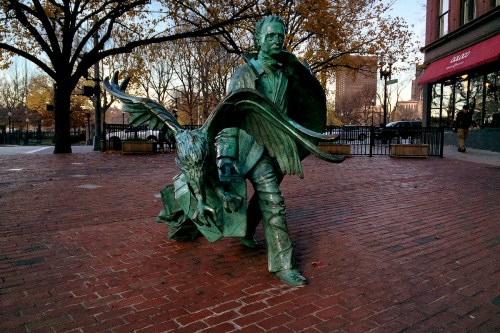
Patricia Bartevian owns Bartevian’s on Boylston Street, around the corner from the newly installed Edgar Allan Poe statue.

Source: Meet the 92-Year-Old Who Helped Recognize Edgar Allan Poe

Patricia Bartevian sits at the counter of Bartevian’s on the first floor of 160 Boylston Street.

Glancing around the store, you almost miss her. She’s surrounded by the items she consigns—paintings, clothing, stacks of VHS tapes, jewelry, furniture, and porcelain dolls, to name a few. Her seat, in the corner of the store next to its window, has a perfect view of the sprawling display of Edgar Allan Poe souvenirs by the door. Poe is a poet who owes a thank you to the shop owner.

Bartevian, or Pat, as she’s known, has spent most of her life in this store.

“We’re a nonprofit family trust,” she explains to me. “We’ve been here over 105 years. My father started the business back in 1910 and we take things on consignment to help people.”

The 92-year-old clarifies: She was away from the store for part of her life.

“During the ’40s, my sister Priscilla and I went to Hollywood. We were in the movies for ten years,” she says. “The Hickory Sisters. We’re on Google and Yelp.”

Flipping through a large, black, three-ring binder filled with photos, Bartevian speaks affectionately of Old Hollywood.

Eventually, the sisters returned to Boston to help with the business as their father approached age 100. Bartevian has been at the store since, where she tries to make it feel “like a living room.” Her sister Priscilla painted cherubs on the store’s ceiling.

When they weren’t tending to customers or their upstairs tenants in the building, Pat and her sister realized there was nothing commemorating an author who’d once lived around the corner at 62 Carver Street. Born there on January 19, 1809, Edgar Allan Poe was never particularly fond of Boston, but was a Bostonian, nonetheless.

“We thought, ‘Well, there isn’t anything about Poe in town. We should have something,’” says Bartevian.

Poe’s home was torn down in 1959, so the Bartevians started by aiding in the installment of a plaque on a nearby building in 1989.

Though Priscilla passed away after a battle with cancer ten years ago, Pat continued to recognize Poe. In 2009, she helped in requesting that the city name the area Edgar Allan Poe Square. But most notably and most recently, she played an important role in the commissioning of the Edgar Allan Poe statue in October 2014.

The Edgar Allan Poe Foundation of Boston was formed in 2010 solely to fund the statue, and Bartevian promptly joined as its treasurer. She aided its president, John LaFleur, and chair, Paul Lewis, in fundraising efforts. As they applied for grants, Pat sold Poe baubles in her store. Poe playing cards, Poe buttons, Poe t-shirts, Poe bandages, Poe action figures, Poe bobbleheads, Poe mugs, Poe books, and even stuffed ravens sit on a few shelves.

Proceeds from the Poe gifts now go toward upkeep and maintenance of the statue.

“Without Bartevians’ physical promotion, it would have been a different project,” says LaFleur.

Bartevian put up posters and flyers for events, and gave the Poe Foundation a home in an office on the second floor of 160 Boylston.

“With everybody who came into her store, she was the person shilling for it day-to-day,” he says. “Without her, it would have been like a lot of things these days—they just unwind.”

Bartevian sees the fruits of her labor each time she heads into work: the life-size bronze statue done by Stefanie Rocknak.

“Between the suitcase with all the stories falling out and him walking to his room, it’s a very clever statue,” says Bartevian. “[Rocknak] is extremely talented.”

And as Bartevian appreciates Rocknak, the artist behind the Poe statue nods to Bartevian.

“She’s always been terrific,” says Rocknak. “She had people come into her shop to check out the marquettes (small versions of the statue), and she’s selling postcards now. I usually stop in whenever I get the chance.”

Bartevian has made a commitment in writing for her store and building to be a perpetual nonprofit location. And while there is some flexibility, the building will always have a Poe theme to support the Poe legacy efforts as well as Edgar Allan Poe Square.

“It’ll be a perpetual ‘leave the light on for Poe,’” says LaFleur. “He’ll always have a place on the first floor of Bartevian’s.”

Leave a comment

Filed under 2016, author tribute