

The weather and calendar turn to spring. Invariably, there will be picnics. Here’s a writing prompt. Build a scene, story, or poem around it.
The weather and calendar turn to spring. Invariably, there will be picnics. Here’s a writing prompt. Build a scene, story, or poem around it.
Filed under 2015, photo by David E. Booker, Photo Finish Friday
My insanity: /
the only thing keeping me /
well … kind of … normal.
Filed under 2015, Haiku to You Thursday, poetry by author
The Top 10 Elements of a Book People Want to Read
by Helga Schier, PhD
Aim for High Readability

Helga Schier
As an independent editor, I’ve come across my fair share of readable books, and all of them are well crafted on three distinct but intricately connected levels.
Highly readable books are polished, refined, sophisticated, and mature on all three levels. To fulfill the potential of your book, develop and sharpen the following top ten elements.
1. Your Words Are Your tools; Make Sure They Are in Working Order.
Avoid typos, sort out commonly mistaken words such as die/dye or there/their/they’re. Watch your grammar—make sure your nouns agree with your verbs and the personal pronouns fit. If a paragraph begins in the past tense, it likely ought to end in the past tense, too. Figure out where those commas go to help your readers make sense of your sentences. Sounds basic? It is. So run that spell-check and get it right.
2. Check for Inconsistencies.
Writers revise their work constantly. As a result, characters may appear or disappear at random, because chapters were rearranged; subplots remain unresolved, because chapters were cut; and timeline issues may tiptoe in. Looking for inconsistencies and holes in your story is an integral part of polishing your work.
3. Avoid Overwriting.
Your style or voice should step into the background to serve your story. No need for a clever metaphor in every sentence, or for an adjective before every noun. Avoid complicated sentences if a simple sentence will get your point across. Avoid inflated sentences and unnecessary introductory or summarizing phrases. Don’t be verbose—every sentence has a point; get to it.
4. Avoid Underwriting.
Allow your language to adapt to its context. Using the same words and/or sentence structures repeatedly makes a novel repetitive and monotonous. If the teenage girl and the CEO of a multibillion dollar company have the same voice, we’ll learn more about the writer than about the characters and their relationships. Avoid clichés and create your own personal images instead. Or use clichés and stereotypes to your advantage—say, to define a character.
5. Make Sure Your Characters Are More Than a Name.
As a reader, I want to be able to relate to your characters. I don’t have to always like them or agree with their choices, but I want to understand why they say and do whatever it is they say and do. I want to care for them, fear and worry with them. Therefore, your characters need to be recognizable and unique at the same time. They need to be complex rather than cardboard cutouts, and dynamic rather than passive. Even a bad guy deserves a redeeming quality.
The other five recommendations are:
6. Show, Don’t Tell.
7. Sharpen that Dialogue…
8. …And Expose that Subtext.
9. Drive the Plot Towards Your Reader’s Aha-Moment.
10. Build Your World.
Filed under 2015, writing tip, Writing Tip Wednesday
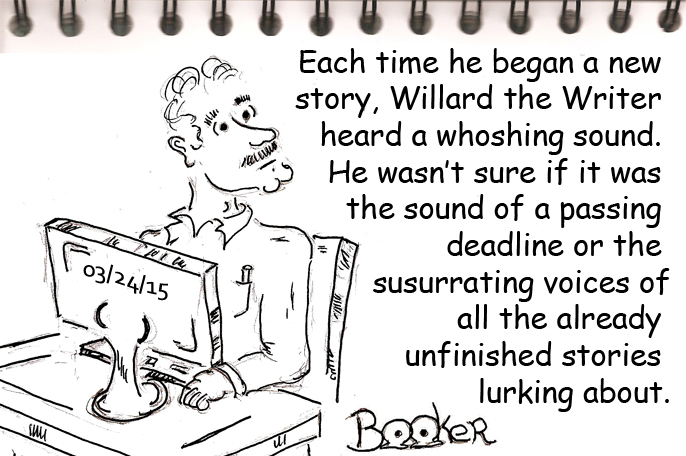
The haunting of the incomplete never ended.
Filed under 2015, cartoon by author, CarToonsday
It is the second full weekend of the month and time, once again, for a new word to live by. This is a word or phrase not currently in use in the U.S. English lexicon, but might need to be considered. Other words, such as obsurd, crumpify, subsus, flib, congressed, and others, can be found by clicking on the tags below. Today’s New Word is a compounding of two words cackle and brain. Without further chattering, slop kick is the new word / phrase for this month:
slop, n. 1) badly cooked or unappetizing drink or food. 2) liquid carelessly spilled or sloshed about. (There are other definitions, but these will do.)
v. the act of the liquid sloshing over the edge of its container. (The liquid slopped to the floor.)
kick, v. 1) to drive with a foot or feet (as in kick the ball). 2) to force, drive, make, etc. 3) to strike in recoiling (as in a gun kicking the shooter when it recoils).
How about slop kick?
slop kick, v. The act of hastily passing off to somebody else something you don’t want to do, but then you still find yourself stuck with at least part of what you tried to get rid of. Often, the most unwanted part.
Example: Barbara slop kicked the Van Buren project to me, but still found herself part of the team tasked with the completing the project, and she was assigned the part she liked least.
Filed under 2015, new word, New words to live by

Photo prompt: what’s the first idea that comes to mind?
Filed under 2015, photo by David E. Booker, Photo Finish Friday
Road sign overhead reads: /
“EXPECT POTHOLES, USE CAUTION” /
Would prefer asphalt.
Filed under 2015, Haiku to You Thursday, poetry by author
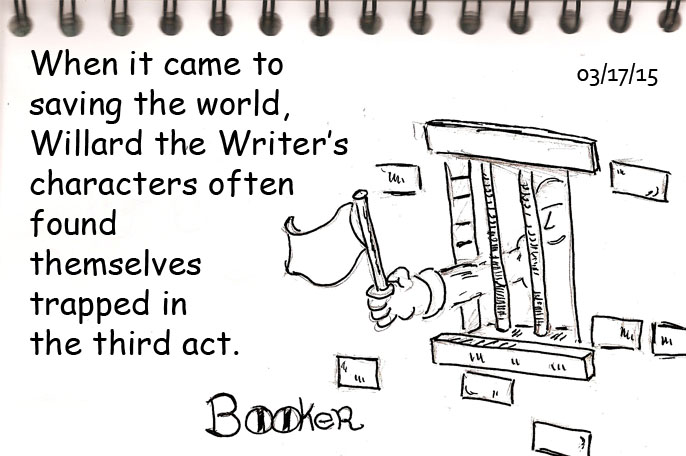
Willard’s stories were so full of imprisoned characters, they were starting to complain of overcrowding.
Filed under 2015, cartoon by author, CarToonsday
A songwriter sitting at a bar tried explaining to the woman next to him why he’d given up dating.
“Did both sisters know you were dating the other one?” the woman asked.
The songwriter nodded. “At first, they both said: ‘cool, date all.'”
“Then?”
“Then it wasn’t. So I said I was leaving. Tina cried when I left, and so did her sister, Marge. I told them, ‘Don’t cry for me, Marge and Tina.'”
The woman poured her drink on the songwriter and she left.
Filed under 2015, Monday morning writing joke


 Booker's Blog