
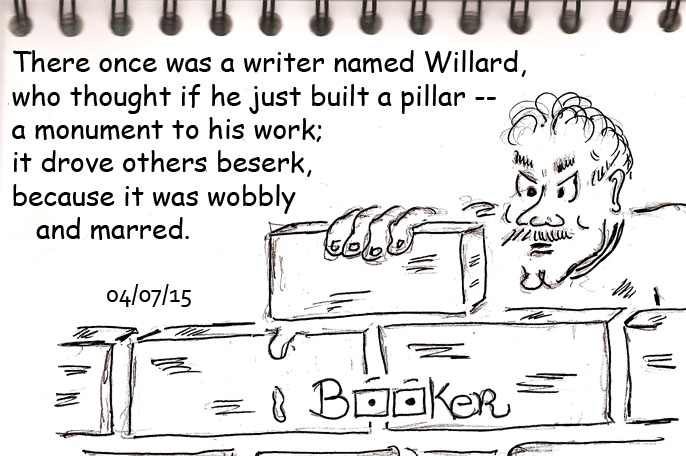
Sometimes the building blocks of writing are a bit mislaid.
Sometimes the building blocks of writing are a bit mislaid.
Filed under 2015, cartoon by author, CarToonsday
An Act of God
It was an Act of God, we said
that killed the children and made them dead.
There was no other answer so
for why the children had to go.
The triggers were pulled, the bullets fast
and it was God when made them past.
Oh why, oh why would God do so?
But “An Act of God” is all we know.
We now put guns in our parks
in case of criminals there in the dark
acting out God’s will, you know
culling the herd of those too slow
to pull a gun and aim it fast
to squeeze the trigger and make it blast
the muzzle to thunder with God’s own voice.
After all, you know, we have no choice.
“It’s An Act of God,” we will say
when the police take us away
and we’ll utter that magical chant
and our actions we won’t recant
when the body’s pulled into the light
of the child who’d hidden in fright
thinking we were the ones to fear
and how that now seems so queer
that we would be the ones to fear.
Yes, we would be the ones to fear.
Written by David E. Booker
Inspired by this political insanity: http://nashvillepublicradio.org/post/top-republicans-say-theyll-oppose-proposal-let-guns-tennessee-capitol
which is part of this: http://aattp.org/tennessee-state-rep-proclaims-child-shootings-an-act-of-god-like-bicycle-accidents/
Background information: http://www.knoxnews.com/news/state/haslam-expresses-major-concerns-about-gunsinparks-bill_96846738
and http://www.knoxnews.com/news/state/tennessee-mulls-removing-control-over-guns-in-parks
Filed under 2015, poetry by author
There once was a writer from town /
who met every blank sheet with a frown. /
That it is why it is said /
he never went to bed /
and slept on his couch face down.
Filed under 2015, Monday morning writing joke, poetry by author
When it comes to books, libraries and publishers should be in it together, argues a leading marketing expert
By David Vinjamuri
Publishers are running out of space. Not in their headquarters, some of which are larger and more imposing than ever, but in retail. The number of booksellers has been dwindling since the demise of Borders, and the largest book retailer today is Amazon, which has no physical space at all.
So the question is, where can publishers showcase new books? If only there were a space dedicated primarily to reading that hundreds of millions of Americans visit annually. If only there existed a trusted space, free of the revenue pressure that necessitates displaying lightly pornographic books of debatable quality. If only there were a space largely inhabited by active readers, where publishers could showcase new authors or shine new light on talented mid-listers.
That space exists in the 16,000 public library branches in America. They’re trusted and willing, and they welcome your attention. But libraries receive surprisingly little coordinated help from publishers beyond lip service—in fact, they’re still in the middle of a very public dispute with publishers about the high prices and restrictive access libraries must contend with to lend e-books to their patrons.
The tension between libraries and publishers seems odd in a market where physical space for displaying books is quickly disappearing. How did we get here? And could libraries actually represent a much better opportunity for publishers than they are given credit for?
A History of Indifference
In the beginning, publishers and libraries were interdependent. When modern publishing houses emerged from printers in the late 19th century, public libraries in the U.S. and U.K. were often the first and only guaranteed customer for a title.
Even as late as 1950, libraries were indispensable customers for publishers. The entire output of the domestic publishing industry in that year was 11,000 titles, and the average branch of a public library purchased 14,000 titles annually. The most reliable market for many books was the 11,135 library branches operating then.
Things are different today. Publishers produced nearly half a million new ISBNs in 2013 (with self-publishers included, that total nearly doubles), though increasingly cash-strapped libraries are purchasing fewer titles. According to industry stats, the library market now represents just over 1.3% of publishers’ trade sales. But just as the crucible of the book superstore transformed publishing in the 1980s, the advent of online sellers—particularly Amazon—is remaking it today. And as the conflict between Hachette and Amazon last year proved, Amazon is both indispensable and despised as a partner to publishers.
But a new challenge has emerged from the transformation of sales channels in the past three decades: discovery. Five years, ago in 2010, just under a third of all frequent readers (who purchase 80% of all books and number 43 million) found the last book they bought at a bookstore. This year, that number is down to 17%, according to Peter Hildick-Smith, of the Codex Group—a change that gives Amazon more power than ever.
“A small group of authors control the bestseller lists,” Hildick-Smith observes. “When we indexed the New York Times hardcover fiction and mass market bestseller lists from June 2008 through June 2014, nearly 16,000 spots in total, we found that all those places were occupied by fewer than 650 authors.”
That concentration has created a problem for publishers, which Amazon has ruthlessly exploited. By promoting both self-published and Amazon-signed authors on the Kindle platform, the online retailer has come to exert tremendous pricing pressure on the entire industry. Amazon can now manipulate the products of hundreds of thousands of other authors through price reduction.
Meanwhile, the dominance of bestsellers has also put the squeeze on the marketing budgets of debut and midlist authors. Since publishers can only afford to make a few big bets per year, the route to building new franchise authors is more uncertain than ever.
Author Brands Matter
A great deal of attention has been paid to the question of so-called platform size for new authors. How large is the social media footprint of the author? How active is she on Facebook, Twitter, and
Continued at: http://www.publishersweekly.com/pw/by-topic/industry-news/libraries/article/66106-the-case-for-libraries.html
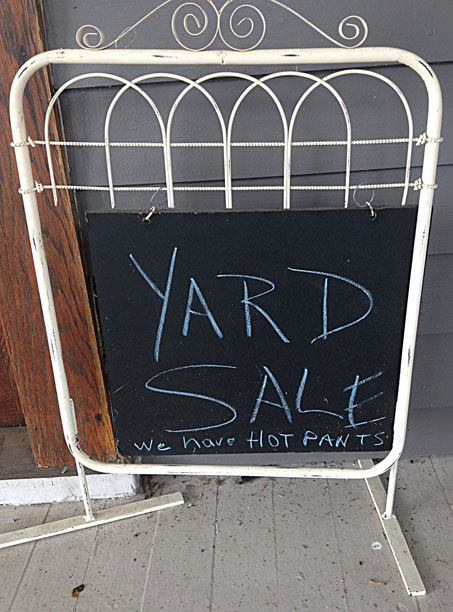
One size rarely fits all — except possibly to entice all to fits.
Fit
Yard Sale – we have hot pants!
Stop! Buy today and take a glance.
Try a pair – they’re over there
Under the bicycle kit for repair.
“Women’s Plus Size Petite Pants”
Marketing words meant to entrance.
That’s how they’re being sold online.
They can be yours: they once were mine.
Wore them once and put them away.
“Petite, my ass,” is all I’ll say.
But they’re a treasure beyond all measure
and they’re here today to give you pleasure.
Yard Sale – we have hot pants.
Stop! Buy today and give them a chance.
You want a pair, I know you do.
Make that two or three or quite a few.
–Photo and poem by David E. Booker
And now there is rain /
The boom of thunder echoing /
Your name in my heart.
Filed under 2015, Haiku to You Thursday, poetry by author
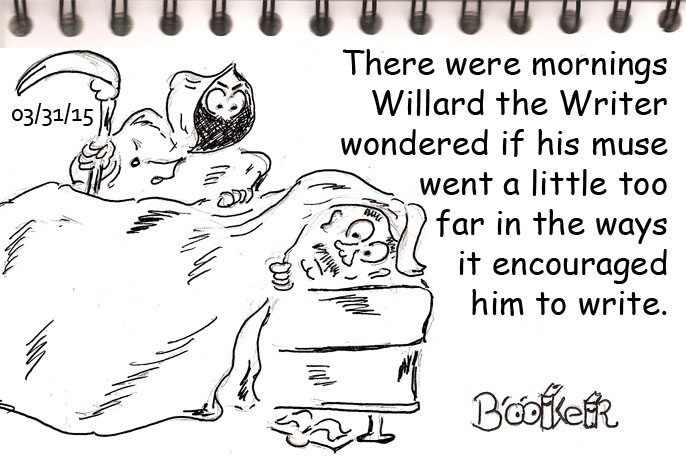
Some days even staying in bed did not help.
Filed under 2015, cartoon by author, CarToonsday
There once was a writer from Spokane /
who did his best output in the can. /
Flushed with success, /
he created such a mess /
and ruined his one and only fan.
[Editor’s note: writing joke in the form of a limerick. It might not be the last one as April is Poetry Month. You have been warned.]
Filed under 2015, Monday morning writing joke, poetry by author
Jonathan Lethem: “My intent to skewer is practically nonexistent”
He talks to Salon about his new book “Lucky Alan,” comics, fans and adoring his characters—even the difficult ones
Source: http://www.salon.com/2015/03/28/jonathan_lethem_my_intent_to_skewer_is_practically_nonexistent/
by MATT BELL
I started reading Jonathan Lethem with “Amnesia Moon,” maybe five or six years after it first came out. A teacher had suggested the book, after seeing me struggle with the more realist selections of the typical undergrad creative writing syllabus of the early 2000s, and almost immediately I was hooked, on both that book and Lethem’s writing in general. “Amnesia Moon” is an intoxicating but very strange novel — perhaps Lethem’s strangest, at least for me — and so I was surprised, in 2003, to find myself reading “The Fortress of Solitude,” with its much more grounded period setting beginning in 1970s Brooklyn.
I would soon immerse myself in the rest of Lethem’s books, and this range became one of the most exciting aspects of reading his novels and stories and essays: His interests are broad, his obsessions deep and his influences both announced and fully explored, engaged, built upon. If Lethem has topics or time periods or genres he returns to frequently, it feels to me less like a tic or a limitation and more like an indication that something is not yet finished, that his unshed obsessions return often to further provoke his imagination into new stories.
Jonathan Lethem’s “Lucky Alan” is his first short story collection since 2004’s “Men and Cartoons,” collecting the stories written in the decade that followed. In the years between, he’s published three novels, including 2013’s “Dissident Gardens,” and a slew of other projects in other genres, including penning a reboot of the comic book “Omega the Unknown”; collecting two books of essays, including “The Ecstasy of Influence,” titled after his provocative Harper’s essay of the same name; editing a volume of selections of Philip K. Dick’s journals; and another nonfiction book on The Talking Heads album “Fear of Music” for the popular 33 1/3 series. Our conversation with Lethem discusses how stories in “Lucky Alan” were written, as well as what changed (and what stayed the same) throughout this busy and productive decade.
Once I was a few stories into “Lucky Alan,” I started thinking about the book’s ordering, wondering if you’d consciously decided to start with two of the more realist stories — the title story and “The King of Sentences” — before moving on to stranger fare, like “Traveler Home,” where the protagonist is given a baby by a pack of wolves, or “Procedure in Plain Air,” with its surreal “installation” involving a man left in a hole outside a coffee shop, “an inverted phone booth of dirt and rubble.” But then a friend mentioned seeing you read “Procedure in Plain Air” at Skylight Books in Los Angeles a few weeks ago, where he reported that you’d said the stories appear here in the order they were written.
That answers one question but begs another: How do you chart the progress of your interests in the short story over that time? Does “Pending Vegan,” the last story, complete some line of artistic thought that began with the first, “Lucky Alan,” or is the book simply a method of collecting all the short work of a certain period in one place?
Q.: I’ve got at least 12 answers to this question, depending on whether I grab it by trunk or tail or some other appendage. Somewhere I once read a pragmatic assertion that the way to order a story collection is to put the best story first and the second-best last and the rest anywhere you like. I do think “Lucky Alan” and “Pending Vegan” are the two most satisfying and complete stories I’ve written, or at least that were uncollected. When I threw them into those positions, just to see what that looked like, I noticed immediately that one was the earliest piece in the book, and the other the most recent. Putting them in chronological sequence made for a quick solution to what probably wasn’t an important question in the first place: Does anybody typically read a story collection from beginning to end? (Of course many would say I could quit that rhetorical question sooner: Does anybody typically read a story collection?)
A.: Of course, I may have forgotten or been mistaken or be lying about the order of writing of some of the stories between those two. I jiggered the sequence at some point to make for what I thought would be a better alternation of the “more realist” with the “stranger fare” — though we might differ on what’s strange. In the experience of their maker, “The King of Sentences,” for instance, is stranger than “Procedure in Plain Air.” The first is an unrepeatable language pratfall, the second a pretty methodological fiction, putting two incommensurate things together and playing out the result. That one feels traditional to me. But that’s just the experience of the maker.
More at: http://www.salon.com/2015/03/28/jonathan_lethem_my_intent_to_skewer_is_practically_nonexistent/
Filed under 2015, author interview
This Guy Created His Own Hilarious Book Sections At A Local Bookstore
Source: http://www.boredpanda.com/funny-accurate-book-section-names/
Tired of having to look at boring and often misleading book sections at his local bookstore, one guy decided to create his own alternative sections that would describe the books more accurately. He carefully placed them all around the bookstore, photographed the results and quickly got away before anyone noticed.
For example, the culinary section is now called “Meals You Intend To Make, But Never Will” – which we have to agree is a much more accurate description. Also, instead of looking for romance novel section, girls can now ask the store manager to show them where the “Dudes who lost their shirts” section is.
Finally there’s some order in the book world!
Section titles include:
Dudes Who Lost Their Shirts
Meals You Intend To Make, But Never Will
Great Places To Poop
And others.
To see photos and read more about it, go to http://www.boredpanda.com/funny-accurate-book-section-names/


 Booker's Blog