
After the answer /
came the question no one asked: /
are answers enough?
After the answer /
came the question no one asked: /
are answers enough?
Filed under 2015, Haiku to You Thursday, poetry by author

Willard never saw Mr. Firestone after 6th grade, except in his nightmares.
Filed under 2015, cartoon by author, CarToonsday
There once was a writer from Glasgow /
Whose writing was always a slow go. /
When turtles would mate /
He could write and relate; /
But for meeting deadlines he was always a no-show.
***
There was a writer who sent twenty different puns to his friends, with the hope that at least ten of the puns would make them laugh. No pun in ten did?!
Filed under 2015, Monday morning writing joke, poetry by author
Award-winning book banned in New Zealand. First time in 22 years.
by Simon Collins
Source: http://www.nzherald.co.nz/entertainment/news/article.cfm?c_id=1501119&objectid=11509128
The author of the first book to be banned in New Zealand for at least 22 years is asking: “Will I be burnt next?”
Ted Dawe, 64, the head of studies at Taylors College for international students in Auckland, is the unlikely subject of the first interim restriction order on a book under the Films, Videos and Publications Classification Act 1993.
His award-winning book for teenagers, Into The River, has been banned from sale or supply under the order issued by the president of the Film and Literature Board of Review, Dr Don Mathieson, QC.
The order took effect when it was issued on September 3 and applies until the full board meets to decide on a permanent classification for the book. Dr Mathieson said that would be as soon as possible and “may very well be at the end of this month”.
In the meantime, media law expert Professor Ursula Cheer has said it was illegal to supply the book even to a friend.
“Having it for your own personal use is okay. Passing it around to your friends is not,” she said.
Mr Dawe said he was “blindsided” by the ban, which was sought by lobby group Family First after deputy chief censor Nic McCully removed a previous R14 restriction on the book on August 14, making it totally unrestricted.
“It’s extraordinary,” Mr Dawe said. “I’ve had quite a few emails from people who share that sense of outrage. Do we live in a country where books get banned? I’ll get burnt next.”
He said Family First director Bob McCoskrie and Dr Mathieson, who wrote a dissenting view advocating an R18 restriction when the majority of the board rated the book R14 in 2013, were overstepping the rules of a democratic society.
“Those two individuals are united in their determination to establish this as a line that will not be crossed. I feel they have wildly overstepped the whole mechanism of looking at art and making judgments on it,” he said.
“New Zealand has taken a giant step towards that sort of regulatory moralising that I think most people felt we had left far in our past.”
He said it was not easy to write a book that teenagers would want to read, or to get it published.
“People involved with teaching boys, especially English teachers, know how important books like this are because they speak to boys about the things that other boys’ books don’t have the firepower or the vitality to do effectively,” he said.
“The book was never about sex and drugs, it was always about bullying people and how that damages people for the rest of their lives. That is really the underlying theme, everything else is just the trappings that go along with that.”
Ms McCully’s decision last month quoted another writer for teenagers Bernard Beckett as saying that sex, violence and bad language were common in books that were taught in schools such as his own 2014 novel Home Boys, which “includes a boy showing his friend how he masturbates, and ends with an explicit sex scene”.
“Thinking back to the classic school texts, Catcher in the Rye started it all,” he said. “A Clockwork Orange is as brutal as they come, and is frequently taught in senior school.”
Libraries Association director Joanna Matthew said Auckland Libraries submitted a British graphic novel Lost Girls to the censor this year because it included images of sexual activity by children. The censor rated it R18.
But she said libraries generally supported freedom of speech and saw the ban on Into The River as “a tragedy”.
“If we censor literature that talks frankly about some of these issues, then I think we run the risk of burying them,” she said.
“We would be much more effective as a society if we worked to counter the problems that the book articulates rather than trying to restrict the book.”
The NZ Booksellers Association has placed a notice on its website warning bookshops that they face fines of up to $3000 for an individual or $10,000 for a business if they supply the book.
However the book is still on sale on Amazon at US$24.99 in paperback or US$9.99 on Kindle.
Source: http://www.nzherald.co.nz/entertainment/news/article.cfm?c_id=1501119&objectid=11509128
Filed under 2015, book banning, books

Profile photo: is this Richard Nixon reincarnated as a tomato?

Top view: you decide. Is Tricky Dick at it again?
Filed under 2015, photo by David E. Booker, Photo Finish Friday
Highway traffic churns: /
R-P-Ms, heat, wheel, anger. /
Asphalt is man’s hell.
Filed under 2015, Haiku to You Thursday, poetry by author
After researching and writing my novel Orphan #8—which was published by William Morrow in 2015 and is the August Target Club Pick and an Indie Next Great Read—I put together this list of eight rules for historical fiction research. For each I’ll give you an example of how I applied that rule of research to writing my novel.
By Kim van Alkemade
1. Take bad notes.
In 2007, I took some brief notes about a woman doctor who X-rayed eight children at a Jewish orphanage. I didn’t even write down her name. Yet these bad notes inspired me to write my first historical novel, Orphan #8. Only after the novel was finished, sold, and rewritten did I go back to this archive to consult the source of my notes. There, I learned the real name of this doctor, Elsie Fox, and with a little more research I learned she had been born in Austria, educated at Cornell, conducted X-ray research at the Home for Hebrew Infants, and founded a school for radiology in the Bronx. The character I created from my bad notes is named Mildred Solomon. She was born in the United States, went to medical school in New York, conducted X-ray research at the fictional Hebrew Infant Home, and went on to have a career in radiology at a hospital. The parallels are spooky, but I’m glad my bad notes allowed my imagination free reign to create a character who is entirely my own.
2. Use archives.
You don’t have to be an academic or a librarian to use archival materials. Archives are maintained for the purpose of preserving and sharing documents. Find an archive that relates to your period and subject. I did most of my archival research at the Center for Jewish History in New York where the American Jewish Historical Society has the archives of the Hebrew Orphan Asylum. I found amazing information at the New York Academy of Medicine Library, and they later invited me to write a blog post about my research for the novel. But I’ve also used both paper and digital collections at the New York Pubic Library and materials from the Lesbian Herstory Archives in Brooklyn. When you use archival materials, look for quirky details and be open to inspiration.
3. Study old pictures.
Evocative historical writing is made up of more than facts and figures. By examining old pictures—either paintings or photographs—you can glean impressions that inspire your imagination and details that populate your descriptions. Many digital archives are now coming online, making this aspect of historical research easier than every before. I relied on the New York Public Library’s Old New York collection, where you can see a photograph of the Hebrew Orphan Asylum. I also used the Beck Archives Photograph Collection at the University of Denver, where I saw a photograph that informed my description of heliotherapy (a real treatment for tuberculosis) and inspired my fictional Hospital for Consumptive Hebrews. The photograph below of a dormitory at the Hebrew Orphan Asylum was crucial for the setting of several important scenes in the novel.
4. Go on location.
Sometimes you have to go away from your desk and out of your house to get first-hand experience of your setting. I made two trips to Colorado while researching Orphan #8 and the descriptions based on those visits are more sensory than anything I could have gotten from a book or photograph. Your artistic impression of a place is crucial to creating an historical world that rings true for you as a writer. Landscapes may be the same as they were centuries ago; some city neighborhoods haven’t changed in a hundred years; ancient ruins can still be inspiring. If possible, talk to people while you are on location; their memories and impressions can yield invaluable details. I learned so much from Hy Bogan, who I interviewed at the location of the Hebrew Orphan Asylum.
5. Read old books.
6. Visit museums.
7. Use the Internet.
8. Stop researching, start writing.
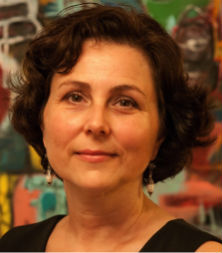
Kim van Alkemade
Filed under 2015, writing tip, Writing Tip Wednesday
There once was a party writer from Beijing /
Who couldn’t get published one thing. /
So, he took an American name /
And tried publishing all the same: /
Suddenly his words had a following.
***
Two cannibals are eating a comedy writer. One says to the other: “Does this taste funny to you?”
The other says: “No, and it doesn’t even taste like chicken.”
Filed under 2015, Monday morning writing joke, poetry by author
Poet Michael Derrick Hudson was published in The Best American Poetry 2015 anthology under the name “Yi-Fen Chou.” Hudson claims to use this name as a “strategy” for getting poems published.
by Isaac Fitzgerald
Source: http://www.buzzfeed.com/isaacfitzgerald/yi-fen-chou-is-michael-derrick-hudson#.ljkm9RZAe1
The poetry world was shocked Monday to discover that Yi-Fen Chou, a poet who appears in the anthology The Best American Poetry 2015, is actually the pen name of Michael Derrick Hudson.

Michael Derrick Hudson a/k/a Yi-Fen Chou via poetryfoundation.org
Hudson’s poem “The Bees, the Flowers, Jesus, Ancient Tigers, Poseidon, Adam and Eve” was both originally published in Prairie Schooner and reprinted in The Best American Poetry 2015 under the name Yi-Fen Chou.

In his bio for the anthology, Hudson admits that he used the pen name of Yi-Fen Chou as a strategy for getting his poems accepted by literary journals:
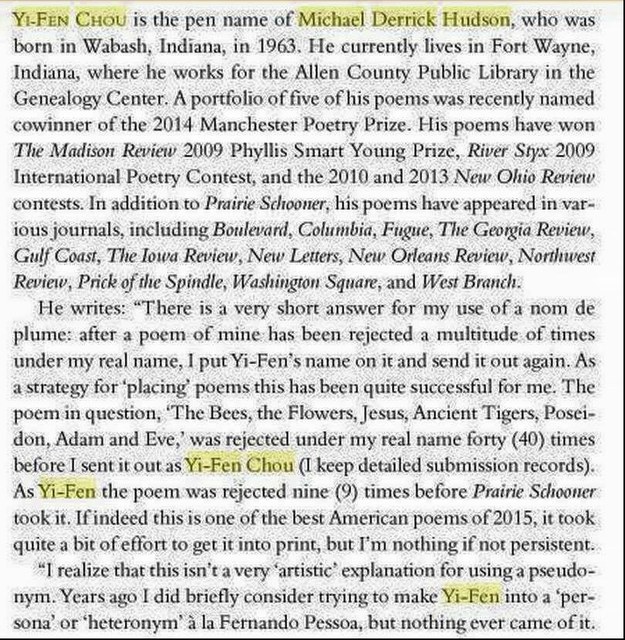
Many in the literary community took to social media to raise their concerns about the publication of Hudson’s poem in light of his nom de plume.
But Sherman Alexie, guest editor of The Best American Poetry 2015 — and in some sense originally a victim of a hoax — defended his decision to publish the poem, even after learning that Yi-Fen Chou was a pseudonym.
Details at: http://www.buzzfeed.com/isaacfitzgerald/yi-fen-chou-is-michael-derrick-hudson#.ljkm9RZAe1


 Booker's Blog